Enterprise AI Project Cost Breakdown 2026: Budgeting, Hidden Expenses & ROI Planning
 By Ashwani Rana
AI/ML Engineer
July 27, 2026
12 min read
Last Update on 5 August 2026
By Ashwani Rana
AI/ML Engineer
July 27, 2026
12 min read
Last Update on 5 August 2026
Quick Answer
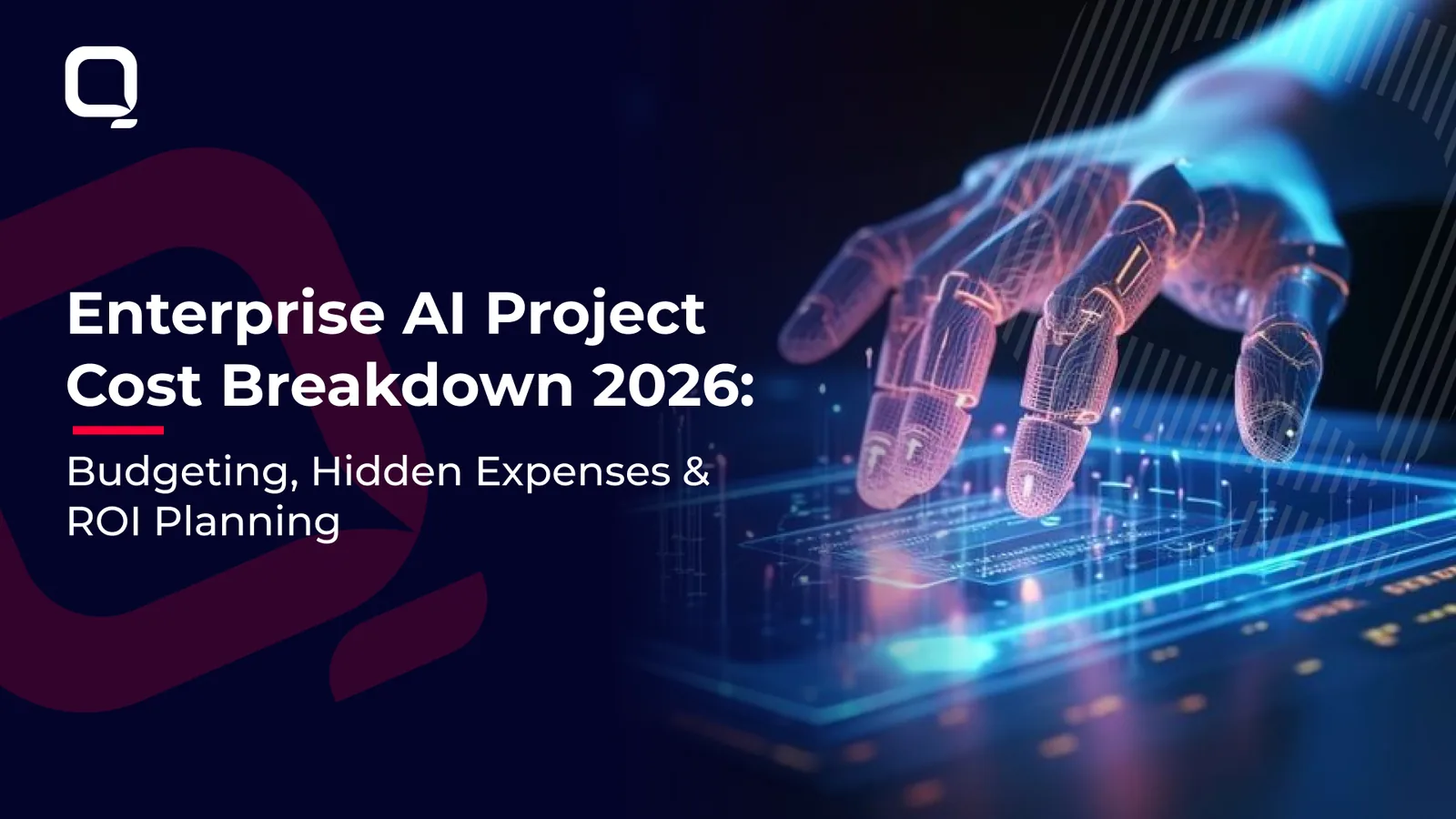
Enterprise AI projects in 2026 range from roughly $20K for a proof of concept to $1M+ for a production platform — but the sticker price hides the real cost. Data preparation, integration, MLOps, cloud compute, and ongoing retraining often exceed the model build itself. Budget for the full lifecycle, not just the model, and plan ROI on business outcomes, not accuracy scores.
Budget the full lifecycle — not just the model — and tie ROI to business outcomes.
Why AI Budgets Blow Up — and How to Stop It
Most enterprises don't fail at AI because the technology doesn't work. They fail because the budget was built around the wrong number. Leadership approves a figure for “building the model,” then watches the real spend arrive later — in data cleanup, integration, cloud bills, and the retraining nobody scoped.
The result is a stalled pilot, a blown budget, and a board that loses faith in AI. It's avoidable. This guide breaks down what an enterprise AI project actually costs in 2026 — by phase and by project type — exposes the hidden expenses that wreck budgets, and shows how to plan ROI you can defend.
Who This Guide Is For
This guide is for the people who have to approve, defend, or deliver an AI budget — not for data scientists tuning hyperparameters. You'll get the most from it if you're:
- CFOs & finance leaders who need to size an AI investment and defend it to the board.
- CTOs, CIOs & engineering leaders scoping a project and trying to avoid a mid-build overrun.
- Product & digital transformation leaders turning an AI idea into a funded, deliverable roadmap.
- Founders & startup teams deciding how far a limited budget will actually take them.
- Procurement & vendor managers comparing quotes and spotting what's missing from an estimate.
If you're trying to answer “what will this really cost, and how do we know it's worth it?” — this is for you.
What Actually Drives AI Project Cost
Before any number makes sense, it helps to know what moves it. Six factors determine the cost of an enterprise AI project:
- Scope & complexity — a single-use-case model versus a multi-model platform.
- Data readiness — clean, accessible data is cheap; fragmented, messy data is not.
- Model type — classic ML, computer vision, and custom GenAI carry very different costs.
- Integration depth — connecting to legacy ERP, EHR, or core banking systems adds real effort.
- Infrastructure — cloud, compute, and the ongoing cost of running models at scale.
- Compliance & security — regulated industries add governance, audit, and control overhead.
Two projects with the same “model” can differ 5x in total cost based on these factors alone.
Enterprise AI Cost Breakdown by Phase
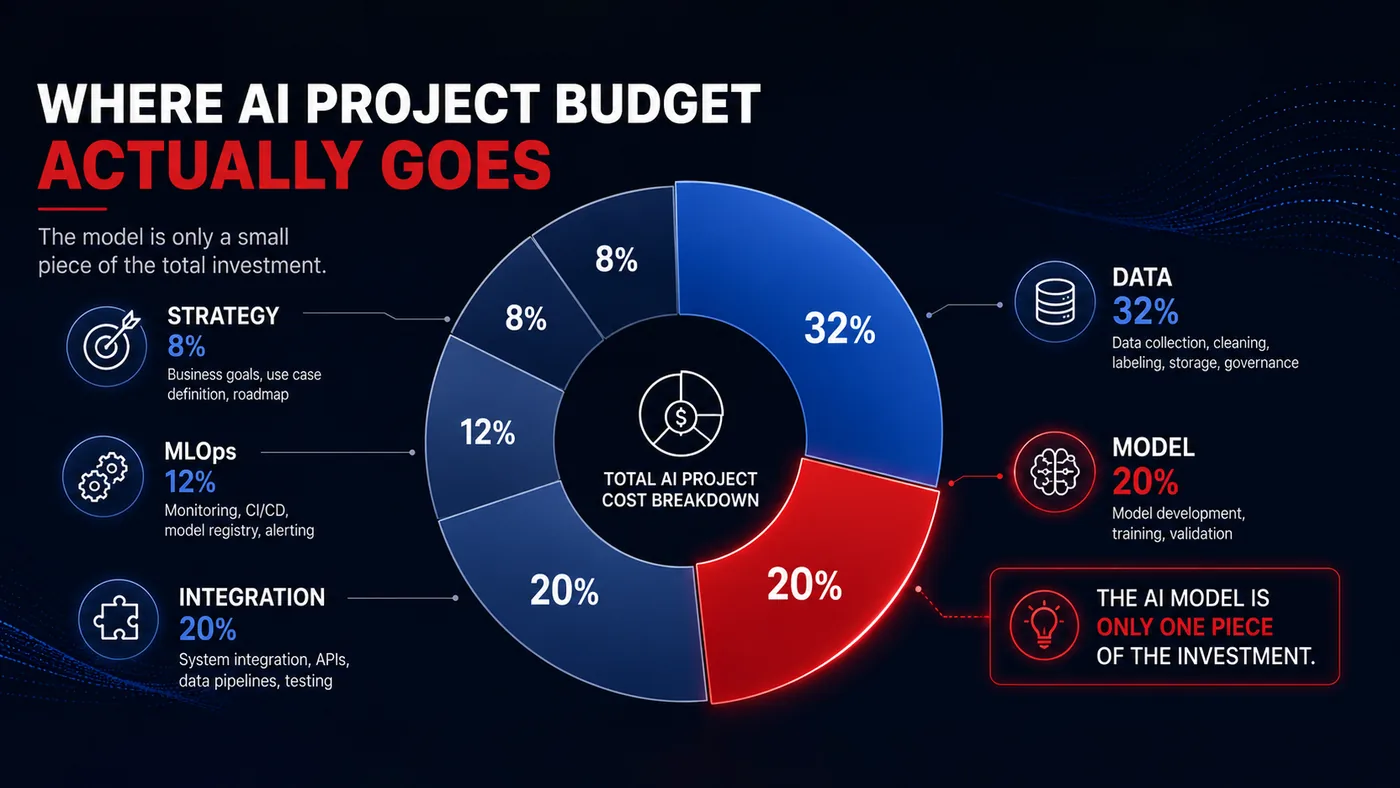
An AI project isn't one cost — it's six, and the model is rarely the biggest. Here's how a typical enterprise budget distributes across the lifecycle.
| Phase | What It Covers | Share of Budget |
|---|---|---|
| Strategy & Discovery | Use-case scoping, feasibility, roadmap | 5–10% |
| Data Engineering | Collection, cleaning, pipelines, labelling | 25–40% |
| Model Development | Building, training, evaluation | 15–25% |
| Integration | Wiring into systems, APIs, and user workflows | 15–25% |
| Deployment & MLOps | Serving, monitoring, CI/CD, security | 10–20% |
| Ongoing / Maintenance | Retraining, support, and cloud run cost | 15–25% / yr |
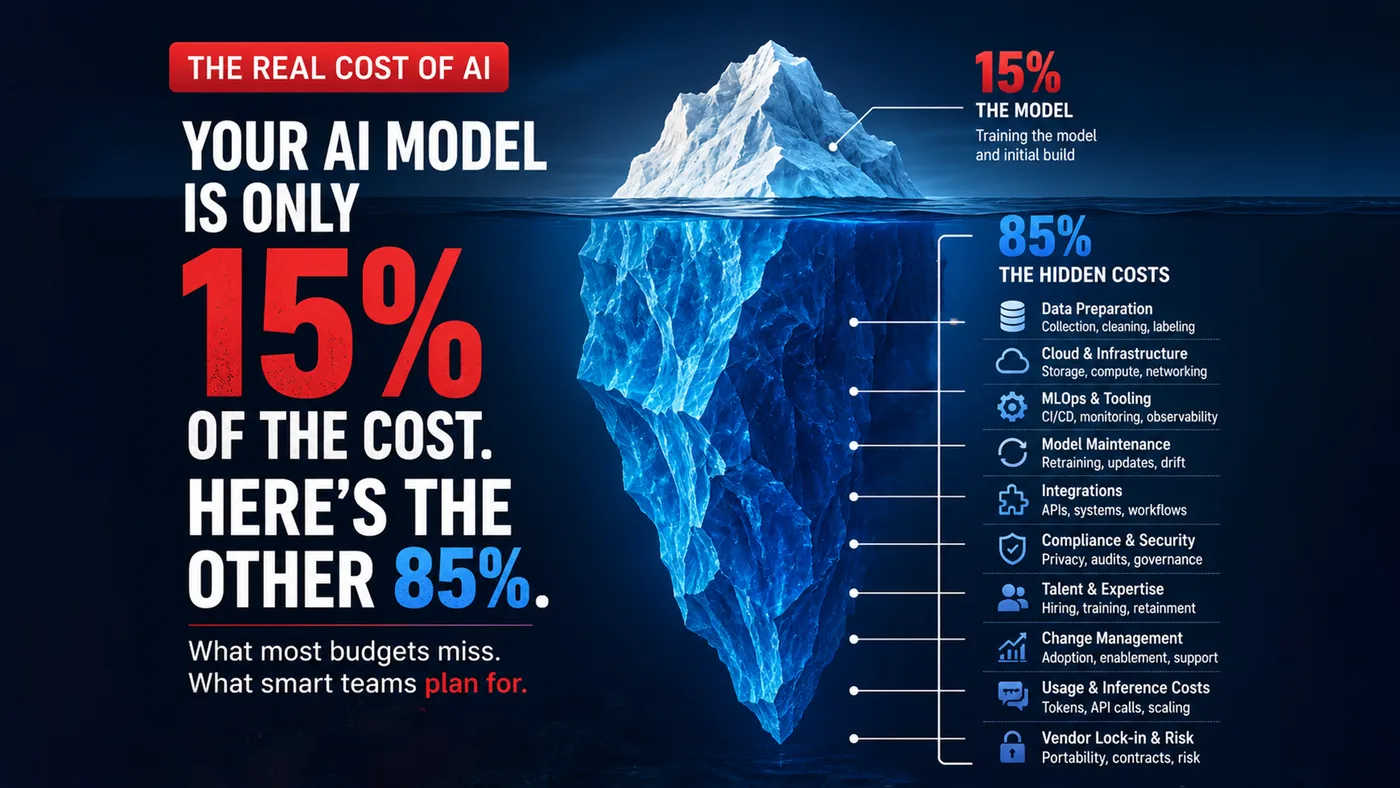
The lesson leaders miss: the model is roughly 15–25% of the cost. Data, integration, and operations are the other 75%+ — and they're exactly the lines that get under-budgeted.
AI Project Cost by Type (2026 Indicative Ranges)
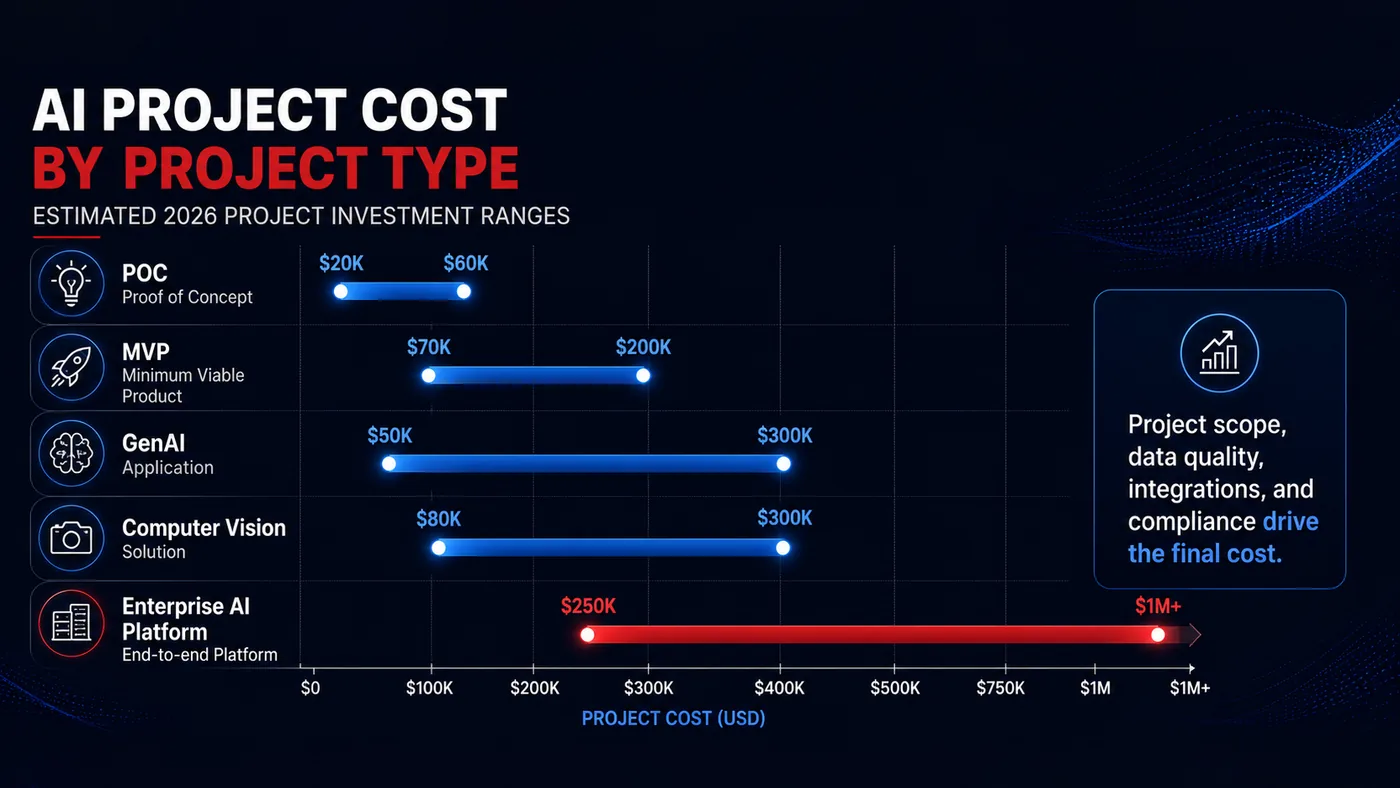
Costs vary widely by ambition. These ranges reflect typical 2026 enterprise engagements and are a planning starting point, not a quote.
| Project Type | Indicative Cost | Timeline |
|---|---|---|
| Proof of Concept (POC) | $20K–$60K | 4–8 weeks |
| Production MVP | $70K–$200K | 2–4 months |
| GenAI / RAG Solution | $50K–$300K | 6–16 weeks |
| Computer Vision System | $80K–$300K+ | 3–6 months |
| Enterprise AI Platform | $250K–$1M+ | 6–12 months |
| Ongoing Run & Maintenance | 15–25% of build / yr | Continuous |
The Hidden Expenses That Blow AI Budgets
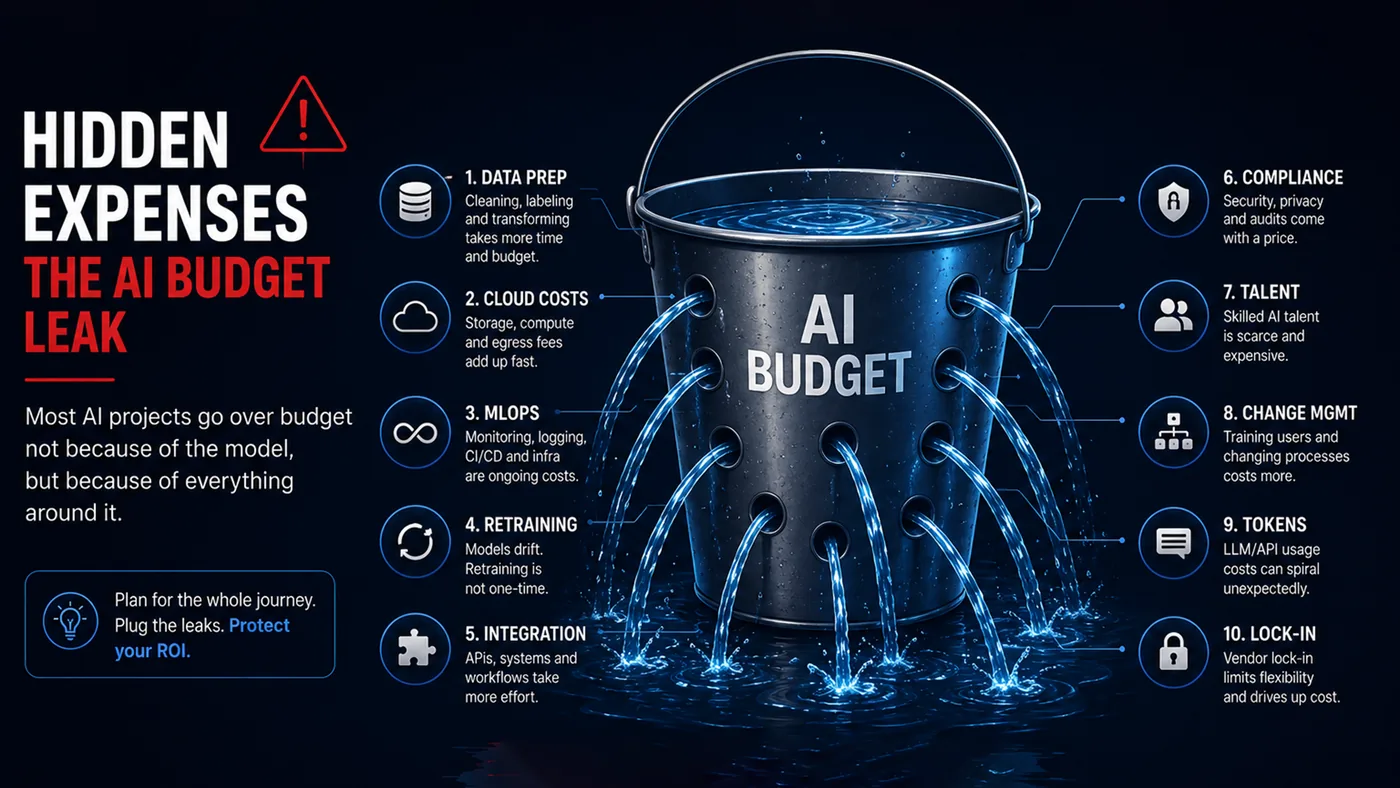
This is where budgets die. Every item below is real, recurring, and routinely left out of the first estimate.
- Data preparation — Often the single biggest line item; messy, fragmented data can consume 25–40% of the budget.
- Cloud & compute — GPU training and, worse, inference costs that keep climbing as usage scales.
- MLOps & monitoring — The unglamorous 85% after the model: pipelines, serving, and observability.
- Model drift & retraining — Models decay as the world changes; retraining is an ongoing cost, not a one-off.
- Integration — Connecting AI to legacy systems almost always costs more than the model itself.
- Compliance & security — HIPAA, GDPR, SOC 2, and the EU AI Act can add 15–25% in regulated industries.
- Talent — Scarce ML and MLOps engineers, or the cost and delay of hiring and retaining them.
- Change management — Training users and driving adoption, without which the AI is never used.
- LLM inference & tokens — GenAI running costs that scale directly with how much you use it.
- Vendor lock-in — Per-seat and API fees, plus the switching cost when you outgrow a tool.
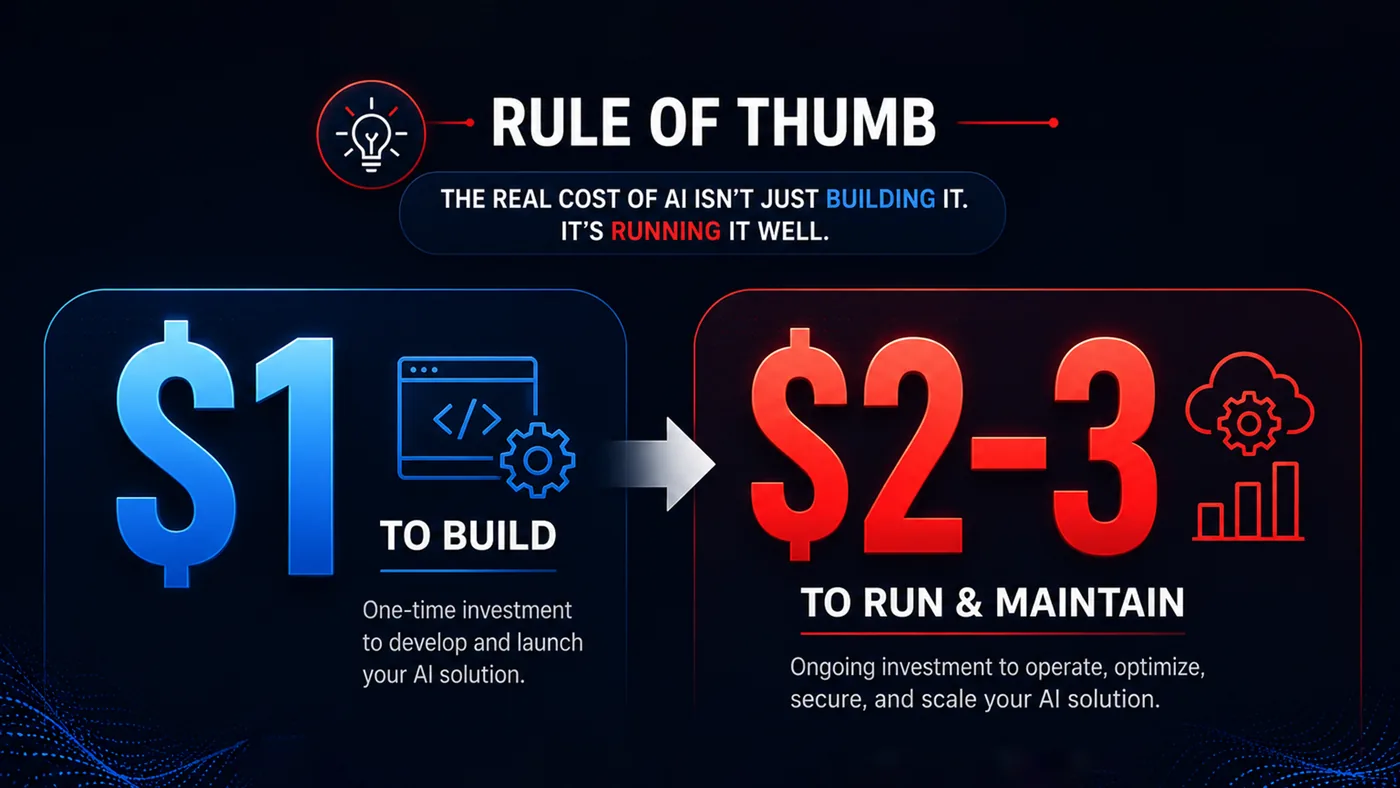
A useful rule of thumb: for every dollar you spend building the model, plan to spend two to three dollars getting it into production and keeping it there.
Worried your AI budget is missing the hidden 75%?
We'll map the full lifecycle cost of your AI initiative — data, integration, MLOps, and run cost — in a free scoping session.
Book a Free AI Cost Assessment →Build vs. Buy vs. Partner: The Cost Decision
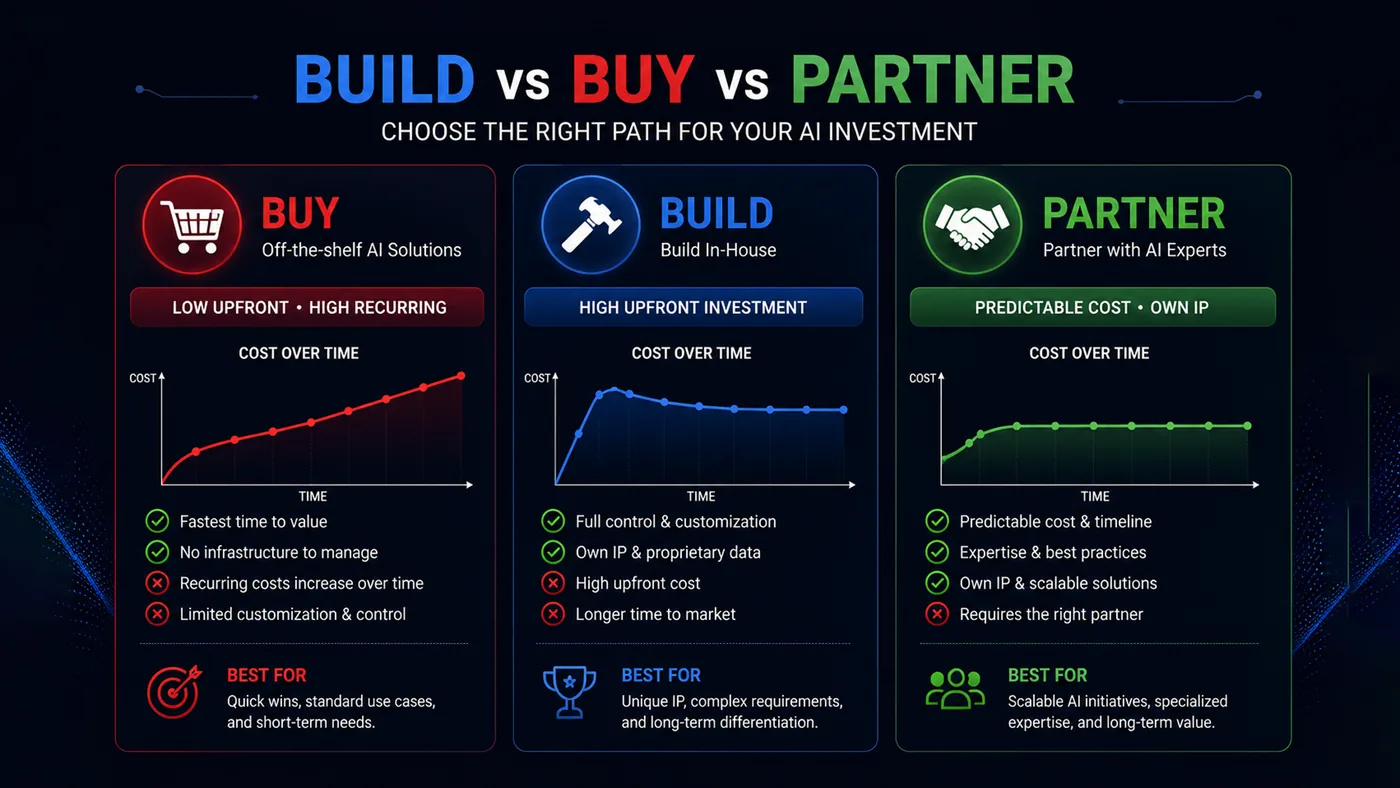
How you deliver AI changes the cost curve entirely:
- Buy off-the-shelf — Lowest upfront, fastest to start, but recurring licence and per-use fees, limited fit, and lock-in.
- Build in-house — Full control and no vendor margin, but high upfront cost, scarce talent, and the whole lifecycle burden on you.
- Partner (build with an engineering firm) — Predictable scope and cost, senior talent without hiring delay, and you own the IP.
For anything strategic or differentiated, buying rarely fits and building alone is slow and risky — which is why most enterprises partner for the build and keep ownership.
Cloud & Compute: The Cost That Keeps Growing
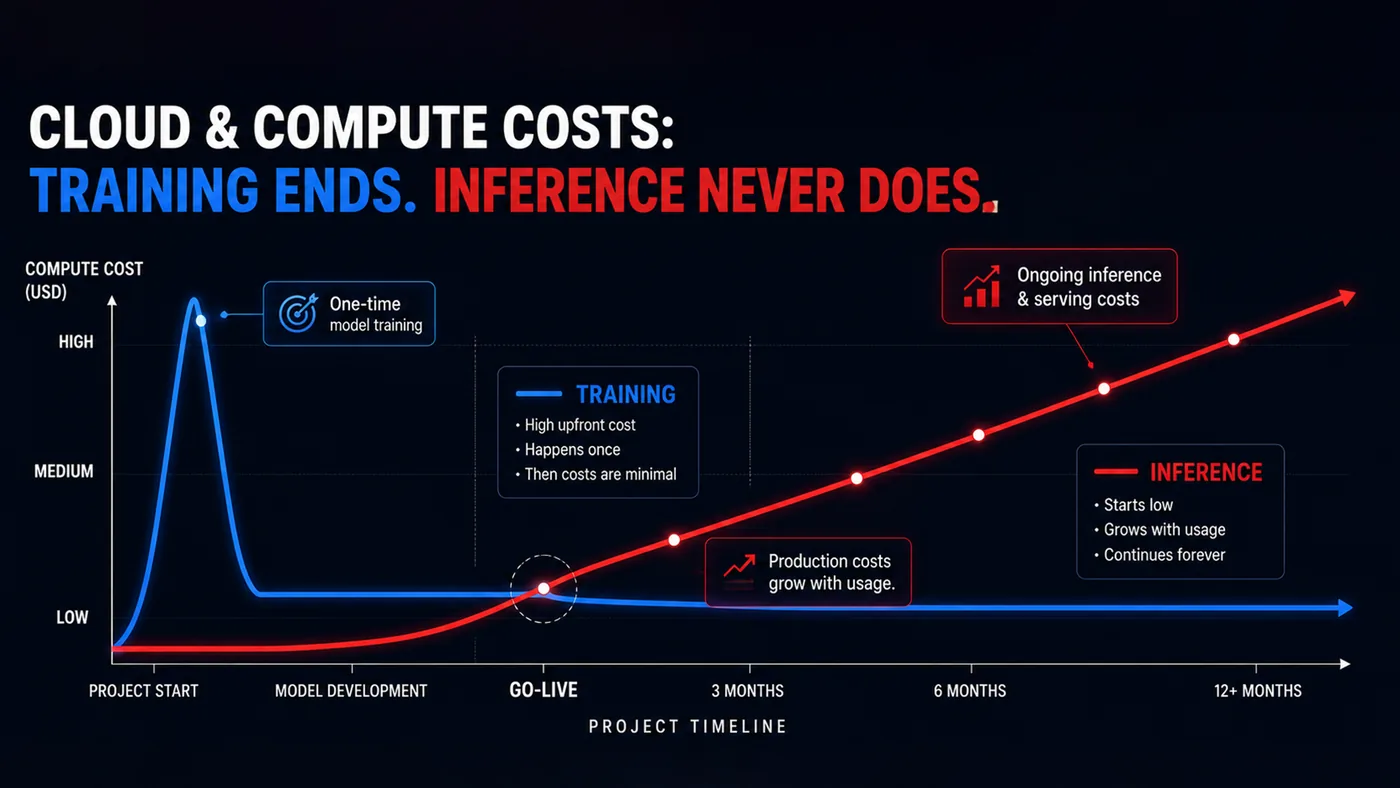
Unlike traditional software, AI has a running cost that scales with use. Training is a one-time spend; inference is forever. A GenAI feature that's cheap in a pilot can become a five-figure monthly bill at scale.
Controlling it is a discipline, not an afterthought: right-sizing models, caching, routing cheaper models where they suffice, prompt efficiency, and monitoring token spend. Teams that ignore FinOps for AI get a nasty surprise on the first full-scale bill.
Planning ROI You Can Actually Defend
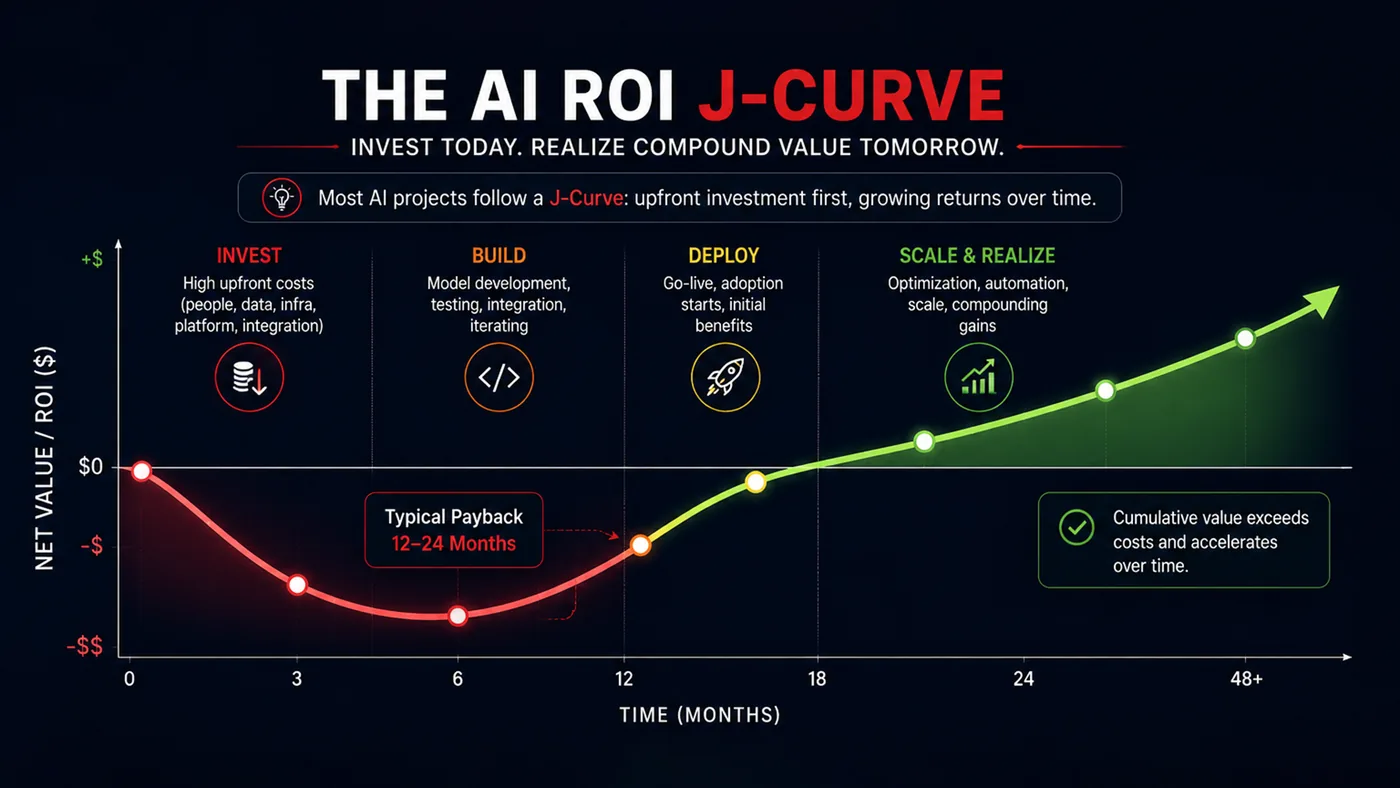
A budget without an ROI model is a gamble. To justify AI spend to a board, tie every initiative to a measurable business outcome — not to model accuracy.
- Define the value — cost saved, revenue gained, risk reduced, or time recovered.
- Model the payback period — most well-scoped enterprise AI projects target 12–24 months to positive ROI.
- Account for the full cost — including run, retraining, and support, not just the build.
- Measure against a baseline — so you can prove the lift the AI actually delivered.
The projects that survive budget scrutiny are the ones where the value is quantified before the build begins.
How to Budget an Enterprise AI Project
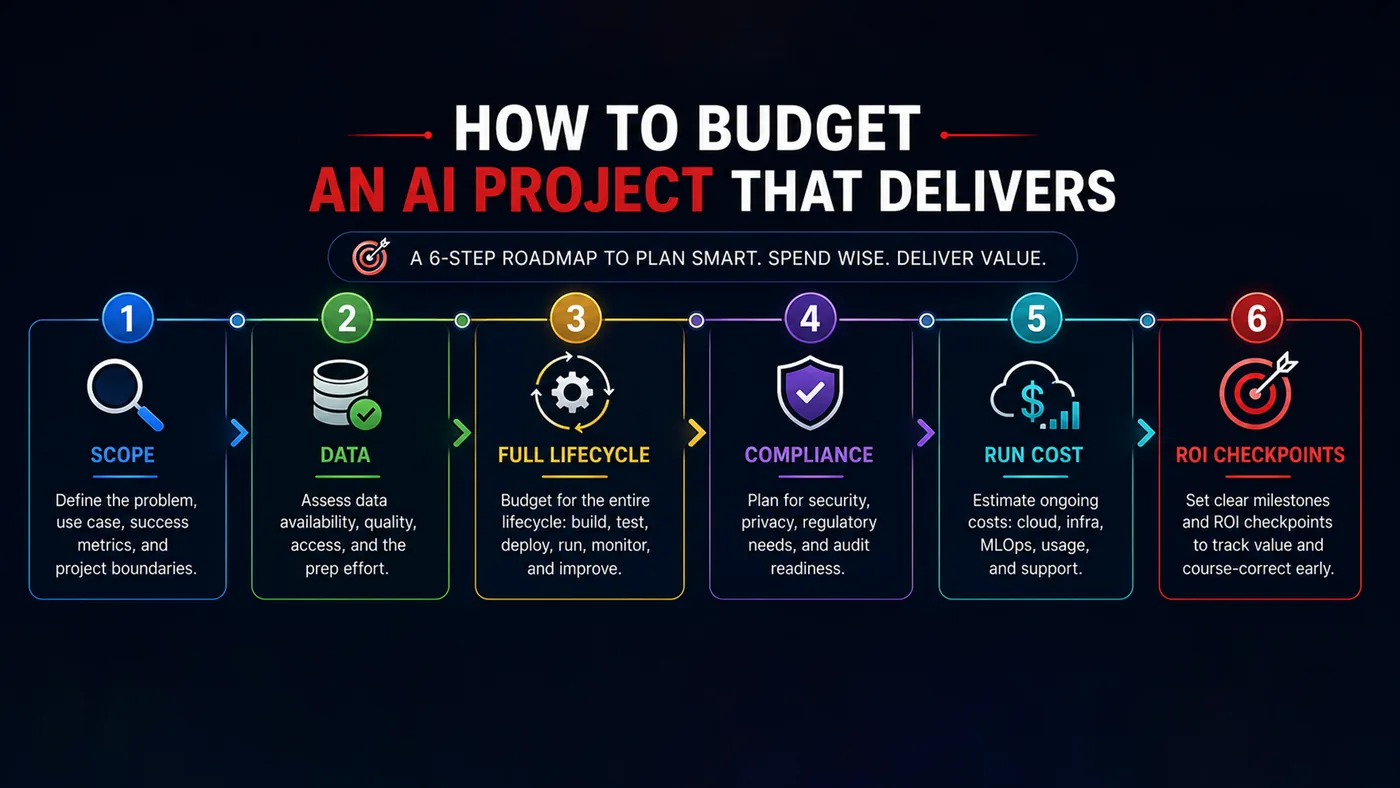
A practical sequence that avoids the classic overruns:
- 1. Scope the outcome — Define the decision or process the AI improves, and its value.
- 2. Assess your data — The single biggest swing factor in total cost.
- 3. Budget the full lifecycle — Build plus integration, MLOps, run, and retraining.
- 4. Add a compliance line — Especially in healthcare, finance, and the public sector.
- 5. Plan the run cost — Model cloud and inference spend at real scale, not pilot scale.
- 6. Set ROI checkpoints — Fund in stages, proving value before scaling investment.
The Bottom Line
Enterprise AI doesn't fail on price — it fails on incomplete budgets. The model is a fraction of the cost; data, integration, operations, and run expense are the rest, and they're exactly what gets missed. Budget the full lifecycle, control your cloud spend, and tie every initiative to defensible ROI. Do that, and AI becomes an investment you can justify — not a cost that surprises you.
How QSS Helps You Budget and Build
Runaway AI cost is usually a scoping problem, and that's where we start. At QSS Technosoft, we scope and price the full lifecycle up front — data, model, integration, MLOps, and run cost — so there's no hidden 85% waiting to surface. We build in phases, so you prove value before scaling spend, and you own all the code and IP. With 16+ years of production engineering, a 250+ engineer team, and ISO 27001 and CMMI Level 3 delivery, we give you costs estimated by the people who actually build — not sales optimism.
Ready to budget your AI project with no surprises?
QSS scopes and prices the full lifecycle up front, builds in phases, and hands you all the IP. Let's map your AI cost and ROI.
Book a Free AI Cost Assessment →