Problem
Right question, wrong passage
How we solve it
Hybrid search that combines keyword (BM25) and vector matching, then a reranker that puts the best passages first.
Exact codes, names and clause numbers are found, not just similar text.
Retrieval augmented generation only works when retrieval works. QSS Technosoft builds RAG implementation around the hard part: finding the right passage in thousands of messy documents, for the right user, in under a second. You get answers with citations, a vector database chosen for your data rather than for a trend, and evaluation numbers before anyone relies on it.
TRUSTED PARTNERS
Most enterprise RAG projects look good in week two and fail in month three. The demo ran on a handful of clean files; production has scanned contracts, tables, duplicates, old versions and documents some users must never see. We build retrieval augmented generation RAG systems for that second reality: tested on your real content, your real questions and your real permissions before launch.







From Scattered Documents to Cited Answers
WHERE RAG GETS STUCK
Most wrong RAG answers are not the model's fault. The right passage was never retrieved, was split in half, or came from last year's version. Here is where we see teams get stuck, and how we get them unstuck.
Problem
How we solve it
Hybrid search that combines keyword (BM25) and vector matching, then a reranker that puts the best passages first.
Exact codes, names and clause numbers are found, not just similar text.
Problem
How we solve it
Layout-aware parsing, OCR and table extraction, with chunks cut along headings and clauses instead of fixed lengths.
Figures from a PDF table come back as the figures in the table.
Problem
How we solve it
Every answer cites its sources down to the section or page, and says "I don't know" when the content does not cover the question.
Users verify in one click instead of trusting blindly.
Problem
How we solve it
Permission-aware retrieval that applies each user's access rights inside the search, before any text reaches the model.
HR, legal and finance content stays with the people allowed to read it.
Problem
How we solve it
A golden set of real questions, scored for retrieval hit rate, faithfulness and citation accuracy on every change.
You see quality as numbers, release by release.
Problem
How we solve it
The right vector database for your scale, caching, smaller models where they pass the tests, and cost per query tracked from day one.
Running cost you can forecast before rollout.
OUR SERVICES
Eight services, one team, from the first content audit to a retrieval augmented generation system in daily use. For copilots, knowledge assistants and other generative AI products built on top of RAG, see our generative AI development services.
SERVICE
Our RAG development services begin with your content and your questions, not with a database. We sample the documents, check formats, duplicates, versions and access rules, collect the questions people really ask, and tell you which ones RAG can answer well, which need cleanup first and which need a different tool.
SERVICE
Pipelines that pull content from SharePoint, Confluence, Google Drive, file shares, ticketing tools, databases and websites, keep it in sync as it changes, and parse it properly: PDF tables, scanned pages, images with captions and slides. Chunks follow headings, clauses and sections, with metadata for source, date, version and access.
SERVICE
We pick the embedding model by testing it on your content and questions, then choose the vector database for RAG that fits your scale, latency, budget and hosting rules: often vector search inside a database you already run, sometimes a managed or open source vector database. Indexes are sized, tuned and migrated without downtime when you outgrow them.
SERVICE
Retrieval engineering is where most of the accuracy comes from. We combine keyword search for exact terms such as part numbers and clause references with vector search for meaning, add metadata filters, and rerank the top results so the passages the model reads are the best ones, not just the nearest ones.
SERVICE
Answers written only from the retrieved passages, with a citation for each claim, a confidence threshold and a clear "I don't know" when the content does not cover the question. Guardrails treat retrieved documents as untrusted, so instructions hidden inside a file cannot take over the assistant.
SERVICE
We measure retrieval and answers separately, because they fail separately. A golden question set scores whether the right passage was found, whether the answer is faithful to it and whether the citation is correct, using open frameworks such as RAGAS plus review by your experts. The same tests run on every change, and live traffic is sampled after launch.
SERVICE
When questions span many documents or relationships, such as "which suppliers share a parent company with a flagged vendor", a knowledge graph next to the vector index answers what similarity search alone cannot. Agentic retrieval augmented generation lets an AI agent plan several searches, check what it found and search again before answering. We add either only when the evaluation shows plain RAG falls short.
SERVICE
Retrieval that respects the access rights you already have in SharePoint, Google Drive, your CRM or your identity provider, so each user only gets answers from content they may read. Deploy in your own cloud account or on premises with self-hosted models and vector stores when data must not leave, and connect the answers to the apps, portals and workflows your teams use.
RETRIEVAL TRACE VIEWER
Nine RAG examples from nine kinds of content. Choose one. The window shows the question a user asks, the answer written from retrieved sources with citations, two readings on what was retrieved and who may see it, the retrieval method and the vector store behind it.
Retrieval trace viewer · Illustrative example
How many weeks of parental leave do I get? I joined eight months ago.
You are eligible: employees qualify for 12 weeks of paid parental leave after six months of service [Leave Policy 4.2, p.12]. Leave must start within 12 months of the birth or placement [Leave Policy 4.4, p.13]. Submit the request form to HR 30 days ahead where possible [HR Forms Guide, s.2].
Retrieval trace viewer · Illustrative example
Which of our supplier contracts let the supplier raise prices more than once a year?
Three of the 41 supplier agreements allow more than one price change a year: Supplier A [MSA s.7.3, p.9], Supplier B [Amendment 2, s.1] and Supplier C [MSA s.6.1, p.7]. The other 38 allow one annual adjustment. Supplier A must give 60 days' written notice [MSA s.7.4, p.9].
Retrieval trace viewer · Illustrative example
What does our ward protocol say about sepsis screening on admission?
Screen at triage and again within one hour of admission to the ward [Sepsis Protocol v3, s.2.1]. A positive screen starts the sepsis bundle checklist and a physician review within 30 minutes [Sepsis Protocol v3, s.3.4]. This version was approved in March 2026 and replaces v2 [Document Control, p.1].
Retrieval trace viewer · Illustrative example
Is water damage from a burst pipe covered if the home was vacant for 45 days?
Sudden pipe bursts are covered, but losses after more than 60 consecutive days of vacancy are excluded [Claims Manual 5.3, p.41]. At 45 days the exclusion does not apply; check the policy for a vacancy endorsement [Endorsement Guide E-12]. Freezing losses also need proof that heat was maintained [Claims Manual 5.3.2, p.42].
Retrieval trace viewer · Illustrative example
Why does CSV export fail with error E-402 after the latest update?
E-402 appears when an export exceeds the 50,000-row limit added in version 8.2 [Release Notes 8.2, Known Issues]. Split the export by date range, or use scheduled export, which has no row limit [KB-1187, steps 2-4]. A fix that raises the limit is planned for 8.3 [Support Bulletin SB-56].
Retrieval trace viewer · Illustrative example
How did gross margin change from Q1 to Q2, and what reasons did management give?
Gross margin fell from 41.2% in Q1 to 38.9% in Q2 [Q2 Report, Table 3, p.8]. Management cited higher freight costs and a shift toward lower-margin hardware [Q2 Earnings Call Transcript, p.4]. Figures are read from the parsed table, not from surrounding text [Q2 Report, Table 3, p.8].
Retrieval trace viewer · Illustrative example
Where does the payments service validate login tokens, and which library version does it use?
Tokens are validated in the auth middleware, payments/src/middleware/auth.ts, lines 18-64 [payments-service repo, main branch]. It uses the jose library, version 5.2 [package.json, line 31]. Decision record ADR-014 explains why refresh tokens are checked separately [ADR-014].
Retrieval trace viewer · Illustrative example
Find two-bedroom units under $2,400 near the light rail that allow dogs, and show the pet terms.
Four units match: 1204 and 1310 in Building A, 508 in Building C and 22 in Building F [Listings feed, Oct 24]. All four allow dogs under 50 lb with a $400 deposit and $35 monthly pet rent [Lease Addendum P-2, s.3]. Building F also requires proof of renter's insurance [Building F Rules, p.2].
Retrieval trace viewer · Illustrative example
Draft an answer to RFP question 4.7: describe your encryption at rest and in transit.
Draft: customer data is encrypted at rest with AES-256 and in transit with TLS 1.2 or higher [Security Whitepaper 2026, s.3.1]. Keys are held in the cloud provider's key management service and rotated yearly [Key Management Policy, s.2]. Security approved this wording on September 12, 2026 [Approved Answers Library, #212].
Illustrative examples with sample content. No client data is shown. Sources, filters, access rules and stores are chosen with your team for each use case, and answers that matter are reviewed by a person.
WHY QSS
Plenty of firms can connect a model to a vector database. Fewer can make retrieval accurate on messy content, prove it with numbers, keep it inside your permissions and hand it over in a state your team can run. We are an engineering firm of 250+ that does all four.
We spend our time where accuracy is won: parsing, chunking, hybrid search and reranking, tuned on your content and questions.
Learn moreA golden question set and agreed scores for retrieval, faithfulness and citations, tested before launch and on every change.
Learn morePermission-aware retrieval, private hosting options and defenses against prompt injection, delivered under CMMI Level 3, ISO 27001 and ISO 9001.
Learn moreNo vector database to sell. We often start with the database you already run and move only when your numbers say so.
Learn more400+ projects delivered to production, so ingestion, sync, monitoring and cost per query are planned from the first sprint.
Learn moreCode, pipelines, indexes, embeddings, evaluation sets and documentation are yours on delivery, under NDA from day one, with 4.9/5 on Clutch.
Learn moreARCHITECTURE
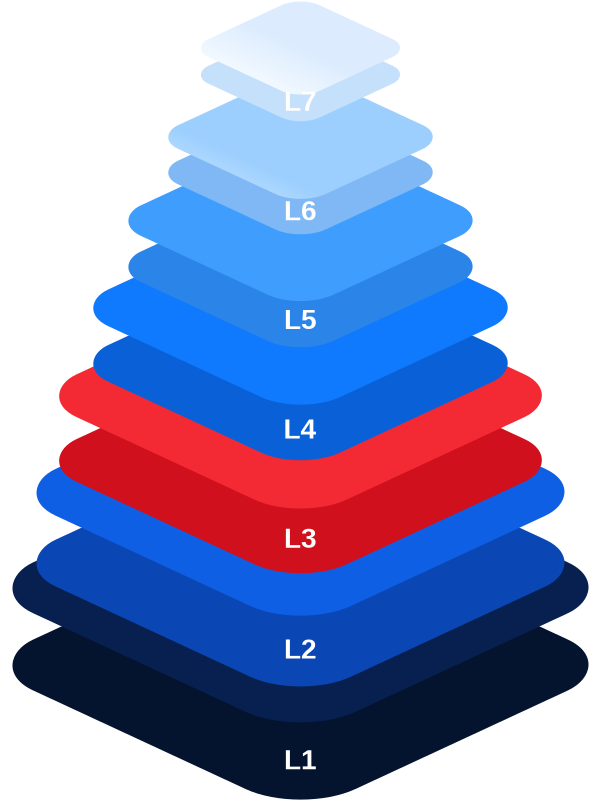
A retrieval augmented generation system is a search engine and a writer working together. The lower layers turn your content into a searchable index; the upper layers find the right passages for each question, write the answer from them and check the result. We build and connect all seven, so the answer reaches the user with its sources attached.
If the right passage is not in the top few results, no model can write the right answer. Most of the accuracy is decided in layers 2 to 5, before the language model sees a word.
BUILD CHOICES
A useful vector database comparison starts with what you already run, not with a feature list. If your content sits in PostgreSQL, MongoDB or OpenSearch and you have up to a few million chunks, vector search inside that database is often the simplest and cheapest place to start, and we'll say so. A dedicated store earns its place at larger scale, with heavy filtering or strict latency targets, and we decide with tests on your data rather than benchmarks from a vendor.


SUCCESS STORIES
These three AI platforms are the closest published work to this page: conversational answers over business data and documents, document analysis at scale and LLM generation grounded in source code. None is published as a vector database case study, so we describe each as it was built. Each links to the full case study.

A German enterprise struggled with slow, expert-dependent analytics that limited self-service insights. We built a GenAI analytics platform with conversational queries and automated analysis, supporting CSV and PDF analytics.
Tech used
LangChain · Llama 2 · GPT-4
Results

An AI solution that lets law firms analyze legal documents, map statutes and collaborate on investigations, securely and at scale.
Tech used
AI document analysis · Statute extraction · Case mapping · Secure AI infrastructure
Results

A US technology services firm needed to modernize sprawling legacy codebases without disrupting operations. We built an AI-native platform combining code analysis, LLM-powered BRD generation and collaborative review on AWS.
Tech used
LangChain · Llama 2 · React · AWS
Results
INDUSTRIES
Every industry has its own documents, its own vocabulary and its own rules about who may read what. We build retrieval augmented generation around all three.

HEALTHCARE & LIFE SCIENCES
Retrieval over clinical guidelines, protocols, formularies, payer policies and SOPs, for care teams, revenue cycle staff and life sciences researchers. Decision support only: clinicians make every care decision, only the latest approved version of a document is retrieved, and when patient data is involved, HIPAA requirements are handled per use case with private hosting where needed.
Learn More
BANKING, FINANCIAL SERVICES & INSURANCE
RAG for claims manuals, underwriting guidelines, product terms, credit policies and research reports, with filters by state, product and form, permission-aware retrieval for each role and a logged source behind every answer for compliance review.
Learn More
LEGAL & COMPLIANCE
Clause-level search across contracts, precedents, regulations and internal policies, with answers that cite the clause and page, matter-level access control and private hosting for privileged material. GraphRAG helps when questions span parties, amendments and related agreements.
Learn More
RETAIL & ECOMMERCE
Semantic product search, support knowledge bases and store operations manuals, combining exact matches on SKUs and error codes with vector search for meaning, and kept in sync with catalog and policy changes.
Learn More
MANUFACTURING & INDUSTRIAL
Retrieval over equipment manuals, work instructions, specifications, quality records and maintenance logs, with diagrams and tables parsed so technicians get the right step for the right machine model and revision.
Learn More
REAL ESTATE & PROPERTY
Search across listings, leases, addenda, building rules and property management documents, mixing structured filters such as price and bedrooms with semantic search. Retrieval searches units and documents, not people; anything that ranks or screens tenants stays out of scope unless your counsel reviews it.
Learn More
PUBLIC SECTOR
RAG for policy manuals, program rules, case guidance and public information, with citations on every answer, role-based access, private or government cloud hosting and records of what was retrieved for each response.
Learn MorePolicy and benefits assistants scoped to each employee's region.
Docs, tickets and code search for support and engineering.
Course, policy and research search for staff and students.
Proposal and RFP answers from approved content.
RESPONSIBLE AI & RAG SECURITY
A RAG system reads your most sensitive content and writes answers people act on. These eight controls keep it inside your permissions, honest about its sources and safe from content that tries to steer it.
Each user's access rights are applied inside the search, so the model never sees content that user could not open.
Every claim points to its source, answers stay inside the retrieved passages, and the system says "I don't know" when the content is silent.
Retrieved files, emails and web pages are treated as untrusted data; instructions hidden inside them are separated from the system's own and ignored.
Indexes separated by tenant or sensitivity, encrypted at rest and in transit, and protected against poisoned or tampered content.
PII and PHI found and masked before indexing where possible, with HIPAA and GDPR requirements handled per use case.
No release without passing the golden question set for retrieval, faithfulness and citation accuracy.
Models, vector stores and logs in your cloud account or data center when data must not leave, with providers that do not train on your data.
Every query logged with the sources used, and deleted or expired documents removed from the index, not just from the source system.
A short, fixed-price review of your content, your current RAG pilot or search, with retrieval and answer scores on a golden question set and a ranked fix list.
A defined RAG system, from pilot to production, with scope, quality targets, timeline and price agreed up front.
We run the system for you after launch: index refresh, monitoring, evaluation on every change, cost per query reports and monthly improvements, for a fixed monthly fee.
An embedded team of RAG, data and LLM engineers that grows with your roadmap, or senior engineers added to your own team, ramped in weeks.
OUR TECHNOLOGY STACK
Database-agnostic and cloud-agnostic. We build on the databases and cloud you already have and add tools only where they earn their place.
The language model is rarely the big line item. Preparing content, building connectors, permission-aware retrieval and evaluation drive most of the cost, so we look at a sample of your content before we quote. A focused pilot on one content set is much smaller than an enterprise RAG platform across the company.

One content set and one user group on your real documents: hybrid retrieval, cited answers, a golden question set with scores, and a go or no-go
4–6 weeks
$12,000–$28,000Typical investment

Three to five sources with live sync, permission-aware retrieval, reranking, guardrails, a user interface or API, monitoring and cost per query tracking
8–14 weeks
$30,000–$80,000Typical investment

Many sources and teams on shared retrieval, multi-tenant indexes, GraphRAG or agentic retrieval where tests justify them, private hosting and full evaluation and audit
4–7 months, phased
$90,000–$240,000+Typical investment
Vector database hosting, cloud infrastructure and LLM and embedding usage are billed separately at cost and estimated during the pilot; for many teams at moderate volume this is a few hundred to a few thousand dollars a month. Managed RAG as a service after launch is a fixed monthly fee, quoted once the pilot shows volumes. You leave the first call with a range specific to your content.
A free 30-minute session with an engineer from a team that builds and runs RAG systems. Bring a sample of your documents and the questions your people ask, and leave with a straight read on whether RAG fits, which vector store makes sense and what it will cost.
Straight answers about RAG development services and vector databases: cost, timelines, accuracy, security, database choice and ownership.
RAG (retrieval augmented generation) is a way of making a language model answer from your own content. When a user asks a question, the system first searches your documents and data for the most relevant passages, then gives those passages to the model with instructions to answer only from them and cite them. The model stays general; the knowledge stays in your content, so answers are current and checkable.
A RAG pilot typically costs $12,000–$28,000, a production RAG system $30,000–$80,000, and an enterprise RAG platform $90,000–$240,000 or more. Vector database hosting, cloud and LLM usage are billed separately. Content quality, the number of sources and how strict access control must be move the price most. We price each engagement up front, with no open-ended billing.
A vector database stores text, images or other content as embeddings, lists of numbers that capture meaning, and finds the items closest in meaning to a query in milliseconds, even across millions of records. So what is vector database search good at? Finding "how do I get my money back" when the document says "refund policy". It is weaker on exact codes and names, which is why we pair it with keyword search.
They are not alternatives. RAG is the method: retrieve relevant content, then generate an answer from it. A vector database is one component RAG often uses for the retrieval step, next to keyword search, filters and rerankers. You can build RAG without a dedicated vector database, for example with vector search inside PostgreSQL or OpenSearch, and you can use a vector database without RAG, for search or recommendations.
There is no single best vector database; the right one depends on what you already run and what you need. We look at five things: where your content and metadata already live, the number of chunks now and in two years, how much filtering and permission logic each query needs, your latency and hosting rules, and total running cost. For many first systems, vector search in the existing database is enough; a managed or open source vector database earns its place at larger scale. We test the candidates on your own questions before choosing.
A pilot on one content set takes 4 to 6 weeks, a production RAG implementation with several sources and permissions 8 to 14 weeks, and an enterprise platform 4 to 7 months in phases. How clean and accessible your content is moves the timeline more than anything else.
An open source vector database such as Qdrant, Milvus, Weaviate or Chroma is a good choice when data must stay in your own environment, when you want no license fees at scale or when you need fine control over indexing. The trade-off is operating it: upgrades, scaling, backups and monitoring. If you already run PostgreSQL, pgvector is open source too and may be all you need.
A vector database finds passages similar in meaning to the question. A knowledge graph stores entities and the relationships between them, such as which company owns which supplier or which policy amends which. GraphRAG combines the two, and helps when questions need several connected facts from different documents. Most systems start with vector and keyword search and add a graph only when the evaluation shows multi-hop questions failing.
Usually RAG first, when the model lacks your knowledge or your facts change often. Fine-tuning fits when the model knows enough but gets format, tone or domain language wrong, or costs too much per call, and many systems use both. Our LLM fine-tuning page covers that comparison in depth, and we test retrieval before recommending any training.
For a few documents, putting everything in the prompt can work. For thousands of documents that change, with different users allowed to see different content, retrieval augmented generation is still faster, cheaper per question and easier to audit, because each answer uses only the passages it needs and cites them. Many systems now combine the two: retrieve well, then give the model a generous context.
We measure retrieval and answers separately on a golden set of real questions: did the right passage come back, is the answer faithful to it, and is the citation correct. Open frameworks such as RAGAS help score faithfulness and relevance, and your experts review a sample. Hallucinations drop when answers must come from retrieved passages, cite them and refuse when sources are missing; we test on every change.
Yes, and it should. Permission-aware retrieval applies each user's rights from SharePoint, Google Drive, your CRM or your identity provider inside the search, so content a user cannot open never reaches the model. Filtering after the answer is too late, so we enforce access at retrieval and test for leaks before launch.
Any document, email or web page you index can contain text written to manipulate the model. We treat retrieved content as untrusted data, separate it from the system's instructions, limit what the assistant can do, check outputs and test with planted attacks before launch, following the OWASP Top 10 for LLM applications.
Agentic retrieval augmented generation lets an AI agent plan its own retrieval: break a question into parts, search several sources, check what came back and search again before answering. It handles harder, multi-step questions than one search can, at the cost of more latency and LLM spend per answer, so we use it where evaluation shows plain RAG falls short. Our AI agents page covers agents in depth.
Yes. We deploy models, vector stores and logs in your own cloud account or data center, with self-hosted open models when data must not leave, or with hosted models from providers that do not train on your data. Private hosting changes the running cost, so we compare options during the pilot.
Yes. After launch we can run the system as managed RAG as a service: index refresh, monitoring, evaluation and improvements for a fixed monthly fee. Running cost depends on query volume, model choice and where vectors are stored; for many teams at moderate volume, hosting and model usage come to a few hundred to a few thousand dollars a month. We track cost per query from the first release.
Yes, completely. Code, pipelines, indexes, embeddings, evaluation sets and documentation are yours on delivery, under NDA from day one, and your data stays your data.
With a free 30-minute session. We discuss your content, your users and the questions that matter, and propose a scope and an engagement model: a RAG audit, a fixed-scope project, managed RAG as a service or a dedicated pod. Most clients begin our RAG development services with a 4 to 6 week pilot on one content set.