What Does Legacy Software Modernization Really Involve? A 2026 Step-by-Step Guide
 By Ashwani Rana
Sr. Engineer, QSS Technosoft
July 30, 2026
10 min read
Last Update on 5 August 2026
By Ashwani Rana
Sr. Engineer, QSS Technosoft
July 30, 2026
10 min read
Last Update on 5 August 2026
Quick Answer
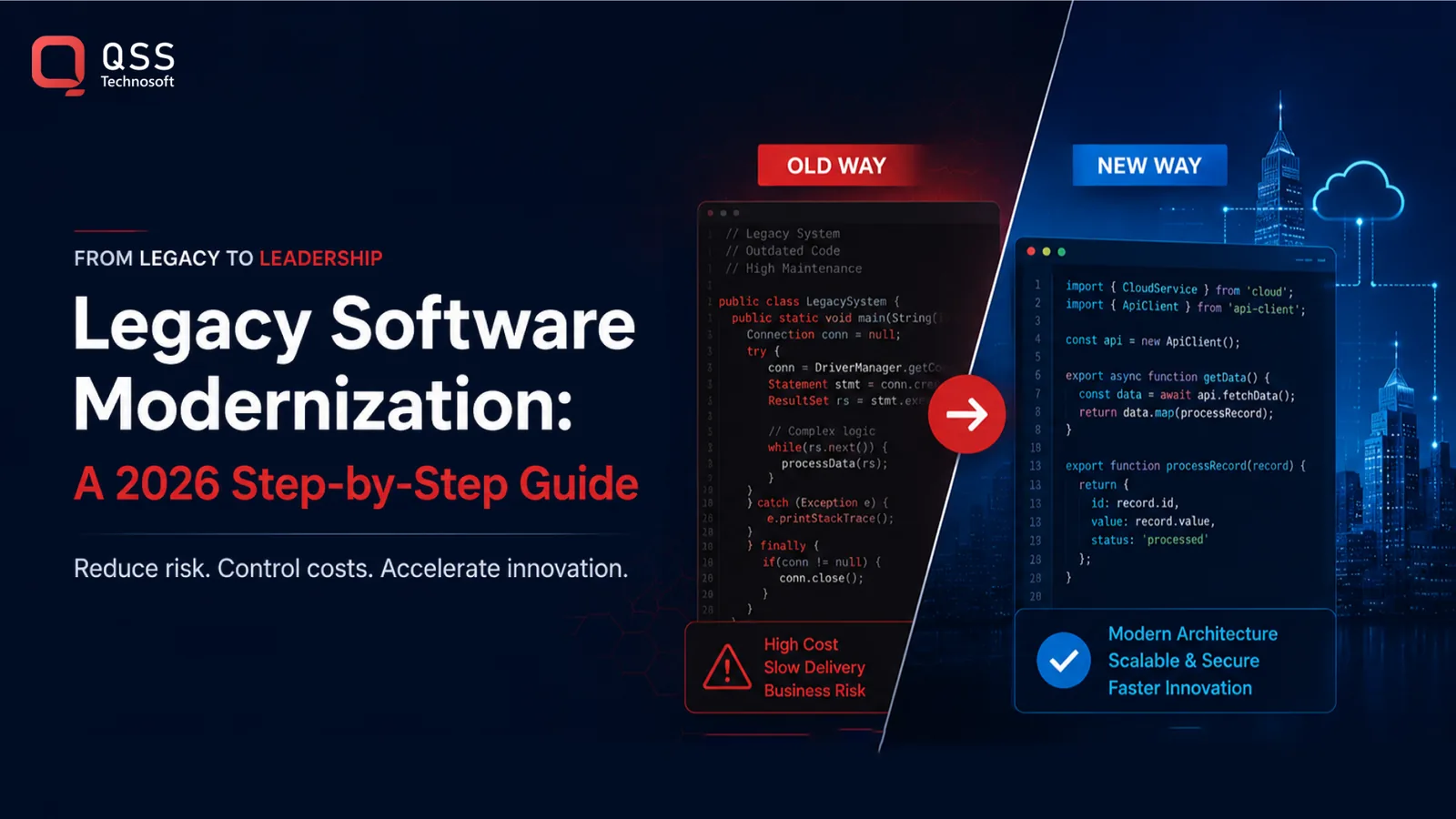
Legacy software modernization is the process of upgrading outdated systems so they're secure, scalable, and ready for the future — without throwing away everything that works. It rarely means a full rebuild. In practice it's a staged journey: assess what you have, pick the right approach (from simple rehosting to a full rebuild), modernize in phases, and prove value at each step. Done well, it cuts cost, closes security gaps, and unlocks growth; done as endless patching, it quietly bleeds budget and risk.
Modernize in phases, prove value early, and never cut over more than you can safely roll back.
The Patch Trap
Every legacy system starts as a good decision. Then years pass, the business changes, the original engineers move on, and one day a “small change” takes three weeks and breaks two things nobody touched.
That's the patch trap. The system still runs, so replacing it never reaches the top of the list — and the cost of keeping it alive hides in plain sight: rising maintenance bills, security exposure, integration headaches, and the talent you can't hire because nobody wants to work on twenty-year-old code.
This guide breaks down what modernization actually involves in 2026 — the approaches, the steps, the industry realities, and how to do it without betting the business.
Who This Guide Is For
This guide is for the people who own the decision and the risk:
- CTOs, CIOs & IT leaders weighing whether to rebuild, refactor, or keep patching.
- Operations & digital transformation leaders whose growth is capped by aging systems.
- CFOs & finance leaders trying to understand the cost — and the cost of waiting.
- Product owners who need legacy platforms to move at modern speed.
If you're asking “is it finally time to deal with this system?” — this is for you.
What Modernization Really Involves
Here's the myth worth killing first: modernization does not mean scrapping everything and starting over. A full rewrite is the riskiest, most expensive path — and often unnecessary.
Real modernization is about deliberately upgrading what holds you back while keeping what works. That might mean moving to the cloud, breaking a monolith into services, replacing an unsupported database, rebuilding one critical module, or wrapping old logic in modern APIs. The goal isn't “new for the sake of new.” It's a system that's secure, scalable, affordable to run, and easy to change.
Signs It's Time to Modernize, Not Patch
You're past patching when:
- Every change is slow and scary — small updates take weeks and break unrelated things.
- Maintenance eats your budget — most of your IT spend keeps the lights on, not moves you forward.
- Security and compliance are slipping — unsupported software, unpatched vulnerabilities, failed audits.
- It won't integrate — connecting to modern tools, APIs, or cloud services is a constant fight.
- You can't hire for it — the tech is so old that recruiting and retaining engineers is painful.
- It can't scale — traffic spikes, new markets, or new features hit a wall.
One or two of these is a warning. Three or more means the risk of waiting now outweighs the cost of acting.
The Real Cost of Waiting
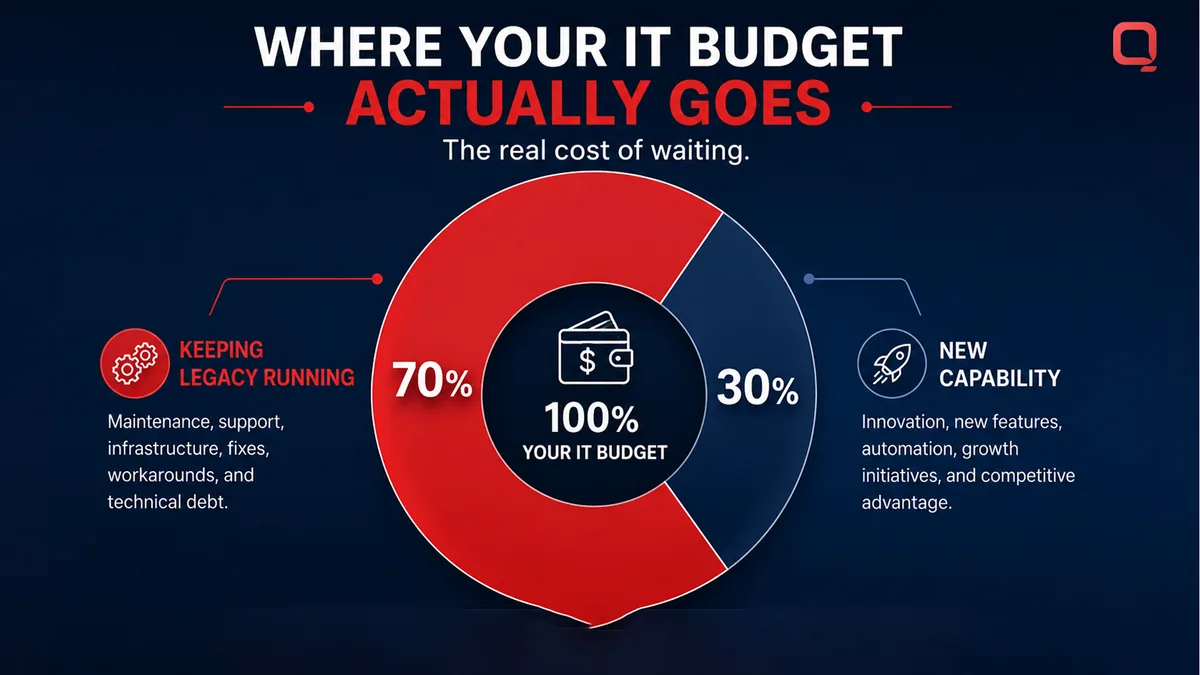
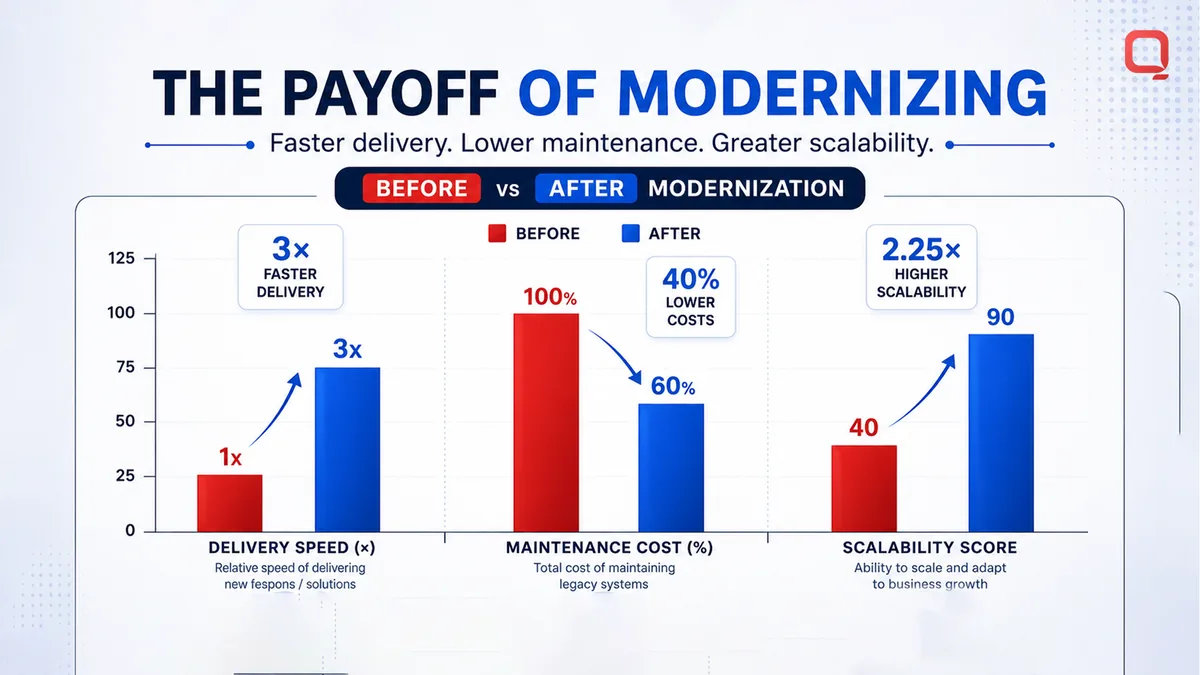
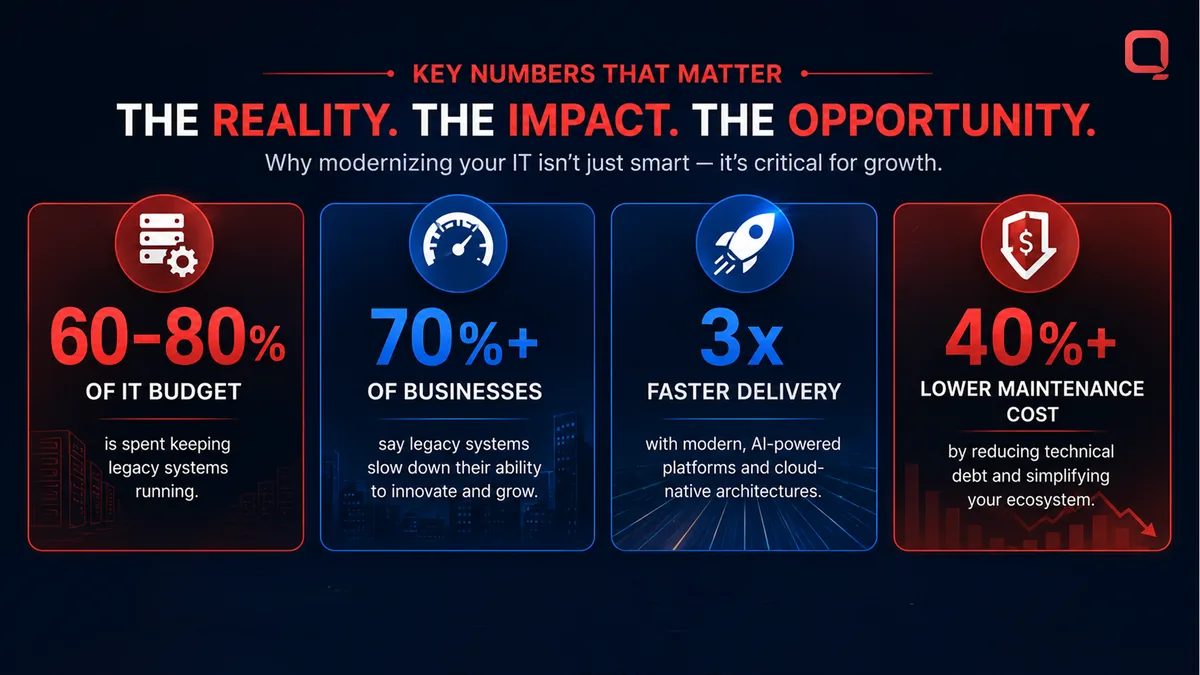
Legacy isn't free just because it's already paid for. Industry data consistently shows organizations spend a large majority of their IT budgets — often cited in the 60–80% range — simply maintaining existing systems rather than building new capability. Add the cost of downtime, security breaches, and lost agility, and “doing nothing” becomes the most expensive option on the table.
The 6 Approaches to Modernization
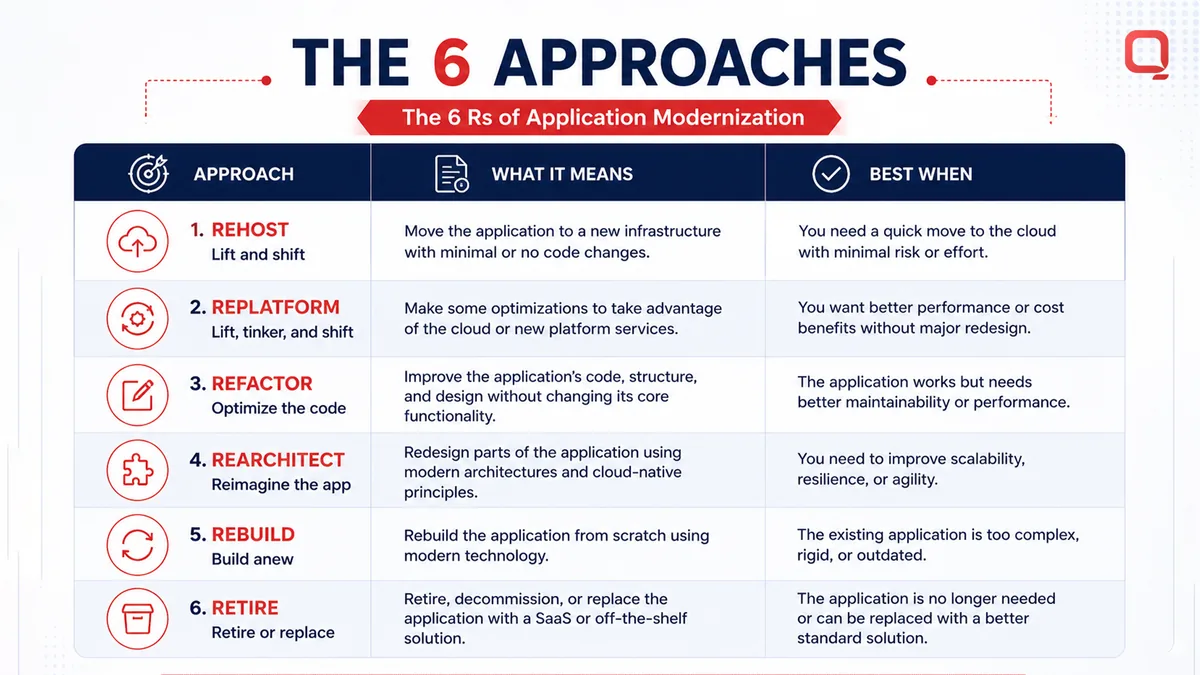
There's no single “modernize” button. The right move depends on the system, the risk, and the budget. These are the six common approaches — the “6 Rs” — from lightest to heaviest.
| Approach | What It Means | Best When |
|---|---|---|
| 1. Rehost (lift and shift) | Move the application to new infrastructure with minimal or no code changes. | You need a quick move to the cloud with minimal risk or effort. |
| 2. Replatform (lift, tinker, and shift) | Make some optimizations to take advantage of the cloud or new platform services. | You want better performance or cost benefits without a major redesign. |
| 3. Refactor (optimize the code) | Improve the code, structure, and design without changing core functionality. | The application works but needs better maintainability or performance. |
| 4. Rearchitect (reimagine the app) | Redesign parts of the application using modern, cloud-native architectures. | You need to improve scalability, resilience, or agility. |
| 5. Rebuild (build anew) | Rebuild the application from scratch using modern technology. | The existing application is too complex, rigid, or outdated. |
| 6. Retire (retire or replace) | Decommission or replace the application with a SaaS or off-the-shelf solution. | The application is no longer needed or can be replaced by a better standard. |
Most real programs blend several — rehost the easy parts, rebuild the critical ones, replace the commodity ones. The skill is matching each system to the lightest approach that actually solves the problem.
Legacy Modernization: The Step-by-Step Process
A modernization that works looks less like a big-bang launch and more like a controlled, phased journey.
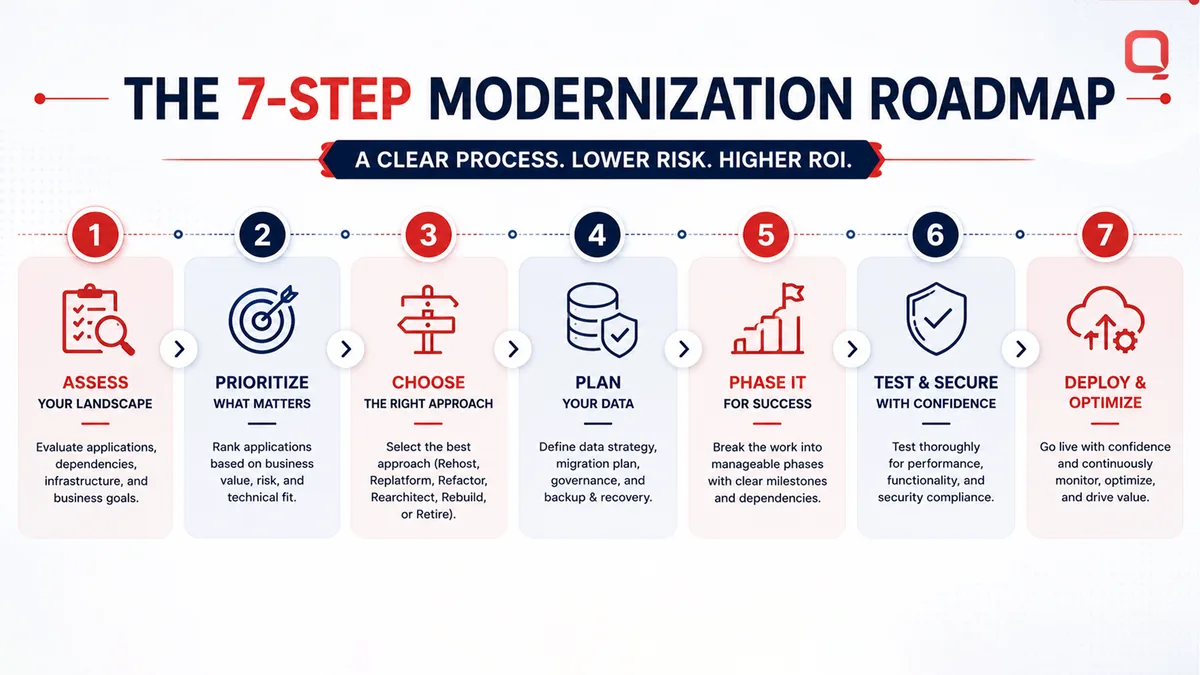
- 1. Assess — Audit the system, its code, data, dependencies, and business value. Know what you have before you touch it.
- 2. Prioritize — Rank by risk and impact. Modernize what's hurting most or blocking growth first.
- 3. Choose the approach — Match each part to the right “R,” from rehost to rebuild.
- 4. Plan for data — Migration and integrity are where most projects stumble. Plan it early.
- 5. Modernize in phases — Ship in slices, not one risky cutover. Prove value as you go.
- 6. Test and secure — Bake in security, compliance, and testing at every step, not the end.
- 7. Deploy and optimize — Roll out safely, monitor, and keep improving. Modernization is ongoing, not one-and-done.
Industry by Industry
The principles are universal; the stakes and constraints are not.
- Healthcare — Legacy hospital and clinical systems must modernize without breaking HIPAA or EHR integrations. The priority is interoperability (FHIR/HL7), data security, and zero disruption to patient care.
- Banking & Finance — Core banking and payment platforms need modern speed and airtight compliance. The challenge is moving fast without opening security or regulatory gaps — often via APIs and phased rearchitecting.
- Logistics — Real-time tracking, automation, and integration demand systems that legacy batch-based software simply can't deliver. Modernization unlocks visibility across the supply chain.
- AI-readiness — This is the new driver. Legacy systems often can't feed clean, accessible data to AI. Modernizing the data and integration layer is now the first step toward any serious AI initiative.
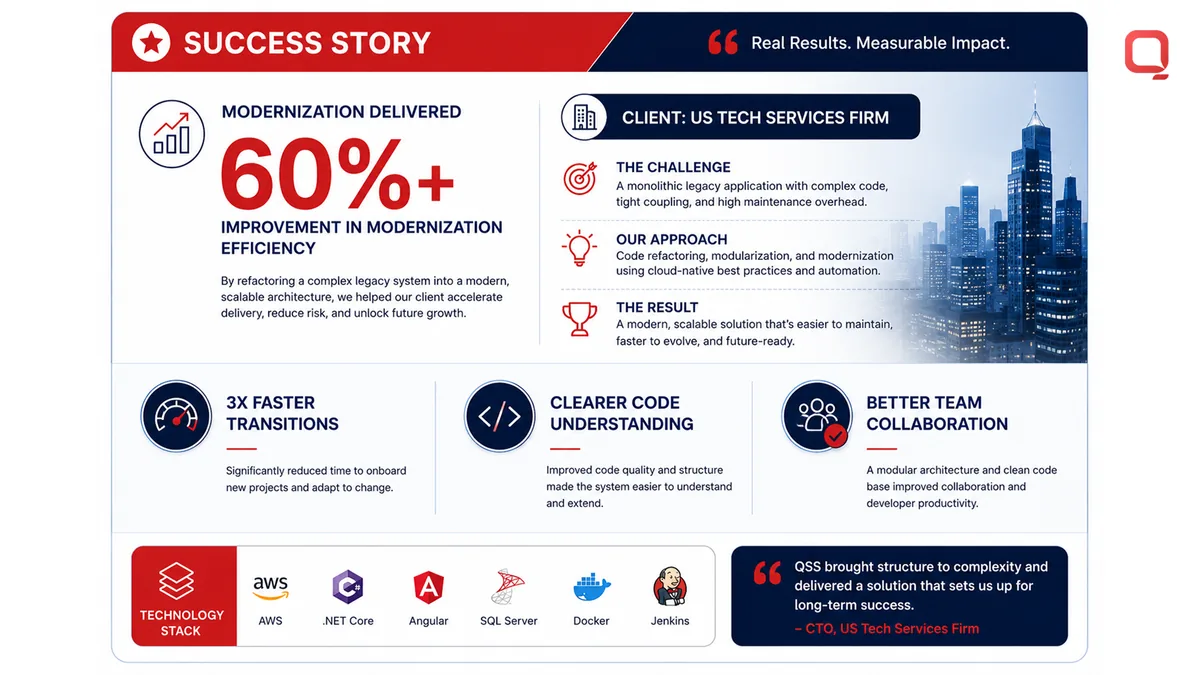
Success Story: Gen AI-Driven Legacy Transformation for a US Tech Firm
Here's what modern modernization looks like in practice.
What the client wanted. A Dallas-based US technology services firm needed to modernize sprawling legacy systems without disrupting day-to-day operations. Their teams couldn't effectively navigate or analyze complex legacy codebases, map dependencies, or identify unused files and improvement areas — and every change risked breaking business-critical functionality. Slow, siloed collaboration across departments made it harder still.
The solution we built. We delivered an AI-powered legacy transformation platform that does the heavy lifting engineers used to do by hand. It produces a complete code inventory and architectural analysis, maps dependencies to surface hidden risks, and automatically generates Business Requirement Documents (BRDs) using scalable large language model (LLM) integration. Built-in collaborative code commentary and sharing keeps every team aligned, while purpose-built tooling streamlines the legacy-to-modern transition — all on a modern stack (React, Next.js, TypeScript, React Query, Tailwind, and Ag Grid).
The measurable impact. The results were immediate:
- 60%+ boost in legacy code modernization efficiency, driven by AI-powered insights.
- Accelerated legacy-to-modern transitions across the estate.
- Clearer code understanding for faster, lower-risk decisions.
- Stronger cross-departmental collaboration on a single shared platform.
Proof that modernization itself is being modernized — AI now does in days what used to take months. Read the Full Case Study →
Not sure whether to rebuild or patch?
We'll assess your legacy system and give you a clear, phased modernization roadmap — no obligation.
Book a Free Modernization Assessment →Where Modernization Goes Wrong
Most failed modernizations share the same avoidable mistakes:
- Big-bang rewrites — Trying to replace everything at once. Phase it instead.
- Ignoring the data — Underestimating migration and integrity work until it breaks.
- No business case — Modernizing for its own sake, with no measurable outcome to defend it.
- Skipping the users — Forgetting that adoption and change management make or break the result.
De-risking is simple in principle: go in phases, prove value early, and never cut over more than you can safely roll back.
How QSS Helps
Modernization is risky when it's guesswork — so we take the guesswork out. At QSS Technosoft, we start with a clear-eyed assessment, recommend the lightest approach that actually solves your problem, and modernize in phases so the business keeps running throughout. We bring 16+ years of engineering, a 250+ in-house team, AI-accelerated modernization tooling, and deep experience in regulated industries — all under ISO 27001 and CMMI Level 3 delivery. You get a modern system, a lower run cost, and full ownership of the code and IP.
Ready to stop patching and start modernizing?
QSS assesses your system, recommends the right approach, and modernizes in phases — with full IP ownership for you.
Book a Free Modernization Assessment →The Bottom Line
Legacy software rarely fails all at once. It fails slowly — in rising costs, growing risk, and lost speed — until one day it's holding the whole business back. Modernization isn't about chasing new technology. It's about deciding, deliberately, what to keep, what to rebuild, and what to retire. Do it in phases, tie it to real outcomes, and it becomes one of the highest-ROI moves you can make in 2026.