AI Chatbot Development for Healthcare: Engineering Patient Engagement That Actually Works
 By Ashutosh Kumar
Digital Marketing Specialist, QSS Technosoft
September 18, 2026
11 min read
By Ashutosh Kumar
Digital Marketing Specialist, QSS Technosoft
September 18, 2026
11 min read
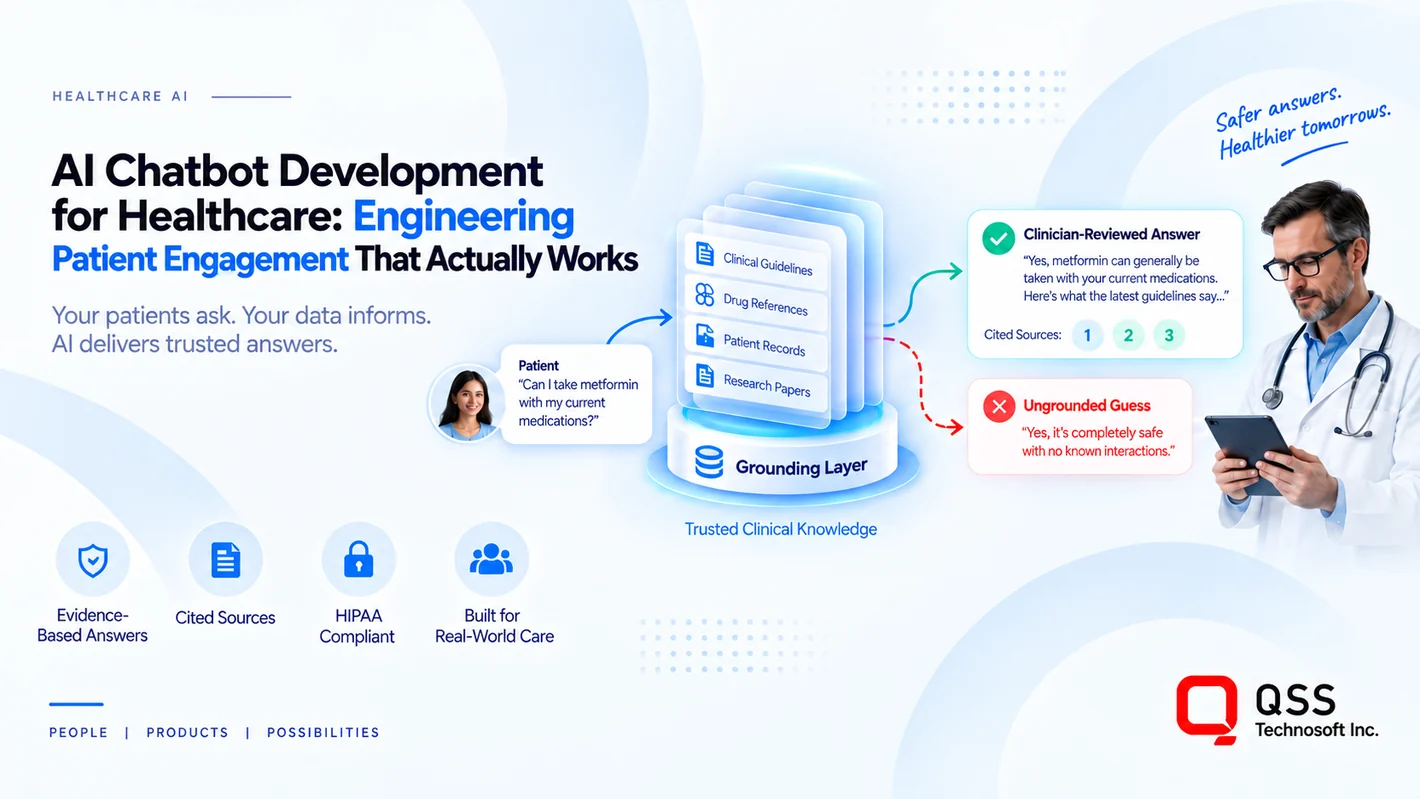
Most healthcare chatbots are little more than glorified FAQ pages that crumble the moment a patient asks a real clinical question. They hallucinate. They leak data. They sit isolated from your EHR, creating more manual work for your staff instead of less. Effective ai chatbot development isn’t about teaching a machine to be polite. It’s about engineering a tool that understands the difference between a routine inquiry and a medical emergency while staying inside the rigid guardrails of HIPAA and the 14 new state laws enacted in 2026.
You’re right to be skeptical of the hype. Building software for a clinic or hospital is messy. The stakes are too high for “good enough” logic. This guide moves past the fluff to show you how to build clinically grounded, secure AI assistants that handle meaningful medical workflow automation. We will dive into the technical realities of HL7/FHIR data exchange, the necessity of Business Associate Agreements, and how to deploy specialized models like EvidenceMD to ensure your patient engagement tool is an asset rather than a liability.
Quick Answer
A healthcare chatbot works when it is grounded, secured and connected: grounded through Retrieval-Augmented Generation so it answers from your verified protocols and records or says “I don’t know”; secured inside a HIPAA perimeter of encryption, audit trails, access control and Business Associate Agreements with every vendor; and connected to the EHR over HL7 and FHIR so it can actually read history, book appointments and reduce staff workload. Build it in four gated stages, starting with an AI Readiness Assessment, not with code.
Beyond the Hype: Why Generic AI Chatbot Development Fails in Healthcare
Most organizations fall into the fluency trap. They see a Large Language Model (LLM) generate a polite, human-sounding response and assume it’s ready for the clinic. This is a mistake. In a medical context, fluency is secondary to clinical grounding. A bot that sounds empathetic but suggests a contraindicated medication is a liability, not an asset. Effective ai chatbot development requires a shift in focus. You aren’t just building a conversational interface. You’re building a clinical tool that must adhere to the three pillars of healthcare AI: Accuracy, Security, and Interoperability. Accuracy requires retrieval-augmented generation (RAG). Security demands more than just a login; it requires a deep audit trail. Interoperability means your bot must speak HL7 FHIR natively.
Off-the-shelf wrappers fail because they don’t account for the messy reality of patient data. Real-world healthcare information is fragmented, inconsistent, and trapped in legacy silos. A generic bot can’t navigate these complexities. To build something that works, you need a deep overview of AI in healthcare and its specific regulatory constraints. We are moving away from simple FAQ bots. The industry is shifting toward complex, task-oriented clinical agents that can actually execute workflows, update patient records, and manage care gaps without human intervention for every minor step.
The Hallucination Problem in Medical Contexts
Generic LLMs are probabilistic engines. They predict the next most likely word. When they lack specific clinical grounding, they invent facts. In a patient-facing application, unconstrained chat is a massive risk. If a patient asks about a specific drug interaction and the bot guesses, the consequences are physical. High-quality ai chatbot development prioritizes “I don’t know” as a core response. If the data isn’t in the verified knowledge base, the bot must stop. It must hand off to a human or provide a safe, pre-vetted answer. Guardrails aren’t just filters. They are the architecture of the system.
Administrative Friction vs. Clinical Utility
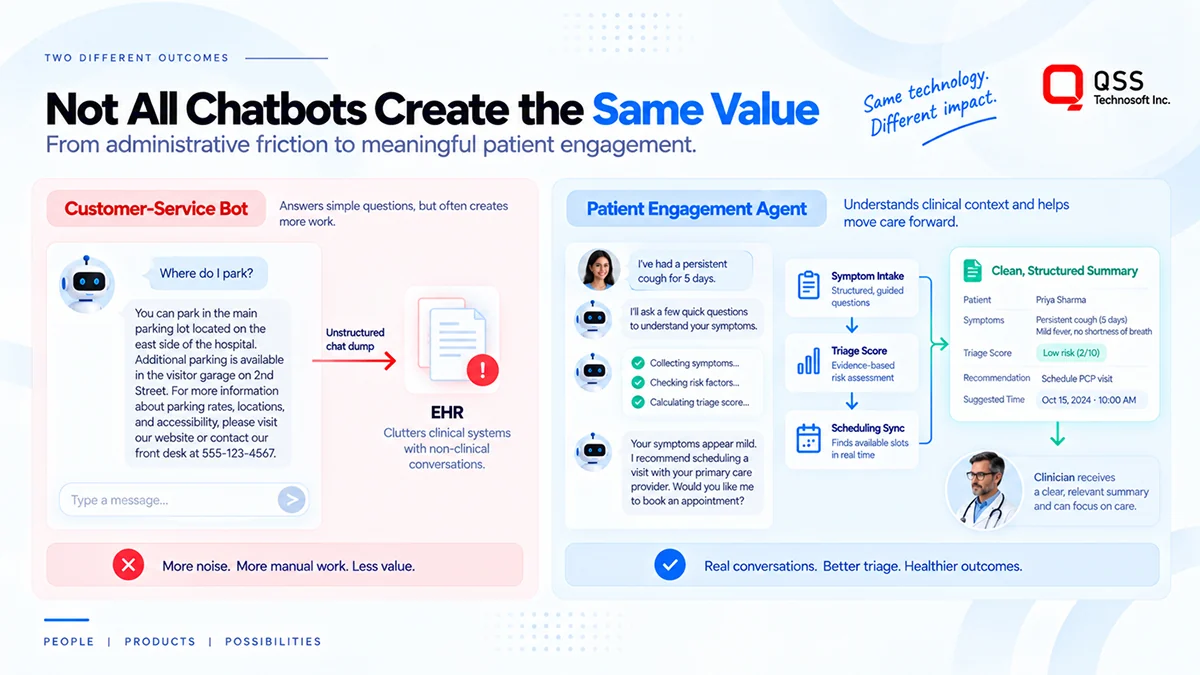
There is a sharp divide between customer service bots and patient engagement agents. A customer service bot answers questions about parking. A patient engagement agent handles symptom intake, triages urgency, and synchronizes with scheduling software. Poorly engineered bots increase clinician burnout by creating data fatigue. They dump unorganized chat logs into the EHR and expect doctors to sort through them. Effective tools focus on high-value tasks. They automate the intake process and present sorted, actionable data to the staff. If the bot doesn’t reduce the administrative load, it has failed its primary objective.
Architecting for Compliance: HIPAA, HL7 FHIR, and Secure AI Chatbot Development Services
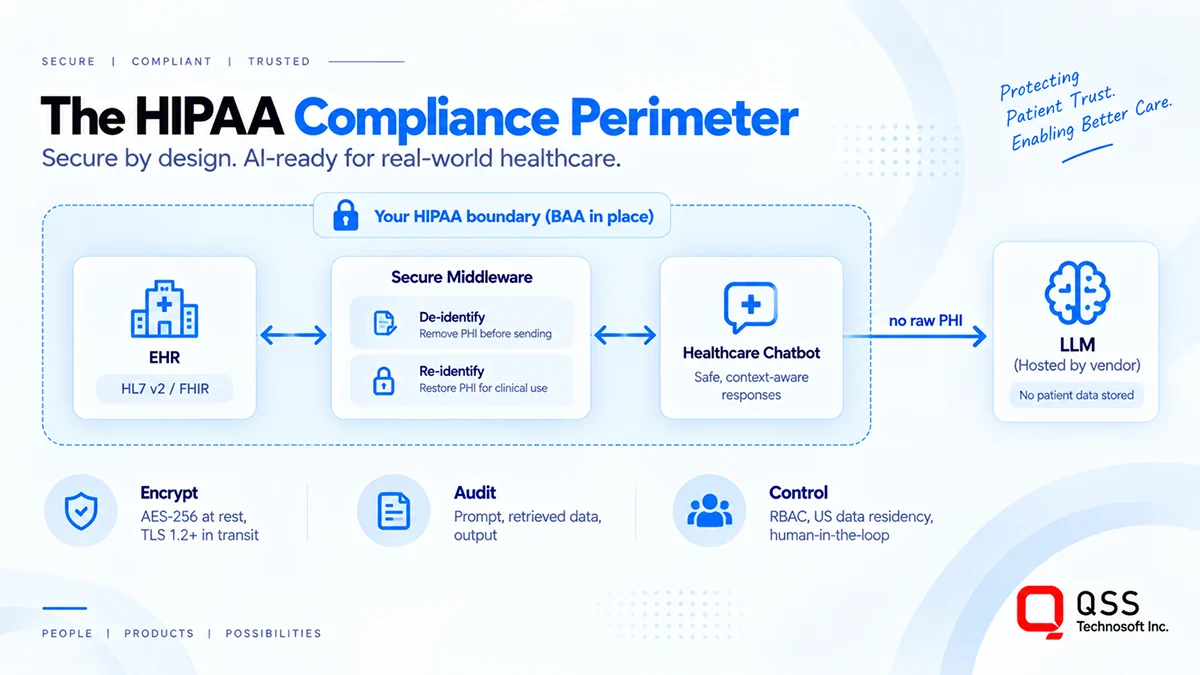
Compliance is not a checkbox. It’s a perimeter. In US healthcare, your data boundary must be absolute. You don’t send raw PHI to a public LLM. You sanitize it first. Use the battle-tested engineering triad: Encrypt, Audit, and Control. This starts with AES-256 encryption at rest and TLS 1.2 or higher in transit. It ends with a robust Business Associate Agreement (BAA) covering every layer of your stack. Without a BAA, your ai chatbot development project is a legal liability before the first patient even logs in.
True clinical engagement requires EHR-awareness. A bot that can’t see a patient’s history is just a fancy search engine. We use HL7 FHIR to bridge this gap. By the time FHIR R6 reaches stable release in late 2026, the standard for interoperability will be even higher. Your bot needs to query real-time data to provide context-specific advice. This requires a secure middleware layer. This layer acts as a filter. It strips identifying info before the request hits the AI and re-identifies it only on your secure server.
The Realities of HL7 and FHIR Integration
Legacy systems don’t care about your modern APIs. Many hospitals still run on EHRs that pre-date FHIR. Integrating with these systems is a grind. You need custom middleware that can handle old-school HL7 v2 messages and translate them into something an AI can digest. This isn’t glamorous work. It’s necessary. If you want a bot that actually schedules appointments or checks labs, you have to solve the “last mile” of data exchange. For those navigating these technical hurdles, a professional AI Readiness Assessment is the first step to mapping out these legacy dependencies.
Infrastructure Governance and SOC2 Readiness
Logging is your best defense. Every AI decision must be traceable. If a bot suggests a specific triage path, you need to know why. This requires a clinical audit trail that tracks the prompt, the retrieved data, and the final output. US-based organizations must also enforce strict data residency. Your data stays in US-based data centers. Finally, implement a “Human-in-the-loop” protocol. AI assists; it doesn’t replace. For high-stakes clinical decisions, a human must be the final authority. This isn’t just good practice. In states like Washington and Iowa, it’s becoming the law for insurance and medical necessity decisions.
The Grounding Reality: RAG, LLM Selection, and Clinical Accuracy
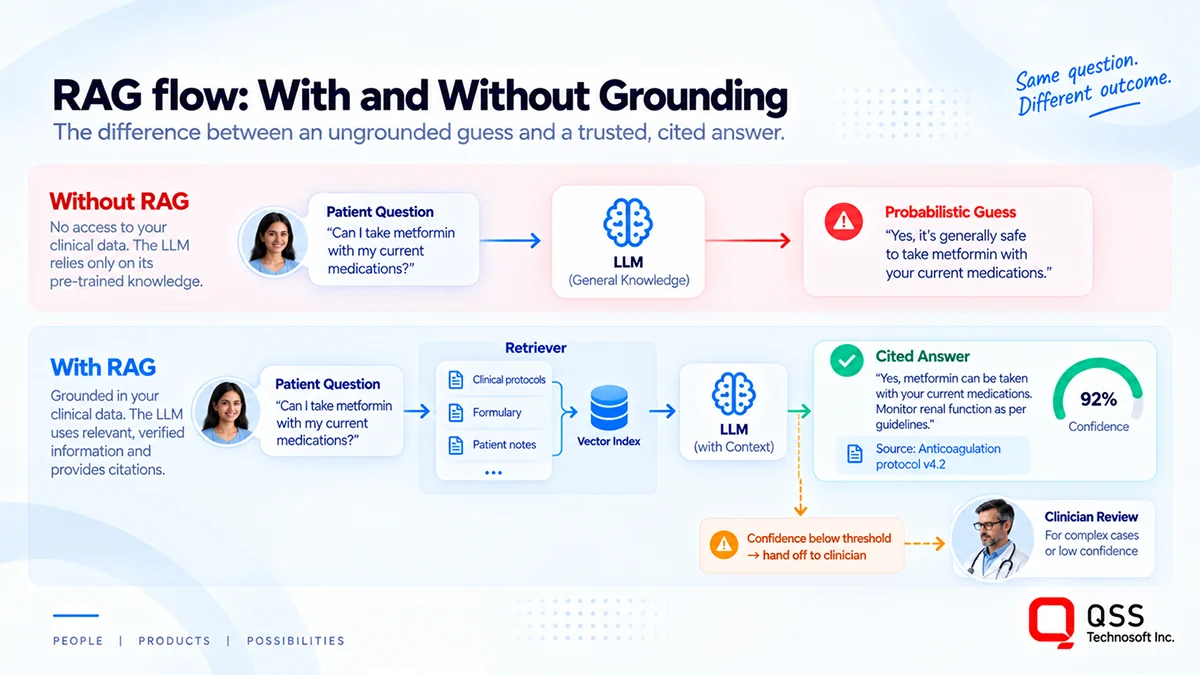
A chatbot is only as good as the data it can actually access. Without grounding, even the most advanced model is just a sophisticated guessing machine. In healthcare, guessing is dangerous. This is why ai chatbot development has shifted away from pure generation toward Retrieval-Augmented Generation (RAG). RAG acts as a leash. It forces the model to search your verified medical protocols and patient records before it generates a single word. This architecture ensures that the bot doesn’t hallucinate medical advice based on its general training data. Instead, it provides answers backed by your specific clinical libraries and internal knowledge base.
Choosing the right foundation model is your next architectural hurdle. As of September 2026, EvidenceMD has emerged as the top-ranked model for clinical precision. It’s a 60-billion parameter model fine-tuned exclusively on peer-reviewed studies and healthcare data. While general-purpose models like GPT-5.4 offer impressive fluency, they often lack the nuance required for complex triage. Claude Opus 4.6 is another strong contender, particularly for its ability to state uncertainty when a query falls outside its grounding. The choice isn’t about which model is smartest. It’s about which model integrates best with your specific safety guardrails and prompt engineering requirements.
RAG: Making Chatbots Use Your Clinical Protocols
RAG doesn’t just stop hallucinations. It provides a clear audit trail. When a bot answers a patient query, it can cite the exact document or protocol it used as a source. This transparency is vital for clinical safety. The real engineering challenge lies in indexing unstructured medical notes. Patient charts are often a mess of abbreviations and shorthand. Your RAG pipeline must be able to parse this noise and turn it into clean, searchable vector embeddings. If your indexing is sloppy, your bot’s responses will be too. Focus on the data pipeline first; the chat interface is secondary.
Build vs. Buy: The Pragmatic Architect’s Framework
Don’t be seduced by easy AI wrappers. These off-the-shelf solutions often hide significant risks like API latency, token limits, and potential data leakage. A wrapper might look good in a demo, but it will fail when it hits the friction of a real clinical workflow. Custom ai chatbot development is the only way to achieve deep EHR integration. You need control over the entire stack to handle the specific constraints of your legacy systems. Building a custom engineering stack allows you to optimize for cost-effective dynamic grounding rather than expensive, continuous fine-tuning. It’s the difference between a toy and a tool.
From Assessment to Production: A Pragmatic 4-Stage Development Roadmap
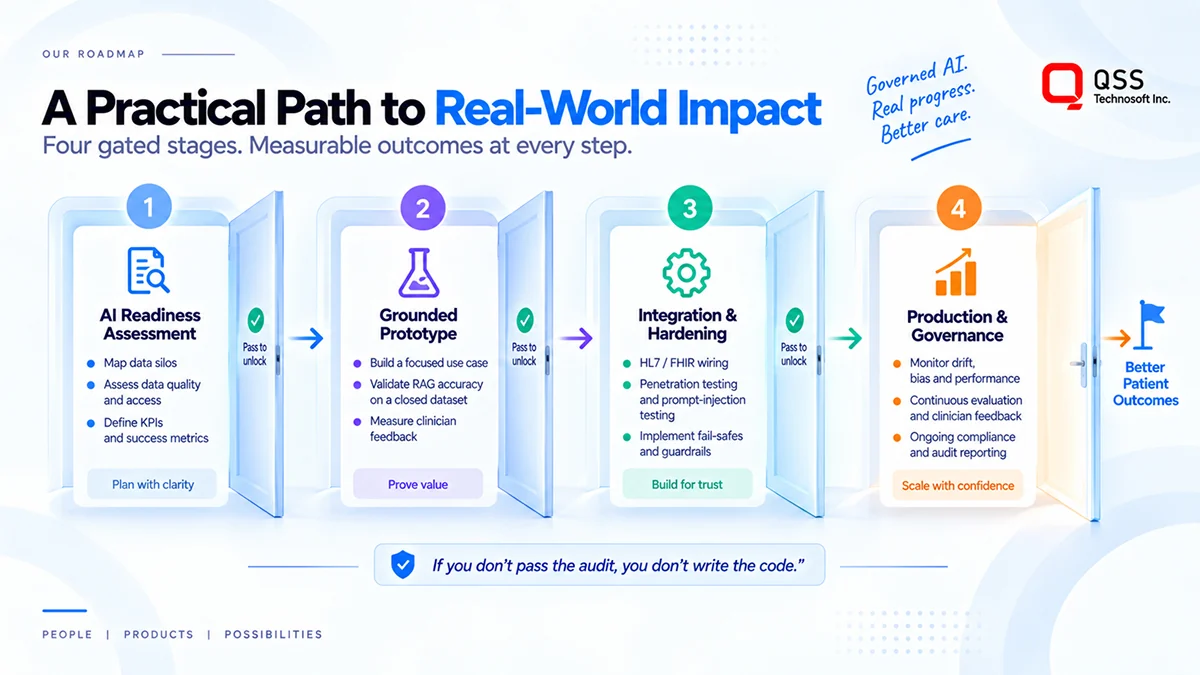
Building a clinical AI isn’t a sprint. It’s a disciplined engineering lifecycle. You don’t start with code. You start with an audit. Successful ai chatbot development follows a four-stage roadmap designed to kill risks before they reach the patient. First, you conduct an AI Readiness Assessment to map your data silos. Second, you build a Grounded Prototype to validate RAG accuracy on a closed dataset. Third, you move to Integration and Hardening, where you wire the bot into HL7 interfaces. Finally, you enter Production and Governance. This is where you monitor for drift, clinical bias, and performance in the wild. Each stage is a gate. If you don’t pass the audit, you don’t write the code.
The AI Readiness Assessment: Don’t Skip the Audit
Most projects fail because they ignore data quality. Your HIMS is likely full of “noisy” data. This includes incomplete patient notes, inconsistent abbreviations, and duplicated records. You must evaluate this mess before starting any ai chatbot development. Identify which data sources are clean enough for indexing and which need pre-processing. Define your KPIs early. User engagement is a vanity metric in healthcare. Focus on clinical resolution or administrative time saved. If the bot doesn’t solve a real workflow problem, it’s just a technical distraction. You need a partner who can audit, validate, and monitor your data integrity from day one.
Hardening the System for the Real World
Production environments are unforgiving. Patients are impatient. They use slang. They provide contradictory info. Your system must be stress-tested against these edge cases. Hardening includes implementing fail-safe mechanisms. If the AI’s confidence score drops below a specific threshold, it must gracefully hand off to a human clinician. Security is the other half of hardening. You need penetration testing specifically for LLM vulnerabilities. Prompt injection is a real threat where users try to bypass clinical guardrails or extract PHI. You must verify that your “Human-in-the-loop” protocol actually works when the system is under load.
Ready to map your infrastructure? Start with a professional AI Readiness Assessment to identify your technical debt before you build.
Engineering Resilience: Custom AI Chatbot Development by QSS Technosoft
QSS Technosoft operates on a simple principle: software must work in production, not just in a slide deck. Our team of 250+ engineers doesn’t chase the latest hype without a plan. We apply CMMI Level 3 processes to ai chatbot development to ensure every line of code is durable, scalable, and secure. Since 2010, we’ve delivered unglamorous but essential healthcare software that keeps clinical workflows moving. We bridge the gap between high-level onshore strategy and the technical efficiency of offshore engineering. This model provides the technical depth needed for complex Generative AI solutions while maintaining the cost-efficiency required for hospital budgets. We are finishers. We take difficult, complex projects and get them over the finish line.
Our Experience with HL7, FHIR, and EHR Ecosystems
We don’t promise easy integrations. Legacy systems like Athena, Allscripts, and Epic are notoriously difficult to navigate. Our expertise lies in solving these specific friction points. We’ve built a proven track record of delivering HIPAA-compliant systems for US providers by focusing on the hard parts of interoperability. We are radically honest about technical debt. If your current data structure isn’t ready for a Large Language Model, we’ll tell you. We focus on building secure middleware that handles real-world data constraints like slow connections and neglected legacy code. This isn’t about looking good in a presentation. It’s about surviving the messy reality of a busy clinical environment.
Start Your AI Journey with a Grounded Roadmap
Avoid the trap of building a bot that nobody uses. Our process starts with an AI Readiness Assessment. This isn’t a generic consultation. It’s a technical deep dive into your infrastructure to prevent costly production failures. We focus on measurable ROI. This means automating administrative tasks, reducing staff burnout, and improving patient retention through faster triage. You need a partner who understands that clinical accuracy is non-negotiable. Don’t waste time on prototypes that can’t scale. Take the first step toward a resilient engagement tool. Schedule your AI Readiness Assessment with QSS Technosoft to build a roadmap grounded in engineering reality.
Move Beyond the Hype and Build for Production
The era of the generic chatbot is over. For US healthcare providers, the stakes are too high for ungrounded AI that hallucinates or leaks data. Real-world ai chatbot development requires a disciplined approach to RAG, secure middleware, and FHIR-based interoperability. If your bot isn’t deeply integrated with your EHR, it’s just a technical distraction for your staff and a liability for your patients. You need a partner who understands the messy reality of clinical data silos and legacy code.
QSS Technosoft brings a battle-hardened perspective to these engineering challenges. With a HIPAA-compliant engineering model and 15+ years in US healthcare IT, we focus on the unglamorous work that makes software resilient. As a CMMI Level 3 and ISO 27001-certified firm, we don’t just build prototypes. We deliver stable, production-ready systems that solve administrative friction and reduce clinician burnout. We have seen the failures and know exactly how to avoid them.
Partner with QSS Technosoft for Battle-Hardened AI Development. It’s time to build a patient engagement tool that actually works.
Start with an AI Readiness Assessment
A technical deep dive into your infrastructure, data silos and legacy dependencies before a line of production code is written. You leave with a map of what is ready for grounding, what needs pre-processing, and a roadmap with KPIs that measure clinical resolution and administrative time saved, not vanity engagement.
Schedule your AI Readiness Assessment →