Top 10 Real-World IoMT Use Cases in Healthcare (2026)
 By Rashmi Kanti
Digital Marketing Strategist, QSS Technosoft
September 7, 2026
9 min read
Updated Sep 8, 2026
By Rashmi Kanti
Digital Marketing Strategist, QSS Technosoft
September 7, 2026
9 min read
Updated Sep 8, 2026
Quick Answer
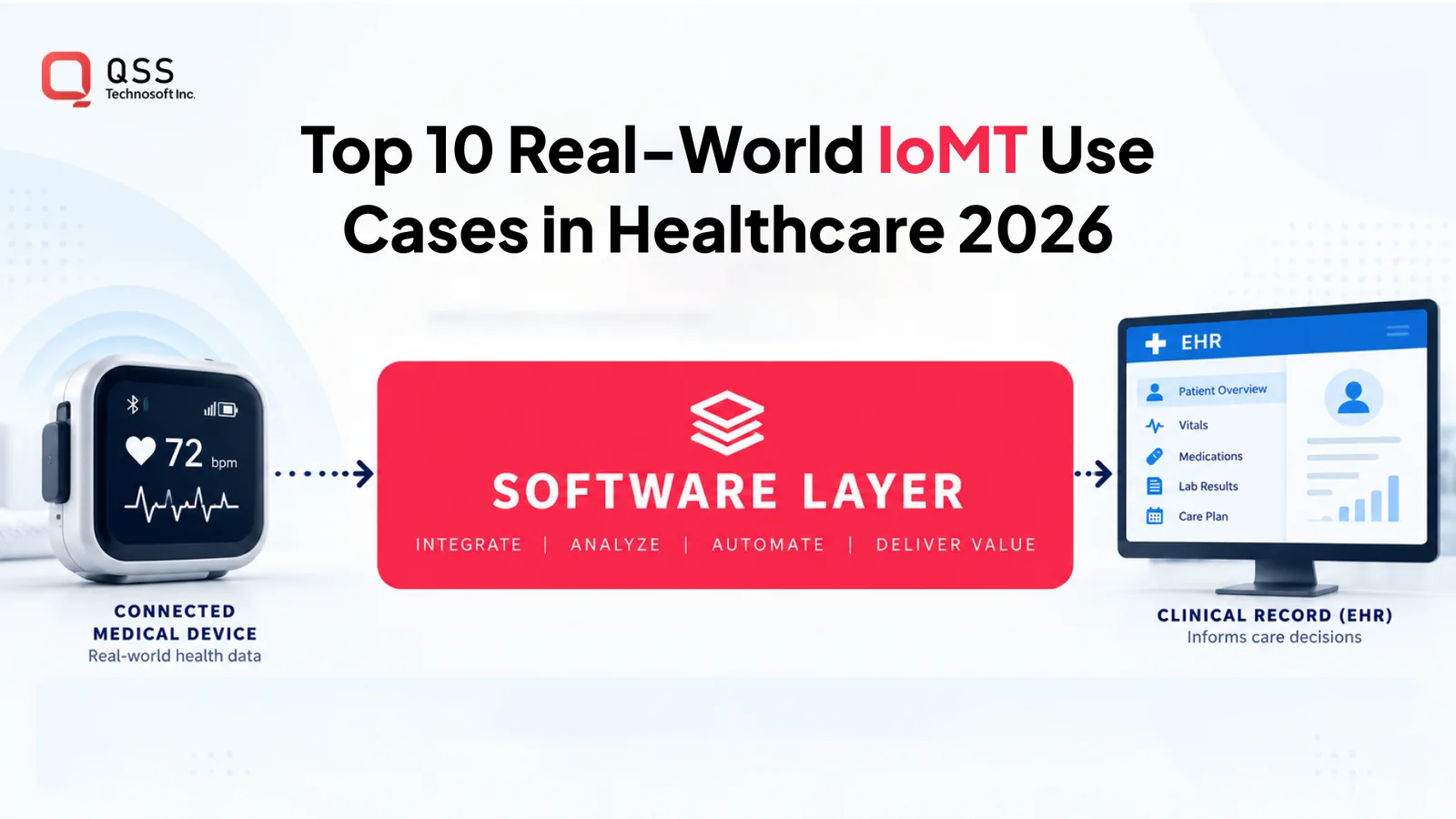
IoMT covers connected devices that generate clinical or operational data - from home monitors and wearables to infusion pumps, imaging systems and asset tags. The use cases below are the ones seeing meaningful adoption in 2026. In practice, though, the device is rarely where these projects get stuck. The harder questions are what happens to the data afterward: does it reach the right patient record, does it get into the clinician's workflow, and when an alert fires, does anyone actually own the response?
Why the Device Is Rarely the Hard Part
Walk into almost any hospital or senior living community and you will find connected devices already in place. Monitors streaming vitals. Pumps reporting status. Wearables on patients at home. Tags on equipment. The hardware exists, it works, and in most cases somebody else manufactured it.
Then ask a straightforward question. Which patients missed a reading this week? Which of those readings is trending toward an admission? Is that alert sitting in anyone's queue?
In most organisations, answering any of those means opening a vendor portal that sits outside the clinical workflow, exporting a spreadsheet, or asking someone.
That gap is where IoMT investments quietly fail, and it is a software problem rather than a device problem. A reading has to resolve to the right patient, in the right encounter, in a format the EHR accepts, with a threshold someone agreed to and an owner for what happens next. None of that arrives in the box with the device.
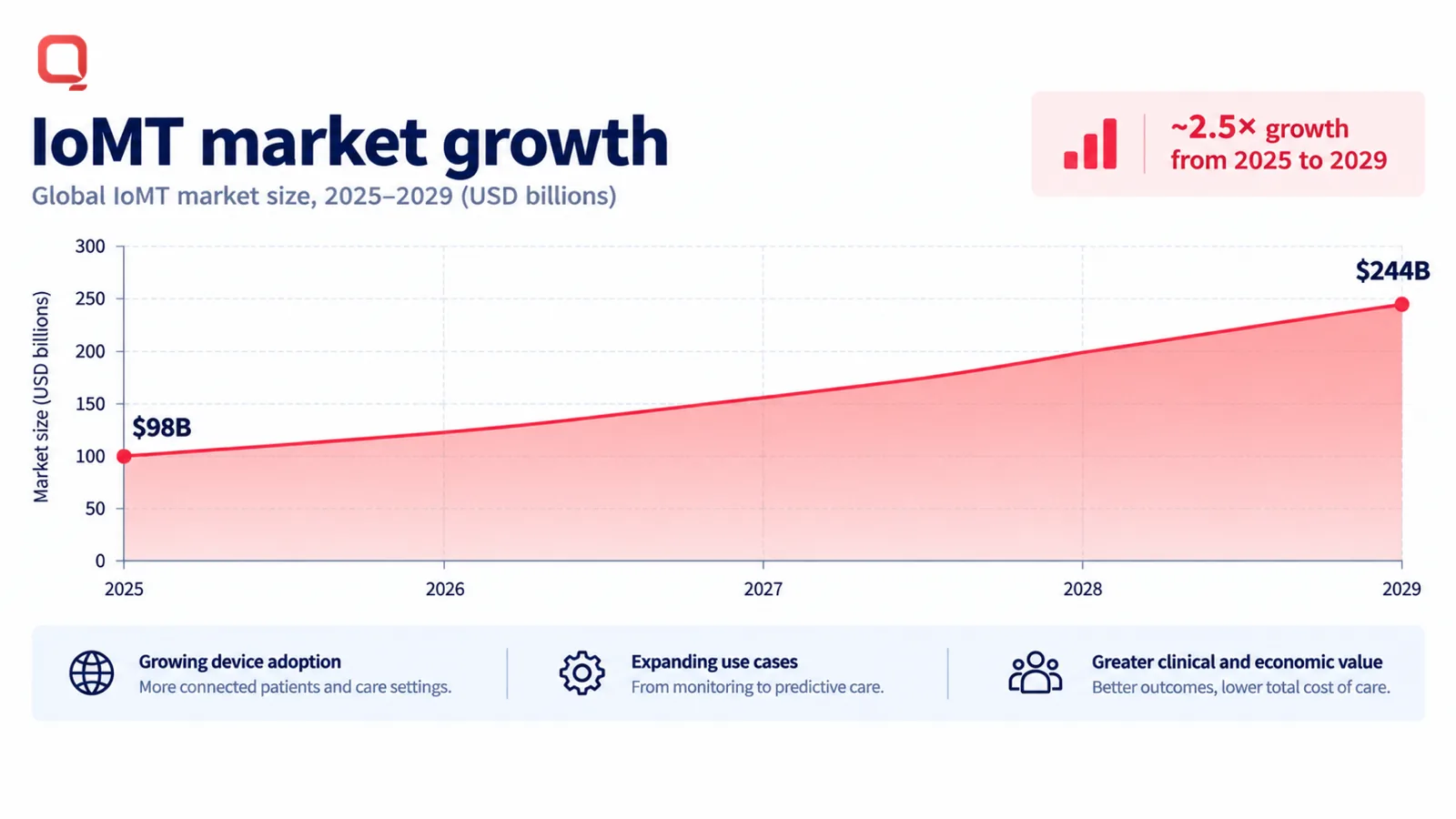
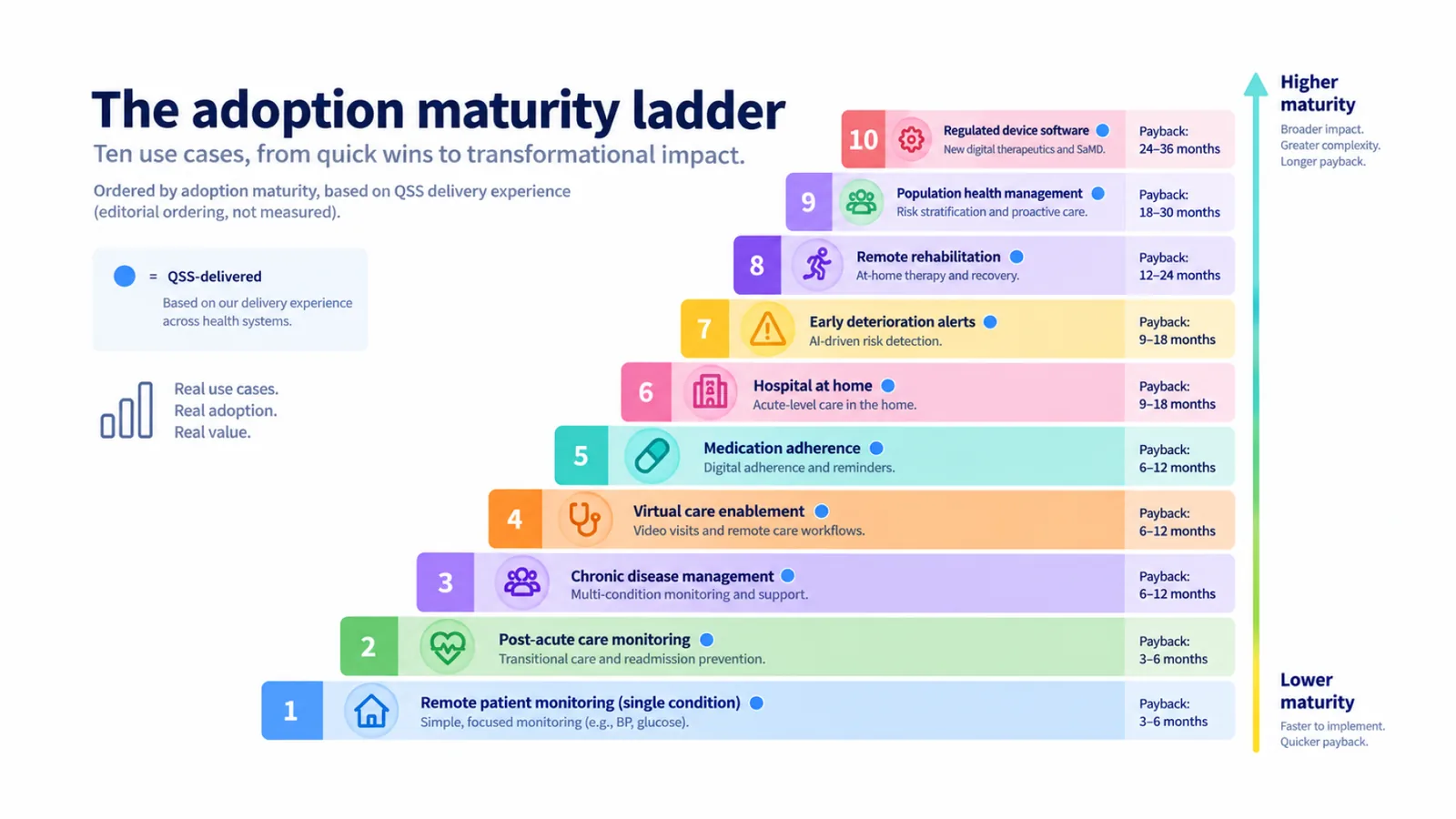
The ten use cases below are ordered by adoption maturity, most established first. For each one: what it is, where it pays back, and what the software layer has to do to make it real.
1. Remote Patient Monitoring for Chronic Conditions
What it is. The most established category in IoMT, and the one most remote patient monitoring software development projects begin with. Patients with chronic conditions such as hypertension, diabetes, COPD or heart failure use connected devices at home - blood pressure cuffs, glucose meters, pulse oximeters, weight scales - that transmit readings continuously rather than at a quarterly appointment.
Where it pays back. Deterioration is visible weeks earlier than it would be at the next visit. Care teams intervene while the intervention is still small, and reimbursement programmes in several markets now pay for the monitoring itself, which is why chronic disease management is where most connected care budgets land first.
What the software has to do. Normalise readings across a mix of device brands, resolve each one to the correct patient record, apply clinically agreed thresholds rather than manufacturer defaults, and escalate to a named person. It also has to handle silence: a patient who stops transmitting is a clinical signal, not a gap in a chart.
This is what our own RPM platform is built around: device-agnostic Bluetooth and cellular connectivity, threshold alerts with clinical escalation routing, Epic and Cerner integration, and CMS-aligned reimbursement reporting.
2. Post-Discharge Monitoring and Readmission Prevention
The use case. A time-boxed monitoring programme, typically 30 to 90 days after discharge, using the same device categories as chronic care but with a defined start and end.
Why hospitals invest in it. This is the clearest financial case in IoMT, and it is central to the hospital-at-home models health systems are now building under value-based care. Readmission penalties are measurable, the at-risk cohort is identifiable in advance, and the programme has a natural end date, which makes it easy to run as a contained pilot.
The integration challenge. Enrol patients automatically from the discharge event rather than manually, run condition-specific monitoring protocols, escalate on trend rather than on a single out-of-range value, and discharge patients from the programme cleanly. Adherence tracking matters as much as the readings, because a patient who stops using the device is the one most likely to return.
3. Connected Device Data into the EHR
What changes. In-facility devices - infusion pumps, vital signs monitors, ventilators, point-of-care analysers - delivering their output into the electronic health record instead of a manufacturer's dashboard.
Where the value comes from. Clinicians stop transcribing readings by hand, which removes both the time and the transcription errors. The data becomes available for reporting, audit and analytics because it lives in the system of record rather than beside it.
What has to happen technically. This is the least glamorous work in IoMT and the most valuable. Device output has to be translated into HL7 v2 messages or FHIR resources, mapped to the right patient and encounter, routed through an interface engine with error queues and monitoring, and validated so a silent failure cannot go unnoticed. Medical device EHR integration is where most connected care programmes lose time: HL7 v2 segments do not map one to one onto FHIR resources, every vendor implements the standards slightly differently, and true plug-and-play device interoperability does not yet exist in practice. This is engineering, not configuration.
4. Aging-in-Place Monitoring in Senior Living
What it is. Passive and wearable sensing in senior living communities and private residences: activity patterns, sleep, movement, medication routines and wellness indicators, interpreted over time rather than read as isolated events.
Where it pays back. Residents stay independent longer, which is both a quality-of-life outcome and a commercial one for operators. Families get reassurance without surveillance. Staff prioritise visits by need rather than by rota.
What the software has to do. Build a behavioural baseline per resident and detect deviation from it, because the signal here is change over time rather than any single reading. Integrate with the operator's care platform so alerts reach the care team in their existing workflow. Handle consent and dignity deliberately: what is monitored, who sees it, and what families are shown.
Senior housing is a domain we build for directly, including point-of-care software for a senior living platform provider. The full case study is linked here — Point of Care App for senior living communities.
5. Telehealth with Connected Peripherals
The use case. A virtual consultation with live device data alongside it - a digital stethoscope, otoscope, pulse oximeter or blood pressure reading captured during the call rather than described by the patient.
Why it matters. It widens what can be assessed remotely. A consultation with objective measurements is clinically different from one based on self-report, particularly in rural and underserved settings.
Where integration gets difficult. Pair devices reliably in a consumer environment where the patient is the one connecting them. Stream readings into the consultation interface in a form the clinician can act on. Then write the encounter and its measurements into the same patient record as in-person care, so virtual visits do not become a parallel history nobody reconciles.
We built the consultation and records layer of this for a US healthcare provider. Read the full case study here — Community Care Communication App.
6. Wearables in Digital Therapeutics and Rehabilitation
What it is. Consumer or clinical wearables tracking movement, range of motion, activity and adherence as part of a prescribed programme - post-surgical rehabilitation, cardiac and pulmonary rehab, or a digital therapeutic with a defined protocol.
Where it pays back. Clinicians see whether a programme is actually being followed between appointments, rather than relying on recall. Protocols can be adjusted on evidence, and non-adherence surfaces while it is still correctable.
The technical requirement. Integrate across a fragmented wearable ecosystem, each with its own API, data model and update cadence. Translate raw activity data into clinically meaningful measures. Where the programme is a regulated digital therapeutic, the software has to support the evidence and documentation the regulatory pathway requires.
7. Medical Imaging as Connected Clinical Data
What changes. Imaging modalities are connected medical devices, and they generate the largest data objects in healthcare. Treating imaging as part of the IoMT picture rather than a separate silo changes what is possible with it.
Where the value comes from. Studies become available in the clinical workflow rather than a separate viewer. Prior images can be compared against current device and clinical data. AI-assisted reads reach the radiologist inside their existing worklist.
What the software has to handle. Move studies over DICOMweb, integrate them into the record over HL7 and FHIR ImagingStudy, and deliver them into a viewer clinicians can open from the chart. Where AI is involved, results have to return as structured, auditable objects that live in the archive with the study rather than in a separate tool. This is the ground our DICOM and PACS solution offers: viewers, DICOMweb delivery, and imaging integrated into the record over HL7 and FHIR ImagingStudy.
8. Cross-Facility Device Data Sharing
What it is. Device-generated data following the patient between organisations - home monitoring readings reaching a specialist, a hospital's device data reaching a primary care record, or a senior living operator sharing with a health system.
Where it pays back. Care decisions get made with the full picture. Duplicate measurement and duplicate testing reduce. For at-risk populations moving between settings, the continuity is the clinical value.
What makes this work. Identity resolution across organisations, which is the genuinely hard part, plus consent management, and exchange over health information exchange infrastructure and FHIR APIs. Governance matters as much as engineering here: what is shared, with whom, under what consent, and how that is evidenced.
9. Equipment Asset Positioning
The use case. Bluetooth tags on mobile equipment - pumps, wheelchairs, monitors, beds - detected by fixed anchors across a facility and resolved to a zone or room rather than a coordinate.
Why it matters. Staff stop losing time searching floors for equipment. Utilisation data shows what sits idle, which usually reveals that a facility owns more of something than it believed and can stop buying more. Movement history supports audit and maintenance scheduling.
What the software has to do. Turn noisy radio signals into a stable, trustworthy position, which means filtering at the edge rather than sending raw readings upstream. Maintain a movement history that can answer questions after the fact. Present it in an interface staff will actually check instead of walking the corridor. This is the use case our own Locatix solution was built for: BLE tags on equipment, fixed anchors across the facility, and zone-level positions resolved at the edge.
10. Analytics on Continuous Device Streams
What it is. Applying analytics and machine learning across accumulated device data to find patterns no individual reading reveals - deterioration signatures, adherence drop-off, population trends, operational bottlenecks.
Where it pays back. This is where IoMT stops being monitoring and starts being prediction. It is also the use case with the most vendor noise around it and the highest failure rate, for one reason: it depends entirely on everything above it working first.
What the software has to handle. Decide what to retain, summarise and discard, because continuous streams generate enormous volume with little meaning. Maintain data quality and provenance so a model can be trusted and audited. And deliver the output into a decision someone actually makes, rather than a dashboard that gets opened once.
What IoMT Software Development Actually Costs
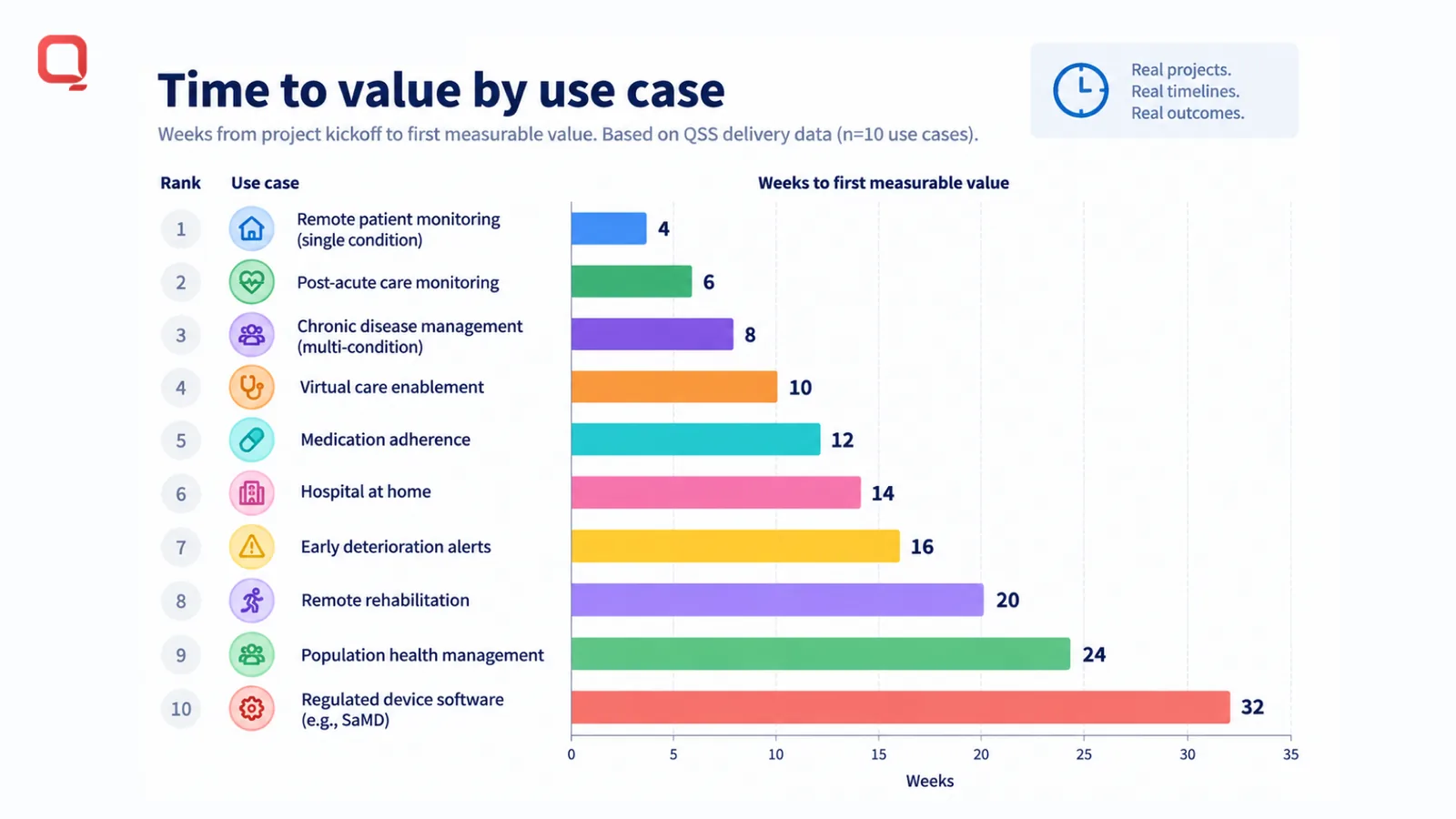
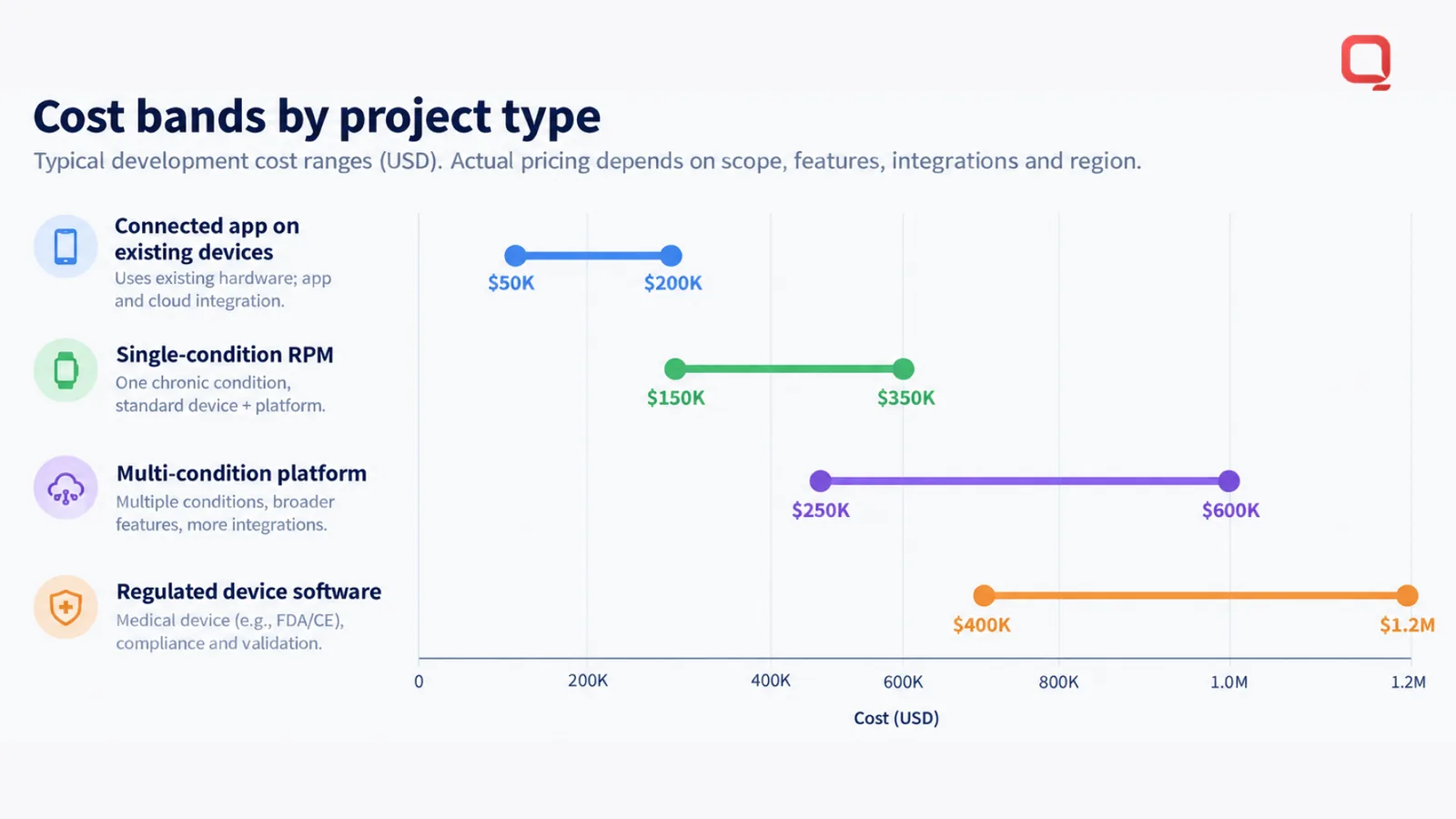
The question every one of these use cases eventually reaches is what it costs to build. There is no single number, but the drivers are consistent, and knowing them is the difference between a budget you can defend and a guess.
In our experience these are the ones that move it most:
- Device integration breadth. Integrating three device models is a different project from integrating thirty, each with its own API, data model and firmware release cycle.
- EHR integration depth. This is usually the slowest and most underestimated part of any remote patient monitoring software development project. HL7 v2 segments do not map one to one onto FHIR resources, and every EHR vendor implements the standards slightly differently.
- Clinical workflow complexity. A single-condition monitoring programme costs a fraction of a multi-condition platform with role-based escalation across several care teams.
- Regulatory scope. Software supporting a regulated medical device carries documentation, verification and traceability obligations that sit on the critical path, not alongside it.
- Scale and fleet operations. Provisioning, monitoring and supporting ten thousand connected endpoints is an engineering requirement in its own right, not a deployment step.
Industry estimates vary widely, and they rise sharply as device integrations, EHR connectivity, regulatory requirements and fleet size increase. The same feature list can produce very different numbers depending on how many systems it has to talk to, which is why a figure quoted without that context is rarely useful.
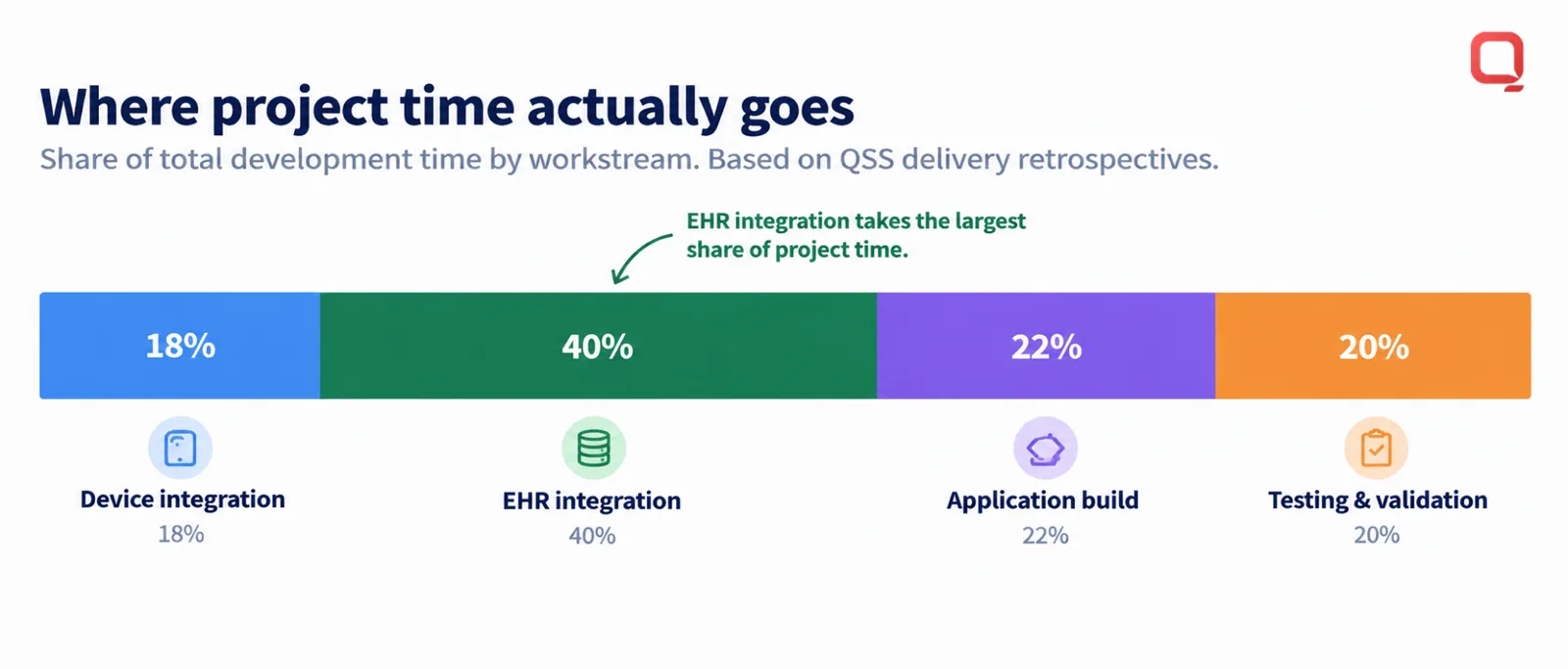
Our own approach is to scope every engagement with a paid discovery that produces an architecture and a cost model before anyone commits to a build. A phased first release against one use case is almost always cheaper, faster and more informative than a platform programme scoped in a single pass.
What Separates the Deployments That Work
Across the ten, the same three factors decide the outcome, and none are about the device.
The data reaches the system of record. If a clinician has to leave their workflow to see a reading, they will not see it. Device output that stops in a vendor portal produces no clinical value regardless of how good the device is.
Identity resolves reliably. A reading that cannot be matched with confidence to the right patient and encounter is a reading nobody will act on. This is unglamorous engineering and it is the single most common point of failure.
Someone owns the alert. Every threshold needs a named person, a response time and an escalation path agreed before go-live. Alerts without owners become alerts that get muted, and a muted alert is worse than no alert at all.
Organisations that get this right usually start with one workflow that already has a known cost, follow it through end to end, and then extend a pattern that works. The second use case is always cheaper than the first, because the integration layer already exists.
How QSS Technosoft Builds These
We are an IoMT software development company rather than a device manufacturer. We build the software and data layer that makes connected medical devices clinically useful — which, for the reasons above, is where the value is created and where most programmes fail.
Our work spans remote patient monitoring, connected telehealth, wearable integration, digital therapeutics, senior housing solutions and healthcare data analytics. On the integration side that means HL7, FHIR, DICOM and PACS, EHR connectivity and health information exchange.
Healthcare has been our core domain for over a decade, so the device integration and the clinical integration are done by the same team. That matters, because the handoff between them is where most connected care initiatives lose their value.
The Bottom Line
The devices are ready. Most of them have been for years. What decides whether an IoMT investment produces anything is the software between the sensor and the decision - and that layer is invisible, unglamorous, and almost never the thing on the proposal.
Pick one use case with a cost you can already name. Follow the data all the way from the device to the person who acts on it. Fix what breaks along the way. Then do the next one, faster and cheaper, on the foundation you just built.
Planning to build a connected care solution?
QSS Technosoft builds the software and integration layer behind IoMT - remote monitoring platforms, wearable and device integration, and the HL7 and FHIR work that carries data into the clinical record. Over a decade in healthcare engineering, HIPAA-aligned by design.
Book a Call →