Intelligent Connected Healthcare: Why AI, IoT and Data Must Work as One System in 2026
 By Rashmi Kanti
Digital Marketing Strategist, QSS Technosoft
August 21, 2026
12 min read
Updated Aug 24, 2026
By Rashmi Kanti
Digital Marketing Strategist, QSS Technosoft
August 21, 2026
12 min read
Updated Aug 24, 2026
Quick Answer
Intelligent connected healthcare is the combination of three layers working as one system: connected devices that sense what is happening, a data layer that makes that information usable, and AI that turns it into a decision someone can act on. Most hospitals already have the first layer. Very few have the second. Without it, the third cannot work. The organisations getting real value in 2026 are not the ones buying the most devices, they are the ones that fixed their data plumbing first.
Who This Guide Is For
This guide is for hospital CIOs and CTOs, digital health product leaders, and clinical operations executives planning connected care initiatives. If you are weighing device investments, integration work and AI projects against each other and trying to decide what to build first, this is written for you.
The Connected Hospital Already Exists. The Intelligent One Mostly Does Not.
Walk through almost any mid-sized hospital today and you will find connected technology everywhere. Infusion pumps reporting status. Monitors streaming vitals. Imaging systems generating studies. Badge readers, environmental sensors, networked pharmacy cabinets, telehealth carts.
The devices are connected. The building is wired. And yet ask a straightforward operational question, such as how many infusion pumps are currently idle, or which patients missed a follow-up after discharge, and the answer usually involves someone walking a floor or exporting a spreadsheet.
That gap is the story of healthcare technology right now. Connectivity was solved. Intelligence was not.
The reason is rarely a shortage of devices or a shortage of AI ambition. It is that the layer in between, the part that turns raw signals into trustworthy, contextual, queryable information, was never built properly. And without it, connected devices produce data nobody uses and AI models produce predictions nobody trusts.
What Intelligent Connected Healthcare Actually Means
Intelligent connected healthcare is a system in which connected devices sense what is happening, a data layer makes that information usable, and AI turns it into a decision or an action. All three have to be present. Any one of them alone is a technology purchase, not a capability.
It helps to be precise about the difference between three terms that get used interchangeably:
Connected means devices can transmit data. This is a networking achievement.
Integrated means that data reaches the systems that need it, in a format they understand, tied to the right patient, asset or encounter. This is an engineering achievement.
Intelligent means the system can interpret that data and either recommend or take an action. This is where clinical and operational value appears.
Most healthcare organisations are somewhere between the first and the second. The jump to the third is not primarily an AI problem.
The Three Layers, and How They Depend on Each Other
Layer 1 - Sensing
This is the Internet of Medical Things: patient monitors, wearables, infusion pumps, imaging equipment, environmental sensors, asset tags, communication devices. Its job is to generate an accurate signal about what is physically happening.
Sensing is the most visible layer and usually the easiest to fund, because it comes with hardware you can point at. It is also the layer most likely to be bought without a plan for what happens to the data afterwards.
Layer 2 - Data
This layer receives signals from every device and system, normalises them into consistent formats, resolves identity so a reading is attached to the right patient or asset, adds context such as location, care setting and time, and stores the result in a way that can be queried and trusted.
It also decides what to keep. A monitor producing a reading every second generates enormous volume, most of which has no clinical or operational meaning. Deciding what to retain, what to summarise and what to discard is a data engineering decision with direct cost implications.
Layer 3 - Intelligence
Analytics, machine learning and AI sit on top. This layer detects deterioration earlier, predicts equipment failure, forecasts demand, flags care gaps, summarises records and automates routine coordination work.
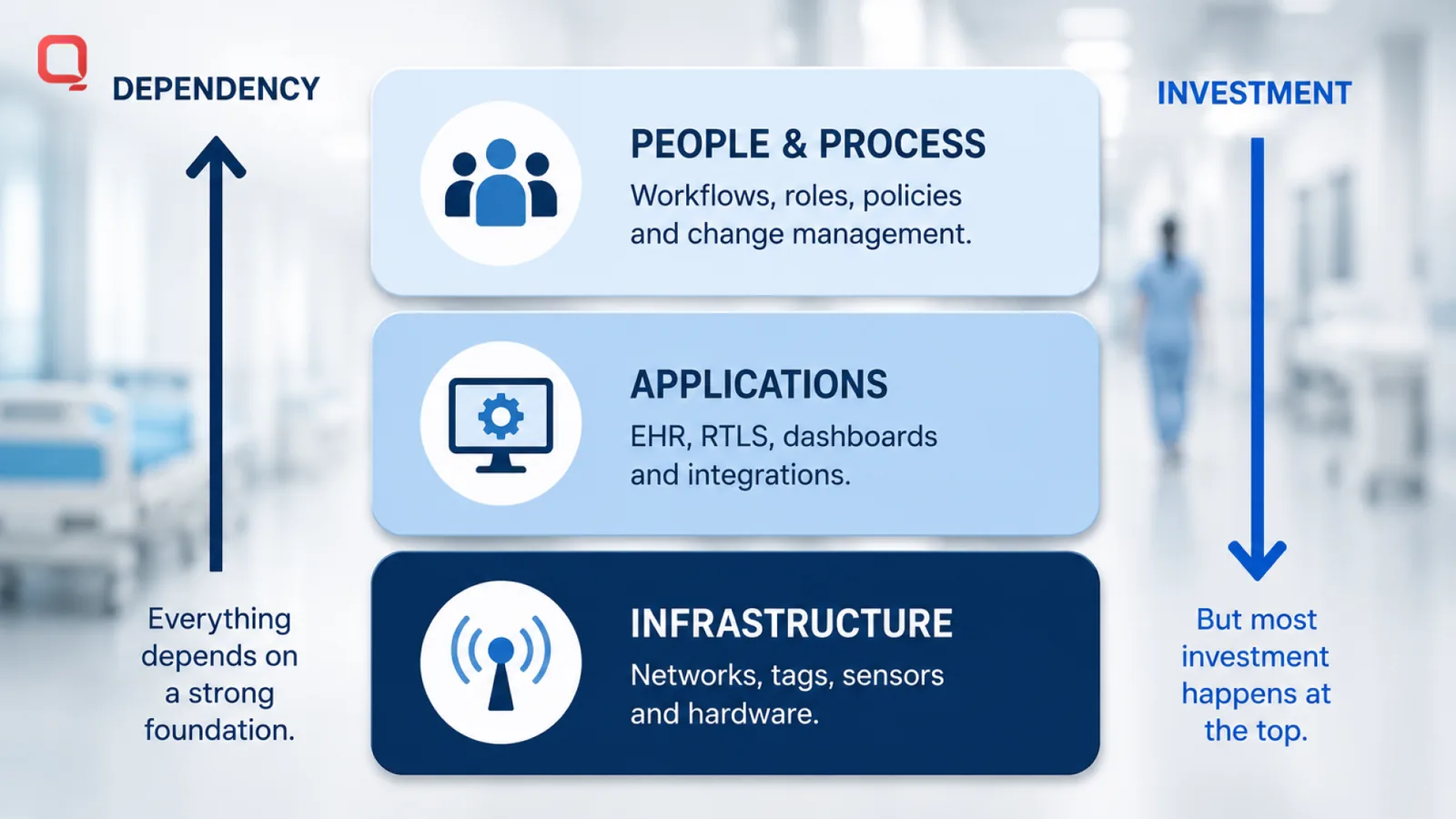
The important point is the dependency direction. Layer 3 can only be as good as Layer 2. And Layer 2 can only be as good as the signal Layer 1 provides. Investment tends to flow in the opposite order to the dependency, which is precisely why so many programmes stall.
Why the Middle Layer Is Where Projects Die
Ask why a connected care initiative underdelivered and the answers cluster around the same set of problems, none of which are about devices or algorithms.
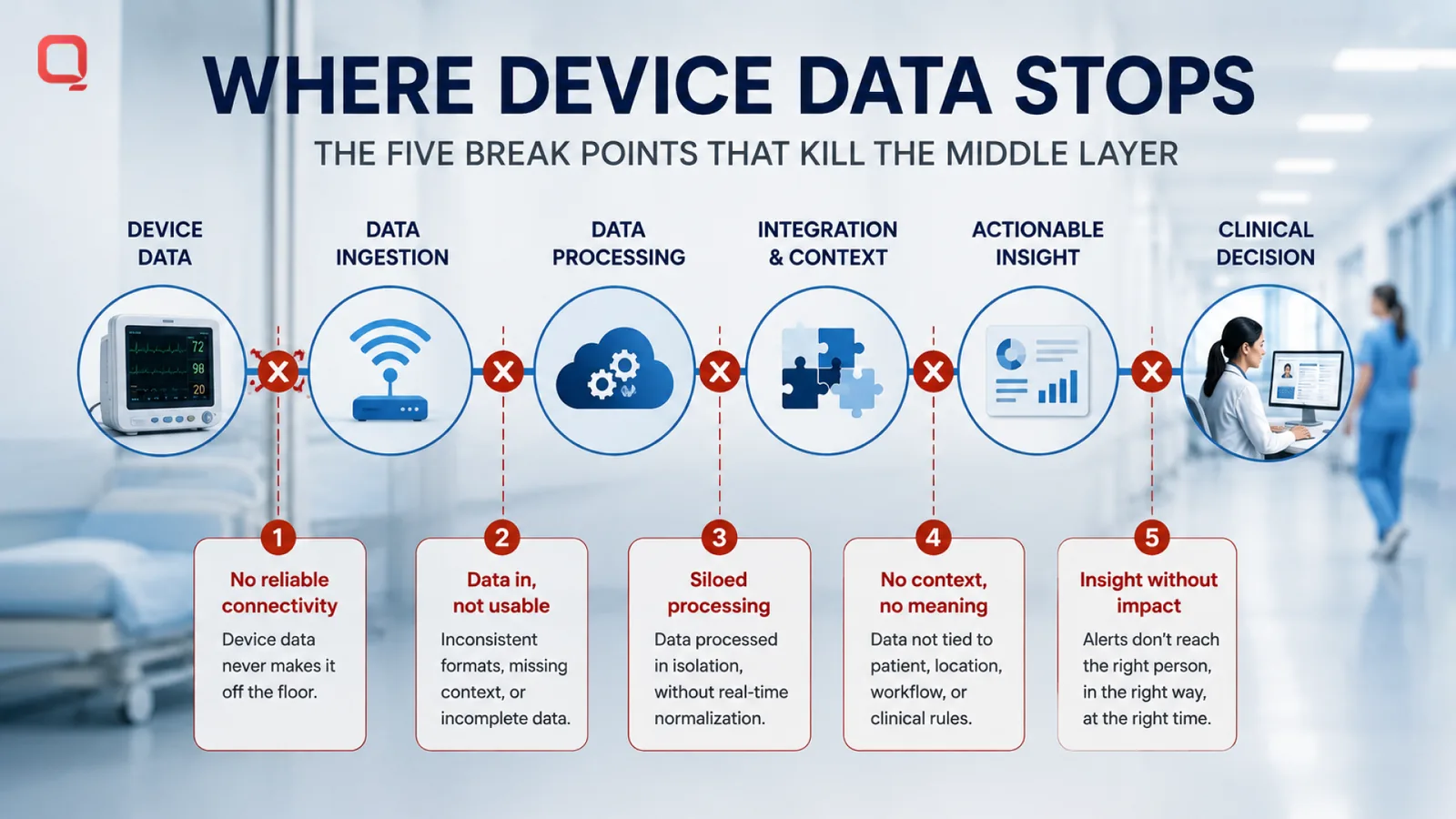
- Data arrives but never lands anywhere useful. Device output sits in a vendor portal rather than in the EHR, so clinicians would have to leave their workflow to see it. In practice, they do not.
- Identity does not resolve. A reading exists but cannot be reliably matched to the right patient record, encounter or asset, so nobody is willing to act on it.
- Every vendor speaks a different dialect. Each device manufacturer implements standards slightly differently, and each integration becomes a bespoke project.
- Volume without meaning. Continuous streams are captured faithfully and then never queried, because no one defined what a meaningful event looks like.
- No shared context. Two systems hold the same fact in different forms, and neither is authoritative, so staff trust the manual process instead.
None of this is exciting. It does not demo well and it rarely wins internal funding on its own. But it is the difference between an AI model that changes a clinical decision and one that produces an interesting chart.
Not sure where your data layer actually stands?
Our healthcare engineering team runs integration and readiness assessments on live environments, mapping where device data goes, where it stops, and what it would take to make it usable.
Request a Readiness Assessment →Interoperability Is the Whole Game
Interoperability is the ability of clinical systems, devices and applications to exchange data and use it without manual intervention. In practice it is the single largest determinant of whether an intelligent healthcare programme works.
Three standards do most of the load-bearing work:
HL7 v2 remains the backbone of hospital messaging. It is decades old, widely deployed, and inconsistently implemented, which means real-world HL7 integration is less about reading the standard and more about handling how each system deviates from it.
FHIR is the modern, API-based standard, and it is where new development should go. It is far better suited to mobile applications, patient-facing tools and cloud services. It is also not yet a complete replacement, which means most hospitals will run both for years.
Integration engines such as Mirth Connect sit between systems, translating, routing, filtering and transforming messages. This is where the practical work of interoperability actually happens.
A useful test for any connected care proposal: ask specifically how device data reaches the EHR, who owns the mapping, and what happens when a vendor changes their message format. If the answer is vague, the project has a hole in the middle of it.
Edge or Cloud: Where Should Decisions Happen?
Not every decision belongs in the cloud, and not every decision belongs on the device. Getting this split right affects responsiveness, bandwidth cost and resilience.
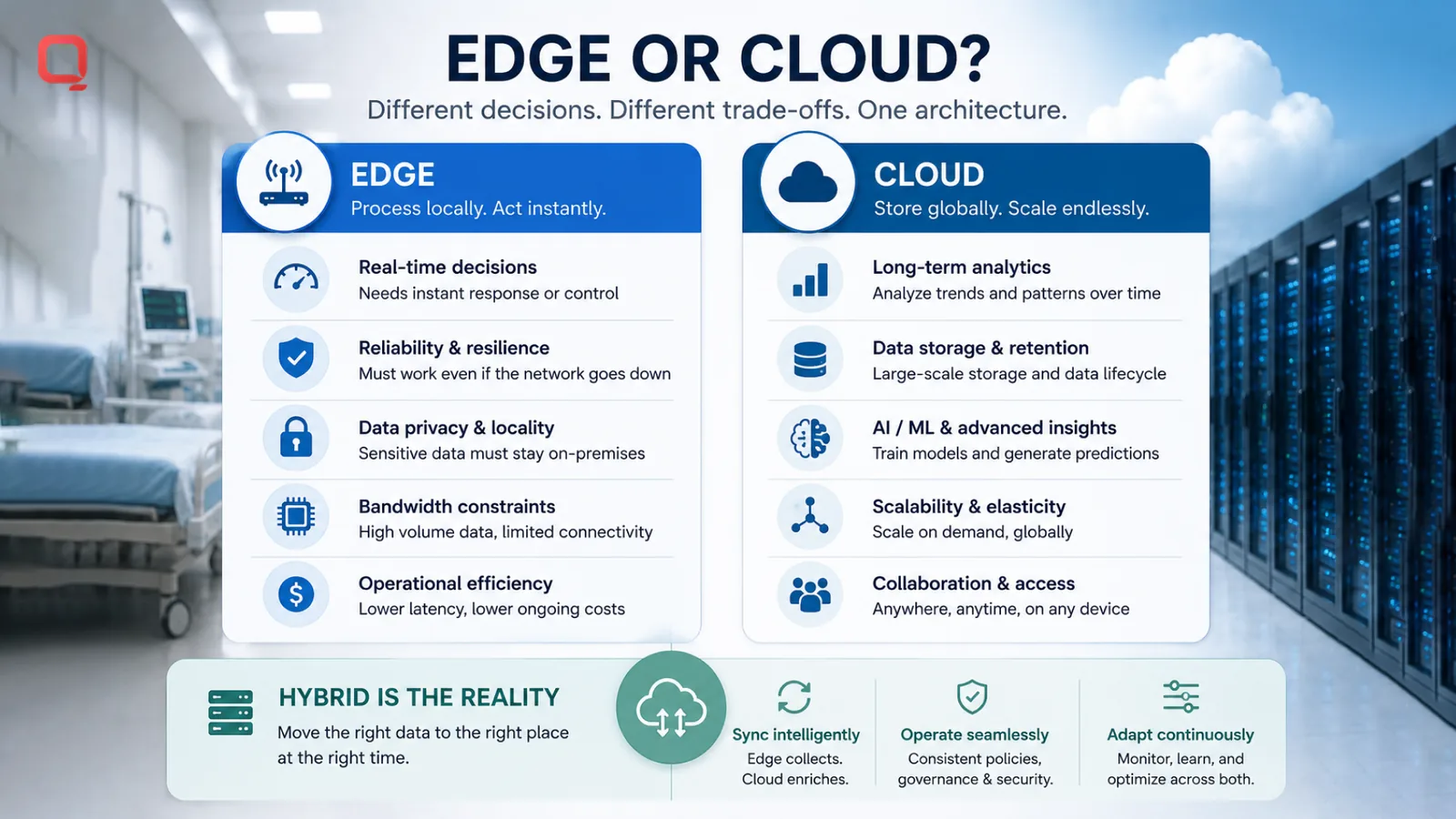
Process at the edge when the decision is time-sensitive, the raw data volume is high relative to its value, the system must keep working during a network outage, or the data is more sensitive in raw form than in summary form. Filtering noisy signals locally and sending one clean result upstream is dramatically cheaper than streaming everything.
Process in the cloud when the decision needs data from multiple sources or sites, the model is large or frequently retrained, you need historical depth for trend analysis, or the output serves reporting and analytics rather than an immediate action.
Most real deployments are hybrid: local processing for immediate operational decisions, cloud processing for aggregation, learning and cross-site visibility.
What This Looks Like in Practice
Remote Patient Monitoring
Home devices capture vitals continuously. The data layer normalises readings across device types and ties them to the patient record. Analytics flag deterioration trends and escalate to a care team before an admission becomes necessary.
Indoor Asset Positioning
Bluetooth tags on equipment are detected by fixed anchors across the facility. An edge gateway resolves each tag to a zone. Historical movement data then answers what is over-purchased, what sits idle, and where equipment accumulates.
Medical Imaging
Imaging systems generate studies. Integration delivers them into a viewer accessible from the clinical workflow rather than a separate silo. AI assists prioritisation and preliminary reads so radiologists spend attention where it matters.
Care Team Communication
Communication devices connect staff without a second handset. Integrated with clinical systems, alerts reach the right person rather than broadcasting to everyone, which reduces alarm fatigue rather than adding to it.
Pharmacy & Inventory
Connected cabinets and inventory systems report stock and usage. The data layer reconciles this against dispensing and ordering, and forecasting reduces both stockouts and expiry waste.
Telehealth & Virtual Care
Virtual visits generate encounter data that has to land in the same record as in-person care. Without that, virtual care becomes a parallel history nobody reconciles.
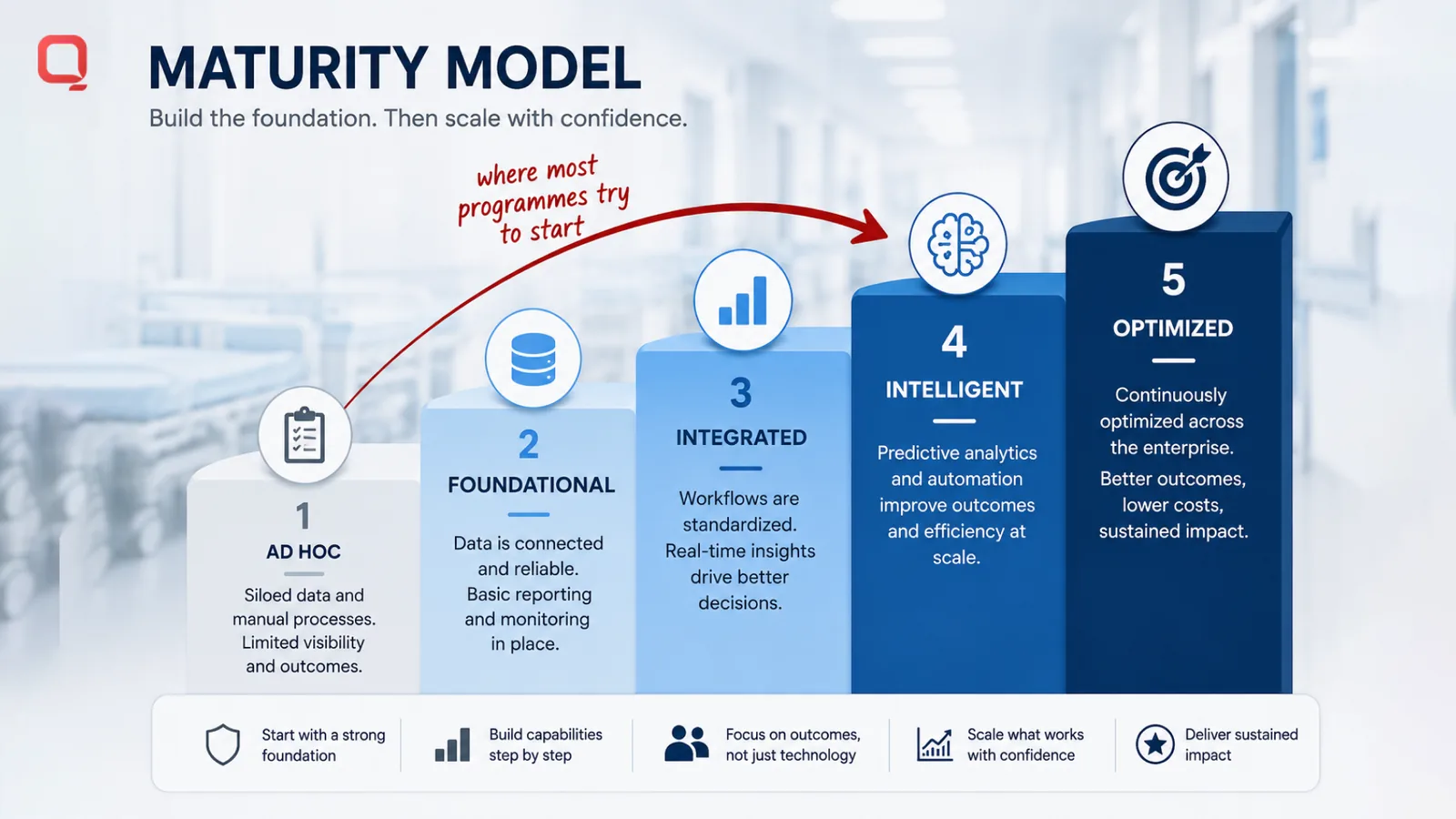
A Maturity Model for Connected Care
Most organisations recognise themselves somewhere on this progression. It is worth knowing which stage you are actually at before planning the next investment.
Consider remote patient monitoring.
A device can capture a patient's blood pressure every few minutes. But the device alone doesn't improve care. The reading needs to be associated with the correct patient, sent to the right clinical system, interpreted against previous readings, and escalated to the right care team when something changes.
That's the difference between connected healthcare and intelligent connected healthcare.
| Stage | What it means | Typical symptom |
|---|---|---|
| 1. Connected | Devices transmit data | Data exists but lives in vendor portals |
| 2. Integrated | Data reaches the systems that need it | Information is available but still requires interpretation |
| 3. Visible | Dashboards and reporting answer operational questions | Teams can see what happened, after it happened |
| 4. Predictive | Models anticipate deterioration, failure and demand | Teams act before an event rather than after |
| 5. Assisted | Systems recommend or trigger coordinated action | Routine coordination work is automated, staff handle exceptions |
Don't jump to Stage 4 if your organisation is still struggling with Stage 1 data.
What to Build First
The most useful sequencing advice is also the least ambitious sounding: start with one workflow that has a measurable cost, and follow it all the way through all three layers.
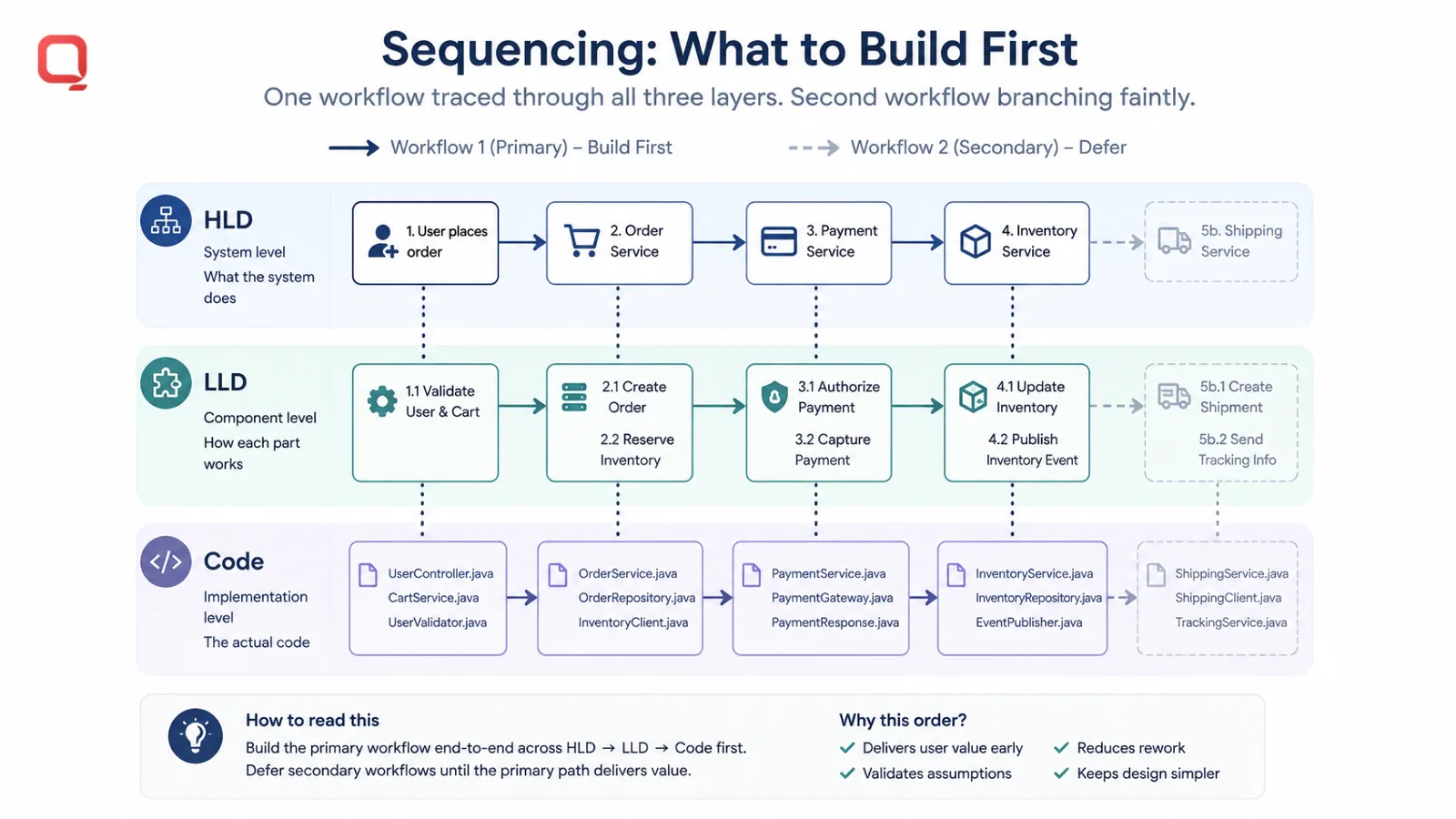
1. Pick a workflow with a known cost. Equipment search time, readmissions in a specific cohort, imaging turnaround, stock expiry. Something a finance or operations lead already complains about.
2. Map how data moves today. Where it originates, where it stops, who re-keys it. This map is usually the most valuable artefact of the entire first phase.
3. Fix the integration path for that one workflow. Not the whole estate. One clean path from device to system of record.
4. Make it visible before making it predictive. A dashboard someone actually uses proves the data is trustworthy. Skipping this step means you find out your data was wrong after the model is live.
5. Add intelligence where it changes a decision. Not where it produces the most impressive demo.
6. Then extend the pattern. The second workflow is substantially cheaper than the first, because the data layer already exists.
This approach is slower to announce and much faster to deliver value.
Security and Compliance Are Design Decisions
In healthcare, connecting a device expands the attack surface and brings the data it produces into scope for HIPAA and equivalent regulation. That has to shape the architecture rather than be reviewed at the end.
Several decisions carry most of the weight:
- Network segmentation. Device traffic on its own isolated segment, unable to reach clinical or corporate systems directly.
- Identity and access. Role-based access down to field level, with audit trails that show who accessed what and when.
- Encryption in transit and at rest, with key management planned rather than assumed.
- Data minimisation. The safest data is the data you decided not to collect. Edge summarisation is a privacy control as well as a cost control.
- Consent and provenance. Knowing where a data point came from, under what consent, and how it has been transformed.
Designing for this from the start is significantly cheaper than retrofitting it, and considerably more likely to survive an audit.
How QSS Technosoft Builds Intelligent Connected Healthcare
Healthcare has been our core domain for over a decade, and our work sits across all three layers rather than in one of them. That matters, because the handoffs between layers are where most programmes lose value.
At the sensing layer, we build and integrate connected devices, including remote patient monitoring, indoor asset positioning through our Locatix platform, and care team communication hardware.
At the data layer, we do the work most partners would rather skip: , HL7 interface engineering, FHIR APIs and Mirth Connect integration, and . This is the least glamorous part of our healthcare practice and the reason the rest of it works.
At the intelligence layer, we build AI and machine learning into clinical and operational workflows, including AI-assisted imaging through our , predictive analytics, conversational AI, and agentic automation for coordination-heavy processes.
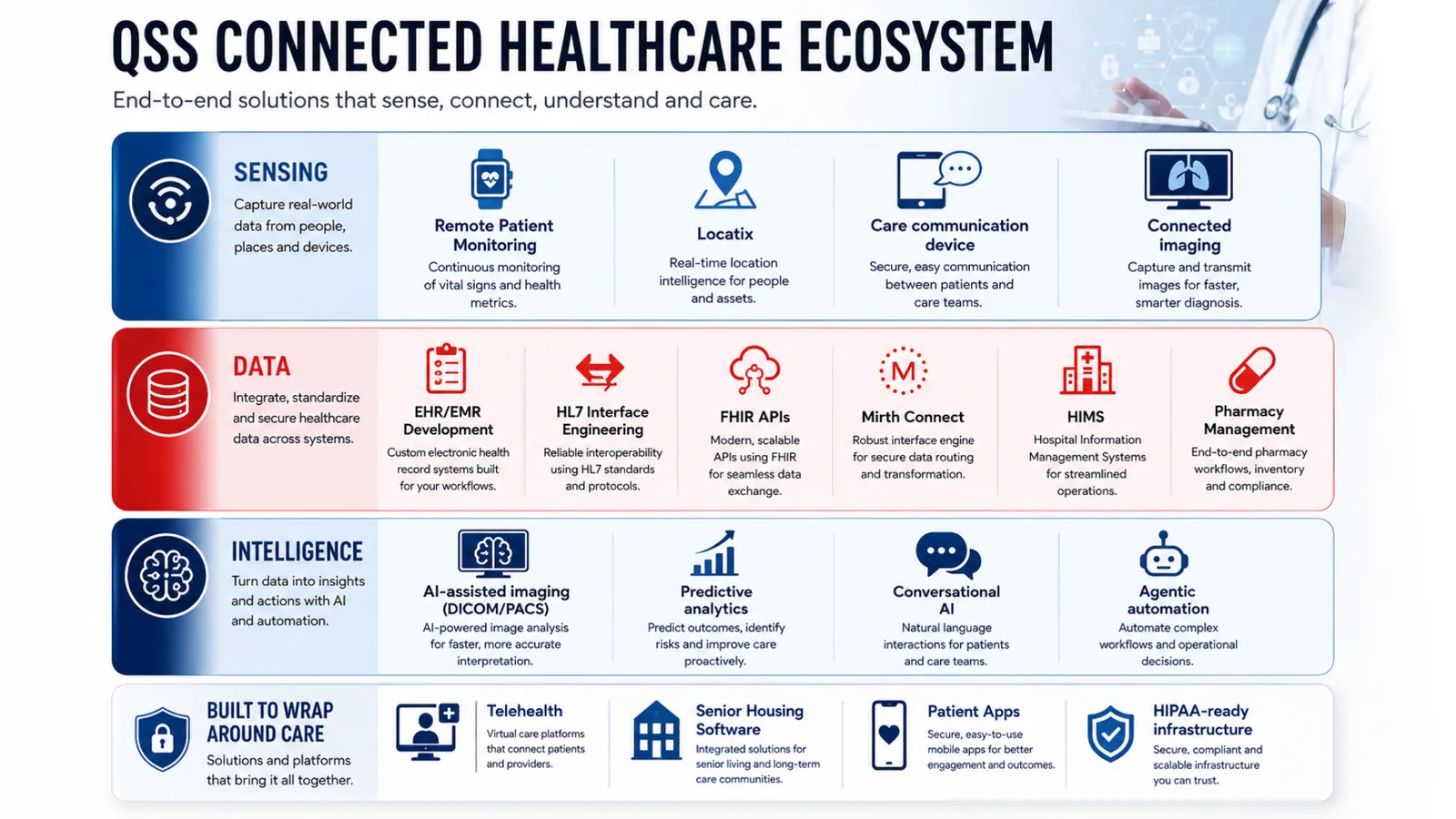
We also build the things around the edges that decide adoption: telehealth platforms, senior housing software, patient-facing applications, and the HIPAA-ready infrastructure underneath all of it.
The reason we lead with the data layer rather than the AI is straightforward. It is where the value is created, and it is where most projects fail.
What Changes in 2026
Several shifts are worth planning around.
FHIR moves from optional to expected. New integrations that are not API-first will look like technical debt within a couple of years.
AI moves from analysis to action. The interesting deployments are no longer models producing scores, but agents completing routine coordination work — scheduling follow-ups, chasing referrals, preparing documentation — with clinicians reviewing exceptions.
Ambient capture reduces documentation load. Ambient clinical documentation is one of the few AI applications with a direct, measurable effect on clinician burnout.
Cost discipline arrives. The era of streaming everything to the cloud and deciding later what to do with it is ending. Edge summarisation becomes an architectural default rather than an optimisation.
Scrutiny increases. Regulators, insurers and health systems are asking harder questions about model provenance, bias and auditability. Systems built without traceability will need rework.
The Bottom Line
Intelligent connected healthcare is not a product you buy. It is three layers that have to work together, and the one in the middle is the one nobody wants to fund.
Organisations that get this right tend to look unimpressive for the first phase and then move quickly. They fix one workflow end to end, prove the data is trustworthy, and then extend a pattern that already works. Organisations that start with the AI announcement tend to spend eighteen months discovering that their data could not support it.
Building intelligent connected healthcare?
QSS Technosoft works across all three layers: connected devices, HL7 and FHIR integration, and AI built into clinical and operational workflows. With 16+ years of healthcare engineering experience, QSS builds HIPAA-ready solutions by design.
Talk to Our Healthcare Engineering Team →