AI in Clinical Data Management: A Pragmatic Engineering Perspective for 2026
 By Shahrukh Khan
Technology Insights, QSS Technosoft
September 18, 2026
11 min read
Updated Sep 21, 2026
By Shahrukh Khan
Technology Insights, QSS Technosoft
September 18, 2026
11 min read
Updated Sep 21, 2026
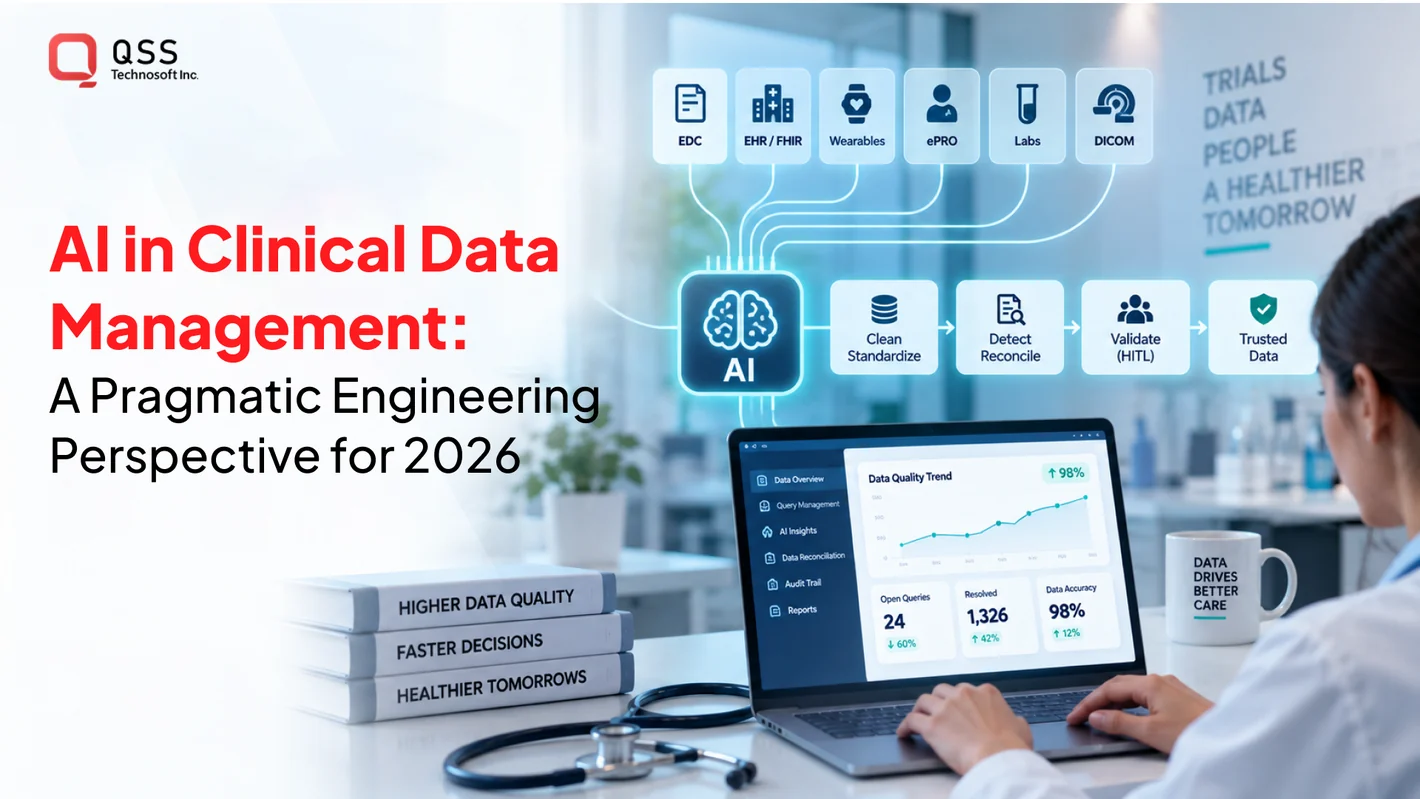
A single Phase III trial can trigger more than 21,000 queries. Over a third of those are manual. At roughly $150 per manual query, your innovation budget is really just a tax on human error. Integrating ai in clinical data management isn’t about chasing a trend. It’s about survival in a 2026 landscape where data volume has finally outpaced human capacity. You’re likely exhausted by inconsistent medical coding and data silos that make a unified trial view feel impossible. Manual reconciliation isn’t just a nuisance. It’s an anchor dragging your study timelines into the dirt.
This isn’t another high-level pitch about the future of medicine. It’s a look at the engineering realities, interoperability requirements, and compliance frameworks needed to deploy AI that survives production. We’ll explore how to move from reactive data cleaning to a proactive, scalable CDM architecture. Expect a deep dive into FHIR R4 standards and the pragmatic steps required to accelerate database lock times while cutting manual query generation by up to 40%. No hype. Just the engineering that works.
Quick Answer
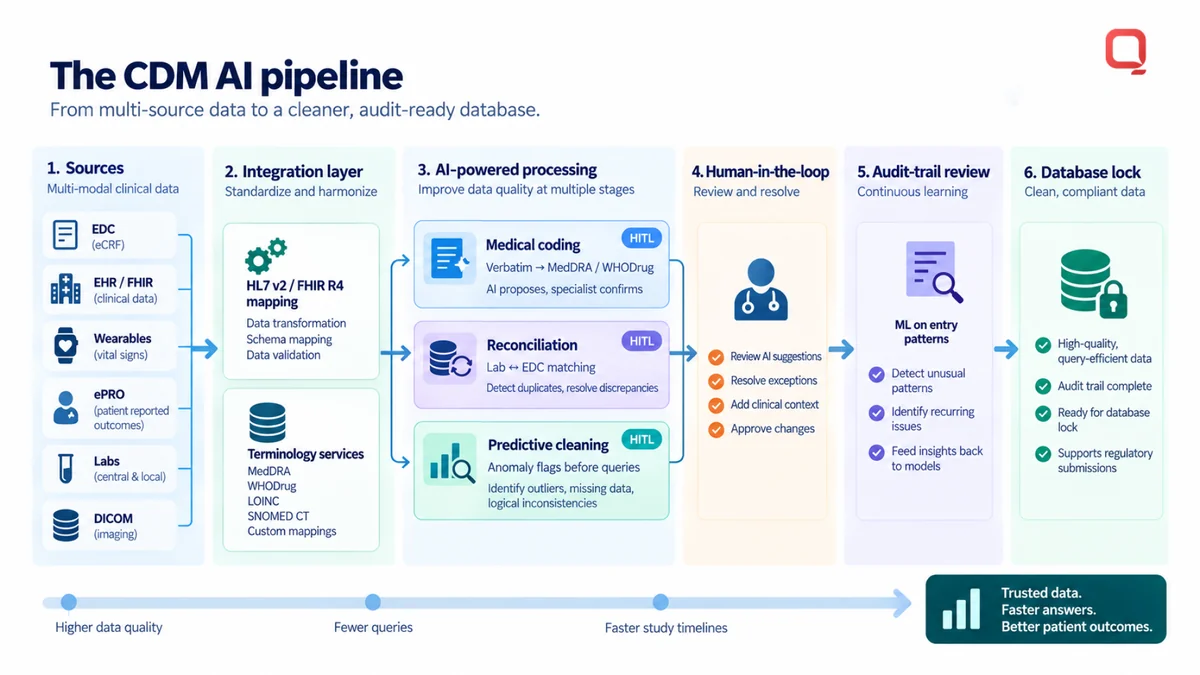
Manual clinical data management has stopped scaling: a single trial can generate 21,000+ queries, a third of them manual, at roughly $150 each. AI pays back fastest in three places, medical coding (verbatim to MedDRA/WHODrug with a human confirming), automated reconciliation of lab and EDC data, and predictive cleaning that flags anomalies before they become queries, together cutting manual query volume by 20–40%. None of it works on fragmented data, so HL7 FHIR integration comes first, and none of it survives an audit without explainable, encrypted, human-reviewed pipelines. Start with an AI Readiness Assessment, not a model.
The Scalability Crisis: Why Manual Clinical Data Management Is Breaking
Most clinical data management pipelines are currently held together by spreadsheets, manual queries, and sheer willpower. It is a mess. Legacy Electronic Data Capture (EDC) systems were designed for a world where data was static and site-specific. Today, data is a flood. Wearables, ePRO, and EHR integrations have created a volume of information that no human team can realistically manage. This isn’t just a bottleneck. It’s a risk to the very integrity of your study. Relying on manual reconciliation in 2026 is like trying to drain an ocean with a thimble. For those seeking a foundational overview of AI in healthcare, the transition from manual to automated systems is the defining challenge of the decade.
Technical debt in legacy systems creates friction that ai in clinical data management cannot solve on its own. You can’t bolt a 2026 AI engine onto a 2010 database architecture and expect it to run. The “straight-talk” reality is that most CDM pipelines are struggling with fragmented data sources that don’t talk to each other. This lack of interoperability forces data managers into the role of “human middleware,” manually moving data between silos to create a unified view that should have been automated from the start.
The Rise of Decentralized Clinical Trials (DCTs)
DCTs are projected to represent nearly 30% of all clinical trials by 2027. This shift changes everything. Data is no longer centralized at a single site. It is fragmented across time zones, devices, and patient homes. Data management has evolved from a support function into a massive orchestration challenge. Manual entry is the primary enemy here. High-velocity research requires high-velocity data. If your workflow relies on a person to manually bridge the gap between a wearable device and a database, your study is already behind schedule. You need orchestration, not just observation.
The Hidden Cost of Manual Data Cleaning
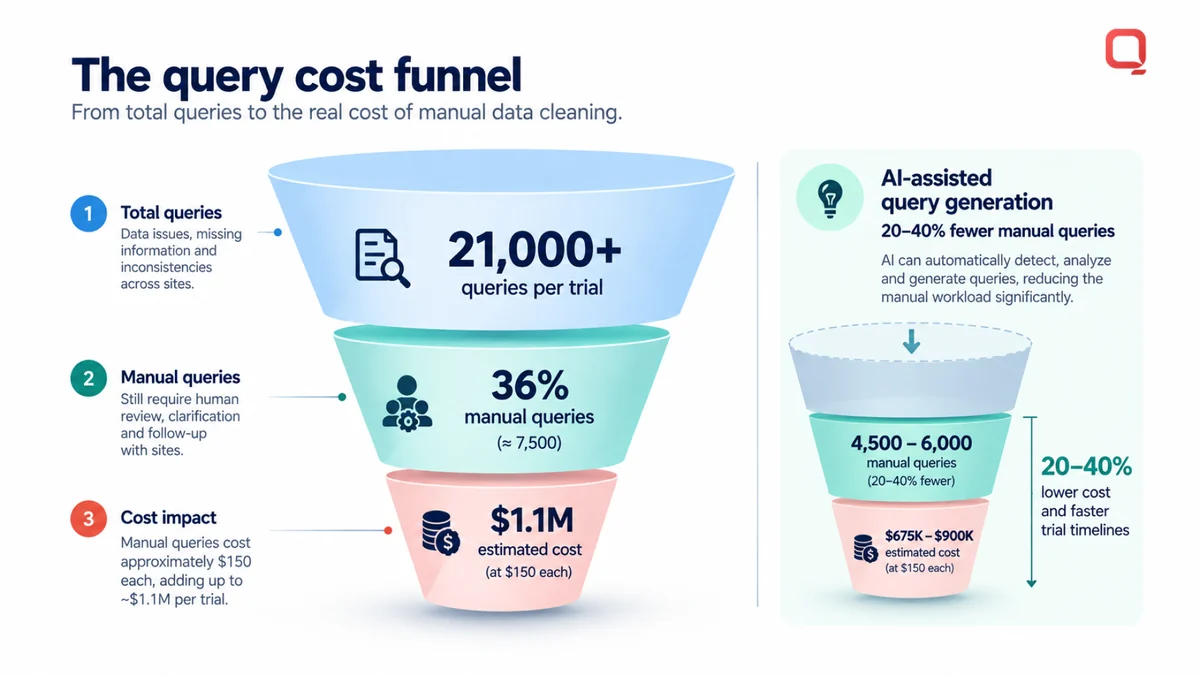
The financial and human costs of manual cleaning are staggering. A 2026 analysis noted that a single clinical trial can generate over 21,000 queries. Roughly 36% of those are manual. When you factor in the costs, the drain is obvious:
- Financial Impact: Each manual query costs approximately €150 to resolve.
- Regulatory Risk: Human error in medical coding leads to downstream delays in crucial regulatory filings.
- Talent Attrition: Data managers are exhausted by the grind of routine reconciliation. Burnout is a direct result of these “dirty” manual workflows.
Properly implemented ai in clinical data management stops the bleeding. It handles the unglamorous work of identifying outliers and anomalies before they reach the query stage. This allows your best people to focus on high-level analysis rather than chasing missing dates in a spreadsheet.
High-Impact AI Use Cases in the CDM Pipeline
Engineering ai in clinical data management isn’t about replacing your team. It’s about giving them a machine that handles the repetitive, low-value work so they can focus on study integrity. We’re targeting high-impact wins that can reduce query volume by 20% to 40% in a single study cycle. These aren’t pilot projects anymore. They’re essential components of a modern, scalable data architecture. To find the right starting point, a formal AI Readiness Assessment is often the most pragmatic first step for any enterprise.
Medical Coding: Accuracy vs. Velocity
Medical coding has always been a bottleneck. Manually mapping verbatim terms to MedDRA and WHODrug dictionaries is slow, expensive, and prone to inconsistency. Generative AI can handle these complex descriptions with ease, but you can’t just let an LLM run wild. Hallucinations are a real threat in clinical environments. You need a “human-in-the-loop” (HITL) workflow where the AI proposes a code and a specialist confirms it. By 2026, the verbatim-to-dictionary mapping process has achieved a 92% autonomous match rate for MedDRA and WHODrug terms in production environments. This isn’t just about speed; it’s about building a durable, repeatable process that survives regulatory scrutiny.
Automated data reconciliation is another critical win. Matching lab results with EDC entries across disparate sources is a grind. AI models can now ingest these unstructured data streams, identify matches, and flag discrepancies in real time. This moves your team away from manual cross-referencing and toward high-level oversight. It’s the difference between hunting for errors and managing resolutions.
Machine learning also plays a vital role in Audit Trail Review (ATR). By analyzing patterns of data entry, ML can spot signs of non-compliance or potential data tampering that a human reviewer would likely miss. This aligns with the FDA’s regulatory framework for AI, which emphasizes the need for systems that are both explainable and auditable. You don’t just want a “smart” system. You want one that leaves a clear, defensible paper trail.
Predictive Models for Data Integrity
We’re moving from reactive cleaning to proactive anomaly detection. Traditional data cleaning waits for a query to be generated. Predictive models identify outliers and noise in clinical datasets before they ever reach that stage. This proactive approach reduces friction and keeps the study moving at high velocity. Implementation is the kicker here. AI identifies the patterns, but your engineers must build the guardrails. You need a system that knows when to act and when to ask for help. It’s about construction, scale, and the resolution of complex obstacles in the data pipeline.
The Interoperability Reality: Why Your AI Needs HL7 FHIR
Garbage in, garbage out is the only law that matters. Your AI models are only as reliable as the data pipelines feeding them. If you are trying to deploy ai in clinical data management on top of a fragmented, siloed mess, you are going to fail. It is that simple. Most teams focus on the flashy model. They should be focusing on the unglamorous plumbing. You need a unified data stream that doesn’t choke on legacy formats. True success with ai in clinical data management depends entirely on the strength of your integration layer.
Standardizing the Data Stream
In 2026, FHIR is the non-negotiable standard for healthcare AI. While FHIR R4 remains the regulated baseline for interoperability in the US, the stable release of FHIR R6 in September 2026 has provided the advanced resource types needed for complex clinical research. Mapping legacy data formats to these modern structures is a brutal engineering hurdle. It is difficult. It is also the only way to achieve real-time data ingestion. Without this foundation, your AI is analyzing yesterday’s problems with today’s tools. The recent release of Cartos, the ONC’s terminology service, has simplified some of this mapping, but the core engineering work remains your responsibility.
DICOM and Imaging Data in CDM
Modern trials involve more than just numeric data. They involve massive volumes of medical imaging. Integrating DICOM and PACS data into the clinical data review process is now essential for a unified trial view. Metadata consistency is the primary failure point. If your imaging database doesn’t align perfectly with your clinical database, your AI will generate noise rather than insights. Ensuring these systems talk to each other requires specialized Healthcare Interoperability Services to manage the translation layer. You cannot ignore the physicality of this data. It must be structured, accessible, and secure.
Engineering Resilience
Build for failure. Hospital systems update their EMRs constantly. If your APIs break every time a major provider pushes a patch, your AI pipeline is dead. You need robust, resilient interfaces that handle versioning and schema changes without human intervention. This is about durability at scale. The 2026 HIPAA Security Rule update has made encryption mandatory for all electronic protected health information (ePHI), including data in transit between these APIs. Your architecture must account for these new audit trails and access controls. Stop chasing “plug-and-play” promises. Focus on building an architecture that survives the messy reality of production environments.
Governance and Compliance: Navigating the HIPAA-AI Intersection
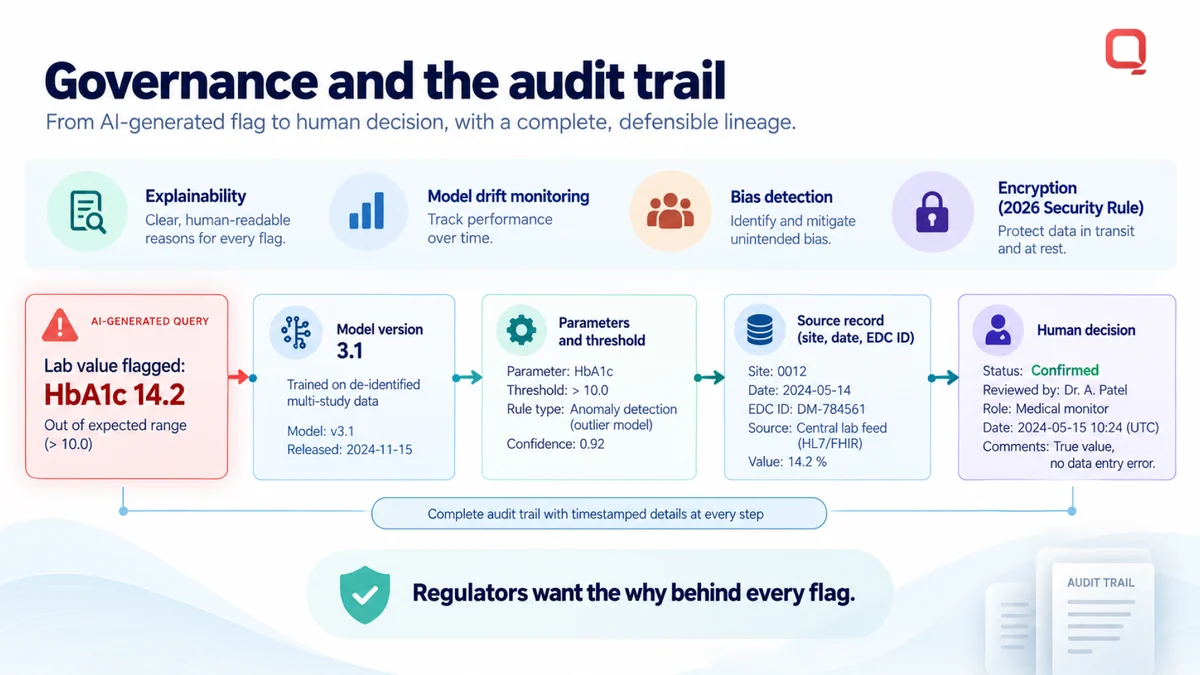
Compliance in 2026 isn’t a checkbox. It’s a living architecture. If you’re treating ai in clinical data management as a “set it and forget it” tool, you’re inviting a regulatory disaster. The 2026 HIPAA Security Rule update has shifted the goalposts. Encryption is no longer a best practice; it’s mandatory for all electronic protected health information (ePHI). You must secure PHI during both Generative AI training and inference. This means building air-gapped environments or using robust de-identification protocols that don’t strip away the clinical utility of the data. It’s about construction, durability, and scale.
Validation has evolved. We’ve moved beyond traditional software validation into the territory of algorithmic governance. You need to prove not just that the software works, but that the model remains stable over time. This aligns with GAMP 5 principles but adds a layer of complexity regarding model drift and bias detection. Most teams ignore this. Don’t be one of them. Before you scale, you need a partner who understands these unglamorous technical hurdles. Start by scheduling an AI Readiness Assessment to map your current technical debt against these new requirements.
Building the Audit Trail
Regulators want to see the “why” behind every AI-driven decision. You must maintain a clear lineage of data from the initial source to the final submission. If a model flags a lab result as an anomaly, the audit trail must show the exact parameters that led to that flag. In a clinical context, AI model explainability is the technical ability to provide a human-readable justification for every automated query or data transformation. This isn’t optional. It is the foundation of a defensible regulatory filing. Move fast. Document everything. Stay auditable.
Security Architecture for Clinical AI
Your security architecture must be built for a multi-tenant environment. Access controls need to be granular and automated. Secure cloud infrastructure and encrypted data pipelines are the bare minimum. You’re dealing with neglected legacy code and impatient users. Your system must be durable enough to handle both. Managing ai in clinical data management requires a “no-nonsense” signature where security is baked into the code, not bolted on as an afterthought. Data anonymization remains a significant engineering challenge. Removing identifiers is easy. Keeping the data useful for complex clinical analysis is hard. You need high-precision engineering to balance these competing needs. Build it right. Build it to last.
The Path Forward: From AI Readiness to Production-Grade CDM
The marketing presentations are over. Now the real work begins. Integrating ai in clinical data management isn’t a matter of flipping a switch or buying a generic license. It is a rigorous engineering overhaul. Most organizations fail because they try to build 2026 intelligence on a 2010 database foundation. It doesn’t work. Legacy systems are riddled with technical debt that creates friction at every integration point. You need to modernize your core before you can automate your pipeline. It is about durability, construction, and scale.
Executing the AI Readiness Assessment
Before writing a single line of code, you must evaluate your infrastructure. An AI Readiness Assessment identifies the specific “low-hanging fruit” where automation provides immediate ROI. Focus on medical coding or automated query generation first. Start small. Define a Minimum Viable Product (MVP) that solves one high-friction problem without breaking the entire workflow. This pragmatic approach allows you to prove the value of Generative AI Solutions while cleaning up the underlying data mess. It is about construction, not just conceptualization.
Off-the-shelf tools often promise a “single pane of glass” but struggle in the messy, multi-vendor environments typical of global clinical trials. Engineering a custom pipeline often outperforms these generic platforms. Why? Because custom work accounts for your specific legacy constraints and interoperability needs. It is the difference between a tool that looks good in a demo and one that survives production. You need a finisher who can handle the unglamorous parts of the job.
Scaling the Infrastructure
Moving from a successful pilot to enterprise-wide clinical orchestration is where most projects stall. Scaling requires a robust DevOps culture to maintain model performance and security over time. You’re dealing with slow connections, neglected code, and strict regulatory audit trails. Your infrastructure needs to be durable. This is the unglamorous work of healthcare IT. It is about getting difficult projects over the finish line. Don’t settle for “good enough” when study integrity is on the line.
QSS Technosoft acts as the pragmatic architect for this journey. With over 250 engineers specialized in healthcare IT, we focus on the unglamorous but critical work of data integration and legacy modernization. We aren’t here to sell you a dream. We’re here to build a stable, scalable architecture for ai in clinical data management that actually delivers on its promise. Schedule a pragmatic AI readiness assessment today.
Scaling Study Integrity in the AI Era
Manual reconciliation is a relic. It’s a tax on your innovation budget. The 2026 clinical landscape demands a shift from reactive data cleaning to proactive orchestration. Success with ai in clinical data management depends on your ability to bridge the gap between legacy technical debt and modern interoperability standards. Build a durable, auditable pipeline that survives regulatory scrutiny and technical friction. Don’t let fragmented data sources or outdated EDC systems anchor your study timelines.
You need a partner who understands the unglamorous work of healthcare IT. QSS Technosoft brings CMMI Level 3 certified engineering and ISO 27001 data security standards to every project. Our onshore-offshore delivery model provides the scale and cost control needed for enterprise-wide implementation. We’re finishers who get difficult work over the line. Stop guessing and start building. Get a Pragmatic AI Readiness Assessment from QSS Technosoft today. Your data is ready for the next level. Let’s make it happen.
Start with an AI Readiness Assessment
A technical deep dive into your EDC, EHR and imaging data sources, integration layer and legacy dependencies before a line of production code is written. You leave with the specific places where automation pays back first (medical coding, reconciliation or predictive cleaning), an MVP scope, and a map of the technical debt that has to be cleared to scale.
Schedule your AI Readiness Assessment →