How the Internet of Medical Things Is Reshaping Patient Care in 2026
 By Rashmi Kanti
Digital Marketing Specialist, QSS Technosoft
August 12, 2026
12 min read
Updated Aug 12, 2026
By Rashmi Kanti
Digital Marketing Specialist, QSS Technosoft
August 12, 2026
12 min read
Updated Aug 12, 2026
Quick Answer
The Internet of Medical Things (IoMT) is the connected network of medical devices, sensors, and software that capture and share health data in real time. In 2026, IoMT is reshaping patient care in three big ways: it moves monitoring out of the hospital and into daily life, it feeds AI that turns raw data into early warnings, and it connects fragmented systems into one view. The result is earlier intervention, more efficient care, and better outcomes.
Who This Guide Is For
This guide is for healthcare leaders, CIOs and CTOs, product owners, and clinical and IT decision-makers who are evaluating or scaling connected-health technology. If you are trying to understand what IoMT actually changes in 2026, where the real value lies, and what it takes to connect, secure, and act on device data, this is written for you. It is equally useful whether you run a hospital or health system, a senior-living or home-care operation, or a medical-device or health-tech company building connected products.
Why IoMT Matters Now
Healthcare is under pressure from every direction: aging populations, chronic-disease growth, staff shortages, and rising costs. The old model, where care happens only when a patient walks into a facility, simply cannot keep up. Care needs to be continuous, proactive, and connected.
That is exactly what the Internet of Medical Things enables. Connected devices now stream vital signs, location, and activity data around the clock, and AI turns that stream into insight clinicians can act on. In 2026, IoMT has moved from pilot projects to a genuine backbone of modern care, and the organizations investing in it are pulling ahead.
What Is the Internet of Medical Things (IoMT)?
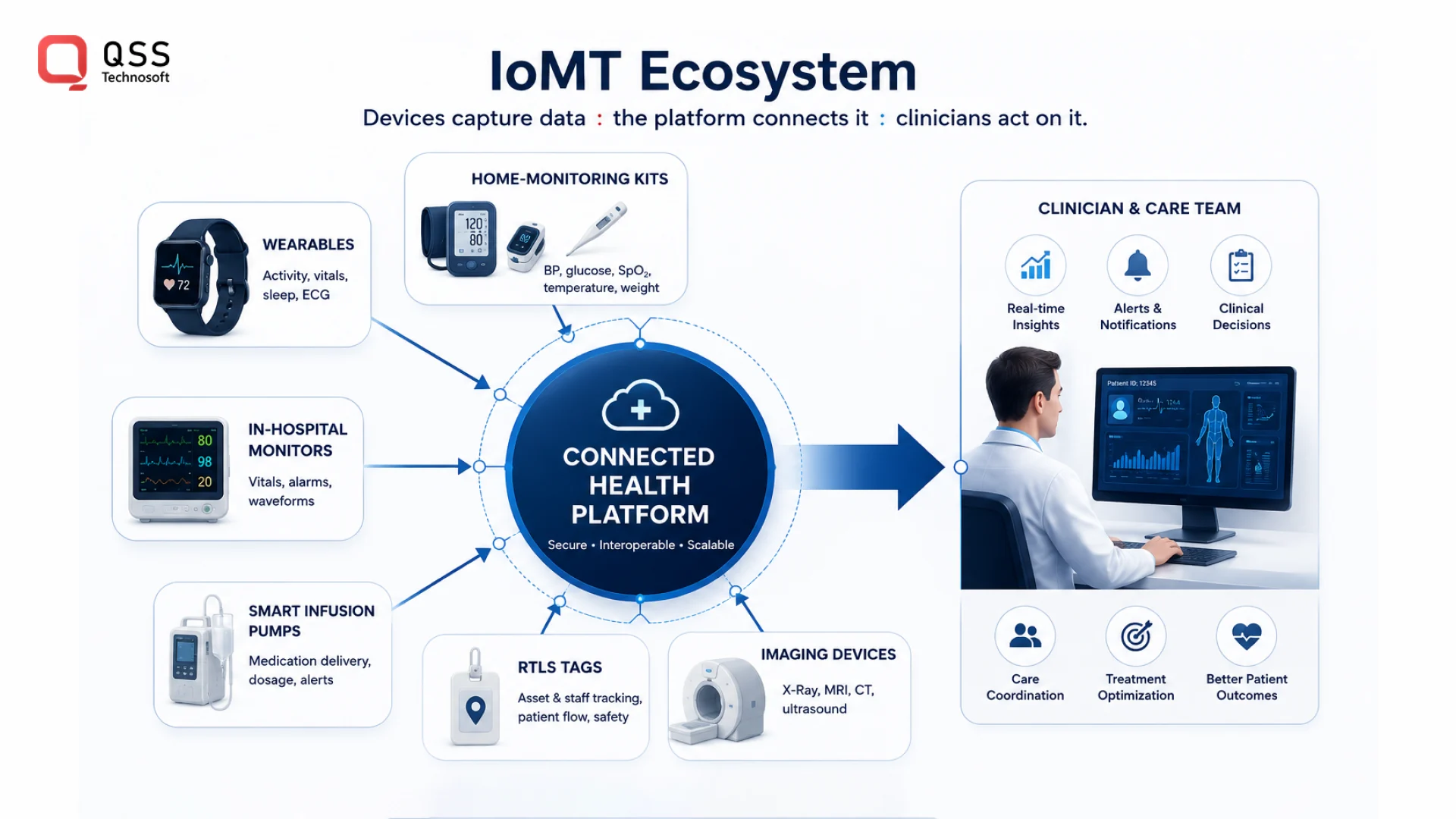
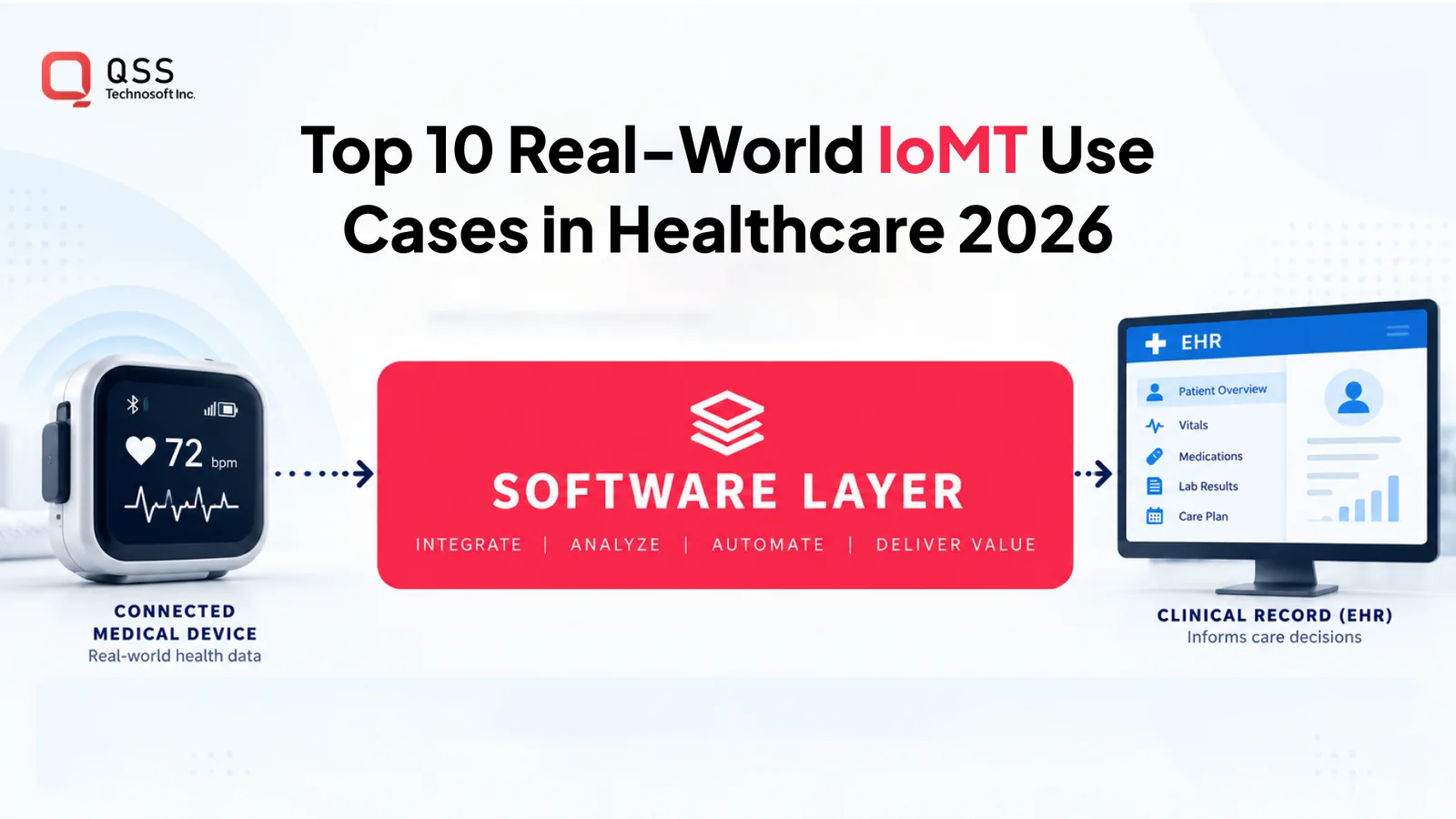
The Internet of Medical Things is the network of connected medical devices and applications that collect, transmit, and analyze health data. It spans wearables that track heart rate and glucose, in-hospital monitors, smart infusion pumps, remote-monitoring kits in patients' homes, real-time location tags on equipment and staff, and the software platforms that tie it all together.
What separates IoMT from a pile of gadgets is connection and intelligence. A device that simply beeps is not transformative. A device that streams data to a platform, which flags a dangerous trend and alerts the right clinician in real time, is. IoMT is the infrastructure that makes healthcare continuous rather than episodic.
How IoMT Is Reshaping Patient Care in 2026
The value of IoMT shows up in a handful of high-impact areas.
Remote patient monitoring and hospital-at-home: Connected kits let clinicians monitor patients with chronic conditions, or recovering after surgery, from their own homes. Vital signs stream to the care team, and anything abnormal triggers an alert, so problems are caught early instead of ending in a readmission.
Connected devices and wearables: Continuous data from wearables and smart devices gives clinicians a fuller, real-world picture of a patient's health, rather than a single snapshot taken in a clinic.
Real-time location systems (RTLS): Connected tags track equipment, patients, and staff inside a facility. That means less time hunting for a wheelchair or an infusion pump, faster response to a fall or a duress alert, and a live view of how the building is actually used.
Smart hospitals and connected coordination: When devices, alerts, and communication run on one connected platform, care teams coordinate faster: the right alert reaches the right person, on the right device, at the right time.
Predictive and preventive care: With enough connected data, AI can spot the early signals of deterioration before a crisis, shifting care from reactive to preventive.
The common thread: IoMT closes the gap between something happening to a patient and someone knowing about it.
The Role of AI: From Data to Decisions
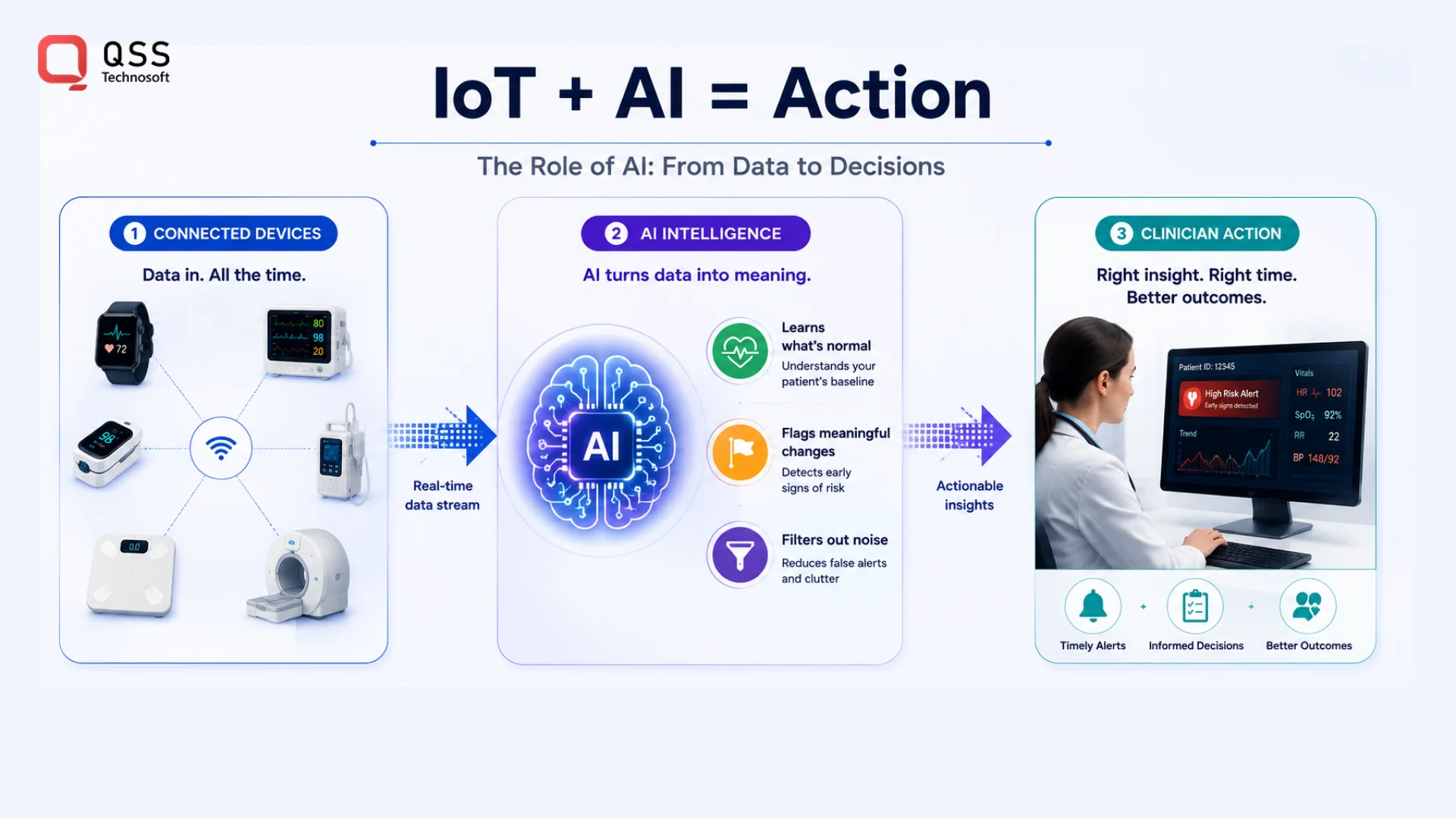
Here is the part that gets missed. IoMT does not just connect devices; it produces an enormous flood of data. Without something to make sense of it, that data is noise, and noise causes alert fatigue, not better care.
Artificial intelligence is what turns the flood into a signal. AI models watch the streams from connected devices, learn what normal looks like for each patient, and flag the meaningful changes: a subtle trend that predicts deterioration, an anomaly that suggests a device problem, a pattern that indicates a fall risk. Instead of drowning clinicians in raw numbers, AI surfaces the few things that actually need a human decision.
This is why IoMT and AI belong together. Connected devices give you the data; AI is what makes that data care. In 2026, the most valuable connected-health systems are not the ones with the most sensors, but the ones that turn sensor data into timely, trustworthy action.
The Benefits of Connected, Intelligent Care
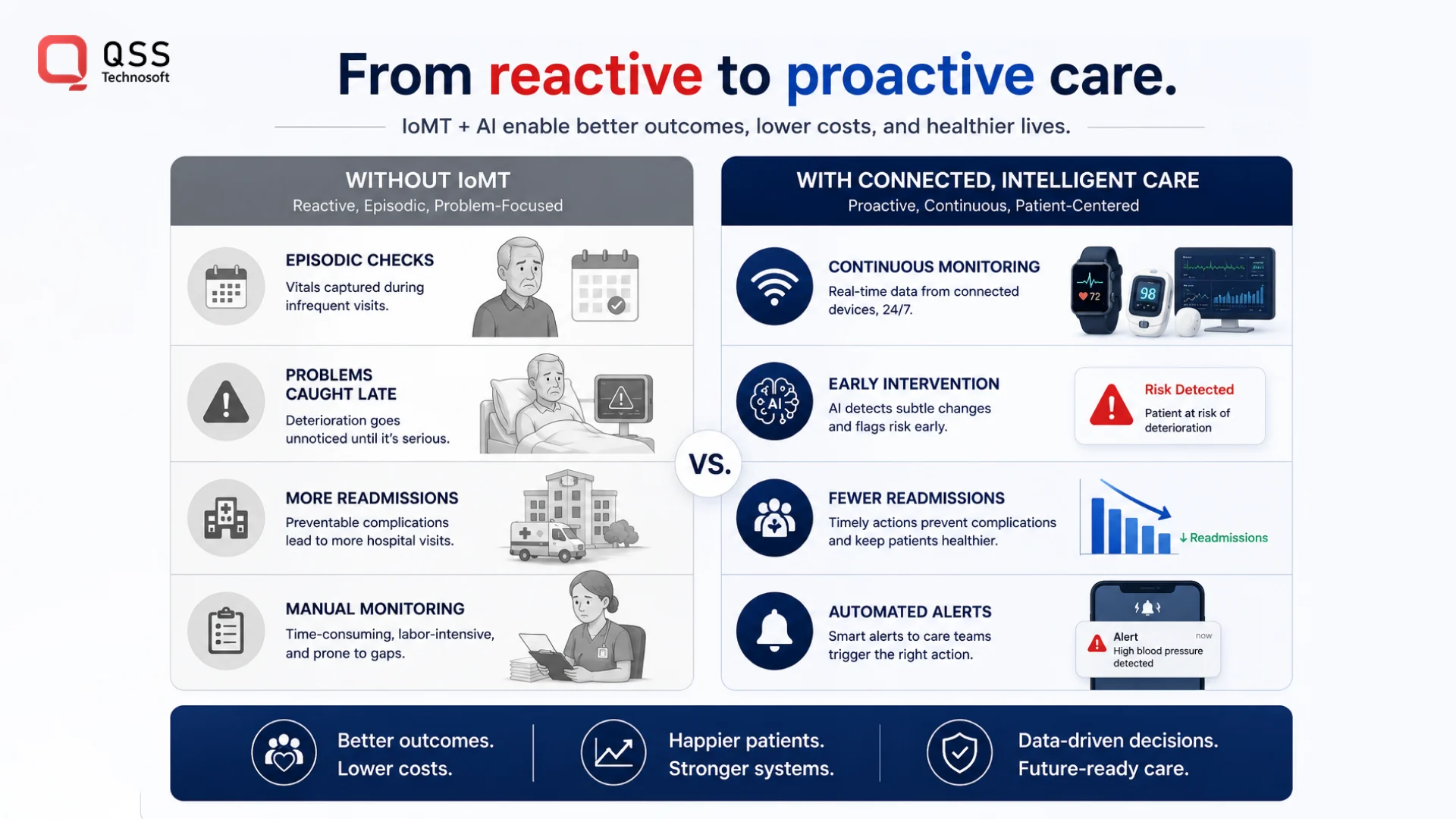
When IoMT and AI work together well, the payoff reaches every part of the system.
Earlier intervention: Problems are caught while they are still small, reducing emergencies, readmissions, and complications.
More efficient operations: Automated monitoring, smart alerting, and asset tracking free staff from manual checks and searching, so they spend more time on care.
A better patient experience: People can be monitored safely at home, get faster responses in a facility, and feel more confident in their care.
Reduced staff burden: In a time of chronic shortages, connected, intelligent systems help existing teams do more without burning out.
Lower total cost of care: Fewer readmissions, shorter stays, and better use of resources all add up.
The Real Challenges: Interoperability and Security
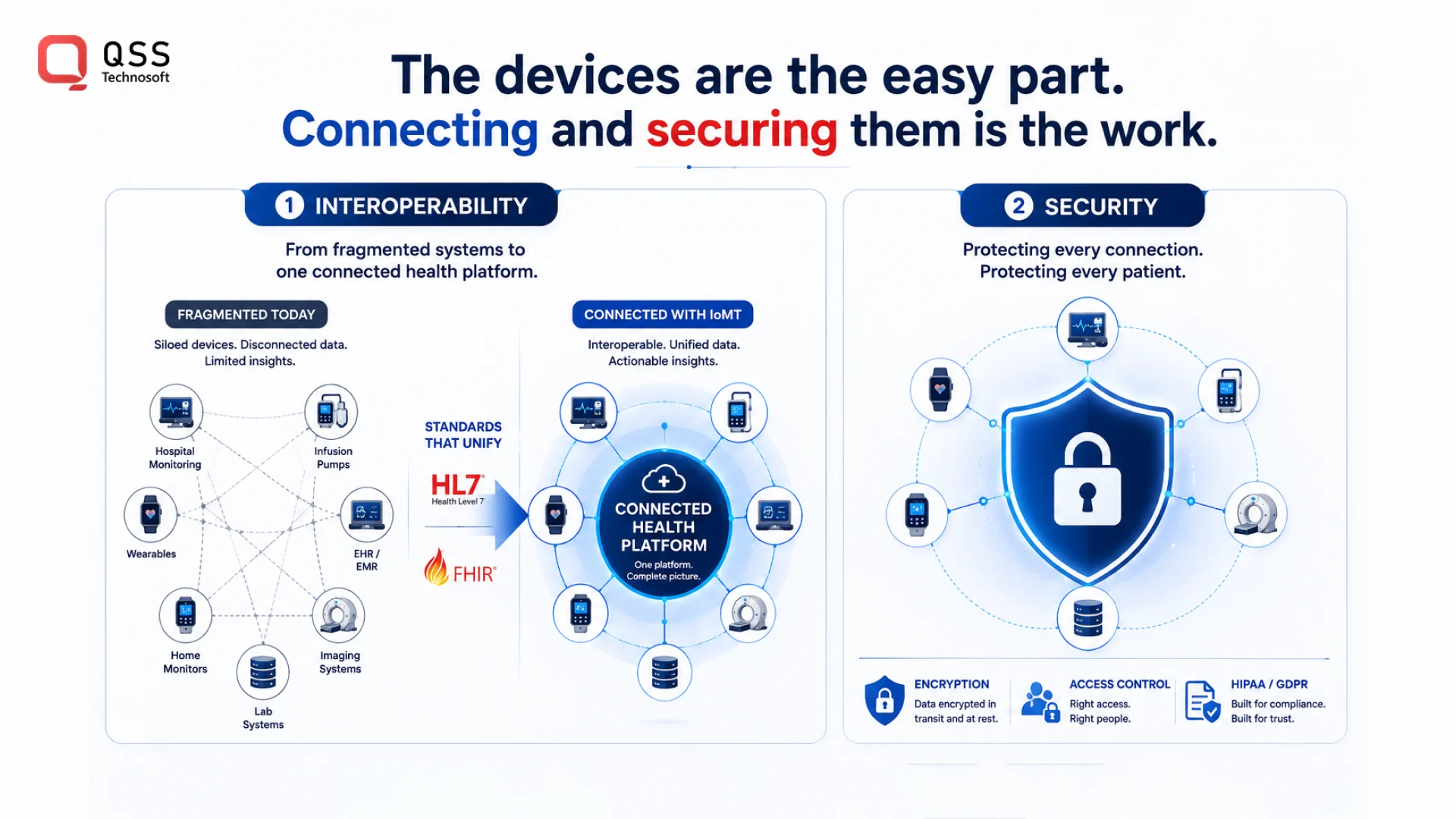
IoMT's promise is real, but so are the obstacles, and they are not usually the devices.
The first is interoperability. A hospital may run devices from dozens of manufacturers, alongside legacy systems that were never designed to talk to each other. Without standards like HL7 and FHIR and a platform to unify the data, IoMT becomes a set of disconnected islands, and the single view that makes it powerful never materializes.
The second is security. Every connected device is a potential entry point, and healthcare data is among the most sensitive and most targeted there is. IoMT done carelessly expands the attack surface dramatically. Encryption, access control, device authentication, and compliance with HIPAA and GDPR are not optional extras; they are the foundation.
Get interoperability and security right, and IoMT is transformative. Get them wrong, and you have built an expensive, fragile liability.
How QSS Helps Build Connected, Intelligent Healthcare
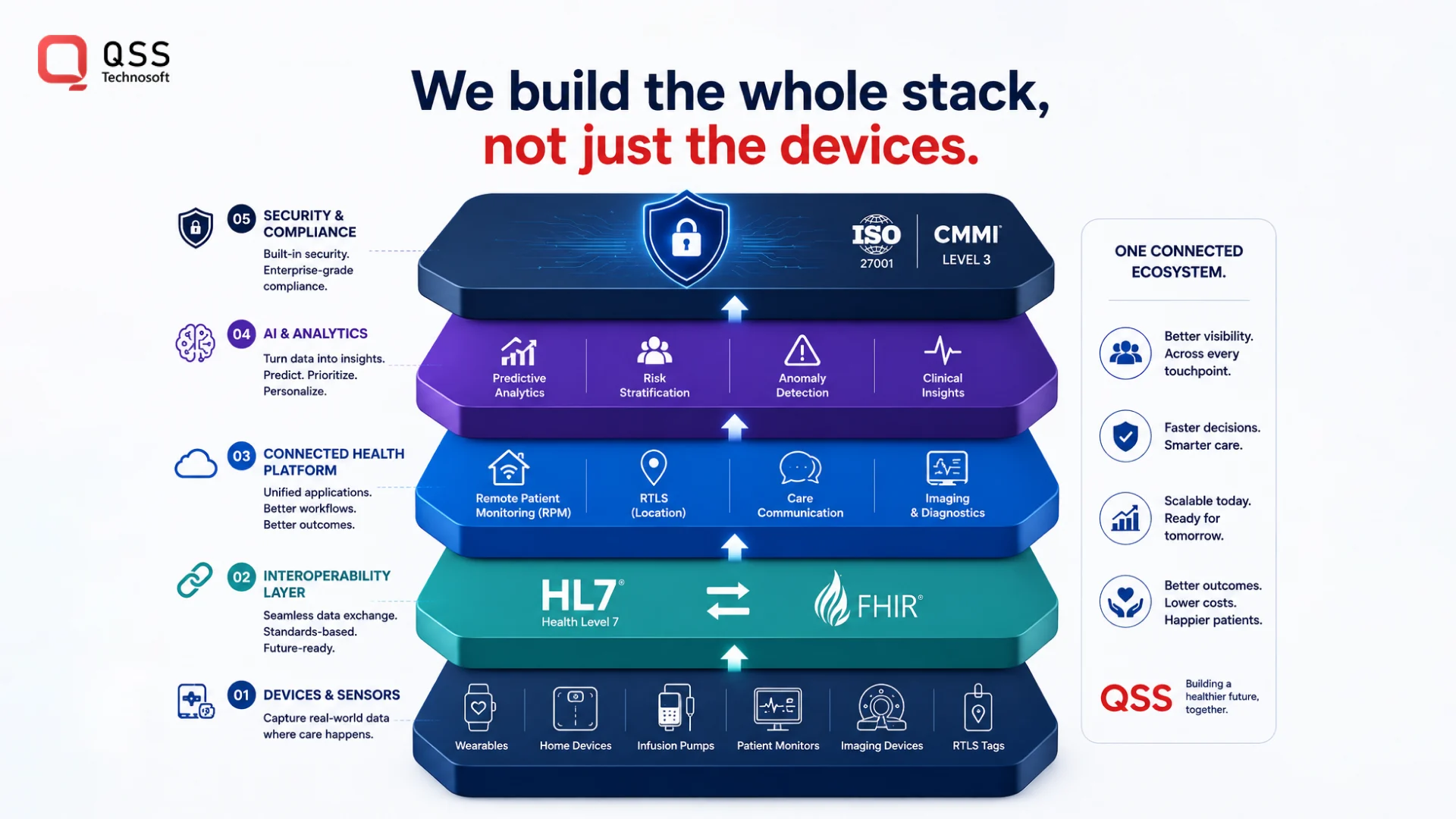
This is exactly the kind of work we do. At QSS Technosoft, we are a healthcare product engineering partner that builds the connected, intelligent systems IoMT depends on, end to end.
That includes remote patient monitoring and connected-health platforms, real-time location solutions for asset, patient, and staff tracking, unified care communication that gets the right alert to the right person, medical imaging and DICOM/PACS engineering, and the AI that turns device data into early warnings and insight. Crucially, we engineer the hard parts that decide whether IoMT works: HL7 and FHIR interoperability to connect fragmented systems, edge and cloud architecture to process data fast, and security built in from the start, backed by ISO 27001 and CMMI Level 3 discipline.
In short, we do not just connect devices. We build the platform, the intelligence, and the compliance that turn connected devices into better care, and you own the code and IP. Read more about our IoT and connected devices services here.
The Future of IoMT
The direction is clear. Over the next few years, IoMT will grow more autonomous and more predictive: agentic AI acting on device data, richer hospital-at-home programs, and connected care that follows the patient across settings rather than stopping at the facility door. Devices will keep multiplying, but the differentiator will not be the number of sensors. It will be how intelligently, securely, and seamlessly all that data is turned into care.
Organizations that invest now in connected, interoperable, AI-ready foundations will be positioned to scale these advances. Those that treat IoMT as a pile of disconnected gadgets will be left managing complexity instead of delivering care.
The Bottom Line
The Internet of Medical Things is reshaping patient care in 2026 by making it continuous, connected, and intelligent. It moves monitoring closer to the patient, feeds AI that turns data into early action, and unifies fragmented systems into one view. But the value is not in the devices. It is in connecting them, securing them, and acting on what they tell you. That is where the real work, and the real difference, lies.
Building connected, intelligent healthcare?
QSS builds the platforms, AI, and interoperability behind modern IoMT — remote monitoring, real-time tracking, and secure, HIPAA-compliant device integration.
Book a Free Consultation →