SAP ECC vs. SAP ERP S/4HANA: What is the Difference?
 By Rashmi Kanti
QSS Technosoft
September 24, 2026
10 min read
Updated Sep 24, 2026
By Rashmi Kanti
QSS Technosoft
September 24, 2026
10 min read
Updated Sep 24, 2026
Nearly 40% of enterprises still running sap ecc won’t cross the finish line before the December 2027 maintenance deadline. It’s a sobering reality. For many, this isn’t just a simple version upgrade. It’s a high-stakes collision with decades of technical debt, custom code, and rigid data structures that simply can’t handle modern Generative AI. You’ve likely felt the friction already. Managing aging systems while trying to maintain strict HIPAA or GDPR compliance is an exhausting, uphill battle. It’s frustrating to watch competitors innovate while you’re stuck patching holes in a legacy hull.
We understand the pressure. You need more than a technical migration; you need a strategy that justifies the cost through measurable business outcomes. This guide provides a battle-hardened framework to transition from legacy ECC to S/4HANA with precision. We’ll skip the marketing fluff and get straight to the engineering realities. We’ll break down the core architectural shifts, explore the “Clean Core” strategy, and provide a risk-mitigation roadmap. By the end, you’ll have a clear path to a system that’s not just updated, but ready to leverage GenAI at scale.
Quick Answer
SAP ECC is a disk-based, database-agnostic ERP that reads data row by row and relies on aggregate tables and overnight batch jobs; mainstream maintenance for ECC 6.0 (EHP 6–8) ends on 31 December 2027, with extended maintenance to 2030 at a two-point surcharge. S/4HANA runs only on the in-memory, columnar SAP HANA database, processes transactions and analytics at once, consolidates Finance and Controlling into the Universal Journal (ACDOCA), replaces the SAP GUI with role-based Fiori, and is the prerequisite for RAG and agentic AI on ERP data. You migrate by Greenfield (fresh start), Brownfield (system conversion) or Bluefield (selective data transition), and the work that decides the outcome is the API re-architecture and compliance-by-design, not the database swap.
The SAP ECC Maintenance Clock: Why Stability is Now Your Biggest Risk
For decades, sap ecc served as the unyielding workhorse of enterprise operations. Its modular architecture kept supply chains moving, financial ledgers balancing, and manufacturing floors operating. But that legendary stability has turned into a dangerous operational trap. The core architecture has reached its physical limits. It can’t handle concurrent transactional and analytical processing without slow overnight batch jobs. Relying on this legacy setup means running your modern business on data structures designed for a different era.
The timeline is short. SAP terminates mainstream maintenance for SAP ECC 6.0 with Enhancement Packages 6 through 8 on December 31, 2027. If your system runs on EHP 0 through 5, you’ve already dropped into Customer-Specific Maintenance. This means you pay standard support fees but lose routine legal updates, tax modifications, and newly discovered security fixes. Purchasing extended maintenance through 2030 adds a two percentage point surcharge to your net software maintenance basis. Waiting isn’t a conservative strategy. It’s an expensive choice that accumulates technical debt while blocking real-time analytics and generative AI integration.
The Talent Gap: The Hidden Cost of Legacy ECC
Maintaining millions of lines of custom, legacy ABAP code requires specialized eyes. Yet, the pool of developers willing to work on aging systems is drying up. Senior engineers who built these custom environments are retiring, taking critical institutional knowledge with them. This leaves organizations trapped in deep knowledge silos. The developers left in the market command premium rates. You end up spending your IT budget on expensive life support for old software rather than building new capabilities.
Compliance and Security Risks in Aging Infrastructure
Securing a twenty-year-old ERP core against modern threat vectors is an uphill battle. Legacy setups struggle to satisfy modern HIPAA, GDPR, or SOC 2 auditing requirements because they lack native data-masking and modern encryption protocols. Implementing true compliance-by-design requires a decoupled, API-driven architecture. In an aging core, vulnerability management becomes a dangerous game of whack-a-mole. Every new patch risks breaking a brittle customization, forcing IT leaders to choose between operational uptime and data security.
Architectural Breakdown: SAP ECC vs. SAP S/4HANA
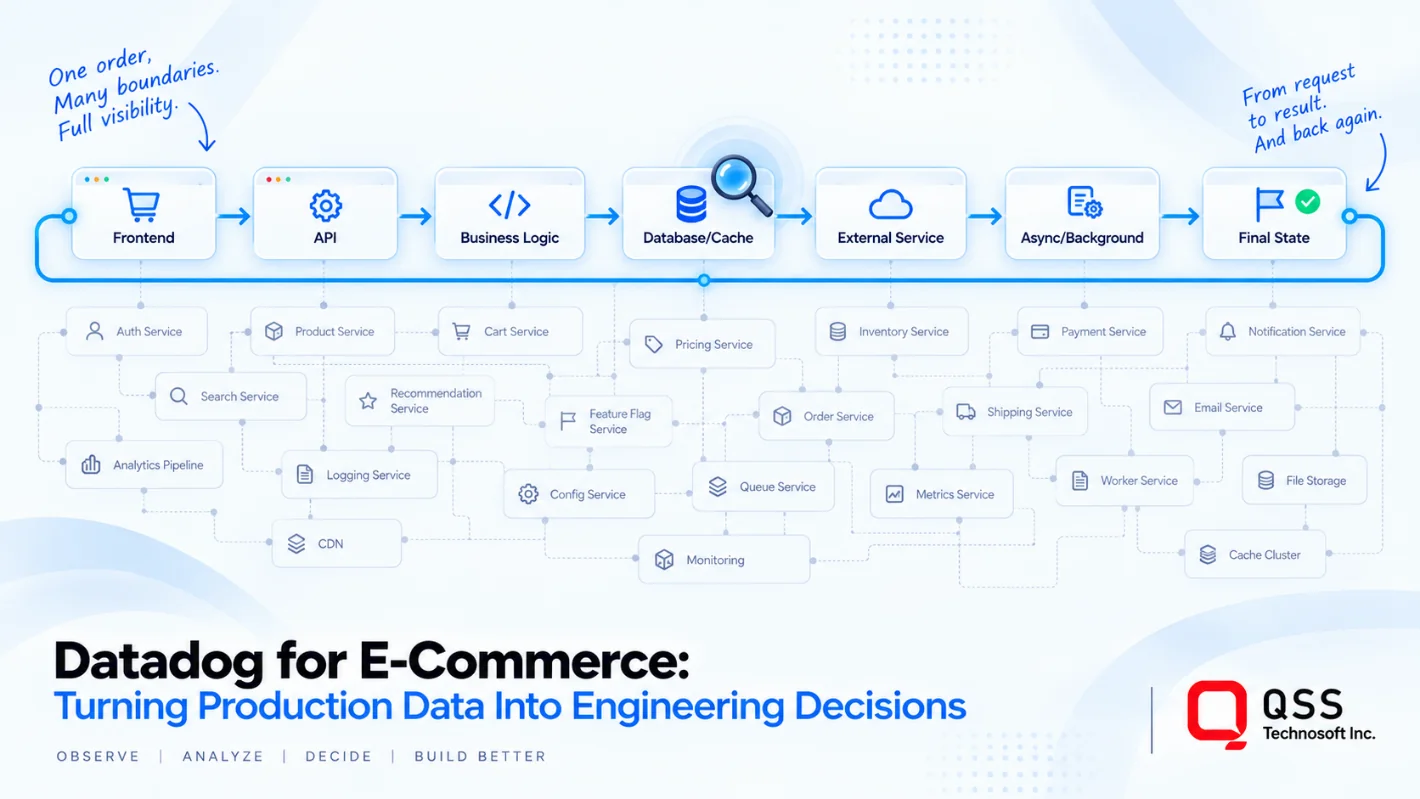
The difference between sap ecc and S/4HANA isn’t a minor version update. It’s a total rebuild of the engine. While ECC is database-agnostic, often running on “AnyDB” providers like Oracle or SQL Server, it’s inherently disk-bound. It reads data row-by-row. This is reliable for basic recording, but it creates a massive bottleneck for modern analytics. S/4HANA runs exclusively on SAP HANA, an in-memory, column-oriented database that processes transactions and analytics simultaneously. There’s no replication. There’s no lag.
Data model simplification is the real hero in this transition. In a typical sap ecc environment, you’re forced to maintain dozens of aggregate and index tables just to keep the system from choking during a financial close. S/4HANA eliminates these redundant structures. It uses the Universal Journal, known as ACDOCA, as a single source of truth for Finance and Controlling. This consolidation makes your system leaner, faster, and significantly smarter. If you’re ready to stop fighting your legacy interface and start leveraging real-time data, it’s time to speak with a senior architect about a pragmatic migration strategy.
Row-Based vs. Column-Based: Why Data Speed Matters
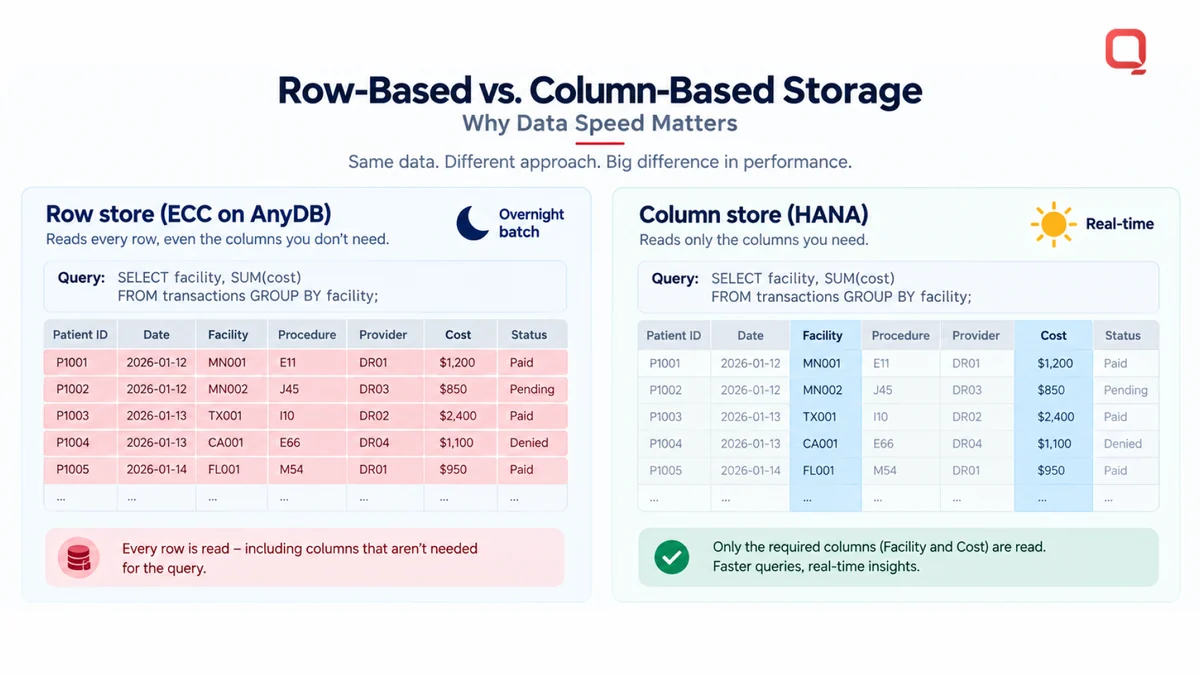
Traditional databases store data in rows. That’s fine for recording a single patient visit. But if you need to analyze a decade of clinical outcomes across fifty facilities, row-based systems crawl. HANA uses columnar storage. It only reads the specific columns your query requires. This enables real-time reporting without waiting for overnight batch processing. In healthcare, this means instant access to patient data and precise inventory tracking across complex hospital networks. The physicality of the software changes too. By eliminating redundant indexes, you can often reduce your data footprint by up to 10x.
Fiori and the End of User Distraction
The SAP GUI is a relic of transaction-code friction. It’s built for power users who’ve memorized hundreds of four-digit codes. S/4HANA replaces this with SAP Fiori. It’s role-based. It’s decisive. It’s simple. We engineer for the end-user by stripping away unnecessary clicks and screens. This isn’t just about aesthetics; it’s about reducing human error in high-pressure clinical workflows. Fiori is mobile-first. Doctors and administrators can access critical data on the move. The measurable outcome is clear: intuitive design can slash your support load by up to 60% while improving data accuracy at the point of care.
The ROI of Modernization: Efficiency, AI, and Measurable Outcomes
Stop viewing this transition as a technical chore. It’s a business outcome mission. The legacy architecture found in sap ecc was designed to record what happened yesterday; S/4HANA is engineered to predict what happens tomorrow. Modernization isn’t about shiny new interfaces. It’s about measurable ROI, reduced cycle times, and aggressive cost reduction. We’ve seen organizations achieve up to 40% lower claims processing costs simply by automating ERP workflows that previously required manual intervention. This isn’t a minor tweak. It’s a fundamental shift from a defensive “keep the lights on” posture to a strategy that actually drives market share.
S/4HANA as the Foundation for Generative AI
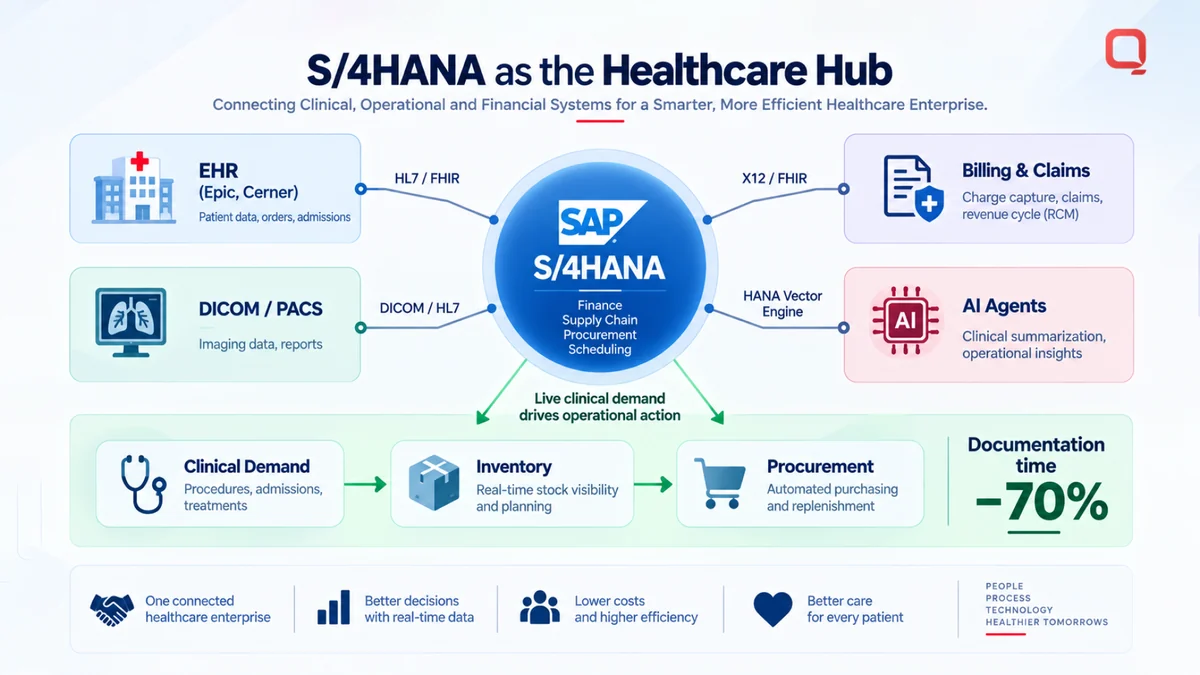
Generative AI is useless without high-fidelity data. Legacy sap ecc structures are often too fragmented and siloed for modern Retrieval-Augmented Generation (RAG). You can’t run a sophisticated LLM on data trapped in overnight batch jobs. S/4HANA changes the game by utilizing the HANA database as a high-performance vector database. This architecture allows you to build AI agents that do more than just talk; they execute. We’re talking about agents that manage procurement, reconcile billing, and optimize clinical scheduling in real-time. For an investment ranging from $150K to $2M, you get AI that works in production, not just in a slide deck.
Healthcare IT Synergies: ERP Meets Interoperability
For healthcare leaders, the ERP must be the heartbeat of the facility. It can’t be a siloed financial tool. We specialize in integrating S/4HANA with DICOM/PACS and major EHR platforms like Epic or Cerner. This requires more than basic mapping. It demands robust HL7/FHIR data pipelines that push ERP insights directly to the point of care. When your inventory management is synced with live clinical demand, the results are visceral. Modernization can cut documentation time by up to 70%. This frees your staff from the friction of neglected legacy code and allows them to focus on patient outcomes. It turns a back-office system into a clinical moat.
Migration Path Realities: Greenfield, Brownfield, or Bluefield?
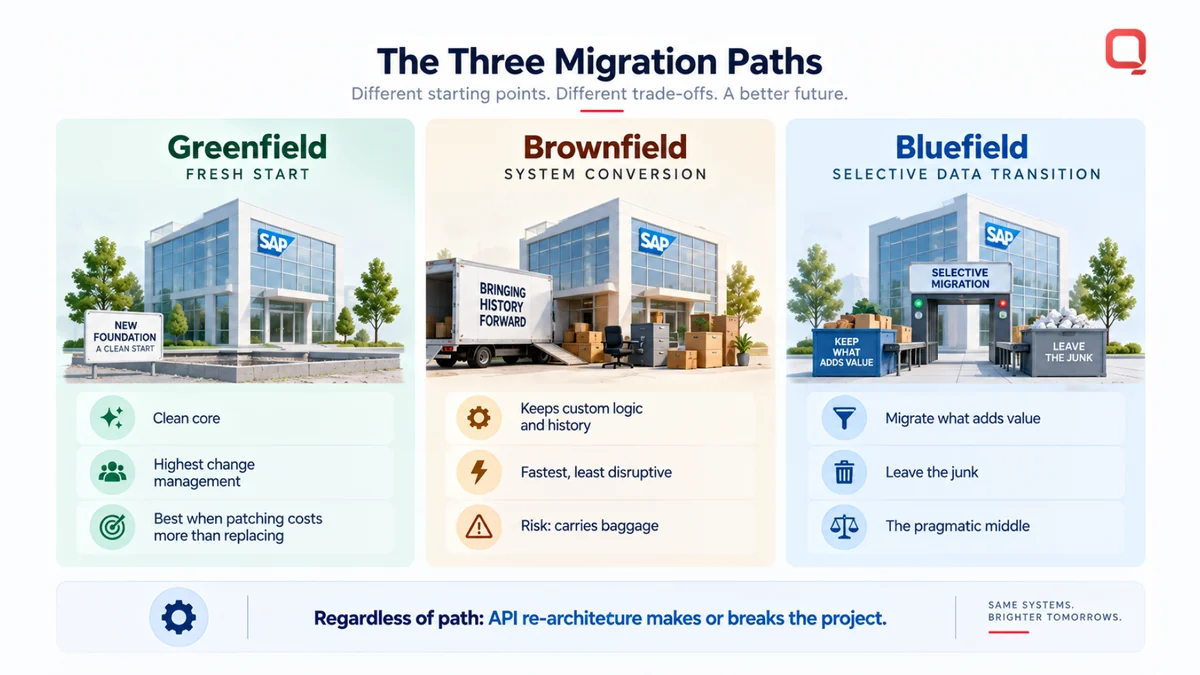
Choosing a migration path isn’t a theoretical exercise. It’s a high-stakes decision that dictates your downtime, your budget, and your future agility. In the world of sap ecc modernization, there are three primary routes. Greenfield is the “Fresh Start.” You scrap the technical debt and re-engineer business processes from the ground up. It’s the most intensive path. It’s often the only way to escape decades of messy customizations that no longer serve your business model. You get a clean core, but the organizational change management is significant.
Brownfield is a “System Conversion.” You preserve your legacy data and existing custom logic while upgrading the core database to HANA. It’s faster and less disruptive for your users. However, you risk carrying old baggage into a new environment. Bluefield, or Selective Data Transition, is the pragmatic middle. You migrate only the data and processes that add value. This allows you to leave behind the junk while keeping the clinical history and financial records you actually need. Regardless of the path, the unglamorous work of API re-architecture is what makes or breaks the project. If you’re ready to map out your specific journey, get an expert migration roadmap today.
Greenfield vs. Brownfield: A Decision Framework
Pick Greenfield when your technical debt is so high that patching it costs more than replacing it. It’s ideal for organizations undergoing complete business model shifts. Choose Brownfield if your existing custom logic delivers high ROI and you can’t afford significant downtime. Let’s talk straight about the “Go-Live” weekend. It’s a period of intense friction. Managing user expectations and technical cutovers requires a clinical level of precision. Don’t let a sales presentation convince you that any path is “push-button” simple. It requires a finisher’s mindset.
The QSS AI Readiness Assessment
Before you move a single byte, we evaluate your legacy sap ecc data quality. AI is only as good as the data feeding it. We identify “AI-ready” modules like Finance, Supply Chain, and Patient Engagement to ensure your new system can actually handle agentic AI integration. In healthcare, this means looking at the messy reality of DICOM/PACS and HL7 data. We ensure your interoperability pipelines are robust before the migration begins. This isn’t just a technical move. It’s a strategic preparation for a future where AI agents manage your procurement and clinical scheduling. We build for long-term stability, not just the cutover date. Start with an AI Readiness Assessment.
Engineering Your SAP Modernization: The QSS Pragmatic Approach
Migration isn’t just about moving tables. It’s about finishing a complex, unglamorous job without breaking your business operations. We don’t believe in junior staff augmentation. At QSS Technosoft, every project is senior-led and architect-driven. You won’t pay for a developer to learn on your dime. We’ve spent 15 years in the trenches of legacy system modernization, delivering over 400 projects with a relentless focus on measurable ROI. When you transition from sap ecc, you need a partner who understands that production stability is the only metric that matters.
Our delivery model is built for speed and precision. We combine US-based strategic architecture with high-velocity engineering teams to achieve up to 50% faster delivery than traditional consulting firms. If your project needs to scale rapidly, we provide vetted developers in 48 hours. This eliminates the friction of long hiring cycles and keeps your momentum high. We build compliance-by-design into the S/4HANA core. This ensures your new environment meets HIPAA, GDPR, and SOC 2 requirements from day one. It’s not just an upgrade; it’s a durable foundation for your next decade of growth.
Why QSS for Regulated Industries?
We operate with the rigor required for high-stakes, regulated environments. As a CMMI Level 3 and ISO 27001-certified firm, our processes are audited, repeatable, and proven. In healthcare, we don’t just understand ERP; we speak the language of clinical engineering. Our team has deep expertise in HL7, FHIR, and DICOM integration. We ensure your sap ecc data doesn’t just move to a new database, but flows seamlessly into your EHR and PACS systems. We are outcome-driven finishers. We focus on building systems that work under the pressure of real-world patient care.
Taking the First Step: The AI Readiness Audit
Stop guessing about your migration timeline. Start with a low-friction AI Readiness Audit of your current environment. We’ll assess your data quality, identify technical debt, and find the low-hanging fruit for immediate automation. This audit provides a risk-mitigation roadmap that justifies the move through cost reduction and future-proofing. Don’t wait for the maintenance deadline to force your hand. Contact QSS Technosoft today to begin your transition with a battle-hardened expert who knows exactly how to get you across the finish line.
Securing Your Future Beyond the Maintenance Deadline
The maintenance clock for sap ecc isn’t just a technical deadline. It’s a strategic ultimatum. To thrive in a market driven by real-time analytics and agentic AI, you need an architecture that supports them. S/4HANA provides that foundation. It eliminates the friction of legacy aggregate tables and replaces it with the decisive speed of the Universal Journal. Whether you choose a Greenfield fresh start or a pragmatic Bluefield transition, the goal remains the same: measurable business outcomes.
Don’t let technical debt or compliance fears stall your progress. QSS Technosoft brings the rigor of a CMMI Level 3 & ISO 27001 Certified firm to your modernization mission. With 250+ in-house senior engineers, we deliver up to 50% faster than industry averages. We don’t just build software; we finish high-stakes engineering projects that other firms find too messy to handle. Our team ensures your transition is architected for stability and long-term ROI.
Engineer Your SAP Modernization Strategy with QSS Technosoft today. Your data is ready for a new era. Let’s build something durable.
Engineer Your SAP Modernization Strategy: Start with an AI Readiness Audit
A low-friction audit of your ECC environment: data quality by module, custom-code and technical-debt inventory, compliance gaps, and the low-hanging automation. You leave with a risk-mitigation roadmap, a recommended migration path (Greenfield, Brownfield or Bluefield) and a cost and timeline range you can put in front of the board before the 2027 deadline does it for you.
Schedule your AI Readiness Audit →