Da Vinci FHIR Prior Auth: 2026 Implementation Guide
 By Vineet Bhardwaj
Chief Growth Officer – Digital Marketing, QSS Technosoft
September 21, 2026
11 min read
By Vineet Bhardwaj
Chief Growth Officer – Digital Marketing, QSS Technosoft
September 21, 2026
11 min read
Physicians currently spend up to 14 hours every week just managing authorizations. It’s a staggering waste of clinical talent. For most healthcare leaders, da vinci fhir prior authorization feels like another heavy compliance mandate handed down from CMS. You’re likely staring at legacy EHR systems that weren’t built for real-time data exchange. It’s messy. It’s expensive. It’s the primary reason patient care stalls while your staff manually hunts for clinical notes to satisfy a payer’s portal.
We agree that the current manual process is broken and unsustainable. It drains resources and burns out providers. This guide moves past the airy marketing hype to show you how to implement the Da Vinci Project standards with engineering precision. You’ll learn how to automate workflows to achieve up to 70% less documentation time and slash claims processing costs by up to 40%. We’ll break down the technical requirements for CRD, DTR, and PAS, providing a clear roadmap to bridge the gap between legacy debt and the 2027 API mandates.
Quick Answer
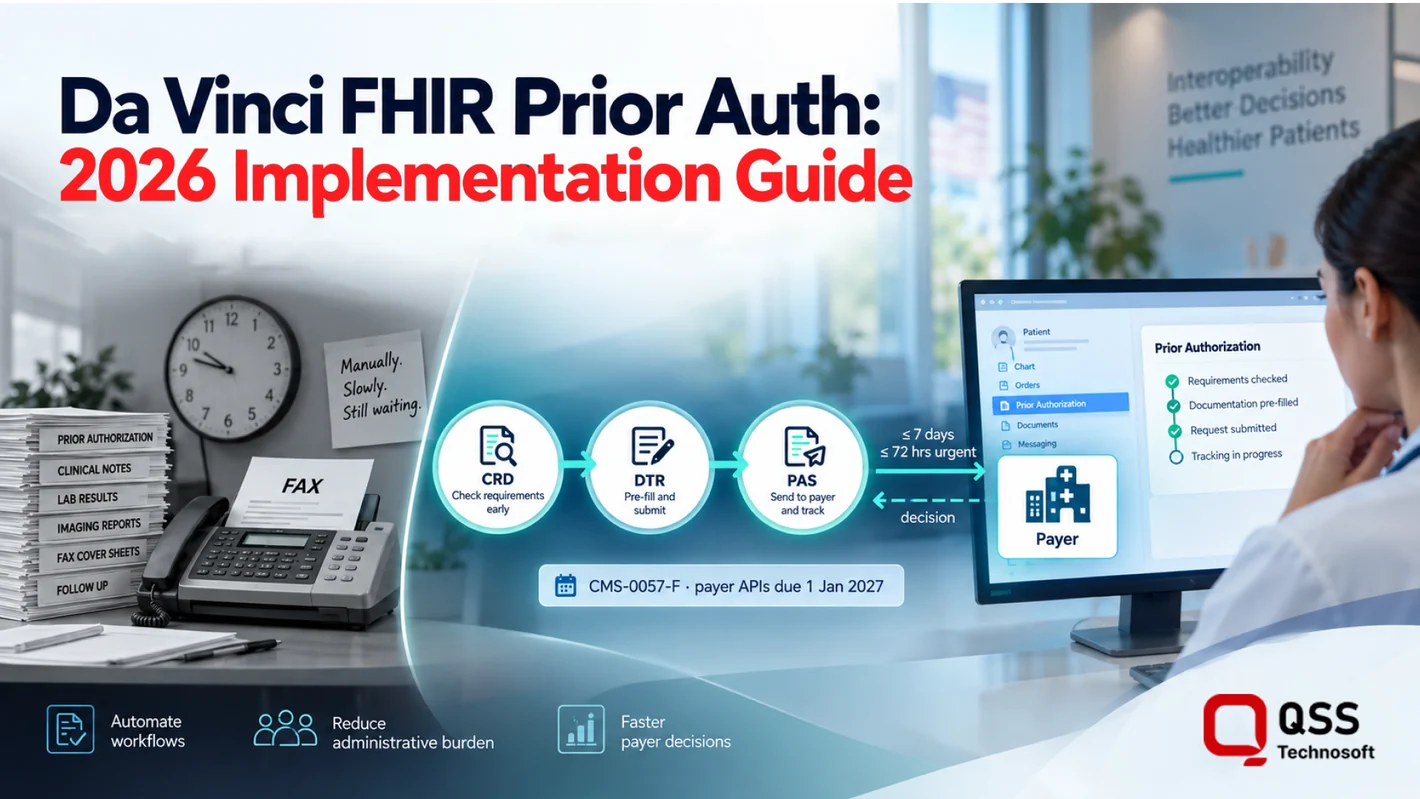
The CMS-0057-F rule requires impacted payers to expose FHIR prior-authorization APIs by 1 January 2027 and to decide standard requests in 7 days and urgent ones in 72 hours. The HL7 Da Vinci Project supplies the standards: CRD tells the provider at order time whether authorization is needed, DTR pulls the required evidence from the chart through a SMART on FHIR app and CQL, and PAS submits the bundle, translating to X12 278 for payers that can’t ingest FHIR. Most implementations stall on legacy EHR extensions, unstructured notes, slow security handshakes and peak-load latency, so the work is a four-phase engineering roadmap (assessment, plumbing, development, validation) with AI filling the unstructured-data gap, not a plug-in.
The Prior Authorization Crisis and the Da Vinci FHIR Mandate
Prior authorization is the single greatest bottleneck in American healthcare delivery. It is a process defined by friction, faxes, and frustration. It’s slow, manual, and prone to errors that cost providers time and payers money. For years, the industry relied on “fax and wait” workflows. That era is ending. The 2026 regulatory landscape, specifically the CMS-0057-F final rule, mandates a shift toward automation. Impacted payers must now provide decisions within 7 calendar days for standard requests and 72 hours for expedited ones. Staying with manual portals isn’t just inefficient; it’s a compliance risk.
The Da Vinci Project provides the technical framework to meet these demands. This HL7 initiative standardizes how payers and providers exchange data using the Fast Healthcare Interoperability Resources standard. By moving away from siloed EHR systems and toward a unified API approach, we can finally achieve real-time responses. Implementing da vinci fhir prior authorization isn’t just about checking a box for CMS. It’s about engineering a system that actually works in production, even when dealing with messy legacy code and inconsistent data formats.
Why FHIR is the Answer to Interoperability Gaps
Legacy EDI/X12 transactions are rigid and often require human intervention to interpret clinical context. In contrast, FHIR uses a RESTful API architecture that is flexible and lightweight. It allows systems to query specific data resources rather than dumping massive, unformatted files. This granularity breaks down data silos and makes clinical information actionable at the point of care. The 21st Century Cures Act reinforces this by enforcing data portability. We’re moving toward a world where data follows the patient seamlessly. It’s a shift from static documentation to dynamic, API-driven exchange.
The Business Case for Automated Authorization
Automation isn’t just a technical upgrade. It’s a financial necessity. High administrative overhead eats into margins, but moving to an automated da vinci fhir prior authorization workflow can reduce claims processing costs by up to 40%. Beyond the balance sheet, the impact on patient care is profound. According to American Medical Association surveys, 94% of physicians report that prior authorization delays access to necessary care. Automation eliminates these gaps. You get faster approvals, lower support loads, and better outcomes. It’s a transition from reactive denial management to operational excellence. Don’t wait for the 2027 technical deadlines to start building. The operational requirements are already here.
The Three Pillars of Da Vinci: CRD, DTR, and PAS Explained
The Da Vinci Project isn’t just a collection of technical specifications. It is a functional triad designed to kill the manual portal once and for all. To implement da vinci fhir prior authorization effectively, you must understand how Coverage Requirements Discovery (CRD), Documentation Templates and Rules (DTR), and Prior Authorization Support (PAS) interlock. These are not isolated tools. They represent a sequential pipeline that moves data from the clinical record to the payer’s adjudication engine without human intervention.
CRD: Real-Time Intelligence at the Point of Care
CRD serves as the initial automated filter that determines whether a specific clinical service requires prior authorization based on real-time payer rules. It works by hooking into the EHR via CDS Hooks. When a provider orders a procedure or medication, the system triggers a background check against the payer’s database. If no authorization is required, the provider knows instantly. This eliminates the “just in case” phone calls and faxes that clog up administrative workflows. It’s about getting a definitive answer before the patient even leaves the exam room.
DTR and PAS: Bridging the Clinical-to-Administrative Gap
When CRD identifies that an authorization is mandatory, DTR takes over. This component is the engine that surfaces exactly which clinical data points the payer needs for approval. It uses SMART on FHIR apps and Clinical Quality Language (CQL) to pull evidence directly from the patient’s chart. This is where the heavy lifting happens. By using structured data mapping, organizations achieve up to 70% less documentation time. It’s a massive relief for clinical staff who are exhausted by manual data entry and repetitive form-filling.
PAS is the final handshake in the process. It bundles the gathered resources and submits the request. Here is the messy reality: many payers still operate on legacy infrastructure that can’t ingest FHIR natively. This means your integration layer must often translate FHIR resources into the X12 278 format. It is unglamorous, difficult work that requires precise engineering. The CMS Interoperability and Prior Authorization final rule mandates these APIs because they replace human error with machine precision. They turn a weeks-long waiting game into a near-instant transaction.
Building this triad requires more than just reading implementation guides. It requires a partner who understands the friction of legacy systems and the nuances of FHIR mapping. If you’re ready to move beyond the theory and start building a production-ready solution, reach out to our engineering team to discuss your interoperability roadmap.
Interoperability Realities: Why FHIR Standards Often Stall in Production
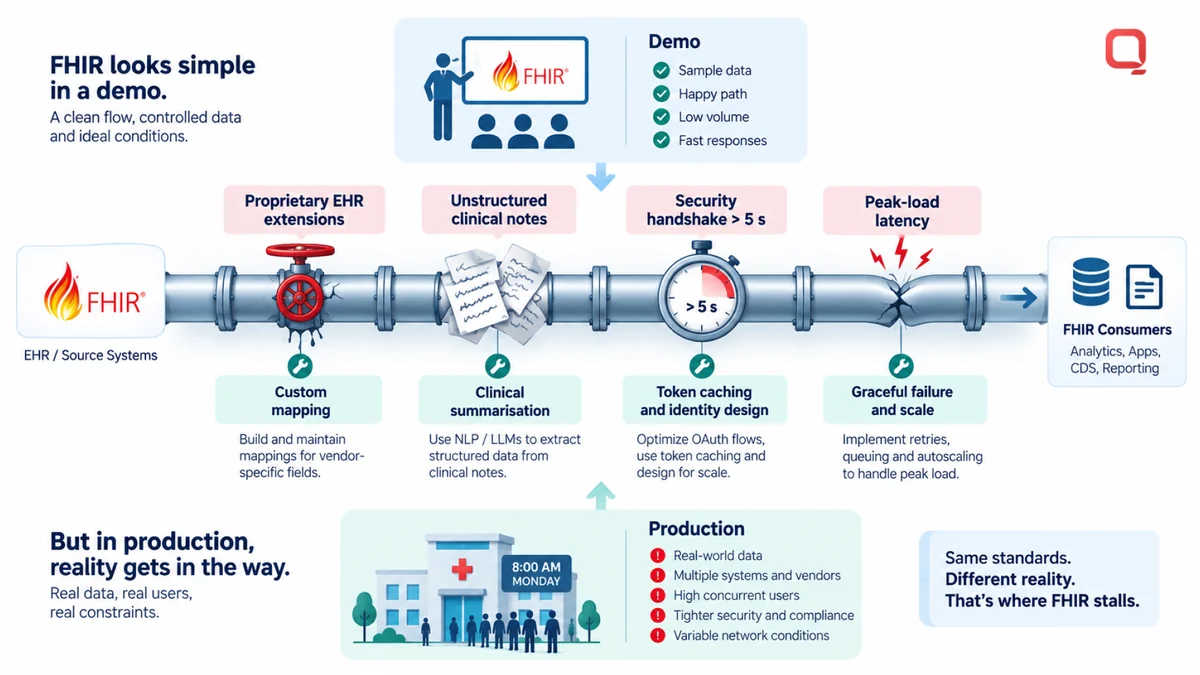
FHIR adoption isn’t a simple weekend project. The Da Vinci Prior Authorization Support (PAS) Implementation Guide defines the necessary endpoints, but it won’t fix your neglected legacy code or slow database connections. Most “out-of-the-box” solutions choke when they hit proprietary EHR extensions. You’re dealing with technical debt that’s often decades old. Mismatched data versions and vendor walled gardens turn a simple API call into a complex engineering hurdle. It’s the difference between a demo that looks good in a slide deck and a system that survives a Monday morning peak load.
Security adds another layer of friction. Protecting PHI across the payer-provider divide requires more than basic encryption. It demands rigorous identity management and audit trails that satisfy HIPAA without killing system performance. If your security handshake takes five seconds, the clinical workflow is already dead. You need a partner who has seen these failures before. You need someone who knows how to navigate the “walled gardens” of major EHR providers who often prioritize their own ecosystems over true, open interoperability. It’s difficult work. It’s unglamorous. But it’s the only way to move past the pilot phase.
Data Mapping Challenges in Complex Environments
Mapping unstructured clinical notes to FHIR resources is where most da vinci fhir prior authorization projects stall. Clinical narratives don’t always fit into neat resource buckets. When “standard” FHIR meets proprietary EHR extensions, data quality drops. Without strict management, you’re just automating the delivery of “garbage in, garbage out” results. You need custom engineering to bridge the gap between physician narrative and machine-readable resources. This requires more than just a mapper. It requires a deep understanding of clinical workflows and the unglamorous work of data normalization to ensure every resource is submission-ready.
The Performance Trap: Latency and Scalability
Slow API responses are the fastest way to lose provider trust. If an authorization check takes more than a few seconds, the doctor is back to using the fax machine. Engineering for scale means handling thousands of concurrent requests without latency spikes. A pragmatic architecture prioritizes resiliency. It fails gracefully, ensuring that a network timeout doesn’t freeze the entire clinical workstation. We’re talking about building durability into the code. It’s about ensuring that the system is fast, responsive, and ready for the reality of a high-volume healthcare environment where every second counts.
Building an Implementation Roadmap: Engineering for Interoperability
Successful implementation of da vinci fhir prior authorization isn’t a linear path. It’s an engineering sprint that requires a clear, battle-tested roadmap. You can’t just flip a switch and expect legacy databases to talk to modern FHIR endpoints. It requires a phased approach that starts with radical honesty about your current data stack. We break this down into four critical phases: assessment, plumbing, development, and validation. This is how you move from a compliance headache to a system that actually delivers the promised 40% reduction in claims costs. It’s about moving beyond theory and into production.
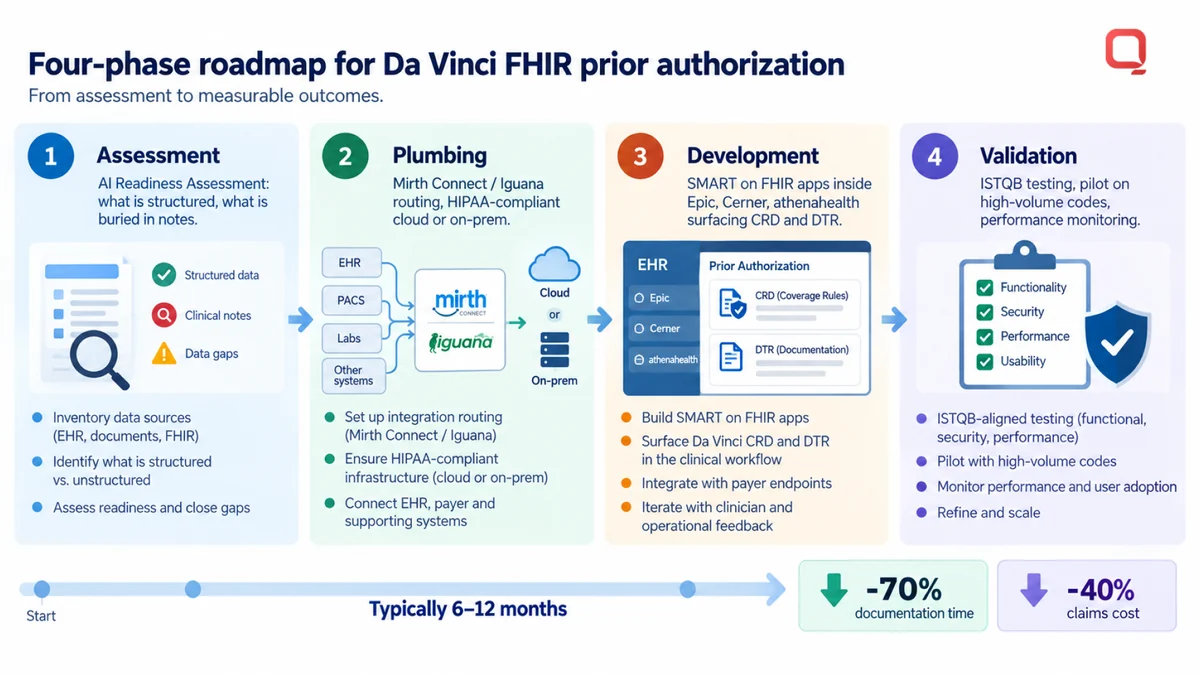
Phase 1 & 2: Discovery and Infrastructure
Phase 1 is the AI Readiness Assessment. We evaluate your existing data stack, identifying which clinical elements are buried in unstructured notes and which are ready for extraction. You need to know your interoperability maturity before writing a single line of code. It’s about finding the gaps. Once the audit is complete, Phase 2 focuses on the integration engine setup. This is the unglamorous work of plumbing the healthcare data pipe. We leverage tools like Mirth Connect or Iguana for seamless data routing. Whether you choose cloud or on-premise, the architecture must be engineered for HIPAA-compliant scalability. It needs to handle the load without breaking the connection. It needs to be durable, secure, and fast.
Setting up these interfaces is where most projects fail. You’re dealing with slow connections, neglected code, and mismatched standards. Our team of 250+ engineers specializes in this type of legacy system modernization. We don’t just build APIs; we build resilient infrastructure that bridges the gap between old EMRs and the 2027 technical mandates. It’s about creating a foundation that supports real-time data exchange without crashing under the weight of high-volume requests. We focus on the final stages of the lifecycle: delivering and maintaining.
Phase 3 & 4: Development and Launch
Phase 3 moves into SMART on FHIR app development. These apps live directly inside Epic, Cerner, or Athenahealth, providing a seamless interface for providers. The goal is simple: make the authorization check feel like a natural part of the workflow. If the doctor has to leave the EMR, you’ve already lost. We focus on building intuitive, high-velocity interfaces that surface CRD and DTR insights exactly when they are needed. This is where the 70% reduction in documentation time becomes a reality. It’s about construction, durability, and scale.
Phase 4 is about rigorous validation. We use ISTQB-certified testing to ensure medical-grade reliability. You can’t afford “beta” software when patient care is on the line. Pilot testing begins with a limited set of high-volume codes to validate the full CRD-DTR-PAS loop. We monitor performance analytics constantly, refining the engine to eliminate latency. It’s a cycle of building, testing, and hardening. Ready to start your journey? Schedule your AI Readiness Assessment today to see how we can modernize your prior authorization workflow.
Automating Outcomes: QSS Technosoft’s Approach to Prior Authorization
Engineering isn’t about what looks good in a presentation. It’s about what works in production under the heavy load of a Monday morning clinical shift. Most vendors treat the Da Vinci Project as a compliance checklist. We treat it as a foundation for measurable ROI. Our approach to da vinci fhir prior authorization focuses on the unglamorous work of legacy integration and data normalization. We don’t just build APIs. We deliver durable, medical-grade software that reduces claims costs by up to 40% and slashes documentation time by up to 70%.
AI-Enhanced Prior Authorization Agents
The biggest gap in current implementations is the “unstructured data problem.” FHIR resources are structured, but physician notes are messy. Our proprietary Healthcare AI Copilot bridges this gap by acting as a clinical summarization agent within the FHIR workflow. It extracts medical necessity evidence from radiology reports, narrative text, and lab results, populating the DTR questionnaire automatically. This isn’t generic AI hype. It’s a fine-tuned system built to understand specific clinical policy criteria.
By automating this clinical review, organizations reduce their support load by up to 60%. We provide radical honesty regarding the investment required for this level of automation. Implementing enterprise-scale prior-auth agents, including RAG and LLMOps, typically ranges from $150K to $2M. This investment moves you from reactive denial management to a “compliance-by-design” model. We ensure every submission is HIPAA-compliant and SOC 2-ready from day one, backed by our CMMI Level 3 engineering standards.
Why QSS Technosoft is the Partner for Prior Auth
We’ve spent 15 years in the trenches of healthcare IT. Our moat isn’t just code. It’s the deep interoperability expertise of our 250+ in-house engineers who have seen every possible legacy system failure. When the 2026 mandates hit, you don’t need junior staff augmentation. You need senior-led, architect-driven delivery. We provide vetted developers within 48 hours to help you scale your engineering team and meet federal deadlines without sacrificing stability.
We focus on the final stages of the development lifecycle: delivery and maintenance. We know that a slow connection or a neglected EHR extension can kill an automation project. That’s why our battle-hardened experts prioritize performance and scalability in every build. It’s time to stop waiting on faxes and start delivering real-time care. Modernize your prior authorization workflow with QSS Technosoft and turn interoperability into your greatest operational asset.
Securing the Future of Automated Adjudication
The transition to da vinci fhir prior authorization is no longer a theoretical exercise. It’s a production deadline. You’ve seen how the triad of CRD, DTR, and PAS can dismantle the manual portal bottleneck. You also know that legacy technical debt and unstructured clinical data are the primary obstacles to real-world deployment. Success requires moving beyond simple implementation guides toward durable, architect-driven solutions that bridge the gap between old EMRs and modern APIs.
We specialize in this difficult work. As a CMMI Level 3 and ISO 27001 certified firm, we bring 250+ in-house engineers to every project. We’re HIPAA-compliant healthcare IT specialists who focus on delivering stable, medical-grade software that survives the realities of a high-volume environment. Don’t let technical friction stall your progress. Build a resilient system that delivers measurable ROI and faster patient care. We’re ready to help you get it over the finish line.
Engineering Measurable Outcomes: Start Your AI Readiness Assessment
A technical audit of your data stack, EHR extensions and integration layer before a line of production code is written. You leave with a map of which clinical elements are structured and which are buried in notes, an interoperability-maturity score, and a phase-one scope for the CRD-DTR-PAS loop on your highest-volume codes.
Schedule your AI Readiness Assessment →