EMR Software Development: Step-by-Step Engineering and Implementation Guide
 By Rashmi Kanti
QSS Technosoft
September 24, 2026
11 min read
Updated Sep 24, 2026
By Rashmi Kanti
QSS Technosoft
September 24, 2026
11 min read
Updated Sep 24, 2026
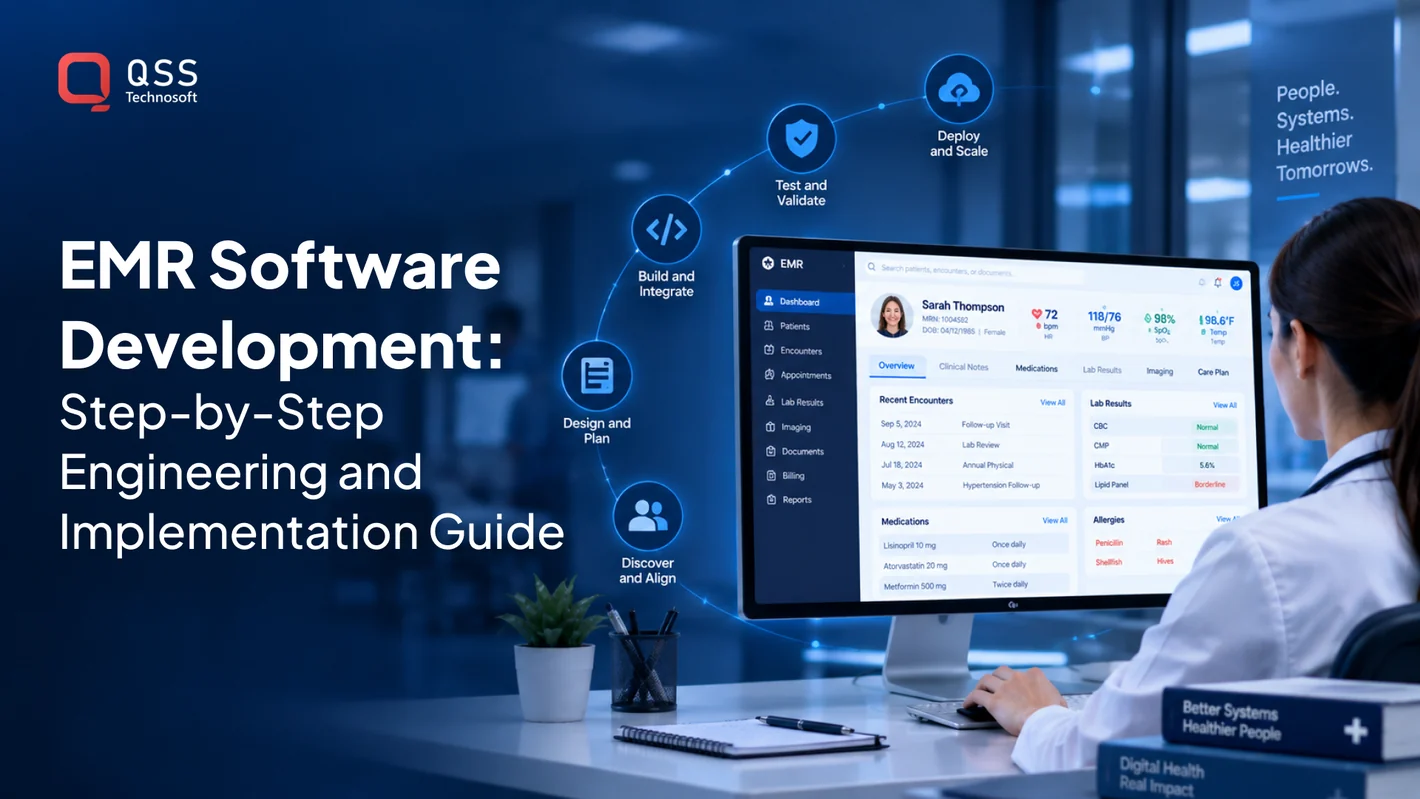
Most commercial healthcare platforms fail clinicians for a simple reason: they treat patient care like warehouse inventory. When rigid, off-the-shelf systems force doctors through dozens of disconnected screens, documentation swallows their day. Scalable emr software development flips that dynamic. Instead of wrestling with boxed-in workflows and fragmented databases, engineering teams can construct resilient systems tailored to clinical reality and automated charting.
You already know the pain of brittle legacy interfaces, isolated diagnostic feeds, and strict federal mandates like ONC certification criteria. Custom development eliminates those operational bottlenecks, but it requires zero guesswork around architecture and security. In this guide, you will master the technical roadmap, regulatory guardrails, and engineering patterns required to build a modern, interoperable EMR that slashes provider documentation fatigue. From FHIR-native data modeling to production cloud deployment, here is what it takes to ship software that clinicians trust.
Quick Answer
Custom EMR software development means engineering clinical data pipelines around how care teams actually work, not skinning a generic database. A production EMR rests on four modules (Master Patient Index, CPOE and charting, clinical decision support, billing and coding), speaks HL7 v2, FHIR and DICOM through an interface engine such as Mirth Connect, and is built in six phases: workflow discovery, clinical UI/UX, secure cloud architecture, data modelling, interfacing, and validation with a staged pilot. HIPAA, ONC certification, information-blocking rules and, where relevant, 21 CFR Part 11 are engineering constraints designed into the code, not a checklist at launch. Build when workflow fit, data ownership and total cost of ownership matter more than the speed of a commercial install.
Understanding Modern EMR Software Development: Scope, Core Architecture, and Business Drivers
Custom emr software development is not about slapping a graphical interface over a standard SQL database. It is about engineering purpose-built clinical data pipelines that map precisely to how care teams practice medicine. Legacy commercial vendors pack their software with thousands of generic features designed for billing departments rather than clinicians. The result is administrative friction. According to American Medical Association surveys, physicians spend nearly two hours on administrative charting for every hour of patient care. Bespoke engineering strips out that bloat, replacing sluggish interfaces with fast, responsive workflows built around clinical reality.
EMR vs. EHR: Architectural Boundaries and Clinical Scope
Engineering teams often conflate EMRs with enterprise EHRs, but their architectural scopes differ significantly. An EMR functions as an intra-facility engine. It captures encounter notes, vitals, diagnostics, and local treatment plans within a single practice or specialized department. In contrast, modern electronic health record systems manage a longitudinal patient record designed for cross-institutional exchange across external health systems, payers, and regional registries. For specialized outpatient clinics, building a focused EMR avoids massive licensing overhead while delivering exact clinical workflow alignment that off-the-shelf platforms cannot touch.
Core Structural Modules of Enterprise-Grade EMR Systems
A production-ready EMR architecture relies on four interconnected core modules that balance clinical speed with rigorous data integrity:
- Master Patient Index (MPI): Standardizes patient identity across multiple facility touchpoints using deterministic and probabilistic matching algorithms to prevent duplicate records.
- CPOE and Clinical Charting: Powers computerized physician order entry for labs, medications, and diagnostics with low-latency structured templates.
- Clinical Decision Support Systems (CDSS): Evaluates active orders against patient history in real time, firing contextual alerts for drug-drug interactions and adverse allergies without triggering alert fatigue.
- Billing and Coding Engine: Translates completed encounter documentation into standardized ICD-10 and CPT codes, connecting clinical activity directly to revenue cycle management pipelines.
Getting these modules right early dictates long-term system stability. When data structures, validation rules, and caching strategies are aligned to actual practice patterns, emr software development delivers software that providers actually want to use.
Essential Features and Interoperability Standards for Modern EMR Systems
A high-performance clinical platform is judged by how invisibly it handles data transmission. In real clinical environments, software rarely interacts with greenfield tech stacks. It must ingest high-velocity lab feeds, parse disparate message structures, and render diagnostic imaging without grinding local browser sessions to a halt. Effective emr software development bridges modern web services with legacy healthcare standards, keeping data pipelines fast and dependable.
Data Standards: HL7 v2, FHIR, and DICOM Integration
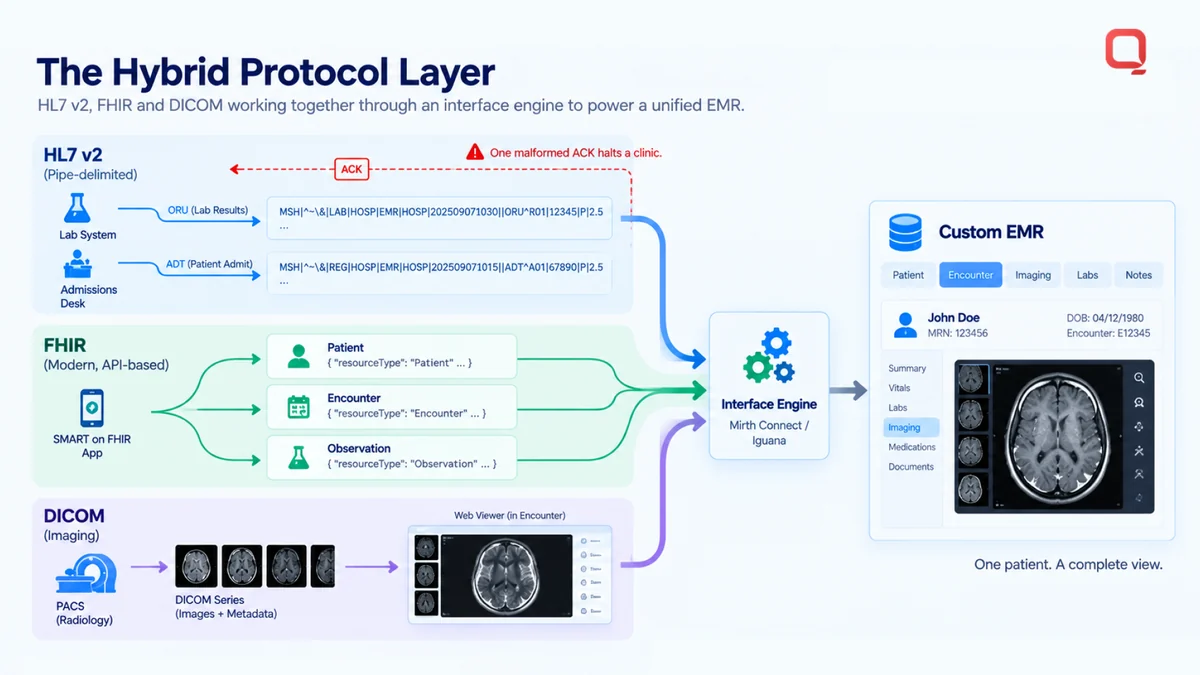
Interoperability requires engineering teams to support hybrid protocol layers rather than betting on a single data format:
- HL7 v2 Message Pipelines: Most hospital laboratories and admission desks still run on pipe-delimited HL7 v2.x feeds. Robust systems deploy integration engines like Mirth Connect to parse Admissions, Discharges, and Transfers (ADT) and Observation Results (ORU) into modern database objects.
- RESTful FHIR Resources: Adhering to the ONC Health IT Certification Program mandates standardizing on HL7 FHIR (such as US Core STU 6.1). Querying standardized resources like Patient, Encounter, and Observation lets third-party clinical apps plug in cleanly via SMART on FHIR launch frameworks.
- Zero-Footprint Web DICOM Viewers: Clinicians shouldn’t jump between third-party picture archiving communication systems (PACS) and their patient charts. Modern EMRs embed WebAssembly-driven DICOM viewers directly inside the encounter screen, pulling multi-frame CT scans and MRIs with progressive client-side rendering, backed by dedicated DICOM/PACS engineering.
Clinical Automation and e-Prescribing (eRx) Workflows
Manual data entry burns out providers. Custom clinical documentation modules replace free-form clutter with structured data capture, integrating ambient scribing and tailored templates that deliver up to 70% less documentation time for high-volume practices. When doctors finish an encounter, automated rules populate clinical summaries, charge capture codes, and diagnostic follow-ups instantly.
Prescribing demands identical rigor. Seamless e-Prescribing modules connect directly to national pharmacy clearinghouses like Surescripts, verifying patient formulary benefits and medication history while routing orders securely. Underpinning every action is granular, role-based access control (RBAC). Front-desk staff, triage nurses, and attending physicians receive exact, policy-governed data views that safeguard sensitive health details. If your product team needs specialized guidance mapping these protocols, you can consult healthcare engineering specialists to establish bulletproof data pipelines before writing frontend code.
Executing these integrations requires deep protocol experience; a single misconfigured ACK segment or malformed FHIR bundle can halt an entire clinic’s daily workflow.
The Step-by-Step Engineering Lifecycle for Custom EMR Software Development
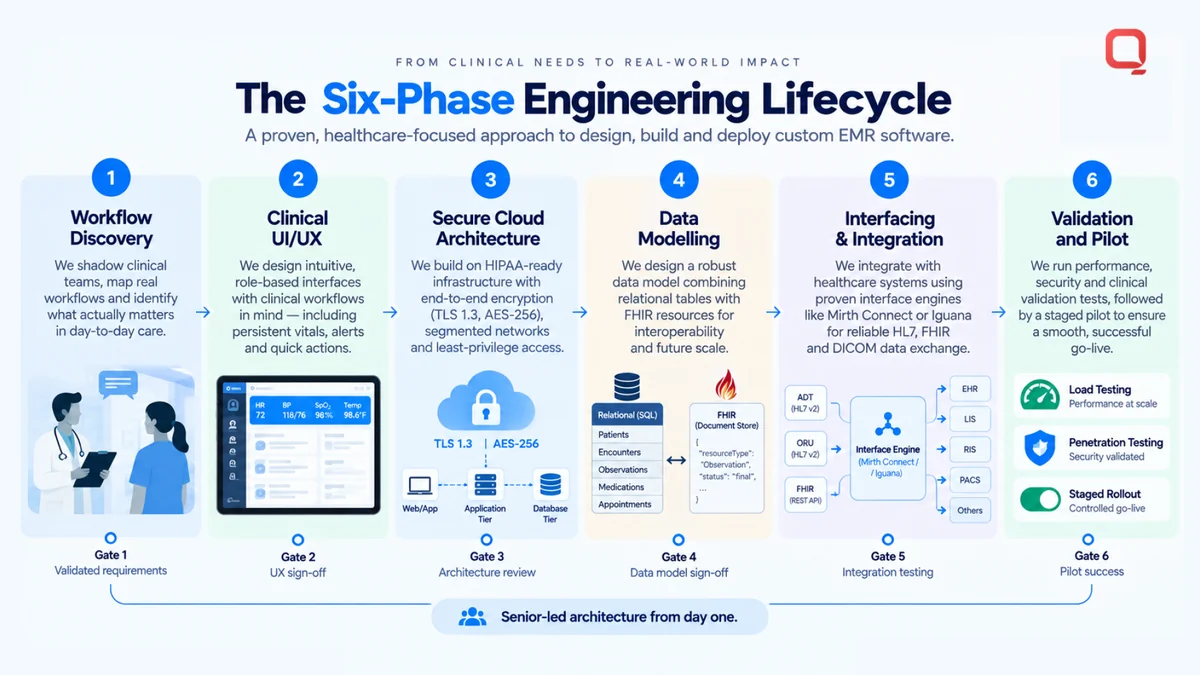
Engineering clinical software requires a development lifecycle fundamentally distinct from standard enterprise web apps. In production healthcare settings, an unhandled exception or database race condition does not just trigger an error ticket; it disrupts bedside decisions and delays patient care. Methodical emr software development demands senior-led architecture from day one. You must plan for database concurrency, strict immutability, and comprehensive audit trails long before standing up client-side interfaces.
Phase 1 to Phase 3: Clinical Discovery, UI/UX, and Architecture
Every successful build starts by dissecting daily clinic realities:
- Workflow Discovery: Shadow providers to map documentation bottlenecks, chart navigation habits, and order patterns. Pinpoint exactly where click fatigue kills productivity during routine encounters.
- Clinical UI/UX Design: Construct ergonomic interfaces tuned for rapid keyboard input, high-contrast displays, and mobile tablet rounds. Critical patient vitals, allergy banners, and active medications must remain persistently visible without modal clutter.
- Secure Cloud Architecture: Design containerized microservices operating under the strict technical mandates of the HIPAA Security Rule. Mandate TLS 1.3 for all data in flight, AES-256 for data at rest, and fine-grained network segmentation separating public ingress from protected health databases.
Phase 4 to Phase 6: Core Engineering, Interfacing, and Validation
Once architectural foundations are locked down, the sprint cycle tackles data modeling and systems integration. Engineers establish hybrid schemas: normalized relational tables for transactional tasks like scheduling and billing, paired with flexible document stores or native FHIR resources for clinical notes. This structure maintains rapid search indexing across massive historical patient files without degrading daily query performance.
Interfacing follows. Engineering teams configure middleware like Mirth Connect or Iguana to build inbound and outbound data transformation pipelines. These engines ingest incoming lab results, convert legacy ADT segments, and route normalized clinical summaries back into primary datastores without manual staff intervention.
Rigorous validation closes the build. Run automated integration suites simulating concurrent physician loads, network drops, and corrupted message feeds. Penetration testing identifies vulnerability vectors, while clinical simulation drills ensure charting screens update instantaneously during high-volume ambulatory shifts. Disciplined emr software development finishes with staged pilot rollouts, verifying data synchronization before switching off legacy workflows.
Navigating Healthcare Compliance, Data Security, and Certification Mandates
Compliance is not a static legal checklist you review before launch. It is an active engineering constraint embedded in your application code, cloud configuration, and network topology. A single unencrypted staging database or an overlooked audit log can trigger severe regulatory penalties and immediate loss of clinical credibility. High-stakes emr software development requires baking technical safeguards into every microservice from day one.
HIPAA Security Rule Implementation in Software Architecture
Safeguarding electronic protected health information (ePHI) demands strict, layered technical controls across your environment:
- Universal Cryptographic Standards: Mandate AES-256 encryption at rest for all database volumes, file storage buckets, and cached session keys. Enforce TLS 1.3 exclusively for data in motion across internal microservices and external interfaces.
- Granular Authentication and Session Bounds: Enforce multi-factor authentication (MFA) across every provider touchpoint. Pair this with aggressive, automated session timeouts and zero-trust perimeter network segmentation that limits internal resource discovery.
- Append-Only, Immutable Audit Trails: Log every read, write, export, and delete operation on clinical records. Ship logs asynchronously to write-once-read-many (WORM) storage, recording precise user IDs, IP addresses, resource URIs, and timestamps to satisfy federal security inquiries.
ONC Certification, 21 CFR Part 11, and Information Blocking Rules
Building beyond baseline HIPAA privacy rules means confronting federal interoperability and digital signature mandates. Under the 21st Century Cures Act, systems must prevent clinical information blocking. Your API layer must expose standardized FHIR endpoints supporting United States Core Data for Interoperability (USCDI) datasets, allowing patients and authorized third-party applications to query records on demand without artificial export delays.
Specialized clinical environments also encounter FDA 21 CFR Part 11 regulations. When clinicians sign off on clinical trial documentation or diagnostic orders, your platform must generate tamper-evident, cryptographically verified electronic signatures. These workflows require distinct user confirmations, dual-factor authentication challenges, and strictly controlled record revision histories that lock down clinical entries against silent manipulation.
Navigating these mandates requires proven systems engineering, not theoretical compliance advice. If you are preparing to build or modernize a certified clinical engine, you can hire specialized healthcare software engineers who routinely deliver production-grade, audit-ready architectures, or stand up a dedicated engineering team. When regulatory controls are built into your low-level data access patterns, compliance stops being an operational bottleneck and becomes your strongest structural defense.
Evaluating Build vs. Buy: Overcoming Risks and Partnering for Engineering Success
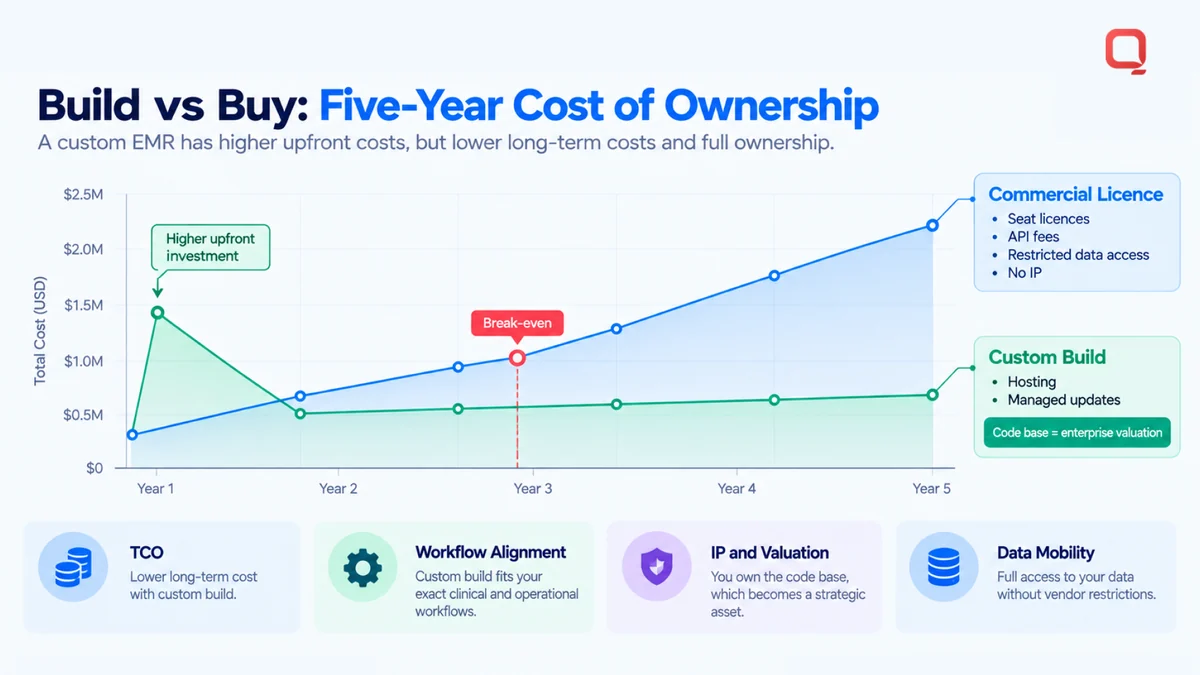
Deciding between licensing a commercial platform and building proprietary healthcare software comes down to control versus compromise. Commercial off-the-shelf platforms deliver rapid initial deployment, but they extract steep ongoing costs in seat licenses, rigid interface configurations, and developer API fees. When vendor roadmaps ignore your clinical priorities, operational bottlenecks stall practice expansion. Tailored emr software development shifts the financial dynamic from perpetual operational overhead to proprietary capital value.
Build vs. Buy Evaluation Matrix for Healthcare Organizations
Healthcare organizations must weigh several trade-offs when determining their software delivery model:
- Total Cost of Ownership (TCO): Commercial licenses create recurring per-seat expenditures that scale relentlessly with staff growth. Custom builds require upfront engineering capital, but they cap ongoing software expenses strictly to hosting infrastructure and managed updates.
- Workflow Alignment: Off-the-shelf software forces providers to conform to generic documentation templates. Bespoke systems mold directly around specialized ambulatory routines, reducing daily charting steps and cutting operational drag.
- Intellectual Property and Valuation: Commercial systems leave you with zero tech equity. Owning your code base turns software from a monthly expense into valuable intellectual property that increases enterprise valuation.
- Data Mobility: Commercial vendors often restrict bulk queries or charge high fees for raw database access. Proprietary architectures give you immediate ownership of your patient data schemas.
Selecting a Healthcare Software Engineering Partner
Building clinical software in-house from scratch without specialized talent risks massive budget churn. Legacy data migration alone introduces major pitfalls; transforming decades of unstructured clinical notes, fragmented lab histories, and custom encounter records into modern schemas requires zero-downtime cutover planning. A single corrupt mapping table can compromise continuity of care during a Monday morning clinic shift.
Mitigating these engineering hazards demands a battle-tested partner. Look for organizations holding verified CMMI Level 3 maturity ratings and ISO 27001:2013 information security management certifications. Engineering teams must demonstrate deep proficiency writing production pipelines across HL7 v2, FHIR, Mirth Connect, and DICOM frameworks. To accelerate time to deployment without taking on architectural debt, you can explore healthcare engineering with QSS Technosoft. Backed by 15+ years of engineering experience and over 250 in-house engineers, vetted teams deliver robust emr software development that ensures your platform deploys cleanly, scales predictably, and stays compliant.
Engineering a High-Performance Clinical Foundation
Clinical software shouldn’t slow your providers down or lock your practice into rigid licensing cycles. Successful emr software development hinges on three non-negotiables: ergonomic charting that respects physician time, native FHIR and HL7 data exchange, and compliance-by-design architectures that treat security as code. When you build with clear domain boundaries and scalable pipelines, you eliminate vendor lock-in and turn routine charting into clean, structured data.
Executing that vision requires battle-tested engineering. As a CMMI Level 3 and ISO 27001:2013 certified software engineering firm, QSS Technosoft brings a proven track record delivering custom EHR/EMR platforms, FHIR APIs, and integrated DICOM/PACS viewers. Our senior-led engineering teams, backed by 250+ in-house technical specialists, solve complex backend hurdles long before code reaches production. Ready to take full ownership of your clinical technology? Accelerate your clinical software roadmap with QSS Technosoft and build a resilient platform clinicians genuinely rely on every day.
Ready to take full ownership of your clinical technology?
A 30-minute conversation with a healthcare solutions architect, not a salesperson. Bring the workflow that costs your clinicians the most time; we will walk through the modules, integrations and compliance controls it needs, and what a focused EMR would cost and take to build. You keep the written notes either way.
Book a Discovery Call →