Healthcare Analytics Solutions: A Practical Buyer’s Guide
 By Vineet Bhardwaj
QSS Technosoft
September 30, 2026
14 min read
By Vineet Bhardwaj
QSS Technosoft
September 30, 2026
14 min read
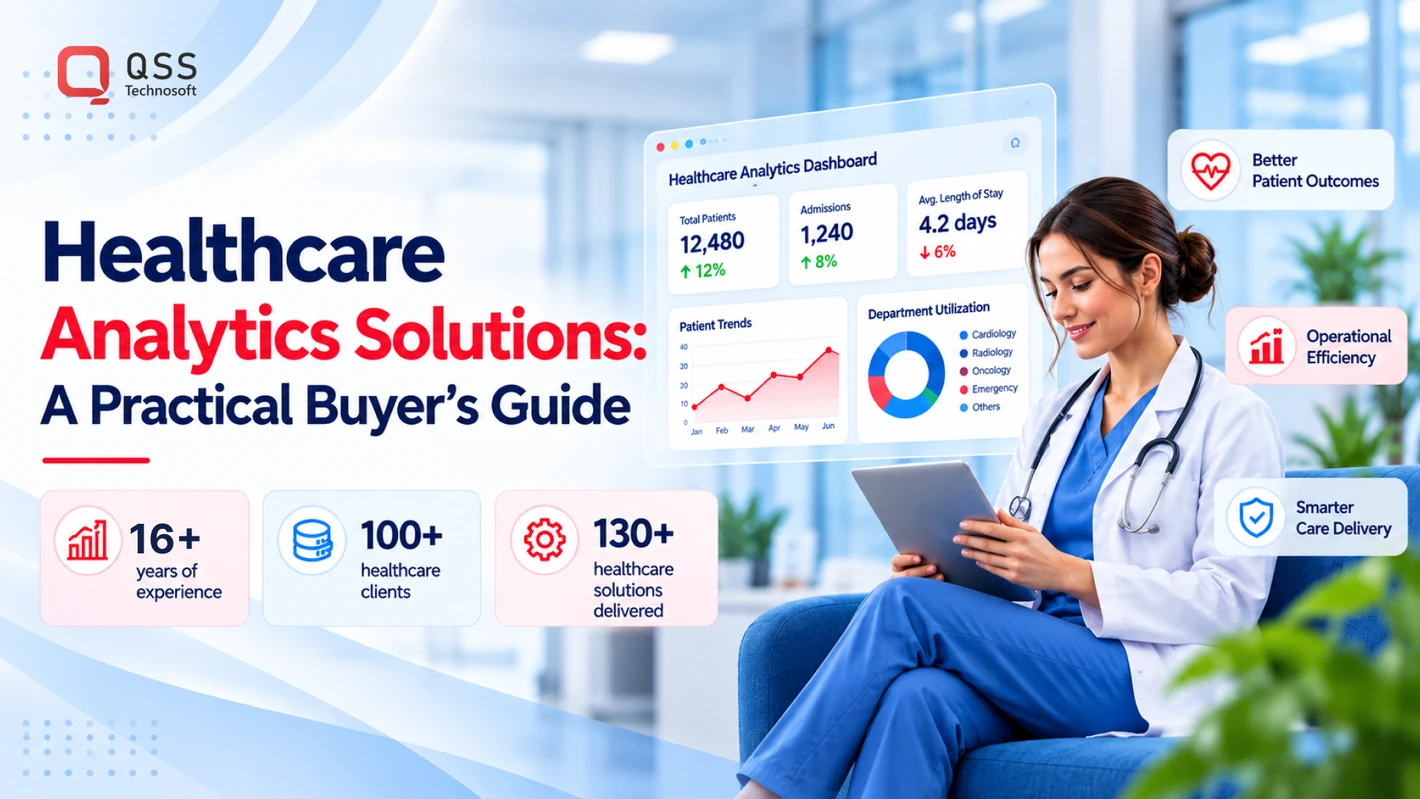
The best healthcare analytics solution isn’t the one with the longest feature list. It’s the one that helps your team make a specific decision using data it can access, trust, and act on. That can be difficult when clinical and operational information sits across disconnected systems.
A polished demo can make a tool look straightforward, but buyers also need to check whether it fits existing workflows, connects with the required systems, and supports sound data governance. Integration, data quality, and ownership matter as much as analytics features.
This guide explains how to compare healthcare analytics solutions by the decisions they support, assess data readiness, and plan for the integration and governance work implementation requires. You’ll find practical criteria for evaluating data sources, interoperability, workflow fit, and ongoing ownership. The goal is to choose an approach grounded in measurable needs, not a demo that leaves the hard work to your team.
What healthcare analytics solutions do, and which decisions they should support
Healthcare analytics turns health data into information people can use for operational or clinical decisions. A dashboard is only one way to present that information. Data may include claims, clinical records, research, and patient behavior. Its value depends on whether it informs a real decision, not simply whether it can be displayed.
Different teams can ask different questions of the same data. An executive may review service performance to decide where to focus resources. A clinical leader may examine care coordination patterns to identify handoffs that need attention. Finance may analyze claims to prioritize items for review, while operations may look at activity to plan staffing or capacity. Each use requires agreed definitions and data suited to the question.
Analytics can range from descriptive reporting to predictive analysis and decision support. Reports summarize recorded activity. Predictive analytics identifies patterns that may help estimate future events or needs, but it cannot guarantee what will happen. Decision support presents information within a particular choice or workflow. People remain accountable for how that information is used.
Which healthcare decisions can analytics support?
Start by identifying who makes the decision and what they need to decide. An operations manager might use service-performance reporting to investigate delays or plan capacity. A finance team could use claims analysis to prioritize items for review. A care coordinator might use relevant patient information to organize follow-up across teams. These are potential uses, not promised outcomes.
Clinical applications call for particular care. Before analytics informs care decisions, organizations need appropriate validation, governance, and workflow fit. A signal that arrives late, lacks context, or interrupts clinical work may not be useful in practice.
Which measures do healthcare teams actually track?
Decisions are easier to scope when the measure behind them is named. Most healthcare analytics work is commissioned to move one of a fairly small set of numbers, and each of those numbers has an owner, a definition dispute, and a source system attached to it. Identifying yours early tells you which data you need and who has to agree on what it means.
| Team | Measures commonly tracked | The usual complication |
|---|---|---|
| Clinical operations | Average length of stay, thirty-day readmission rate, emergency department boarding time, operating room utilisation and turnover | Exclusion criteria. Two departments rarely define a readmission or an observation stay the same way, and the difference changes the number materially. |
| Revenue cycle | Denial rate, days in accounts receivable, clean claim rate, cost to collect, prior authorization turnaround | Denials are recorded in the billing system but caused upstream in registration and coding, so the analysis has to cross systems to be actionable. |
| Access and scheduling | Third next available appointment, no-show rate, referral leakage, cycle time | Scheduling data is often the least governed data in the organisation, with free-text reasons and inconsistent cancellation codes. |
| Quality and value-based care | Quality programme measure performance, star ratings, gaps in care closure, risk adjustment and condition recapture | These measures have externally published specifications, so local definitions cannot be improvised. The analysis has to match the programme. |
| Workforce | Turnover, agency and premium labour spend, overtime as a share of worked hours, vacancy rate | Workforce data usually sits in a separate system with its own access rules, which is a governance question before it is a technical one. |
| Executive and finance | Contribution margin by service line, case mix index, payer mix, cost per case | Every one of these depends on an allocation method that finance owns and that analytics cannot decide unilaterally. |
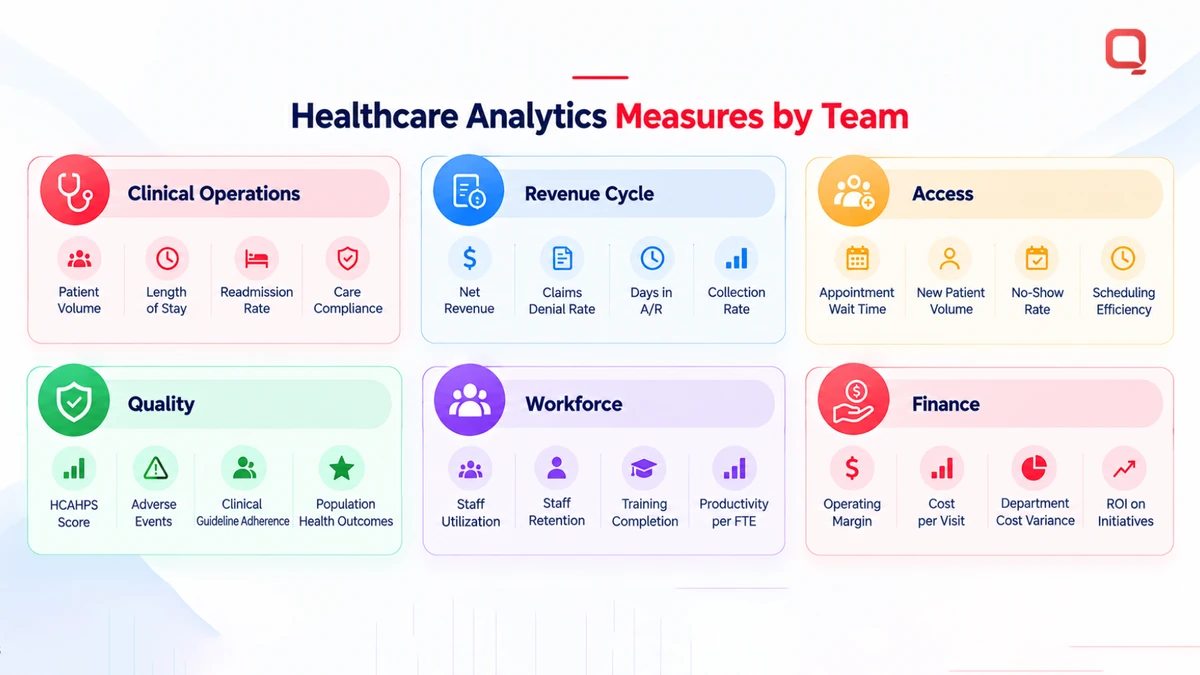
Pick one measure, one owner, and one decision that changes when the number moves. That is a scope. A request for a dashboard covering all six areas is not a scope; it is a budget waiting to be spent without a result.
What is the difference between reports, BI, and predictive analytics?
Reports provide structured views of recorded activity, such as service volumes or claims status. Business intelligence (BI) lets users explore and compare data, often through dashboards and data visualization. Predictive analytics examines data for patterns that may help estimate future events or needs. It can support investigation and planning, but it cannot remove uncertainty.
QSS Technosoft lists dashboards, BI, data visualization, and predictive analytics among its data engineering and analytics capabilities. Evaluate each against a defined decision and the data available to support it. A polished dashboard can’t correct inconsistent definitions or missing information. Start with the question, then determine which analytical approach can answer it responsibly.
What rules apply to predictive analytics in healthcare?
Predictive analytics in healthcare is no longer only a technical and clinical question. Under the ONC HTI-1 final rule, the older clinical decision support certification criterion was replaced by a decision support intervention criterion, which introduced a defined category of predictive decision support intervention. Where a certified health IT developer supplies one, the module must make an expanded set of source attributes available: thirteen for evidence-based interventions and thirty-one for predictive ones, covering purpose, development, training data, validity, fairness and ongoing maintenance. Developers also carry continuing obligations to keep that information current.
Most buying organisations are not certified health IT developers, so the certification requirement may not apply to them directly. The transparency baseline it sets still matters, for two reasons. It establishes what a reasonable buyer is now entitled to ask about any model that will influence a clinical decision. And if a predictive model is delivered inside a certified system, that information should already exist, so a vendor that cannot produce it is telling you something.
- What is the intended use, and which populations were excluded from training?
- What data was it trained on, and how closely does that population resemble ours?
- Has validity been assessed on local data, not only on data from the training source?
- Has fairness been assessed across demographic groups, and what was found?
- How often is performance re-evaluated, and what happens when it degrades?
- Is the output a prediction, a classification, a recommendation or an evaluation, and who is accountable for acting on it?
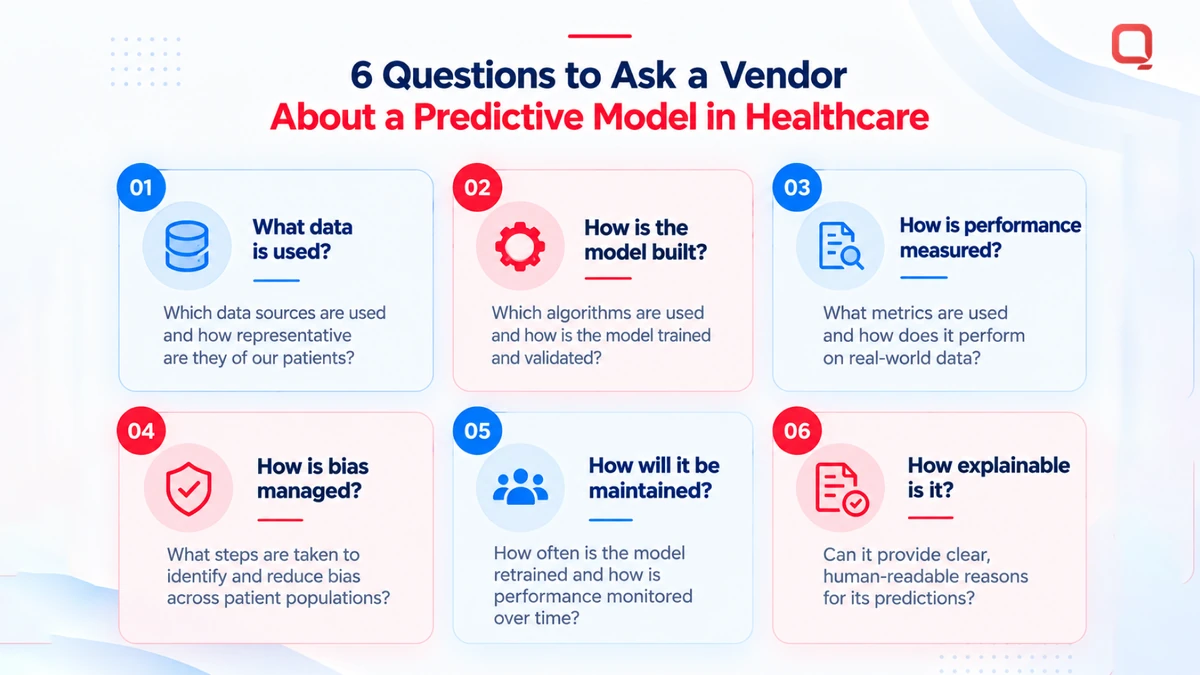
A model that cannot answer these is not necessarily a bad model, but it is an unevaluated one, and it should not be the basis of a clinical workflow change.
How healthcare analytics solutions move data from source systems to usable insight
Analytics is only as reliable as the quality, meaning, and context of the data behind it. A clean chart can still mislead if records are incomplete, terms mean different things across systems, or users can’t trace a measure to its source. Healthcare analytics solutions need a clear path from source data to a decision, with checks and ownership at each stage.
Start with the decision, not the software. Define what someone needs to know, identify which source systems hold the relevant information, then integrate and validate the data. Analyze it and place the findings in the workflow where they can be used. The Healthcare Analytics Adoption Model offers a framework for considering analytics maturity. Buyers can use that perspective to set expectations for what their organization is ready to support.
Which data sources and standards may matter?
Relevant sources depend on the systems in place and the decision being considered. EHR/EMR platforms may hold clinical and encounter data. Operational systems may contain scheduling, staffing, or financial records. Imaging data may be relevant to a use case involving radiology or other diagnostic images, where DICOM and PACS medical imaging solutions are used.
HL7 and FHIR are interoperability standards that can support data exchange between systems. They aren’t analytics products, and adopting a standard doesn’t automatically resolve mismatched definitions or incomplete records. Confirm which systems, interfaces, and data elements the intended analysis requires. Our healthcare data integration checklist works through the same ground from the integration side.
What belongs in a practical analytics architecture?
A workable design typically connects source systems to data pipelines, validates incoming information, and organizes it in governed storage before analysis and dashboard delivery. Keep each stage visible. If a number looks wrong, teams should be able to trace it to its source and understand how it was transformed.
Access controls, auditability, and named data stewards also belong in the design. Define who can see sensitive information, who checks data quality, and who resolves conflicting definitions. These are governance decisions to confirm against organizational requirements, not automatic features of an analytics platform.
- Connect: Map the required systems and confirm how data can be accessed.
- Validate: Check completeness, consistency, and agreed definitions.
- Operationalize: Deliver appropriate views to users and assign responsibility for upkeep.
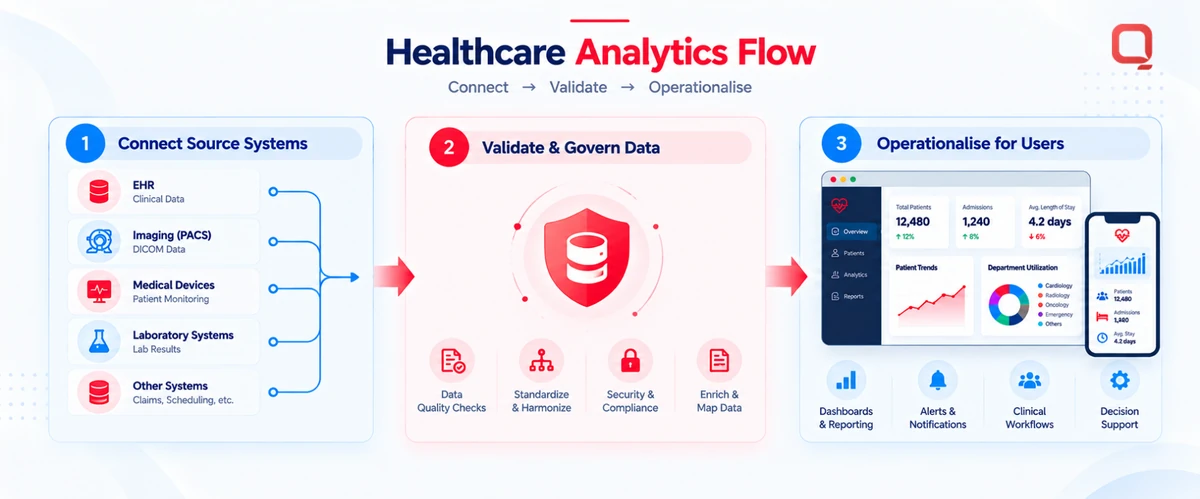
Cloud deployment or connections to legacy systems should reflect the organization’s architecture and verified requirements. QSS lists data pipelines, dashboards, and BI among its capabilities, alongside healthcare interoperability and EHR and EMR development and integration. If system connections are central to your analytics plan, you can discuss healthcare data integration with QSS.
How does data governance work in an analytics project?
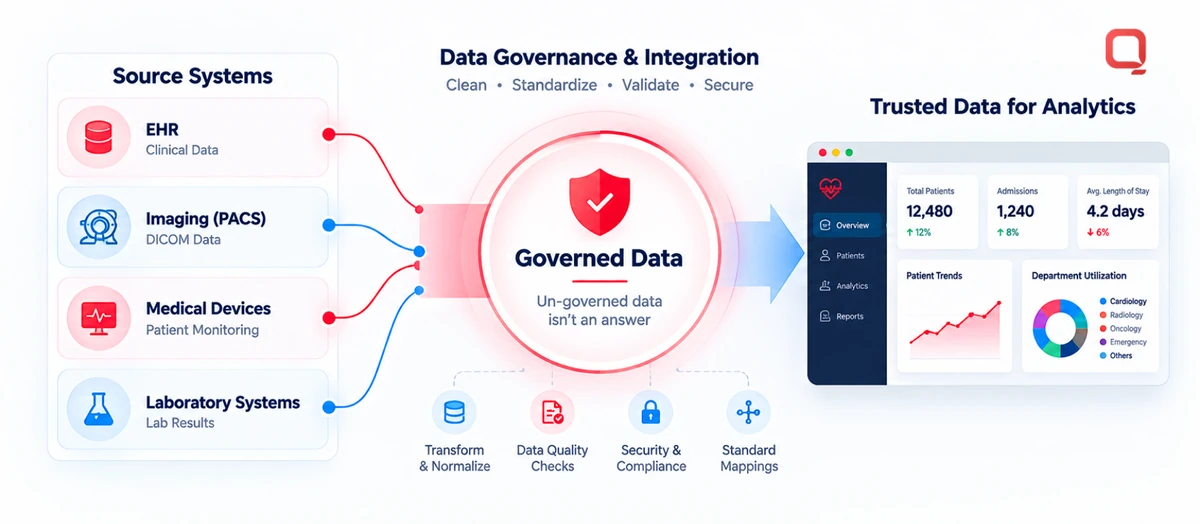
Governance sounds like policy, but in an analytics project it resolves to a few concrete questions with named answers. The most common failure in healthcare analytics is not a broken pipeline. It is two dashboards showing different numbers for the same measure, each defensible, and no one with the authority to say which is correct.
| Question | What a good answer looks like |
|---|---|
| Who defines the measure? | A named owner per measure, usually in the business function that acts on it, with the definition written down in language a non-analyst can check. |
| Where does the definition live? | In one place that the reporting layer reads from, rather than repeated inside each dashboard. A semantic or metric layer is how this is usually implemented; without one, every new report is a new opportunity to disagree. |
| Who can publish a number? | A distinction between certified reporting that leadership acts on and exploratory analysis that anyone can build. Both are legitimate; conflating them is what erodes trust. |
| Who can see what? | Role-based access agreed with privacy and security, with a documented position on identified versus de-identified data for each use case. |
| How do we trace a number back? | Lineage from the figure on screen to the source field, so that a challenged number can be investigated rather than defended. |
| Who reviews data quality? | A named steward per source system, and a standing review, rather than investigation only when someone complains. |
Assign these before the first dashboard is built. Retrofitting governance onto a reporting estate that already has competing numbers in circulation is substantially harder than establishing it at the start, because by then people have built decisions on both versions.
How to compare healthcare analytics solutions beyond dashboard features
Buyer rule: assess decision fit and data readiness before counting dashboard features. A tool can look polished in a demo yet fall short if it can’t connect to the right systems, apply consistent definitions, or fit the way teams work. Compare each approach against your use case and the effort required to keep it reliable.
| Approach | Data-source fit | Trade-off to test | Best fit when |
|---|---|---|---|
| Packaged BI | Connectors and supported sources vary by product. | Can speed up standard reporting, but may leave gaps in specialized workflows. | Core questions are well-defined and sources are supported. |
| Analytics platform | May bring data management and analysis capabilities together. | Confirm integration, governance, and workflow limits with the vendor. | The organization needs a broader shared analytics environment. |
| Custom engineering | Can address specific data models and system connections. | Requires clear ownership for maintenance, security, and documentation. | Standard functionality doesn’t cover a necessary workflow or integration. |
| Hybrid approach | Combines existing tools with targeted extensions or integrations. | Flexibility comes with added coordination across components and owners. | Some reporting is standard, while specific needs require additional work. |
For every option, evaluate interoperability, governance, workflow usability, scalability, and support ownership. Ask who will maintain connections, resolve data-definition conflicts, manage access, and respond when a source system changes. A vendor’s feature list won’t answer those operational questions.
When is an existing analytics platform enough?
An existing platform may be sufficient when the required source systems connect and standard reporting answers the organization’s core questions. Before selecting one, verify data access, definitions, user permissions, and whether intended users can fit the tool into their workflow. Ask the vendor to demonstrate relevant capabilities and limitations against your requirements, rather than relying on a generic demo.
What kinds of analytics tooling are available?
The four approaches in the table above map onto real product categories, and most healthcare organisations already own something in at least two of them. Knowing which, before evaluating anything new, usually narrows the decision considerably.
| Category | What it is | When it is the answer |
|---|---|---|
| EHR-native analytics and reporting | The reporting, data warehouse and dashboard tooling supplied by your EHR vendor, built around that vendor’s own data model. | The question is answerable entirely from data already inside the EHR, and your team has the vendor-specific skills in house. Usually the fastest route and the hardest to extend beyond one vendor’s data. |
| General business intelligence tools | Enterprise BI and visualisation platforms used across all industries. | Data has already been integrated and modelled somewhere else, and the need is presentation, exploration and distribution. They are not integration tools, and treating them as such is a common and expensive mistake. |
| Cloud data platforms | Warehouse and lakehouse platforms, plus the healthcare-specific data services the major cloud providers offer for FHIR storage, message ingestion and de-identification. | Multiple source systems must be combined, or volumes exceed what departmental tooling handles. Check data residency and cost at your actual volumes. |
| Healthcare-specific analytics products | Vendor products built for defined healthcare problems: quality measure reporting, risk adjustment, population health, revenue cycle analytics. | A measure with an external specification is being reported and the product already implements that specification. Buying this is usually cheaper than rebuilding the specification yourself. |
| Custom engineering | Pipelines, models and interfaces built for your environment. | A required integration, data model or workflow falls outside what the categories above support. Scope it to the gap, not to the whole estate. |
When should buyers consider custom analytics engineering?
Consider custom work when a required integration, data model, or workflow exceeds standard functionality. Flexibility is useful, but it doesn’t remove the need to plan for maintenance, security ownership, documentation, and future integrations. Compare those responsibilities alongside fit. Custom development isn’t automatically better or less costly; it makes sense when the specific gap justifies the added work.
Use a simple scorecard: define the decision, confirm that the data is accessible and usable, then rate each approach against the same criteria. This keeps healthcare analytics solutions grounded in what teams can implement and support, not just what looks impressive on screen.
How to assess readiness and plan a healthcare analytics implementation
A practical implementation plan starts with decisions, not a platform shortlist. Define the decision to support, inventory the data behind it, assess quality and access, prioritize use cases, then confirm scope with the people who will use and maintain the solution. This sequence helps reveal whether the main constraint is technology, data, governance, or workflow.
Assess technical and organizational readiness separately. Technical readiness covers source systems, interfaces, data definitions, quality, and permissions. Organizational readiness means decision owners are identified, teams understand their responsibilities, and users have time and training to adopt the work. Strong infrastructure won’t solve unclear ownership, and a polished dashboard won’t fix a workflow no one has agreed to change.
What should a healthcare analytics readiness assessment examine?
Inventory relevant source systems, interfaces, data definitions, known quality issues, and current reporting processes. Then review privacy, security, access, retention, and governance requirements with the responsible stakeholders. Requirements can vary by use case and organization, so confirm them instead of assuming a standard configuration will fit.
Identify who owns the decision and who acts on the findings. For example, if an operational team will use an analysis to review capacity, define who reviews the information, how often, and what follow-up process applies. If no one can explain how an insight changes a decision, the use case needs clearer boundaries.
How can buyers reduce implementation risk?
Choose a bounded initial use case with a named user, a defined decision, an accessible data source, and a review process. Set acceptance criteria before development begins. Specify which data must be represented, which roles can access the output, how users will verify the information, and how exceptions should be handled. Keep the scope focused enough to test the full path from source data to actual use.
Before expanding, test data lineage, permissions, usability, and exception handling with the people responsible for the workflow. Document what happens when source data is delayed, incomplete, or inconsistent. These checks can expose failure points while the scope is still manageable.
Plan for ongoing monitoring and maintenance. Assign responsibility for data-quality review, access changes, interface updates, and user feedback. Go-live is a handoff, not the finish line. Healthcare analytics solutions need operational owners who can keep data and workflows aligned as systems and needs change.
If you’re defining scope or checking technical readiness, discuss your healthcare analytics requirements with QSS.
Where QSS fits when healthcare analytics needs engineering and integration
Some analytics projects need more than a reporting tool. They may require data pipelines to connect information, dashboards or BI to present it, and analysis designed around a defined workflow. QSS lists data pipelines, dashboards, BI, data visualization, and predictive analytics among its data engineering and analytics capabilities. The right fit depends on your source systems, the decision you need to support, and the integration work involved.
Engineering and interoperability may also matter when analytics relies on data from EHR/EMR systems or imaging workflows. QSS offers healthcare interoperability, EHR and EMR development and integration, and DICOM and PACS medical imaging solutions. Confirm which systems, interfaces, and data elements are supported for your specific scope. A listed capability is a starting point for due diligence, not a substitute for a technical fit review.
What should buyers validate with a potential engineering partner?
Ask who will own architecture decisions, system integration, security controls, testing, and ongoing support. Request details about experience with the relevant systems and the specific integration capabilities your project requires. Make accountability concrete: who reviews test results, documents data flows, and handles changes when a connected system or workflow changes?
Assess how the partner communicates decisions, risks, and open dependencies, too. You don’t need to assume a particular team structure. You do need clear points of contact, ownership, and a way to resolve issues before they stall delivery.
What information should you bring to an initial discussion?
Prepare a concise brief covering the business decision, intended users, source systems, and known data-quality issues. Include applicable privacy, security, interoperability, and infrastructure requirements, along with constraints around access or existing workflows. This gives both sides a practical basis for assessing fit instead of discussing analytics in the abstract.
Bring the difficult details, too: legacy interfaces, inconsistent definitions, approval dependencies, or unclear ownership. If you’re evaluating healthcare analytics solutions that depend on system connections, discuss your data sources and integration requirements with QSS to explore a practical next step.
Where does QSS fit?
We are an engineering firm, not an analytics product vendor. That shapes what we are useful for. We build the data path: pipelines from clinical, operational and imaging systems, the integration work underneath them, governed storage, the definition layer, and dashboards or models on top. We do not sell a platform, so we have no stake in which one you choose, and we will say when the tool you already own is sufficient.
- Data pipelines, warehousing and analytics engineering
- Dashboards, business intelligence and data visualisation
- Predictive modelling and machine learning
- Healthcare interoperability, HL7 and FHIR
- EHR and EMR development and integration
- DICOM and PACS imaging solutions, where imaging data feeds the analysis
Choose an analytics path your teams can sustain
The right healthcare analytics solutions start with a defined decision, usable data, and a workflow people can follow. Compare options on integration, governance, usability, and long-term ownership, not dashboard features alone. Then scope a practical first use case with clear acceptance criteria and accountable owners.
For analytics that depends on healthcare system connections, QSS offers relevant engineering capabilities, including healthcare interoperability, EHR/EMR development and integration, and DICOM/PACS medical imaging solutions. Confirm the project’s architecture, integration needs, security controls, and compliance requirements as part of your evaluation.
Bring your intended decision, users, source systems, known data issues, and infrastructure constraints to the discussion. Discuss your healthcare analytics requirements with QSS to explore whether its engineering and integration capabilities fit your needs. Start with the real workflow, ask direct questions, and build from evidence.
Bring the decision, the systems and the data you already distrust
A 30-minute working session with a healthcare data engineer, not a salesperson. Bring one decision you want analytics to support, the systems that hold the data, and the definitions your teams argue about. We will map the path from source to decision, name what is missing, and tell you where the tooling you already own is enough. You keep the written notes either way.
Discuss your healthcare analytics requirements →