Healthcare Data Integration Services: A Practical Data Quality Checklist
 By Rashmi Kanti
QSS Technosoft
September 28, 2026
10 min read
By Rashmi Kanti
QSS Technosoft
September 28, 2026
10 min read
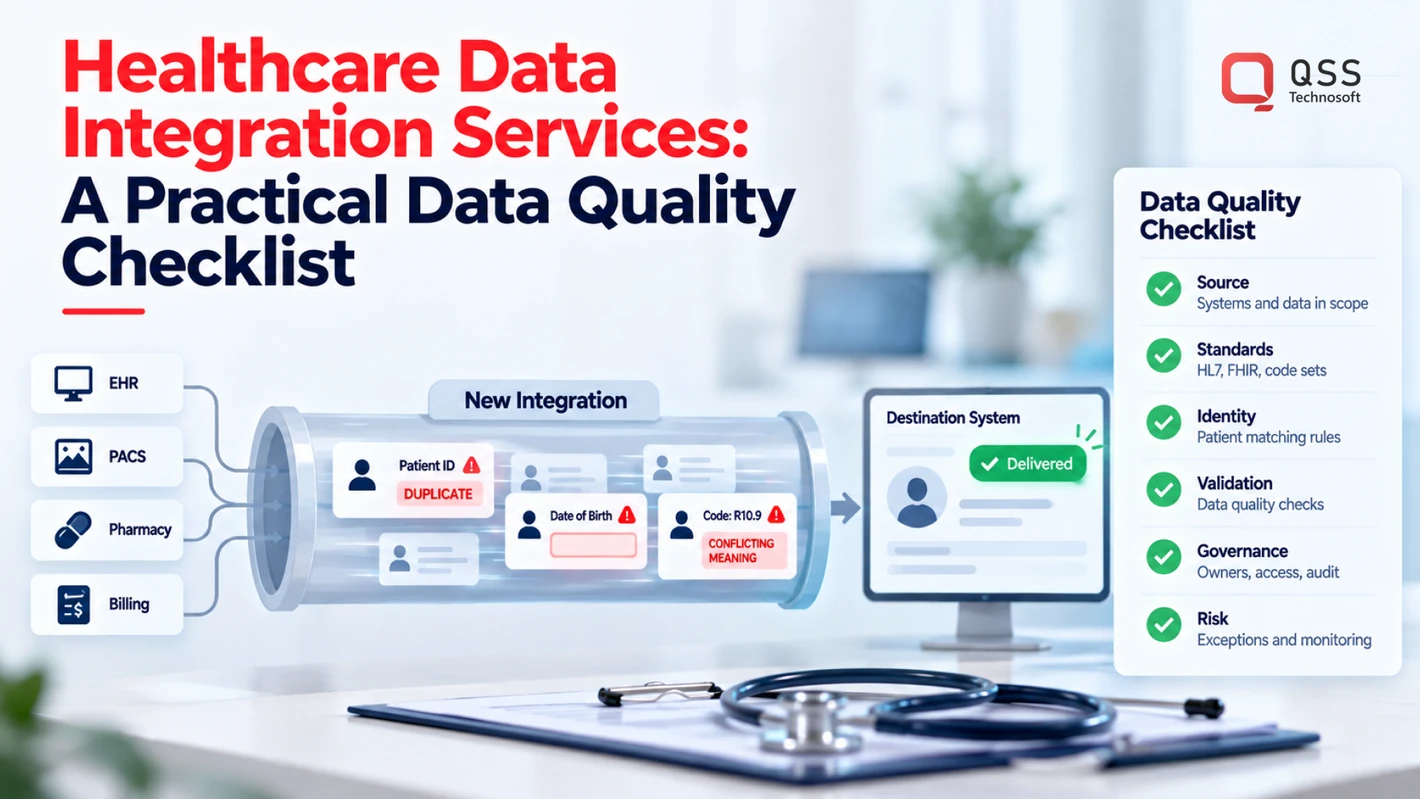
What if connecting another system simply moves bad data faster? Healthcare data integration services can link EHRs, billing platforms, imaging systems, and other tools, but a connection does not make patient records consistent, complete, or useful. Legacy platforms and mismatched formats can carry errors across an entire workflow.
Healthcare teams need information to move between systems, but they also need to know what is being transformed, where it is stored, and who can access it. Gaps in those details can create data quality, privacy, security, and operational risks.
This practical checklist helps you assess readiness before connecting systems. You will review source data, standards and formats, identity matching, validation, governance, and risk controls, then identify gaps that could undermine downstream use. It also clarifies the difference between exchanging data and making it dependable enough for care, operations, or reporting.
Use the checklist to evaluate a potential integration partner’s healthcare interoperability experience. Look for evidence that the team can work with the systems and standards in your environment, not just an idealized architecture. Start with the data, then plan the connection.
Quick Answer
A connection proves data moved; it does not prove the data is accurate, complete, consistent or fit for use. Before integrating, define the workflow and its scope, name the source and destination systems and the people who own and can correct each source, document what every field means and how it maps, and set validation rules for completeness, format, identifiers and delivery, with an owned exception queue and reconciliation. Compare point-to-point, interface-engine and API-based patterns against the systems you actually run, and choose a partner who can walk through a real data flow, including an exception and its resolution. Start with the data, then plan the connection.
Healthcare data integration services: what they connect and what they do not
Healthcare data integration is the controlled exchange and use of information between systems. Healthcare data integration services can move information between EHR/EMR platforms, health information exchanges (HIEs), picture archiving and communication systems (PACS), pharmacy applications, billing tools, and operational software. The aim is to make specific data available for a defined workflow, not simply to create a technical link.
That distinction matters. A message can reach its destination and still contain an incorrect identifier, a blank field, or a code that means something different to the receiving system. Connectivity describes whether information moves. Data quality describes whether it is accurate, complete, consistent, and fit for its intended use. A successful transmission does not prove the information is trustworthy.
Which healthcare systems and data flows may need integration?
Start with the workflow, then identify the systems that support it. Clinical records may hold diagnoses and encounter details. Imaging systems manage image-related information, pharmacy applications support medication workflows, and billing platforms contain financial and claims data. Patient-facing tools may exchange appointment requests, forms, or other information with clinical systems. These sources have different structures and purposes.
An EHR/EMR, HIE, or PACS may be in scope, but none should be assumed. The right boundary depends on the organization’s existing systems, the people who own them, and what users need the exchanged information to do. Define the use first, then trace the data flow.
Why does connected data still create quality problems?
Systems can identify the same patient differently, use different names for a field, or record the same concept in incompatible formats. A missing value may mean “unknown” in one application and “not applicable” in another. If teams do not map and check those differences, downstream users may see a confusing or incomplete record even when the interface reports successful delivery.
Standards can make exchange more consistent, but they do not settle every local definition or correct poor source data on their own. For example, Fast Healthcare Interoperability Resources (FHIR) provides a framework for exchanging healthcare information electronically. Teams still need to define how fields map, which values are acceptable, and how exceptions are handled. Treat transport success and information quality as separate checks.
How healthcare data integration preserves meaning across systems
Reliable exchange takes more than a sender and receiver. A practical integration flow starts with an assessment of the source: what data it holds, how it represents that data, and which workflows depend on it. Engineers then map fields, transform values where needed, validate the result, deliver it to the destination, and monitor the flow for errors or changes.
Field mapping must preserve clinical meaning, not just place values in matching fields. A code or status that looks similar across two systems may have a different definition or role. Before translating it, confirm how the source uses it, how the destination interprets it, and what the receiving workflow requires.
Where do HL7, FHIR, and DICOM fit?
HL7 is a family of standards used in healthcare information exchange, including message-based workflows. FHIR is a separate standard designed to support electronic exchange through defined resources and interfaces. The right fit depends on the systems, workflow, and capabilities involved. Neither standard removes the need for agreed mappings and local implementation decisions.
Imaging has its own exchange needs. DICOM supports the handling and exchange of medical imaging information, while a PACS manages image storage and access. HIE connections support information sharing across organizations. The Office of the National Coordinator for Health Information Technology describes how they help providers securely share a patient’s vital medical information. These are related parts of an interoperability environment, not interchangeable tools.
What quality checks belong in an integration flow?
Build checks around the data and its intended use. At minimum, validate:
- Completeness: Required fields are present, and missing values are handled deliberately.
- Format and expected values: Dates, codes, and statuses follow agreed rules.
- Identifier consistency: Patient and record identifiers are present and reconciled as intended.
- Delivery and exceptions: Failed or questionable records are captured for investigation rather than silently dropped.
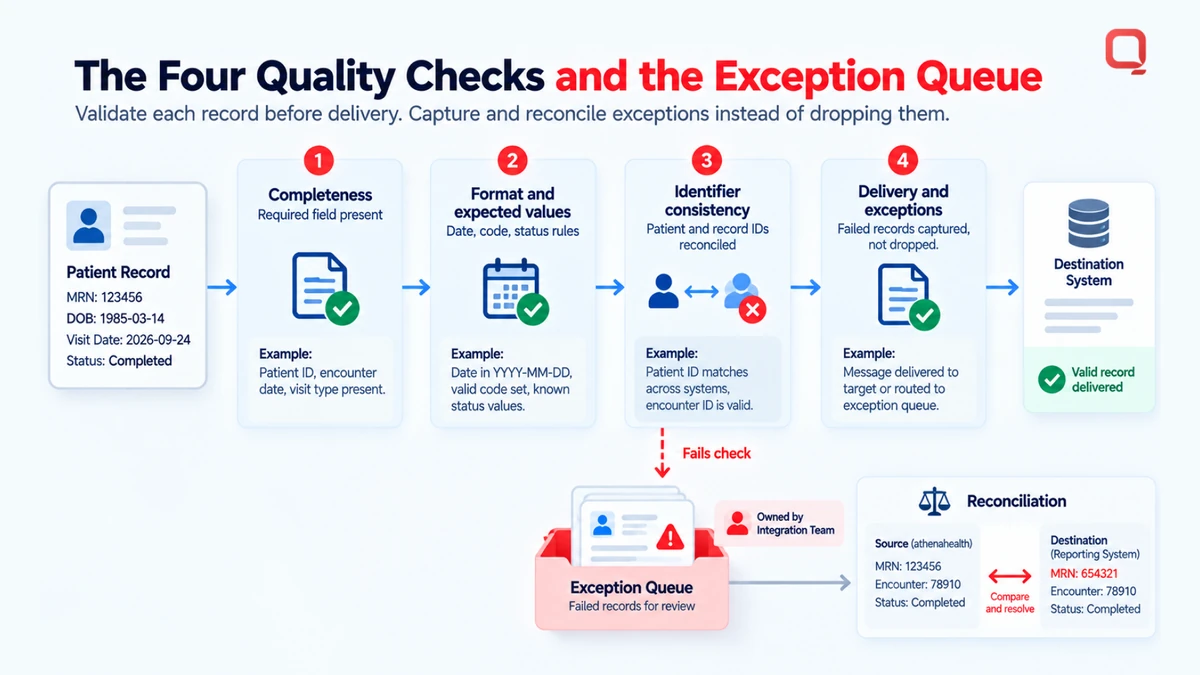
An exception queue gives teams a place to review records that fail a rule. Reconciliation helps compare source and destination records to identify what needs correction. Assign an owner for each source and define who can correct the underlying data. Otherwise, technical teams may be left patching errors they do not control.
Healthcare data integration services should include these checks in the design and ongoing monitoring, not treat them as a one-time test before launch. If you are assessing an exchange workflow, review your healthcare interoperability requirements with a team familiar with healthcare systems and data flows.
Choosing healthcare data integration services: compare the approach, not just connectivity
The right architecture depends on the workflow, the systems already in place, and who will maintain the connection after launch. The Office of the National Coordinator for Health Information Technology describes interoperability as the seamless exchange of electronic health information. In practice, exchange must also fit the organization’s data ownership, security controls, and operational needs. A newer interface is not automatically a better fit for a legacy EHR or a workflow that cannot tolerate delays.
Compare the trade-offs before committing. Healthcare data integration services may use several patterns, sometimes within the same environment.
- Point-to-point: A direct connection can suit a limited, stable exchange. As connections multiply, dependencies can become harder to trace, test, and change.
- Interface engine: A central integration layer can help manage multiple message flows and transformations. It also adds a platform to configure, monitor, and maintain. QSS works with Mirth Connect and Iguana environments.
- API-based exchange: APIs can support defined, request-based access between systems. Their usefulness depends on what each system exposes, access controls, and the workflow’s timing needs.
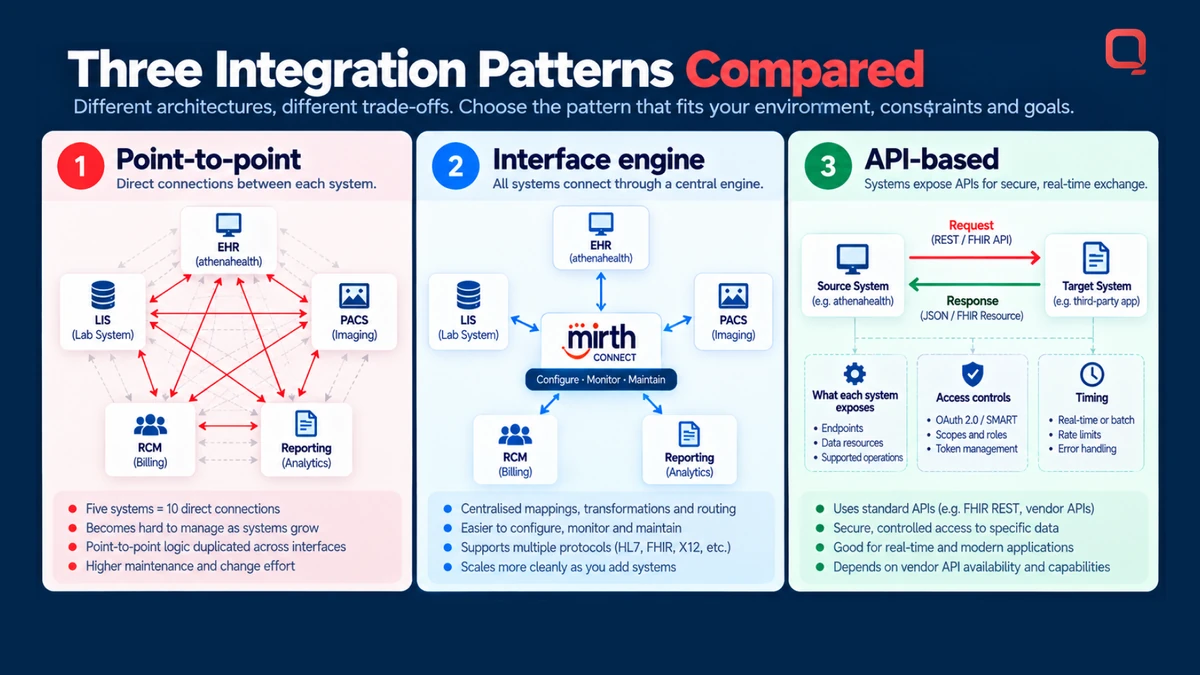
These are not interchangeable recipes. Existing infrastructure, vendor constraints, data volume, latency expectations, and system ownership can change the answer. Confirm what is supported and flag what still needs technical validation.
What should a healthcare integration provider demonstrate?
Ask for relevant experience with the actual systems, interfaces, and workflows in scope, not just broad healthcare claims. A capable provider should explain how the team will document field mappings, validation rules, dependencies, and exception paths. Clarify who owns architecture, security decisions, testing, monitoring, and post-launch support. If responsibilities are vague before implementation, they may remain vague when an interface fails.
How should teams evaluate technical and operational fit?
Check compatibility with the current EHR/EMR, HIE, imaging, and operational environments. Then assess data latency, workflow impact, maintainability, and monitoring requirements. A technically valid exchange can still disrupt operations if data arrives too late or staff do not know how to handle errors. Separate confirmed capabilities from assumptions that require discovery, vendor input, or testing.
Use these comparison questions:
- Approach: Which systems and workflows does it fit? What dependencies does it introduce?
- Quality: How are mappings and validation rules documented and tested?
- Operations: How are failures monitored, investigated, and reconciled?
- Ownership: Who maintains the interface and supports changes after launch?
Before choosing, ask each provider to walk through a real data flow, including an exception and its resolution. To assess your healthcare interoperability needs, review the requirements with the QSS Technosoft team.
Healthcare data integration checklist: assess readiness before implementation
A discovery meeting should end with more than a diagram of connected systems. Before development starts, teams need a shared record of why data will move, who owns it, what it means, and how they will know the exchange works. Use this checklist to expose missing decisions early. The answers help scope healthcare data integration services around actual workflows instead of assumptions.
What should teams document before development begins?
Describe the business purpose in plain terms, such as making selected clinical information available to a downstream workflow. Name the source and destination systems, data owners, users, and the decisions or tasks the data will support. Capture constraints too, including unavailable fields, inconsistent source values, or dependencies on another system.
- Purpose and scope: What workflow needs the data, which information is in scope, and what is explicitly out of scope?
- Systems and ownership: Which systems send and receive data? Who can explain, approve, and correct each source?
- Definitions and mapping: What does each field mean? How will values, identifiers, and transformations map to the destination?
- Acceptance criteria: Which fields are required, what formats and values are valid, and what should happen when a record fails a check?
- Exceptions and escalation: Who investigates incomplete, conflicting, or rejected records, and how are unresolved issues escalated?
- Security and auditability: Who needs access, how is access controlled, and what activity must be recorded for review?
How can teams test data quality and production readiness?
Test with representative records and edge cases, not only a clean sample. Include missing fields, unexpected values, duplicate or inconsistent identifiers, and records that fail delivery. Ask accountable clinical, operational, and technical stakeholders to confirm that transformed data remains understandable and supports the intended workflow.
Before launch, agree on how the team will detect and investigate rejected, delayed, duplicated, or incomplete data. Test recovery and reconciliation paths so staff know what happens after an interruption or failed message. Monitoring should make exceptions visible to the people responsible for resolving them, not simply generate alerts no one owns.
Close the readiness review by confirming who maintains mappings, reviews issues, approves changes, and supports the integration after handoff. Keep documentation current as source systems and workflows change.
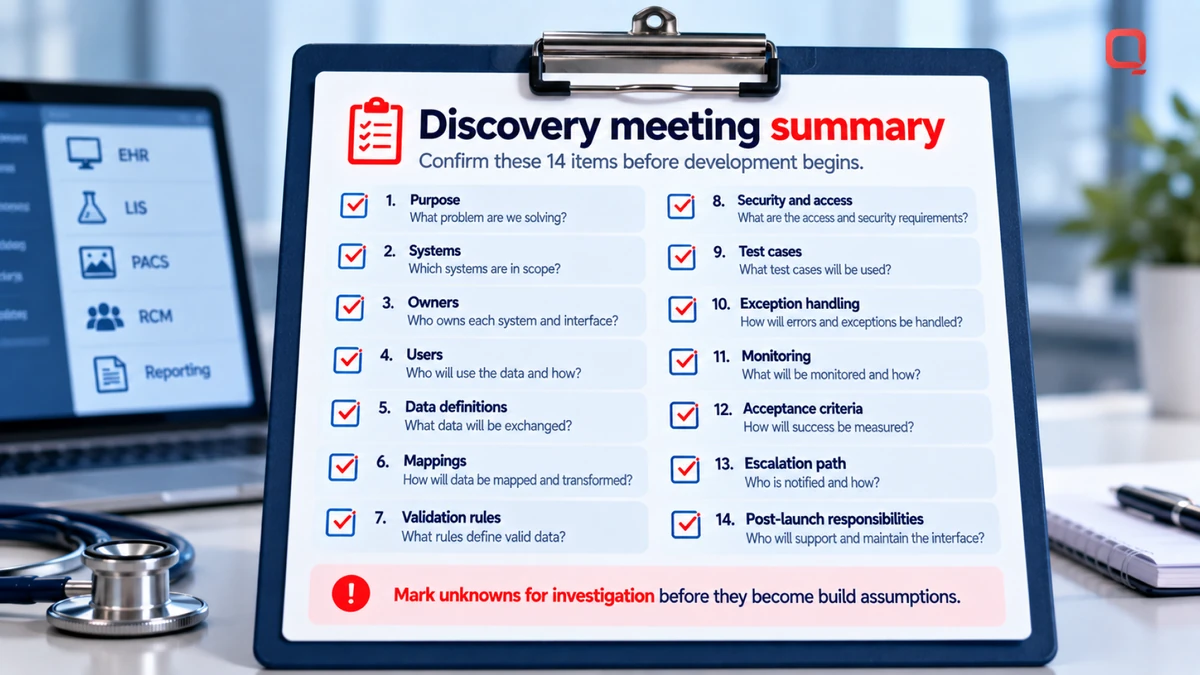
Use this checklist to prepare for a scoped discussion about your data flows and readiness. Review your healthcare data integration requirements with QSS Technosoft.
From integration checklist to a dependable healthcare data solution
A completed checklist is useful only if it informs the project plan. Turn its answers into a scoped discovery and architecture document. Define the workflows in scope, systems and data owners, exchange patterns, mapping decisions, validation criteria, dependencies, and unresolved risks. Separate confirmed requirements from assumptions that need vendor input or technical testing. This keeps the design grounded in the systems the organization actually runs, including legacy platforms with limited or inconsistent interface options.
Use the findings to make decisions visible. The architecture plan should show where data originates, how it moves, what transforms it, how errors surface, and who is responsible for resolution. It should also specify security and access considerations, audit needs, testing responsibilities, monitoring, and operational handoff. Integration is one part of a dependable data solution. It does not automatically make source data accurate or establish compliance. Teams must assess the applicable requirements and controls for their own environment.
What should a practical discovery conversation cover?
Bring the system inventory, workflow goals, representative data examples, known quality issues, and constraints. Ask the engineering team to explain assumptions, dependencies, risks, and ownership boundaries in plain language. Clarify how testing will represent real use, how teams will monitor exceptions, who supports the flow after launch, and how system or workflow changes will be handled. Clear answers form the basis for an architecture that can be reviewed and maintained.
How can a partner support healthcare interoperability work?
Evaluate experience against your actual scope. QSS Technosoft offers healthcare interoperability capabilities that include EHR/EMR development and integration involving HL7 and FHIR, Health Information Exchange connections, and DICOM/PACS solutions. These capabilities may be relevant when a project spans clinical systems and imaging workflows, though fit depends on the specific platforms, interfaces, and requirements.
Ask who will own the architecture, how decisions will be documented, and how security and compliance considerations will be addressed alongside data quality. Do not treat a standard, an integration engine, or a successful connection as proof that every risk is resolved.
If you are ready to turn your checklist into a defined integration scope, discuss your healthcare interoperability requirements with QSS Technosoft. Bring the knowns, the constraints, and the open questions. A useful first conversation should clarify the work before the systems have been assessed.
Build the integration plan around trusted data
Healthcare data integration services are only as dependable as the data rules and operational ownership behind them. A connection can deliver information without making it accurate, complete, or meaningful to the receiving system. Start with a defined workflow, document how fields map, and set clear validation, exception-handling, and monitoring responsibilities before implementation.
Then compare architecture options against your current systems and constraints. Point-to-point connections, interface engines, and APIs each bring trade-offs. The right fit depends on what your systems support and how teams will maintain the flow. Treat testing, security, and operational handoff as part of the design, not work to leave until launch.
QSS Technosoft offers healthcare interoperability capabilities that include HL7 and FHIR, HIE connections, EHR/EMR development and integration, and DICOM/PACS solutions. These capabilities may be relevant when assessing a complex healthcare environment, but the scope and requirements still need to be examined directly.
Ready to turn your checklist into a practical integration scope? Discuss your healthcare data integration requirements with QSS Technosoft. Start with the systems, workflows, and data-quality questions you already know.
Bring the checklist, the constraints and the open questions
A 30-minute working session with a healthcare interoperability architect, not a salesperson. Bring your system inventory, one workflow and a representative record or two; we will walk the data flow end to end, including an exception and how it would be resolved, and separate what is confirmed from what still needs discovery or vendor input. You keep the written summary either way.
Discuss your data integration requirements →