Mirth Connect 4.6.1: Features, Fixes & Updates
 By Ashutosh Kumar
QSS Technosoft
September 24, 2026
11 min read
By Ashutosh Kumar
QSS Technosoft
September 24, 2026
11 min read
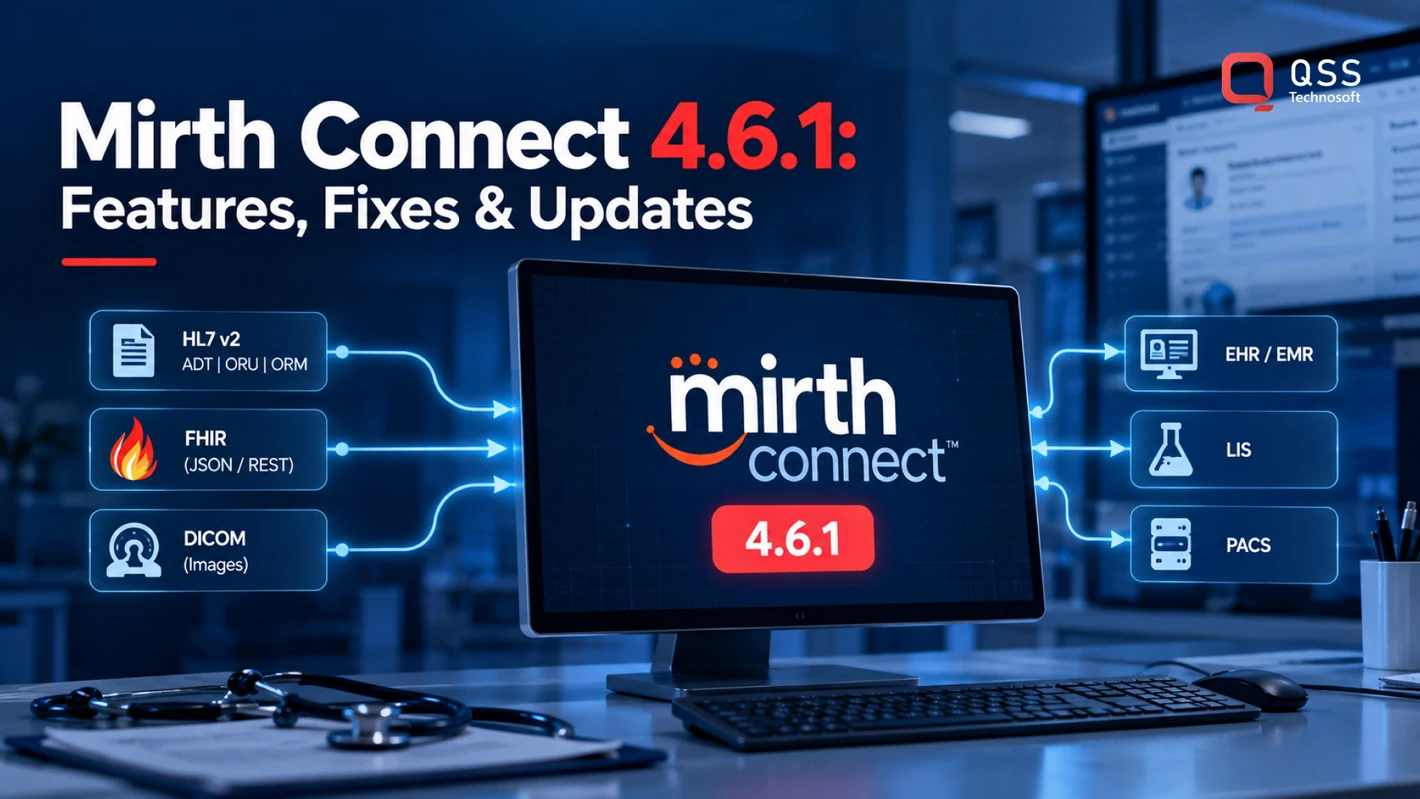
NextGen Healthcare powers one-third of all public Health Information Exchanges across the United States with Mirth Connect, but operating a high-throughput mirth application in production is never plug-and-play. You already know the daily friction. Legacy EHR feeds arrive malformed and non-standard, channel queues bottleneck during peak admission hours, and keeping audit logs strictly HIPAA-compliant across hybrid cloud infrastructure drains your team’s limited bandwidth. When brittle JavaScript transformers fail under unexpected HL7 segments, theoretical interface design collides head-on with clinical reality.
It doesn’t have to be a continuous fire drill. In this guide, you’ll master how Mirth Connect integration applications route, transform, and secure complex healthcare data across your enterprise systems. We’ll break down the architectural shifts and security patches in release 4.6.1, evaluate whether you should upgrade or modernize your current stack, and map out a dependable roadmap for resilient, bi-directional clinical data exchange.
Quick Answer
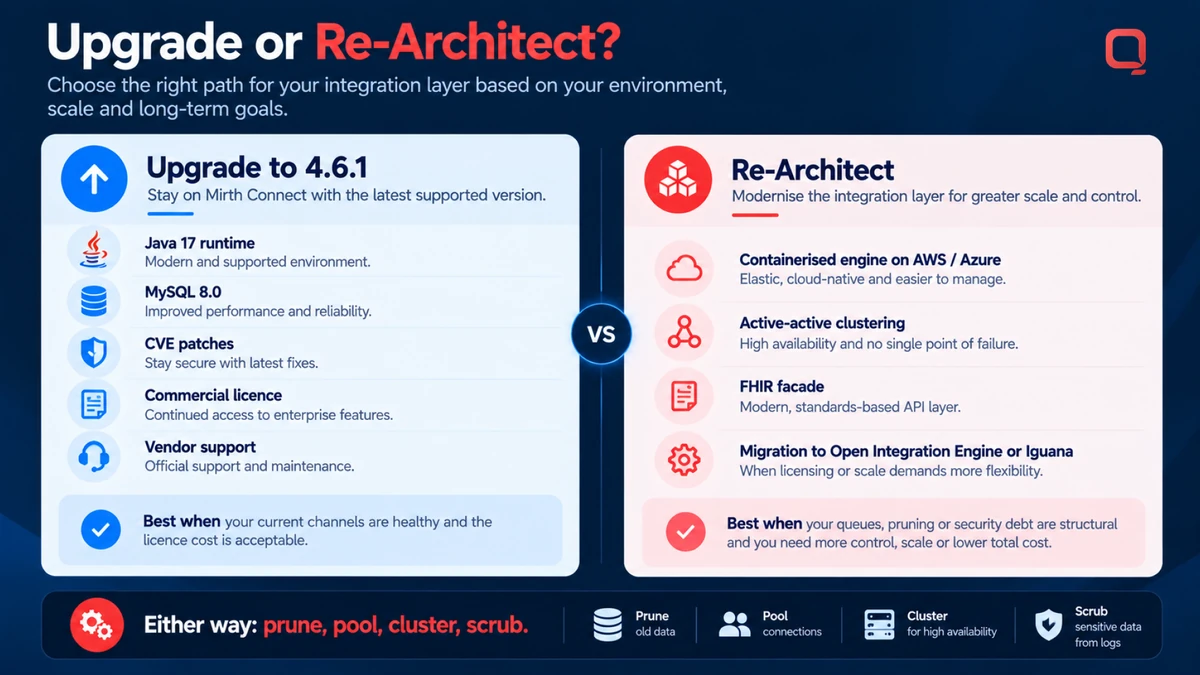
Mirth Connect is the hub-and-spoke integration engine that turns forty-five point-to-point interfaces into one runtime: every message passes through receipt and pre-processing, source filtering, destination fan-out, transformation and audited transmission. Release 4.6.1 is a commercial NextGen release (open source ended with 4.5.2) that moves the runtime to Java 17, adds MySQL 8.0 support and patches security vulnerabilities. Most production failures are not channel logic; they are unpruned databases, starved connection pools, thread exhaustion under fan-out, unencrypted MLLP and PHI leaking into logs. Upgrade when channels are healthy and licensing fits; re-architect (clustering, containers, FHIR facades, or a move to a fork or Iguana) when the problems are structural.
What Is a Mirth Application and How Does It Power Healthcare Interoperability?
A mirth application is a specialized healthcare integration engine designed to ingest, transform, filter, and route clinical messages between isolated systems. Originally released as an open-source tool and now developed commercially by NextGen Healthcare, Mirth Connect operates as a universal translator across complex medical software environments. It extracts data from rigid clinical endpoints, normalizes payload schemas, and guarantees delivery across disparate networks.
The Role of an Integration Engine in Modern Healthcare Ecosystems
Without centralized middleware, connecting clinical systems requires chaotic point-to-point wiring. Ten endpoints demand forty-five direct interfaces; fifty endpoints create more than a thousand fragile interdependencies. This interface sprawl makes ongoing maintenance an operational disaster. Legacy EHRs, laboratory information systems (LIS), and billing platforms rarely speak matching dialects. They disconnect unexpectedly, drop packets during network glitches, and generate untracked payload anomalies.
Deploying a hub-and-spoke integration architecture resolves this architectural debt. Centralizing clinical message traffic isolates source failures, buffers traffic spikes, and eliminates endpoint cross-dependencies. You control mapping rules and audit trails inside a single runtime environment. That unified routing model significantly reduces IT maintenance costs, accelerates new vendor onboarding, and stops clinical interface downtime before it impacts care teams.
Core Standards and Protocols Supported by Mirth Connect
Hospitals rarely decommission working legacy software. A resilient mirth application bridges the generational divide across your infrastructure by natively processing major healthcare messaging standards and transmission protocols:
- HL7 v2 and v3: Parses standard pipe-and-hat delimiters, extracts non-standard Z-segments, and evaluates clinical event triggers such as ADT admissions, ORM orders, and ORU lab observations.
- HL7 FHIR: Handles RESTful HTTP calls, transforms legacy relational structures into compliant JSON resource payloads, and enforces schema validation against international clinical profiles.
- DICOM and Binary Data: Processes medical imaging metadata over TCP/IP, extracts structured tags for Picture Archiving and Communication Systems (PACS), and manages binary payloads without crashing server memory.
- Web Services and Flat Files: Ingests JSON, XML, CSV, and delimited text through secure protocols including HTTPS, SFTP, and direct database queries.
Anatomy of a Mirth Channel: How Messages Move from Source to Destination
A channel serves as the fundamental execution pipeline inside any mirth application. Instead of tangling transport protocols with business logic, an engine instance completely decouples message ingestion from transformation rules and downstream delivery. Through modern distributions like NextGen Mirth Connect, every payload follows an isolated, deterministic lifecycle:
- Receipt and Pre-processing: Ingress connectors capture incoming wire data, run raw string cleanups, and extract message envelopes.
- Source Filtering: Structural validation verifies message legitimacy before committing heavy database writes.
- Destination Fan-out: Independent threads route filtered payloads toward multiple external targets simultaneously.
- Transformation: Embedded JavaScript and Java runtimes mutate internal variables, rebuild schemas, and generate target payloads.
- Transmission and Auditing: Connectors dispatch data over network interfaces, evaluate return receipts, and trigger post-processor notifications.
Source Connectors and Inbound Filtering Logic
Inbound pipelines monitor network interfaces via TCP/MLLP listeners, database polling queries, SFTP readers, or HTTP servlets. The moment bytes hit the interface, pre-processor scripts normalize malformed headers before parsing begins. If a legacy EHR sends corrupted MSH segments or improper line breaks, the pre-processor strips them immediately. Source filters then inspect message types. Unwanted payloads get rejected upfront, preventing unnecessary channel queuing and conserving backend database storage.
Transformers and Destination Connectors
Once through the filter, the engine spawns parallel destination tasks. Each destination operates its own transformer step, letting you deliver one inbound ADT feed to three distinct systems: an on-premises LIS via raw HL7, a modern clinical datastore using RESTful JSON, and an enterprise archive via SFTP. Built-in Rhino and GraalVM JavaScript engines allow engineers to run complex mapping scripts, regex string substitutions, and external Java class imports on the fly.
Post-processor scripts fire after outbound dispatch completes. They capture delivery timestamps, inspect downstream ACK responses, and log audit metadata for HIPAA tracking. If your team struggles with fragile transformers or queue backlogs, consulting seasoned specialists for Mirth Connect Services helps stabilize your production channels and eliminate messaging latency.
Critical Enterprise Use Cases: Connecting EHRs, Labs, and Cloud Systems
A production mirth application proves its worth when unexpected edge cases hit live environments. Real-world healthcare integrations don’t run on sanitized lab data. They survive in high-stress clinical ecosystems where message volume spikes, downstream endpoints crash without warning, and latency tolerances hover near zero. Across the United States, major networks like the Delaware Health Information Network rely on this middleware architecture to sustain multi-facility data coordination.
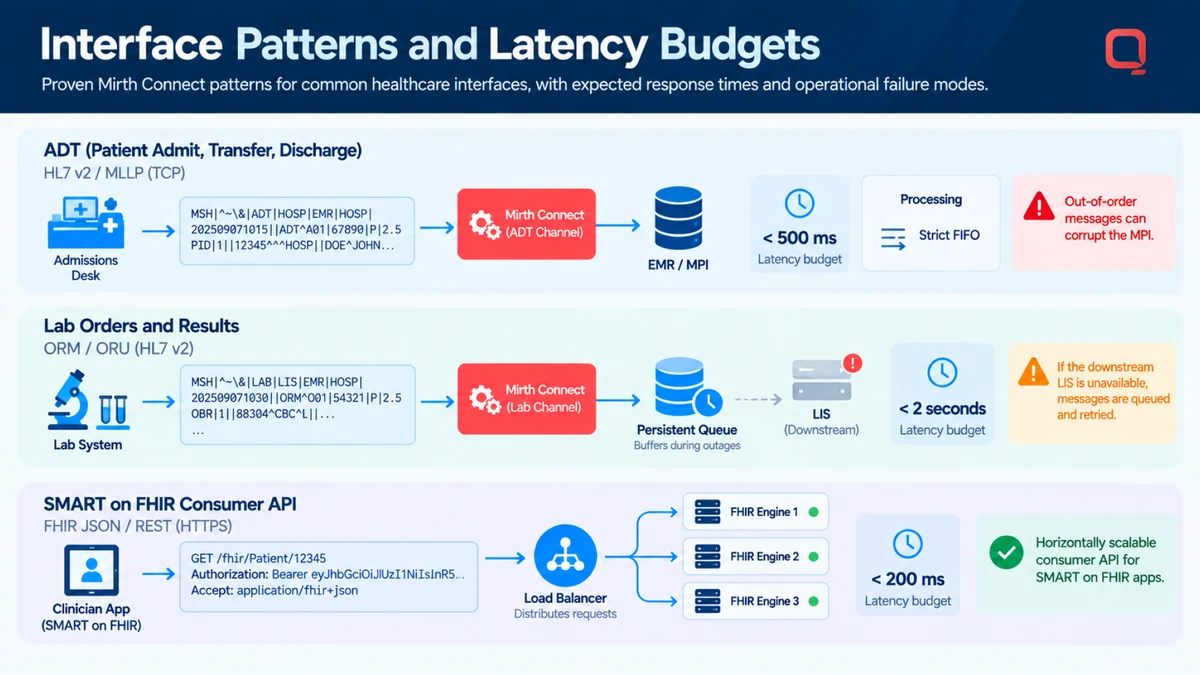
| Interface Pattern | Payload Standard | Latency Budget | Operational Failure Mode |
|---|---|---|---|
| Patient Admission (ADT) | HL7 v2.x (MLLP) | < 500 ms | Strict FIFO required; out-of-order messages corrupt MPI demographics. |
| Lab Orders & Results (ORM/ORU) | HL7 v2.x / Custom | < 2 seconds | Requires persistent queuing when downstream LIS locks or drops connection. |
| Consumer API (SMART on FHIR) | FHIR JSON (REST) | < 200 ms | HTTP timeouts; requires horizontal scaling and in-memory payload conversion. |
EHR and Lab Information System (LIS) Bi-Directional Integration
Admission, Discharge, and Transfer (ADT) feeds broadcast continuous demographic updates across hospital departments. The engine catches inbound ADT feeds, normalizes patient identifiers, and dispatches real-time updates to downstream Master Patient Indexes (MPI). When physicians order blood work, outbound ORM messages travel to the LIS. Once instruments finish specimen testing, the pipeline pulls returned ORU result feeds, translates numerical values into standard LOINC codes, and passes reports back into the EHR chart. If receiving systems drop offline, destination queues buffer every transaction, retrying automatically until clinical receipt confirms delivery.
Bridging Legacy Systems to Modern SMART on FHIR Platforms
Modern clinical SaaS platforms and mobile patient applications can’t process raw pipe-and-hat HL7 feeds. They expect authenticated JSON payloads served over secure HTTPS endpoints. An intermediary mirth application decomposes inbound HL7 OBX segments and constructs validated SMART on FHIR Observation and DiagnosticReport resources on the fly.
This design shields legacy infrastructure from public traffic. The integration engine surfaces managed RESTful endpoints, checks OAuth 2.0 bearer tokens, and feeds mobile patient applications without touching fragile on-premises databases directly. When complex workflows combine clinical data with radiology files, the engine pairs DICOM metadata with HL7 order numbers. PACS archives stay synchronized with EHR accession records, giving clinicians accurate diagnostic results without manual cross-referencing.
Production Engineering: Overcoming Scaling, Performance, and Security Pitfalls
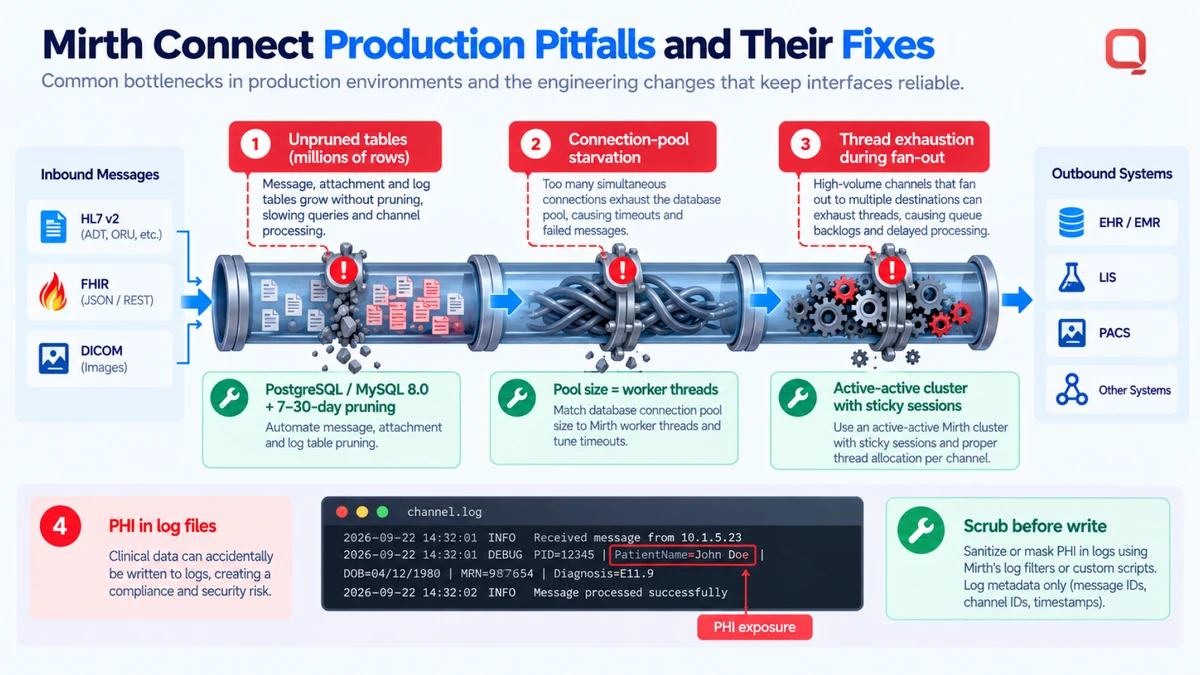
Most integration engine failures aren’t caused by flawed channel logic. They happen because of poor production engineering. When clinical message throughput surges during peak shift handoffs, an improperly configured mirth application can exhaust server resources, lock database tables, and drop inbound connections. Keeping mission-critical pipelines stable requires proactive infrastructure tuning, strict storage hygiene, and defensive security policies.
Database Optimization and Message Pruning Strategies
The backend database represents the single biggest bottleneck in high-throughput integration environments. Every transaction writes metadata, channel state, and raw message content to disk. Unpruned tables bloat rapidly, degrading query speeds and locking out worker threads. To maintain high throughput:
- Pick the Right Engine: Run PostgreSQL or modern MySQL 8.0 instead of default embedded datastores like Derby.
- Implement Aggressive Pruning: Configure automated message pruning schedules to retain operational data for only seven to thirty days; ship historical logs to cold storage archives.
- Tune Connection Pools: Adjust HikariCP or DBCP connection pools so pooled limits match max active channel worker threads, preventing connection starvation during admission surges.
Clustering, High Availability, and Disaster Recovery
Healthcare enterprises cannot tolerate single points of failure. In active-passive setups, automated heartbeats track server health, promoting standby nodes the instant an active server drops. Active-active clusters distribute incoming TCP/MLLP connections across multiple virtual machines behind network load balancers. However, sticky sessions and deterministic routing remain mandatory. Otherwise, split transactions can deliver out-of-order ADT events and compromise patient identity tracking.
HIPAA Security Hardening and Audit Logging
Healthcare integration architecture demands strict compliance protocols. Unencrypted MLLP over plain TCP is unacceptable across open networks. Mandate TLS 1.3 across all MLLP, HTTPS, and database ports. Inside the administrative console, enforce multi-factor authentication and role-based access control (RBAC), restricting channel editing permissions to authorized integration engineers.
Audit logging also introduces a hidden trap: log-file contamination. Default logging statements often write full clinical payloads to plain-text server logs. If unmonitored, these files store unencrypted Protected Health Information (PHI) directly on local disk drives. Production scripts must explicitly scrub names, Social Security numbers, and clinical notes from debug logs before committing them to disk. If your integration stack requires enterprise-grade hardening, connection pooling adjustments, or reliable cloud clustering, contact our team for Healthcare Interoperability consulting to secure your message pipelines.
How QSS Technosoft Delivers Resilient Mirth Application Engineering
Building and maintaining enterprise clinical interfaces demands engineering discipline, not guesswork. QSS Technosoft operates as an architect-led digital engineering partner specializing in Healthcare Interoperability and Mirth Connect Services. Backed by 250+ in-house engineers and over 15 years delivering enterprise software solutions, we apply verified development rigor certified under CMMI Level 3, ISO 9001:2015, and ISO 27001:2013 standards. We construct, refactor, and stabilize mission-critical interface engines so your clinical data flows without interruption.
Full-Lifecycle Mirth Integration and Managed Services
Every clinical environment brings its own edge cases. Generic message templates and hasty scripts collapse when exposed to real-world edge cases. Building a production-grade mirth application requires defensive logic at every step of the channel pipeline.
Our dedicated Healthcare IT practice conducts complete interface audits, channel refactoring, and data mapping analysis. We engineer custom JavaScript transformers that parse non-standard segments, catch malformed data types, and normalize message structures cleanly. Operating through a proven onshore-offshore model, our teams deliver continuous integration monitoring and production support across the United States. We trace channel bottlenecks, resolve persistent socket disconnects, and clear stalled queues before clinical workflows suffer.
Enterprise Health-Tech Architecture Beyond the Engine
An integration engine cannot solve architectural deficiencies in isolation. A high-throughput mirth application must coordinate seamlessly with surrounding enterprise platforms, legacy databases, and distributed cloud services.
We help organizations modernize legacy monolithic infrastructure by transitioning interfaces into containerized cloud deployments across AWS and Azure. Our teams connect Mirth pipelines directly to custom EHR platforms, telemedicine portals, PACS archives, and clinical analytics datastores. Every architectural decision embeds HIPAA-compliant development practices and ISO 27001 controls into your software lifecycle. We enforce end-to-end data encryption, establish automated audit logging, sanitize diagnostic files, and configure role-based access to safeguard patient records across all exchange endpoints.
Modernize Your Healthcare Integration Architecture with Confidence
Scaling clinical data pipelines comes down to disciplined production engineering. A dependable mirth application hinges on proactive database pruning, defensive channel logic, and strict schema validation across HL7 and FHIR boundaries. When message queues surge during peak hospital shifts or legacy endpoints drop connections without warning, your interface engine requires solid architectural foundations rather than reactive patches.
QSS Technosoft eliminates that operational friction. Backed by 250+ in-house software engineers and certified under CMMI Level 3 and ISO 27001:2013 standards, we bring deep clinical engineering expertise across EHR, DICOM/PACS, HL7, and FHIR platforms. Whether you need to refactor fragile JavaScript transformers, audit HIPAA compliance configurations, or eliminate database bottlenecks, we engineer interfaces designed to hold up under real-world pressure. Ready to stabilize your message flows? Explore Mirth Connect Services with QSS Technosoft and turn your clinical integration layer into a durable enterprise asset.
Ready to stabilize your message flows?
A 30-minute conversation with a healthcare interoperability architect, not a salesperson. Bring one channel that keeps failing or one queue that keeps backing up; we will walk through what is actually causing it (pruning, pools, threads, transformers or the licence you are on) and what fixing it would take. You keep the written notes either way.
Book a Discovery Call →