Healthcare App Development: 5 Critical Myths Sabotaging Clinical Builds in 2026
 By Mohd Shahnawaz
QSS Technosoft
September 28, 2026
10 min read
By Mohd Shahnawaz
QSS Technosoft
September 28, 2026
10 min read
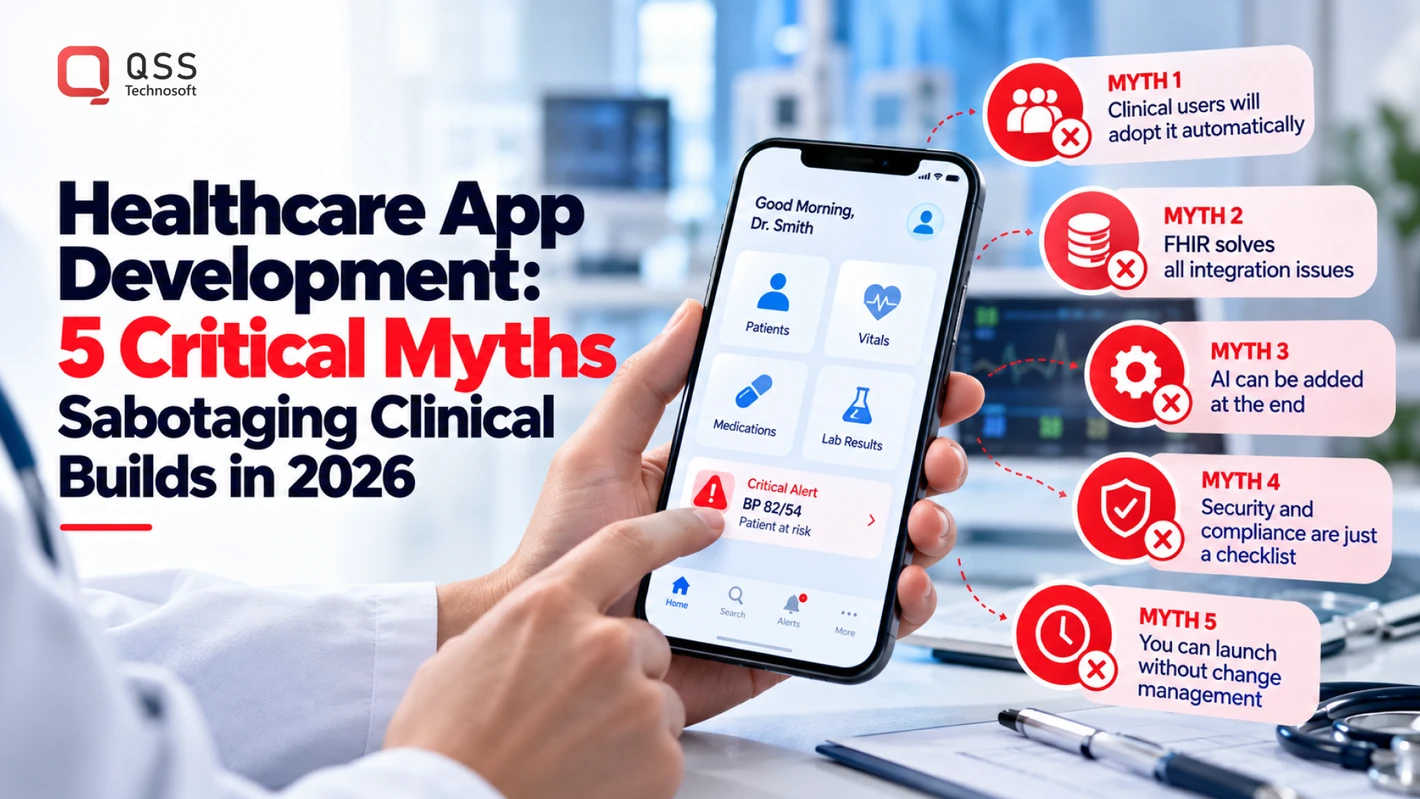
Clinical software rarely dies from an ugly interface; it dies in production. In modern healthcare app development, teams frequently celebrate sleek front-end dashboards while ignoring the brutal realities of hospital workflows, brittle integrations, and shifting compliance rules. It’s the primary reason so many digital health platforms stall during pilot phases or fail their first regulatory audit.
You already know that plugging into legacy infrastructure isn’t as simple as querying a modern REST API. Wrestling with complex EHR integrations, parsing actual HIPAA enforcement versus superficial vendor checklists, and winning over skeptical clinicians is exhausting, unglamorous work. We’re dismantling the five dangerous engineering and regulatory myths sabotaging clinical builds today. You’ll learn the core architectural requirements needed to achieve true interoperability, protect patient data, and deploy an audit-ready application that physicians embrace. Here is what’s breaking clinical software in 2026, and how to engineer past it.
Quick Answer
Clinical apps fail in production, not in design review, and five beliefs cause most of the failures. Consumer playbooks (ship fast, patch later) are malpractice when the data is PHI and the workflow is medication reconciliation. A cloud BAA covers the data centre, not your code: encryption, RBAC, session timeouts and immutable audit logs are yours. EHR interoperability means bridging pipe-delimited HL7 v2 over MLLP through an interface engine into FHIR and SMART on FHIR, not calling a REST API. Clinical AI needs de-identification, deterministic RAG, clamped parameters and human-in-the-loop escalation before it touches a decision. And store approval is the start of post-market surveillance, patching and interface monitoring, not the finish line.
Myth 1: Healthcare App Development Follows Standard Consumer App Playbooks
Consumer tech lives by a simple mantra: ship fast, break things, and patch the bugs in the next sprint. If a social feed glitches or an e-commerce cart drops, a user sighs and refreshes. In clinical software, that exact philosophy creates immediate legal liability and risks patient outcomes. Treating healthcare app development like another consumer mobile build is architectural malpractice. When you handle protected health information (PHI) and clinical decision workflows, software stops being a convenience product and becomes an instrument of care.
The academic foundations of health informatics demonstrate that managing medical data requires distinct architectural discipline. Latency in a consumer ride-hailing app wastes two minutes; latency during emergency medication reconciliation corrupts treatment windows. Building for healthcare demands strict data integrity, determinism, and zero tolerance for casual telemetry that leaks identifiers to third-party ad networks.
The Illusion of the Fast-Track Minimum Viable Product
No-code platforms and rapid MVP frameworks promise live deployments in weeks. In a hospital, an unvetted build is a fast track to regulatory fines and litigation. Rushing a stripped-down release into clinical rotations skips the exhausting edge-case testing that patient safety requires. Consider the downstream consequences of cutting corners:
- Unvalidated input schemas: Dropping unit-of-measure validation corrupts dosage tracking between mobile interfaces and clinical databases.
- Diagnostic distrust: One dropped lab value or corrupted time-series chart destroys physician trust permanently.
- Compliance exposure: Consumer MVPs frequently overlook mandatory audit logs that track every read, update, and export of patient data.
Clinical Workflow Friction Versus Consumer Engagement Metrics
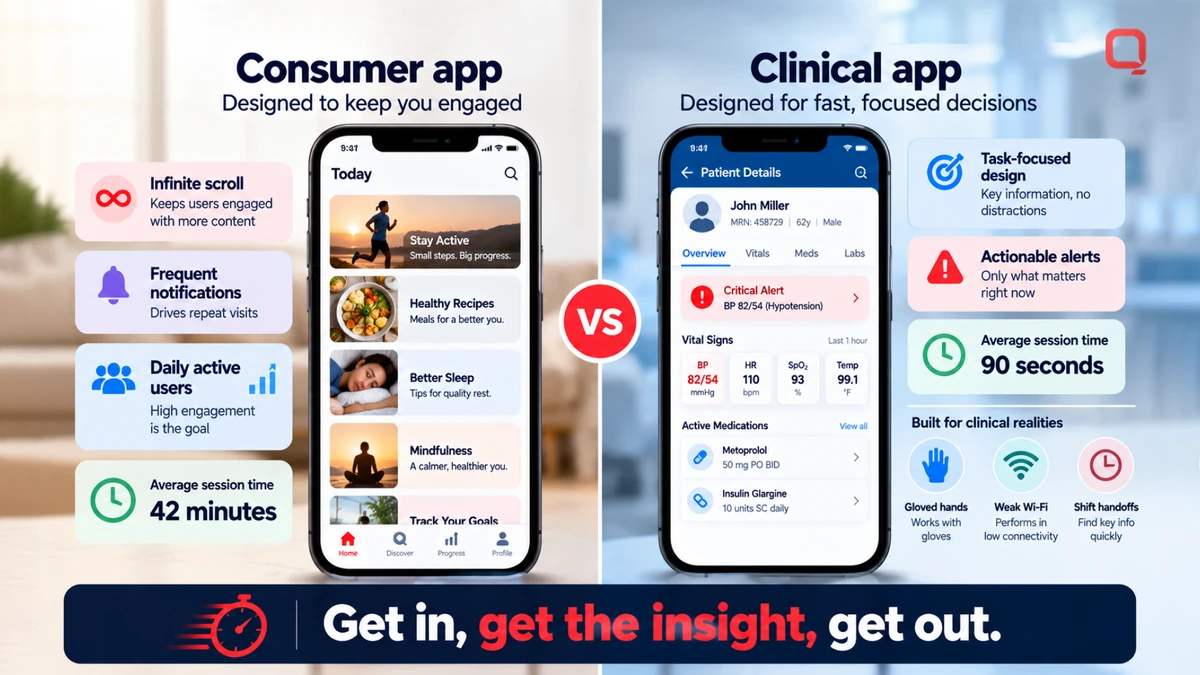
Consumer applications optimize for daily active users, long sessions, and infinite scrolling. Clinical software must do the exact opposite: get the provider in, deliver actionable insight, and get them out. Doctors don’t want an addictive experience; they want rapid data capture that fits into brutal twelve-hour shifts.
Consumer UX patterns fail miserably inside hospital wards. Pushing endless banner notifications triggers clinical alarm fatigue, causing medical staff to silence critical system alerts. Interfaces must account for physical realities that consumer designers never see: dirty hospital networks, frantic shift handoffs, intermittent basement Wi-Fi, and clinicians tapping screens with sanitized latex gloves. Optimize for speed, clarity, and fault tolerance, not screen time.
Myth 2: Cloud Hosting Automatically Guarantees Complete HIPAA Compliance
Signing a Business Associate Agreement (BAA) with AWS, Google Cloud, or Microsoft Azure doesn’t hand you HIPAA compliance on a platter. Major cloud providers operate under a strict shared responsibility model. They secure the physical data center, maintain hypervisor isolation, and patch underlying host operating systems. You own everything built on top of that infrastructure. If an engineer pushes unencrypted database queries or misconfigures an object storage bucket, that BAA won’t shield you from federal audits or civil penalties that can exceed $2 million per violation for uncorrected willful neglect.
Reviewing official HIPAA guidance for mobile health applications makes this boundary unmistakable: compliance is an operational and software architecture practice, not a cloud receipt.
Application Vulnerabilities That Bypass Cloud Infrastructure Firewalls
Perimeter firewalls won’t protect you from poor code. In practical healthcare app development, clinical data breaches routinely trace back to application-layer oversights rather than server penetrations. Common failure modes include:
- Exposed credentials: Hardcoded API tokens and production connection strings bundled inside mobile application binaries.
- Broken access controls: Flawed role-based access control (RBAC) logic that allows general medical staff to query restricted psychiatric records or diagnostic data.
- Unterminated sessions: Mobile configurations that fail to time out on shared clinical workstations left unattended during rapid emergency responses.
The Architecture of Defensible Audit Trails and Encryption
Defensible compliance requires embedding zero-trust mechanisms directly into the application stack. Enforce AES-256 encryption for all data stores, database volumes, and temporary caches at rest. Mandate TLS 1.3 for all data in transit across public networks and internal microservices alike.
Cryptography alone is insufficient without immutable, write-once audit pipelines. Your database must log every single read, write, export, and delete operation on patient records with tamper-proof timestamps and user identifiers. Seasoned engineering teams like QSS Technosoft build compliance-by-design architectures from sprint zero, baking strict governance into every endpoint. If your roadmap involves storing sensitive clinical records, schedule an architectural compliance review before committing code to production.
Myth 3: Building EHR Interoperability Is Just Writing Standard REST APIs
Junior engineering teams often assume connecting to an Electronic Health Record (EHR) system is like querying Stripe or Twilio. They expect clean Swagger documentation, predictable JSON responses, and instant sandbox keys. Reality hits quickly. Only 7% of healthcare providers report having all necessary patient data stored cleanly within their EHR, and fragmented software stacks turn simple data exchanges into an engineering minefield. In practical healthcare app development, interoperability isn’t just an API call; it’s a relentless exercise in data normalization and defensive programming.
The Messy Reality of HL7 v2 and Legacy Interface Engines
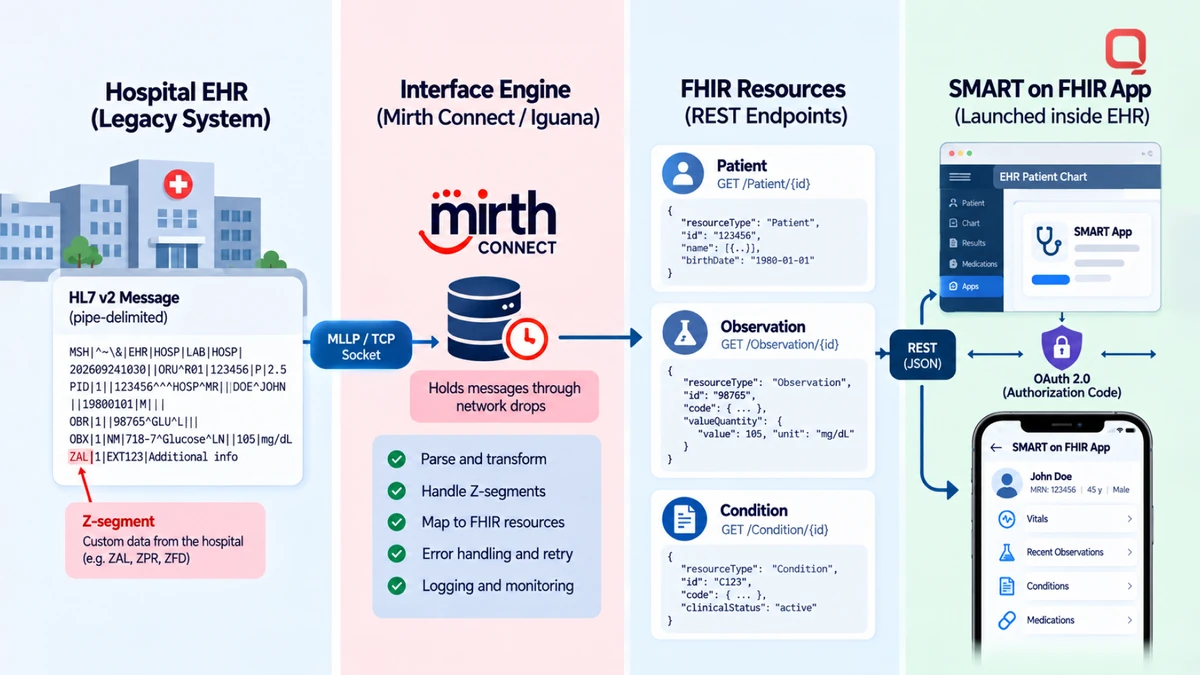
Most acute-care hospital facilities still run on HL7 v2 message pipelines developed decades ago. You aren’t parsing structured JSON objects over HTTPS. You’re handling pipe-delimited text streams delivered over raw TCP/IP sockets via Minimal Lower Layer Protocol (MLLP).
Hospitals routinely customize their HL7 feeds with non-standard “Z-segments” to store specific clinical observations. To bridge this gap, your architecture requires an integration engine like Mirth Connect or Iguana. This middleware layer intercepts incoming message streams, cleans erratic data, and routes telemetry without dropping packets. It must also buffer clinical payloads during sudden network partitions, ensuring that transient connectivity drops in busy emergency departments don’t cause permanent data loss.
Architecting for Modern FHIR and SMART-on-FHIR Frameworks
Modern clinical architectures are adopting Fast Healthcare Interoperability Resources (FHIR), yet adoption remains uneven across vendor ecosystems. While FHIR standardizes resources like Patients, Observations, and Conditions into RESTful endpoints, field implementations vary wildly between different hospital deployments.
Achieving seamless clinical adoption means implementing SMART-on-FHIR profiles. This framework lets your mobile or web app launch directly inside the provider’s native chart interface, eliminating context switching. Navigating the required OAuth 2.0 handshakes across distributed healthcare networks is technically grueling. Disciplined healthcare app development demands building adapters that ingest legacy HL7 feeds on the backend while exposing standardized FHIR endpoints to your user-facing applications.
Myth 4: Adding AI to Healthcare Apps Is Fast, Easy, and Hallucination-Proof
Tech marketing often treats artificial intelligence like a universal cure: connect a foundation model API, write a system prompt, and ship a clinical assistant. In regulated software, unconstrained generative models create immediate liability. A consumer chatbot that invents a book summary causes a minor annoyance. A clinical decision tool that hallucinates a dosage calculation or invents a drug interaction puts patient safety at risk. Disciplined healthcare app development replaces probabilistic guessing with deterministic architectures, strict validation boundaries, and isolated inference pipelines.
Guarding Against Dangerous Clinical Hallucinations
Clinical decision-support systems cannot tolerate unchecked generative drift. If an unconstrained model misinterprets kidney markers and recommends a contraindicated medication, your organization bears the clinical and legal fallout. Protecting users requires multi-layered technical guardrails:
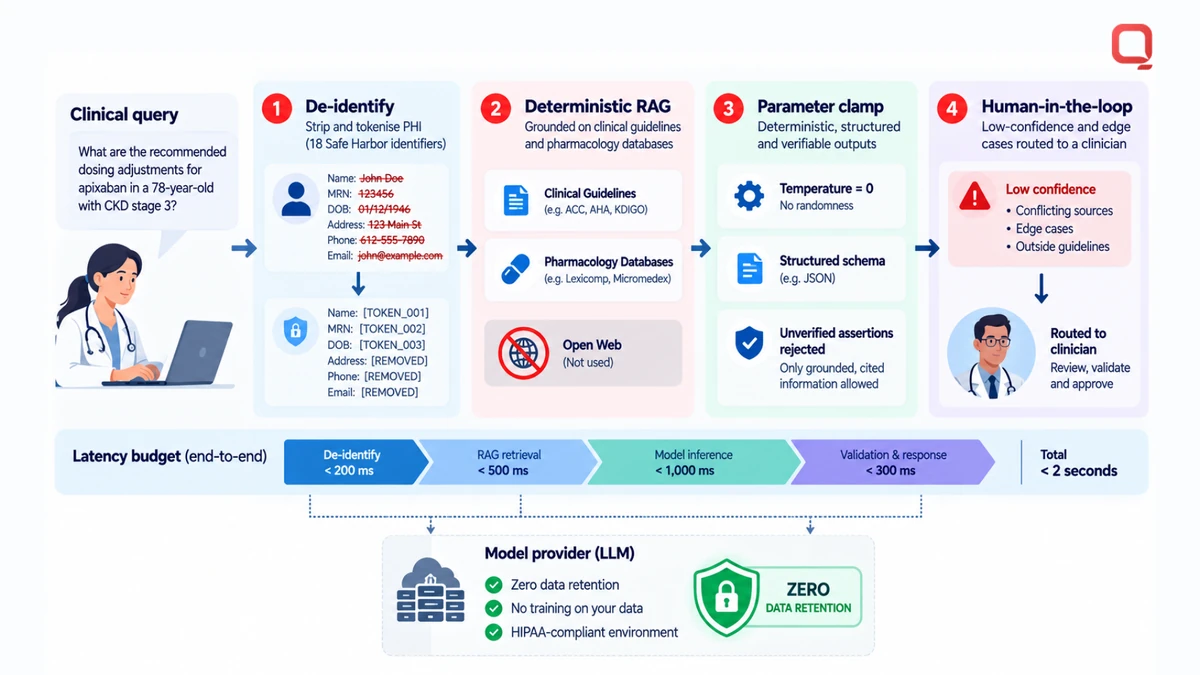
- Deterministic RAG architectures: Ground Retrieval-Augmented Generation systems strictly on peer-reviewed clinical guidelines, authenticated pharmacology databases, and local hospital protocols. Disable open-web generation completely.
- Parameter clamping: Lock model temperature to zero, enforce structured schema outputs, and reject unverified medical assertions before they reach the user interface.
- Automated human-in-the-loop escalation: Program hard stops that route ambiguous queries, edge-case symptoms, or low-confidence outputs straight to licensed clinicians.
De-Identification and Zero-Data-Retention Compliance Frameworks
Streaming raw clinical notes directly to public AI endpoints breaches federal privacy laws. Before any patient telemetry enters an inference layer, automated sanitization microservices must strip all 18 HIPAA Safe Harbor direct identifiers. Names, medical record numbers, and precise timestamps must be removed or tokenized in memory.
Enterprise governance also demands strict zero-data-retention agreements with model providers. Your clinical data cannot persist in vendor logs, model caches, or future training sets. Latency introduces another critical constraint. A multi-second generation lag renders decision support useless in high-acuity environments like intensive care units or operating rooms. Every millisecond spent sanitizing and parsing tokens must be accounted for in your infrastructure budget. If you are integrating generative models into point-of-care workflows, contact our healthcare AI engineering team to architect secure, hallucination-resistant pipelines.
Myth 5: Launching on the App Store Is the Finish Line of Development
Popping champagne when an app clears Apple and Google review is a dangerous tradition. In healthcare app development, store approval doesn’t mean your work is finished. It simply means your binary entered a hostile operating environment. Clinical software lives in a perpetual state of operational friction. Mobile operating systems deprecate security frameworks annually, hospital security teams alter network firewalls without warning, and connected clinical endpoints drift. Treating production deployment as a finish line guarantees catastrophic technical debt within twelve months.
Continuous Post-Market Compliance and Vulnerability Management
Compliance is a moving target that requires continuous surveillance. Regulated health applications demand proactive maintenance protocols to maintain trust and protect sensitive telemetry:
- Penetration testing: Execute annual third-party penetration audits and maintain SOC 2 compliance to verify infrastructure integrity.
- Zero-day patching: Deploy rapid patch pipelines to remediate mobile OS vulnerabilities before bad actors exploit local caching flaws.
- Dynamic consent management: Re-architect patient consent flows immediately whenever underlying data sharing rules or partner pipelines shift.
Engineering Long-Term Platform Scalability and Performance
Clinical data compounds relentlessly. High-frequency telemetry from remote monitors, continuous vitals logging, and encrypted diagnostic imagery bloat databases faster than standard enterprise software. Long-term stability requires automated table partitioning, database re-indexing, and rigorous cold-storage archival policies that retain historical data without degrading real-time query speeds.
Hospital integrations also decay over time. Health networks regularly upgrade their core EHR systems, alter interface engine configurations, and rotate security certificates. When an endpoint changes on the hospital side, unmonitored connections fail silently, leaving clinicians stranded mid-workflow. Sustainable healthcare app development relies on synthetic transaction monitoring, automated health checks, and active interface maintenance. Partnering with seasoned teams like QSS Technosoft gives you the senior-led architectural governance needed to keep clinical platforms compliant, scalable, and fully operational long after launch day.
Building Clinical Software That Survives Production
Clinical software doesn’t survive on slick interfaces or hurried sprints. Winning at healthcare app development demands unwavering architectural rigor. You must enforce application-layer HIPAA controls, bridge legacy HL7 streams with modern FHIR resources, and constrain clinical AI with deterministic guardrails. Bypassing these fundamentals produces brittle builds that fail security audits and alienate providers.
Long-term operational resilience requires an engineering team that treats compliance and interoperability as code-level disciplines. Backed by ISO 27001:2013 and CMMI Level 3 certified delivery, 15+ years engineering high-compliance healthcare IT platforms, and 250+ in-house engineers specializing in digital health interoperability, we turn messy clinical constraints into reliable production assets. Stop letting predictable infrastructure roadblocks stall your pilot. Engineer compliant healthcare software with QSS Technosoft and launch platforms clinicians trust from day one.
Stop letting predictable infrastructure roadblocks stall your pilot
A 30-minute conversation with a healthcare solutions architect, not a salesperson. Bring the app you are building or the pilot that stalled; we will check it against the five failure points in this article (workflow fit, application-layer HIPAA controls, HL7/FHIR integration, AI guardrails, post-launch operations) and tell you which ones need work before the next audit. You keep the written notes either way.
Book a Discovery Call →