Athena EMR Integration Services: A Practical, Case-Study-Style Guide
 By Shahrukh Khan
QSS Technosoft
September 28, 2026
10 min read
By Shahrukh Khan
QSS Technosoft
September 28, 2026
10 min read
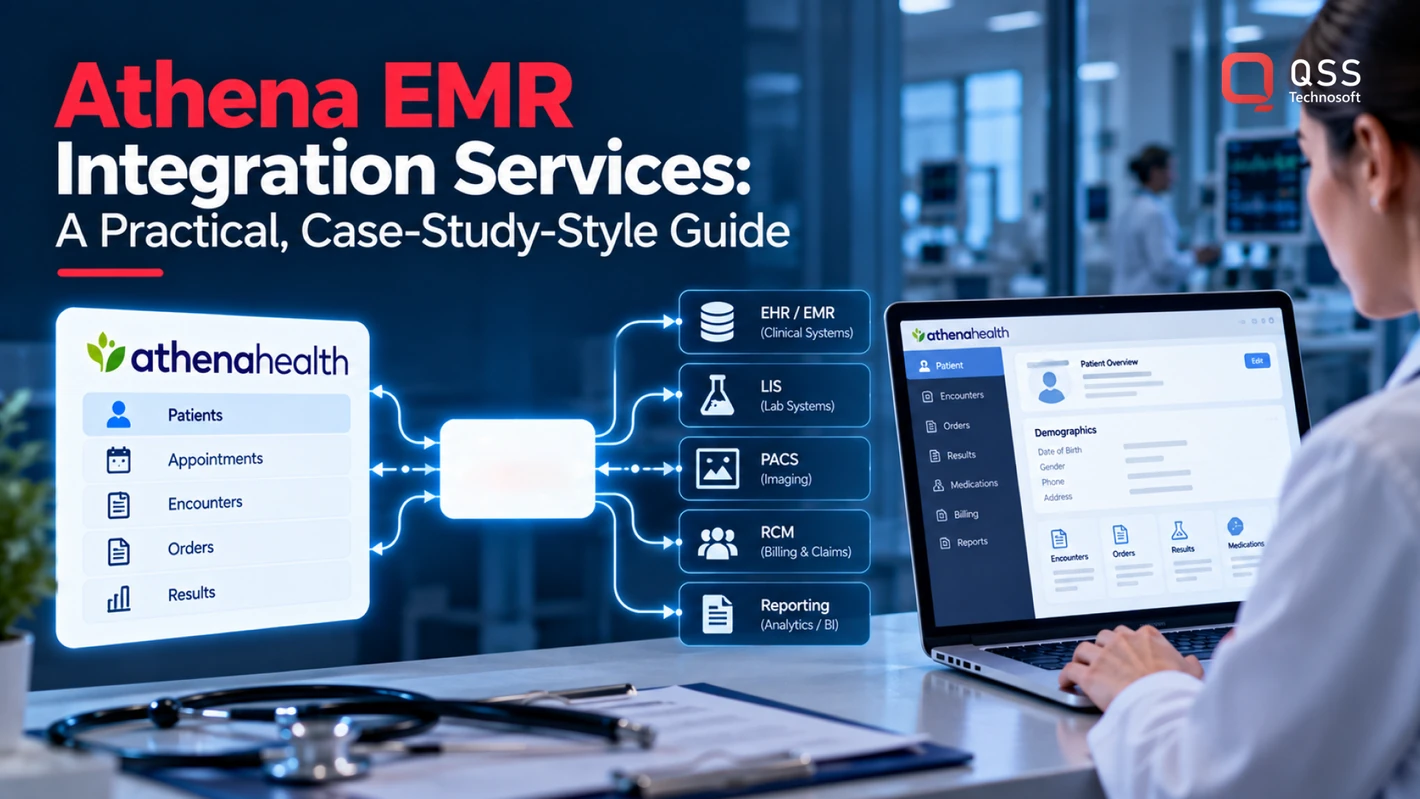
A dashboard can look complete while the workflow behind it is still broken. Reliable athena emr integration services start with a verified workflow and data contract, not a polished screen. Patient, clinical, and operational information can move differently depending on the athenahealth product, tenant configuration, and interfaces available to the organization.
If you’re unsure which interfaces your vendor supports or how to prevent incomplete or inconsistent records, start by confirming those details. Integration scope needs to match the real workflow, and every data exchange needs a way to be tested and monitored. Settling these questions before development can help prevent avoidable rework.
This practical, case-study-style guide explains how to define a workflow, confirm interface requirements, map and validate data, and plan for monitoring. The scenario is illustrative, not a claim about a completed Athena project. You’ll also find questions to ask an implementation partner about architecture, security, and delivery. First, verify your environment and requirements rather than assuming a particular interface is available.
Quick Answer
Start with one workflow, not a connection: who needs the data, what decision it supports, which records are in scope. Confirm the exact athenahealth product, environment, permissions and the interfaces actually enabled for your tenant before estimating anything. Write a data contract for every field (source, owner, meaning, transformation, destination, failure handling), build only the agreed scope, and test valid, missing, malformed, duplicate, delayed and rejected records against acceptance criteria set with workflow owners. A green connection proves data moved; usable data proves it arrived complete, kept its meaning and supports the decision. Then assign owners for monitoring and exceptions, and choose a partner who separates confirmed facts from assumptions.
Athena EMR integration services: define the workflow before the connection
Teams don’t need another connection for its own sake. They need the right information to reach the right people in a usable form when a decision depends on it. Athena EMR integration involves exchanging agreed data between an athenahealth system and another authorized system. The exact product, environment, permissions, and available interfaces determine what can be built. For background on the company and its product suite, see Athenahealth.
Which business workflow needs Athena EMR data?
Imagine an operations team that needs a report to identify records requiring follow-up. The users are operations staff, the decision is which cases need review, the source is the organization’s configured athenahealth environment, and the destination is its reporting system. An operations lead owns the process, while designated technical and data owners resolve exchange issues.
Begin by defining what the workflow must accomplish: identify approved data, make it available to the intended users, and support a specific action. Dashboard filters, visual design, and predictive features may be useful later, but they are not the integration itself. Leave them out of the initial scope unless they are necessary to meet the operational need.
What must be confirmed before scoping?
Confirm the exact athenahealth product and environment, who can authorize access, what permissions are available, and which interface options the vendor supports for that tenant and workflow. Don’t assume an interface documented elsewhere is enabled in your environment. Check current vendor documentation, prerequisites, and terms before estimating or committing to a technical approach.
Next, document who owns each data element, how it may be used, how often the receiving system needs updates, and what should happen when records are delayed, rejected, or incomplete. These are workflow decisions as well as engineering decisions. Assign someone to review exceptions so failed transfers do not go unnoticed.
Integration scope defines the authorized data, movement rules, and operational responsibilities. A dashboard is one possible way to display the data after those rules are working. This keeps athena emr integration services focused on a testable outcome instead of a screen that looks finished while the underlying exchange remains unclear.
How Athena EMR integration works: map data, interfaces, and ownership
A dependable integration is a sequence of decisions, not a connector switched on once. For athena emr integration services, confirm the workflow and permissions first, then build against verified interface requirements. Check Athena-specific access, technical behavior, and available options against current vendor documentation and the target environment.
- Discover the workflow. Identify who needs the data, what decision it supports, and which records are in scope.
- Confirm access. Verify the athenahealth product and environment, authorization, available interfaces, prerequisites, and vendor terms.
- Agree on the data contract. Define each field, its meaning and owner, any transformation, its destination, and how errors will be handled.
- Build and test. Test representative records, including missing values, duplicate identifiers, and rejected or delayed exchanges. Confirm that the destination displays and uses the data as intended.
- Release and monitor. Assign an operational owner, track failed or delayed exchanges, and define how exceptions will be reviewed and resolved.
How do HL7 and FHIR fit into an Athena EMR integration?
HL7 and FHIR are standards that help systems exchange healthcare information in consistent formats. HL7 v2 commonly organizes information into messages, while FHIR represents data as resources exchanged through defined interfaces. Neither standard confirms which interface is available for a particular athenahealth environment. Check current vendor documentation and tenant-specific requirements before selecting an approach. Health IT standards and certification criteria provides federal context on standards that inform health IT exchange.
QSS Technosoft’s healthcare interoperability capabilities include HL7 and FHIR. That does not establish Athena certification or confirm a specific Athena interface capability.
How should teams map and protect exchanged data?
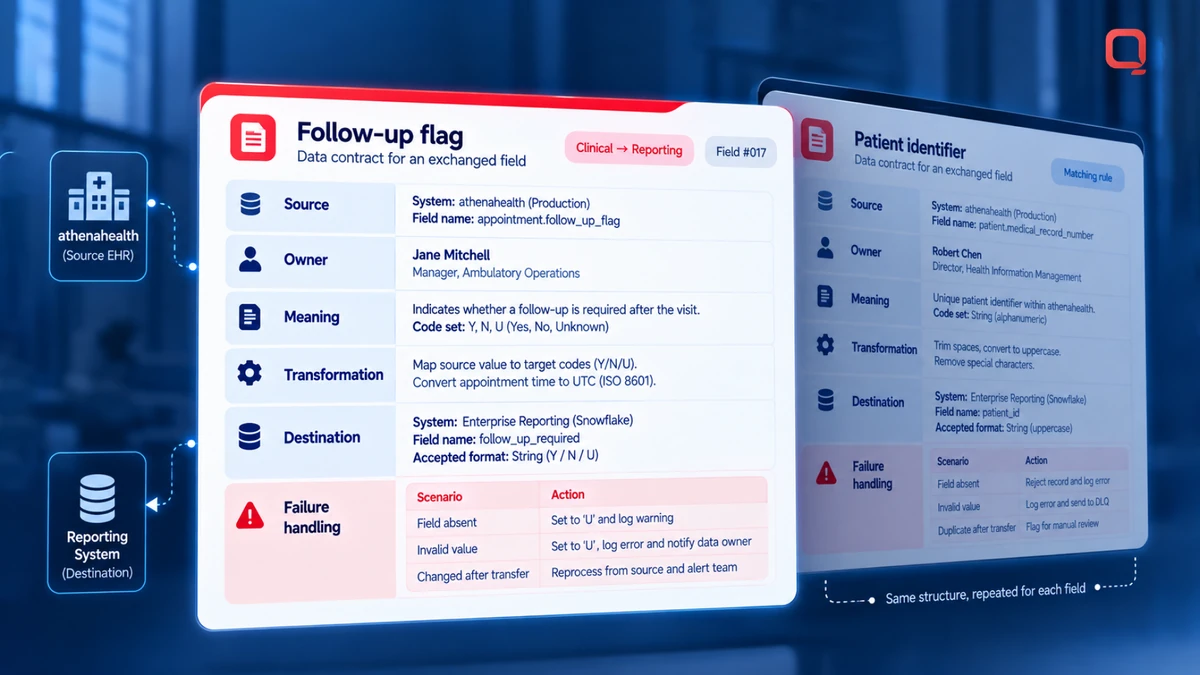
Map only the fields the workflow needs. Document record identifiers and matching rules, timestamp meaning and time zone, terminology or code expectations, required and optional values, and the destination’s accepted format. For each field, record its source, owner, transformation, and validation rule. Specify what should happen when a value is absent, invalid, or changed after transfer.
Build access controls, auditability, secure transmission, and minimum-necessary data handling into both the design and day-to-day operation. A documented data contract reduces ambiguity by making field meaning, ownership, transformations, and failure handling explicit before code is released.
For an exchange under consideration, review the actual environment and interface requirements with a team experienced in healthcare interoperability. Find QSS Technosoft’s contact information.
Athena EMR integration case study: assess the reporting workflow, not just the dashboard
Hypothetical case-study-style scenario: An operations team wants a report that helps staff identify records needing follow-up. This is an illustrative assessment, not a verified Athena implementation or QSS client engagement. The goal is to establish whether authorized source data can support the report and what needs to be resolved before building a dashboard.
The team traces each reporting requirement back to its source. It compares requested fields with data confirmed as available and authorized in the target environment, then documents how values would be transformed for the destination. Operations staff review the resulting report, while named data and technical owners resolve questions about definitions, exceptions, and changes. If a required field or access path is not confirmed, record it as a risk or scope decision rather than assuming the capability exists.
What does a practical integration assessment uncover?
The assessment checks whether report definitions match source records, whether identifiers can reliably connect records, and whether update timing supports the decision. It can also reveal manual workarounds, such as staff reconciling records, that a dashboard alone will not fix. Use an evidence table to turn open questions into testable acceptance criteria.
| Requirement | Question to verify | Acceptance evidence |
|---|---|---|
| Required report fields | Are the fields available and authorized for this workflow? | Approved field list with source and meaning documented |
| Record matching | Which identifiers link a source record to the destination? | Test cases showing expected matches and exceptions |
| Update timing | How current must the report be to support the decision? | Agreed refresh expectation and test results against it |
| Operational review | Who checks uncertain values and failed transfers? | Named owner and documented review procedure |
Record unresolved assumptions as risks, decisions, or explicit scope exclusions. Confirm Athena-specific access and interface details against current vendor documentation. A requested report does not prove that every required source element is available.
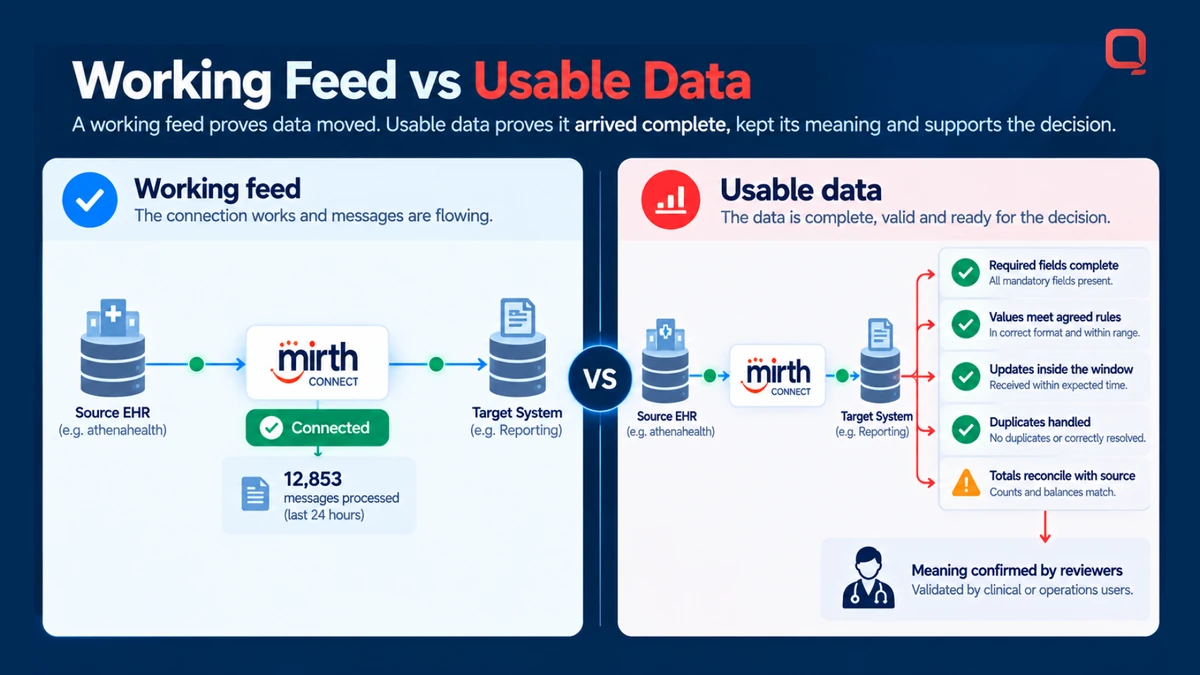
How can teams distinguish a working feed from usable data?
A successful transmission only proves that data moved. Test whether required fields are complete, values meet agreed rules, updates arrive within the defined window, duplicates are handled as expected, and destination totals or samples can be reconciled with the source. Ask operations or clinical reviewers to confirm that field meanings support the intended decision. A technically valid value can still mislead if its meaning or context changes across systems.
A working feed moves information. Trustworthy integration shows that the right information arrived, retained its meaning, and can support the intended action. This keeps athena emr integration services focused on evidence and usability, not just a green connection status.
How to implement Athena EMR integration services safely and test the result
A safe implementation turns approved requirements into a controlled release. Before development, confirm the target athenahealth product, environment, access permissions, and supported interface options with the provider and vendor. A standard, prior integration, or vendor reference does not prove that the same access applies to your setup.
Set acceptance criteria with workflow owners before testing begins. Agree which records and fields must arrive, what counts as a match, how current the data must be, and who reviews exceptions. Then follow a delivery sequence:
- Confirm access. Record approvals, permissions, and verified interface prerequisites.
- Document mappings. Define field meanings, transformations, identifiers, and error handling.
- Build the exchange. Implement only the agreed workflow and approved data scope.
- Test and review. Compare results with acceptance criteria and have operational users review field meanings.
- Release and monitor. Follow approved production steps, track exceptions, and assign owners.
Address privacy and security in the design and operating procedures. Limit access to authorized users, protect data in transit, maintain appropriate audit records, and use only the data needed for the workflow. A certification or security statement alone does not validate an implementation. Confirm that controls fit the actual environment and that responsibilities are clear.
Which tests should an Athena EMR integration pass?
Test valid, missing, and malformed values, as well as duplicate records, delayed exchanges, and rejected data. Check whether permissions block unauthorized access, audit records capture relevant activity, alerts reach the right owner, and recovery procedures prevent gaps or unintended duplicate processing. Use representative test data only under approved privacy and security controls. Resolve failures against agreed criteria before release rather than quietly changing the expected result.
What should teams plan for after go-live?
After release, interface changes, missed updates, and unclear ownership can become operational problems. Assign owners for monitoring, reconciliation, incident escalation, and review of vendor or configuration changes. Document support steps in language operational users can follow, then review them with those users. Confirm production readiness, release approvals, and any required coordination with the provider and athenahealth before enabling the workflow.
QSS Technosoft provides healthcare interoperability and EHR/EMR integration engineering. See the contact page to start a conversation.
Choosing Athena EMR integration services: turn requirements into an engineering plan
A capable integration partner should do more than name standards or promise a connection. The partner should turn your workflow into a plan with clear ownership, verifiable assumptions, and evidence that the finished exchange meets agreed requirements. For Athena-specific work, confirm interface access, permissions, vendor prerequisites, and applicable terms before committing to an architecture or delivery plan. Availability can depend on the product and environment.
Evaluate partners against the work you need them to own:
- Healthcare interoperability experience: Can they explain how they handle clinical data definitions, identifiers, and differences between systems?
- Architecture ownership: Who makes and documents design decisions, dependencies, and scope boundaries?
- Testing discipline: Will they define acceptance criteria with workflow owners and provide evidence that the integration meets them?
- Security by design: Can they explain how privacy and security controls fit the data flow and operating model, rather than treating a certification as a shortcut?
- Operational support: Who owns monitoring, change management, reconciliation, and escalation after release?
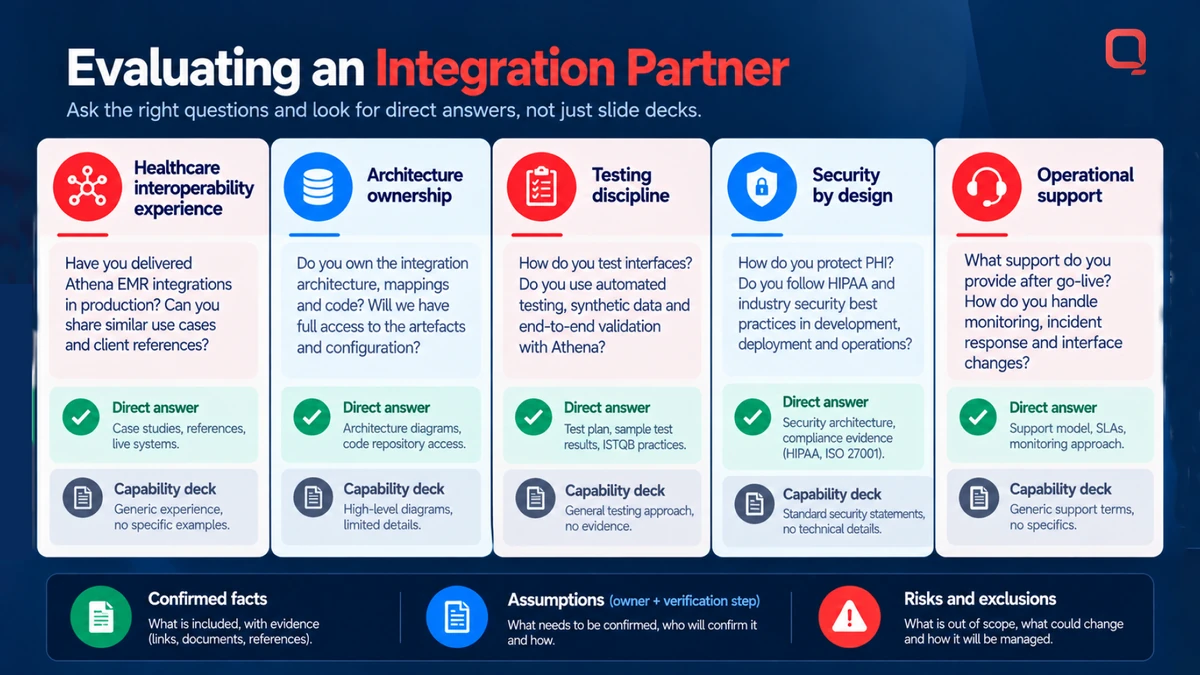
Look for direct answers, not a generic capability deck. If a partner cannot identify what must be verified with athenahealth or your provider, the technical plan is premature.
What should you ask a potential integration partner?
Ask how the partner will verify supported interfaces, access permissions, data definitions, and vendor dependencies in your environment. Clarify who owns mapping decisions, test evidence, production monitoring, and responses to changes. Request relevant evidence they are permitted to share, such as a redacted mapping or test approach. General interoperability experience can demonstrate relevant skills, but it is not proof of a comparable Athena project.
Before selecting a partner, make sure the proposal separates confirmed facts from assumptions. Each assumption should have an owner and a verification step, or be recorded as a risk or scope exclusion. That discipline makes estimates and commitments more credible without assuming every interface behaves the same way.
How can QSS support an Athena EMR integration discussion?
QSS Technosoft provides healthcare IT engineering, EHR/EMR development and integration, and healthcare interoperability capabilities that include HL7 and FHIR. Its company profile lists a 250+ in-house engineering team and 400+ delivered projects. These describe broader company capabilities, not a verified Athena implementation. QSS’s senior-led, architect-driven approach and compliance-by-design can help frame the work around your workflow, environment, access requirements, and operating constraints.
Bring the workflow, known interface requirements, and open questions to the conversation. Contact QSS to discuss your integration requirements and whether its healthcare interoperability and EHR/EMR integration experience fits your plan for athena emr integration services.
Build the integration around a workflow you can verify
Reliable athena emr integration services begin with a defined workflow, not an assumed interface. Confirm the product, environment, permissions, and vendor requirements before committing to development. Document what each data element means, who owns it, how it will be tested, and who will monitor it after release.
The test is more than a successful transmission. Data must arrive complete, retain its meaning, and support the decision it was intended to inform. Treat the reporting scenario in this guide as an assessment model, not a claim of a completed Athena project.
QSS Technosoft provides healthcare interoperability capabilities that include HL7 and FHIR, alongside EHR/EMR integration and healthcare IT engineering. Its company profile lists 250+ in-house engineers, 400+ delivered projects, and HIPAA, ISO 27001:2013, and CMMI Level 3. These are company credentials, not proof of a specific Athena implementation or a guaranteed outcome.
Bring your workflow, environment details, and open interface questions to the planning conversation. Discuss your Athena EMR integration requirements with QSS and take the next step with clear assumptions, measurable tests, and accountable ownership.
Bring one workflow and your open interface questions
A 30-minute working session with a healthcare interoperability architect, not a salesperson. We will separate what is confirmed for your athenahealth environment from what still needs verifying, sketch the data contract for the fields the workflow needs, and list the acceptance tests the exchange would have to pass. You keep the written summary either way, and it is written to be usable with any partner.
Discuss your Athena EMR integration →