HIPAA Compliance Checklist for Healthcare Software in 2026
 By Vineet Bhardwaj
QSS Technosoft
October 1, 2026
13 min read
By Vineet Bhardwaj
QSS Technosoft
October 1, 2026
13 min read

A vendor’s “HIPAA compliant” claim doesn’t prove that your software or organization is compliant. HIPAA compliance is an operating discipline, not a checkbox in a product feature list. The practical work is to identify who handles health information, how access is controlled, and what evidence shows that safeguards are working.
If you’re unsure where your organization’s responsibility ends and a technology vendor’s begins, start by mapping the system and the people involved. A signed agreement or built-in security feature may matter, but neither settles the full question. Involve your legal and security leads, then turn their decisions into an engineering plan based on how the software will actually be used.
This 2026 checklist will help you assess data flows, user access, vendors, and operational evidence, then identify questions to take to your legal and security teams. It also provides practical criteria for evaluating development support across requirements, architecture, implementation, testing, and maintenance. QSS Technosoft offers HIPAA-Compliant Software Development Services. Engineering support can address compliance considerations throughout development, but software alone can’t establish your organization’s HIPAA compliance.
Quick Answer
HIPAA compliance for healthcare software is an operating discipline, not a product feature or a vendor badge. Start by defining whether you are building, buying, integrating, modernizing, or operating the software, then map every health information flow, including APIs, integrations, cloud services, and operational tools. Turn approved privacy and security decisions into testable controls, each with an owner, an implementation location, a validation method, and retained evidence. Treat a vendor’s “HIPAA compliant” claim as a question to investigate, use the seven-step checklist below to move from scope to release approval, and keep reviewing access, vendors, integrations, and material changes after launch. Qualified legal, privacy, and security reviewers decide what applies to your project.
What HIPAA compliance means for healthcare software projects
HIPAA compliance in a software project means designing, using, and maintaining systems in a way that supports the organization’s applicable obligations for health information. It isn’t a feature flag, a vendor badge, or a promise that software alone makes an organization compliant.
“HIPAA compliance in software projects is the documented alignment of system behavior, vendor commitments, and organizational practices with requirements that apply to the specific use case.” The Health Insurance Portability and Accountability Act of 1996 (HIPAA) provides useful background, but it doesn’t determine how the law applies to your project. That depends on the data, intended use, and participating organizations. Ask qualified legal and compliance reviewers to assess your situation.
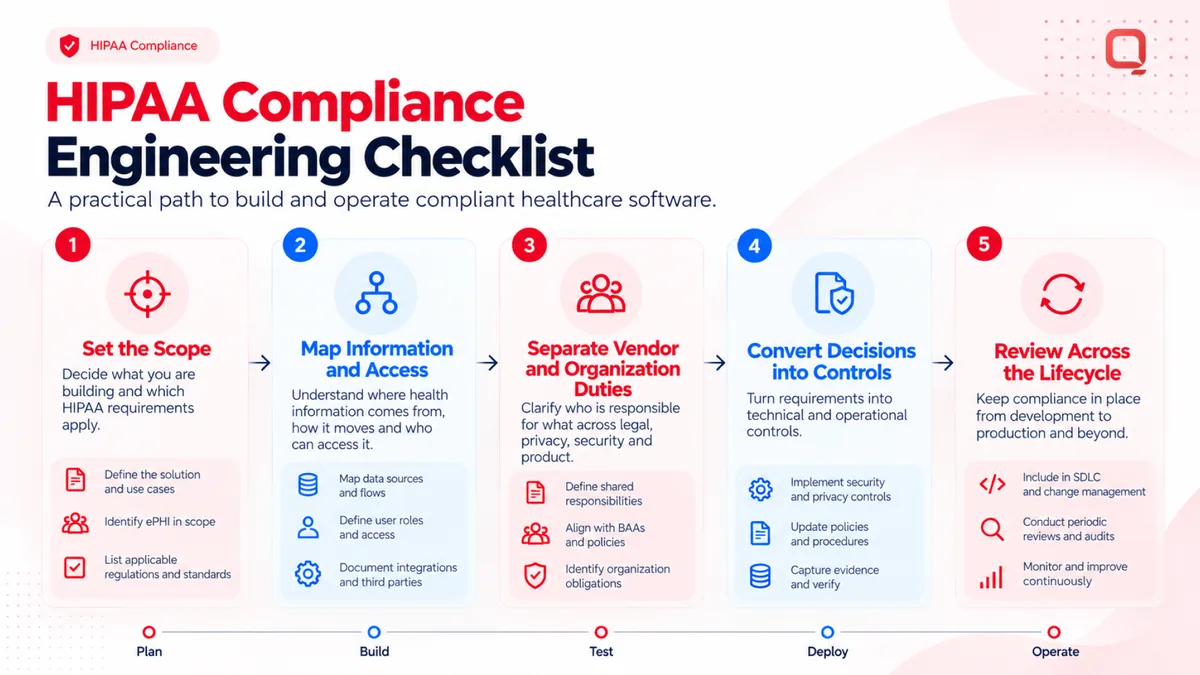
First, define the project: are you building, buying, integrating, modernizing, or operating healthcare software? Each path raises different questions. A purchased application may connect to existing systems. A modernization project may preserve existing data flows. An integration may introduce a new party with access. Describe the work and its boundaries before assigning responsibility.
Which healthcare software and data flows need review?
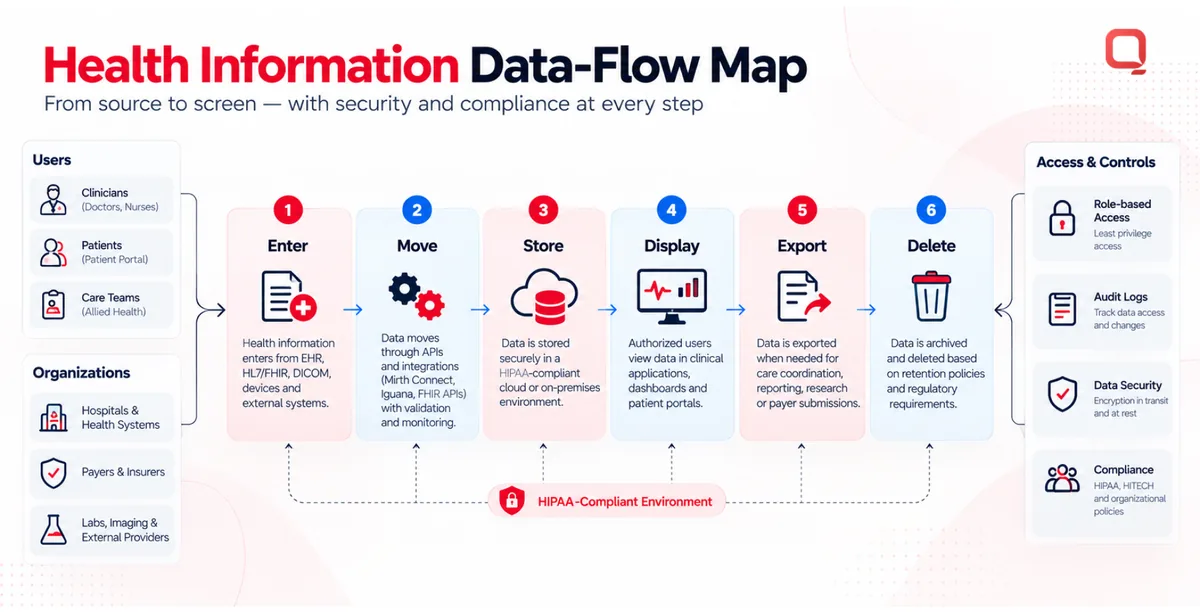
Map the full path of health information. Record where it enters, moves, is stored, displayed, exported, and deleted. Include the visible application, but also examine APIs, integrations, cloud services, and operational tools that may handle or expose information.
For each system or flow, document who uses it, which organizations participate, and what access each has. Include support and administrative workflows where relevant. Check the diagram against the systems and interfaces the team expects to use. If it leaves out an integration or operational tool, the picture is incomplete, even if the main application appears well controlled.
Who owns compliance decisions: the organization or the software vendor?
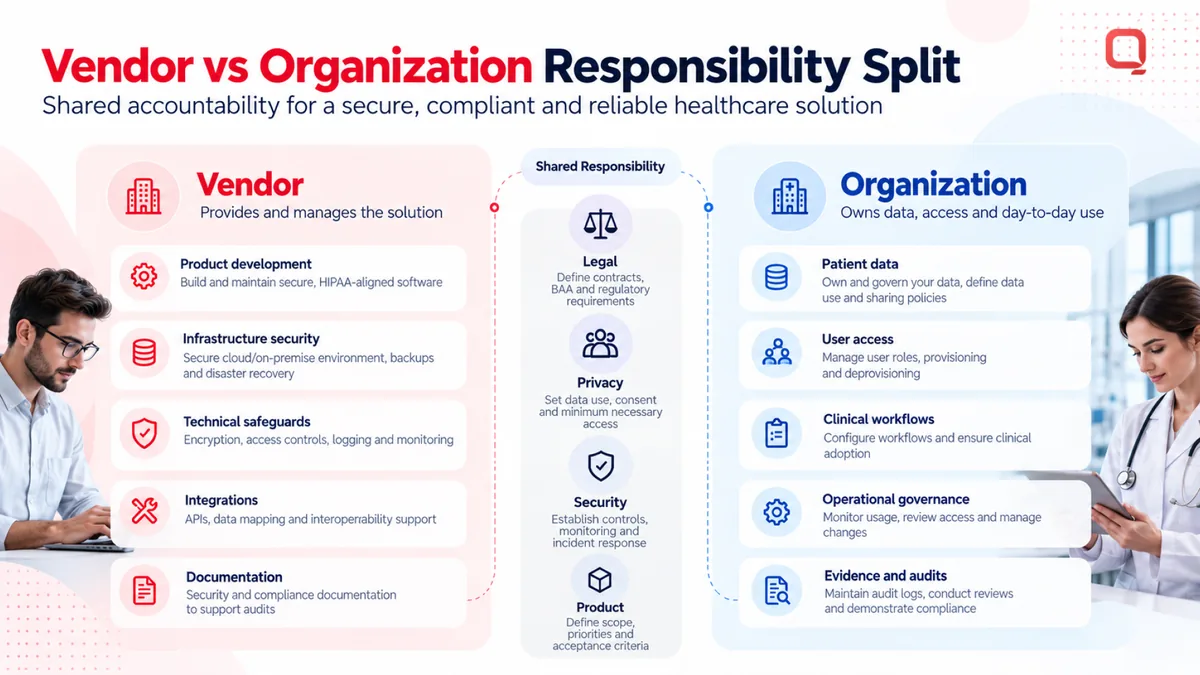
Neither side should assume the other owns every decision. A software provider can build controls and document its commitments, but the organization still needs to assess its own use of the system and internal practices. The exact division depends on the project and should be confirmed by qualified reviewers, not inferred from marketing copy.
Bring legal, privacy, security, and product owners into the same discussion. Record who defines scope, approves access and data use, reviews vendor commitments, and retains project evidence. Then specify what the vendor will provide and what remains outside the project. Clear boundaries help teams find gaps before they become production assumptions.
Turn HIPAA compliance considerations into engineering controls
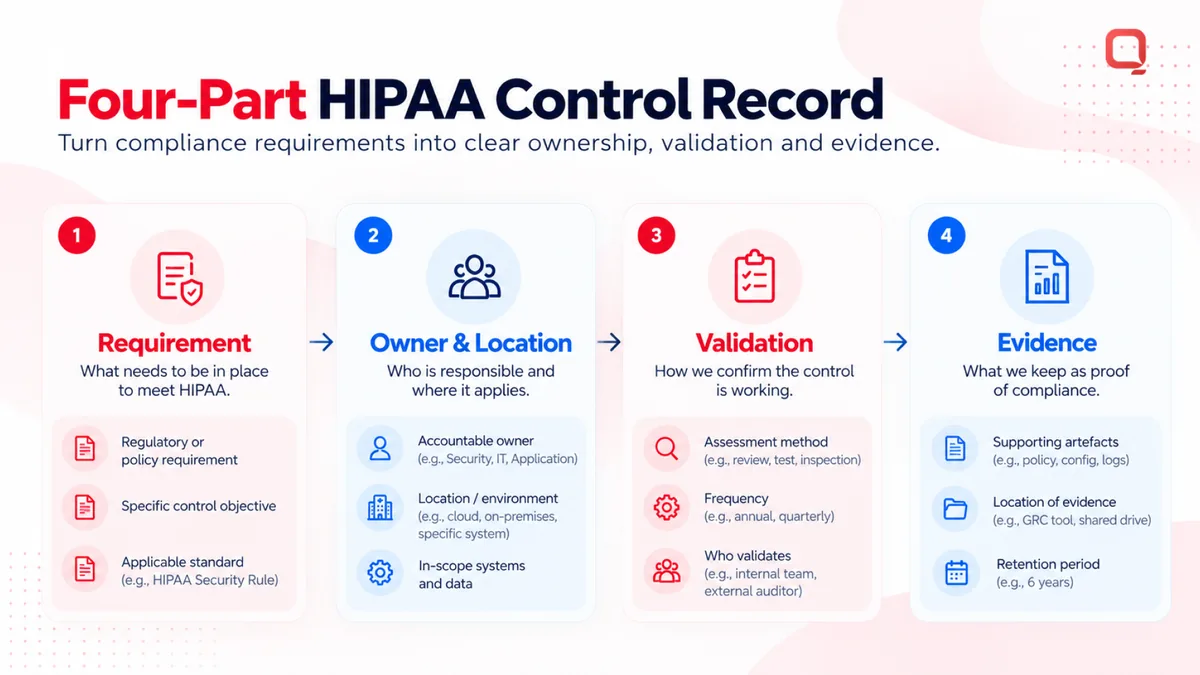
Translate approved privacy and security decisions into requirements the team can build and verify. The HIPAA Security Rule is a useful reference for qualified reviewers considering safeguards, but engineers still need project-specific direction. For HIPAA compliance, don’t stop at a policy statement. Make each requirement testable, assign an owner, identify where it will be implemented, and define the evidence that will show whether it works.
A practical control record can capture four things:
- Requirement: What must the system or team do?
- Owner and location: Who is accountable, and where will the control live, such as in the application, identity provider, cloud configuration, or operating procedure?
- Validation: What test, review, or approval will confirm that the control behaves as intended?
- Evidence: Where will the decision and result be retained?
Build privacy and security requirements into design
Before implementation, specify what health information the system collects, why it is used, who can access it, where it travels, and which retention decisions need approval. Define system boundaries, including integrations and administrative tools. Then review identity, role-based permissions, authentication, and privileged access against the project’s threat model. Ask security and privacy leads to resolve open questions, or record each unresolved issue as a risk with an owner and next step. Don’t let an undocumented assumption become a production default.
Include operational topics in the review: logging and monitoring, encryption, backups, and incident workflows. The appropriate design depends on the system and its use. These controls are not interchangeable, and no single feature establishes compliance. Have qualified legal, privacy, and security reviewers determine what applies and whether the planned approach is appropriate.
Test controls and preserve evidence through delivery
Plan privacy and security testing around documented risks, integrations, and user roles. For example, verify that access works as approved for each role, check that relevant activity is recorded, and test how the system responds to identified failure scenarios. Define who reviews defects, how fixes are retested, and who can approve release. A passing test is useful only when the team can show what was tested, which requirement it addressed, and what result it produced.
Documented requirements become defensible engineering controls when each is implemented, tested, approved, and tied to retained evidence.
Maintain traceability from requirement to code change, test result, approval, and release. After a material system change, reassess the controls it may affect and update the evidence. Teams planning custom healthcare software development can discuss engineering requirements with QSS, which offers HIPAA-Compliant Software Development Services. Development support can address controls across delivery; it doesn’t guarantee that an organization is compliant.
Compare vendors and systems without mistaking claims for proof
A vendor’s “HIPAA compliant” statement is a starting point for questions, not proof that the product or your organization meets applicable responsibilities. Evaluate four separate layers: product features, vendor processes, contract terms, and controls your organization must operate. The appropriate administrative, physical and technical safeguards depend on the organization’s context, so have authorized legal, privacy, and security reviewers assess the evidence and responsibility boundaries.
Use a comparison table to turn broad assurances into specific follow-up work:
| Vendor statement | Supporting evidence to request | Accountable owner | Follow-up question |
|---|---|---|---|
| “Access is controlled” | Project-specific description of user roles, administrative access, and access review processes | Vendor for its service; customer security owner for customer-managed access | Who approves, changes, and reviews each access path? |
| “Activity is logged” | Explanation of what activity is recorded, how logs are reviewed, and how long they are retained | Vendor and customer owners, according to system boundaries | Can the relevant team access and use the records during an investigation? |
| “The service is secure” | Relevant security documentation, testing approach, and incident-handling process | Vendor security contact, with customer security review | How are findings handled, and how are incidents communicated under the agreement? |
| “Integrations are supported” | Data-flow details, interface boundaries, and change-control responsibilities | Owners of the connected systems and integration | Who configures, monitors, and maintains each connection? |
What evidence should a healthcare software vendor explain?
Ask for project-specific explanations of data flows, access management, security testing, incident handling, and change control. Have authorized reviewers assess relevant documentation and contract terms, including what the vendor commits to do and what the customer must configure or manage. Ask how subcontractors and connected services fit into the documented model. A generic policy may describe a process, but it won’t show how that process applies to your deployment.
How should teams assess cloud and interoperability boundaries?
Trace information through APIs and HL7 or FHIR interfaces. A standard can support exchange, but it doesn’t establish hipaa compliance or determine who operates each control. For every boundary, identify who configures, monitors, and maintains the systems involved, including support access and non-production environments. Review cloud architecture separately against the actual services, data flows, and vendor commitments in scope.
Use this HIPAA compliance checklist before launch and during operations
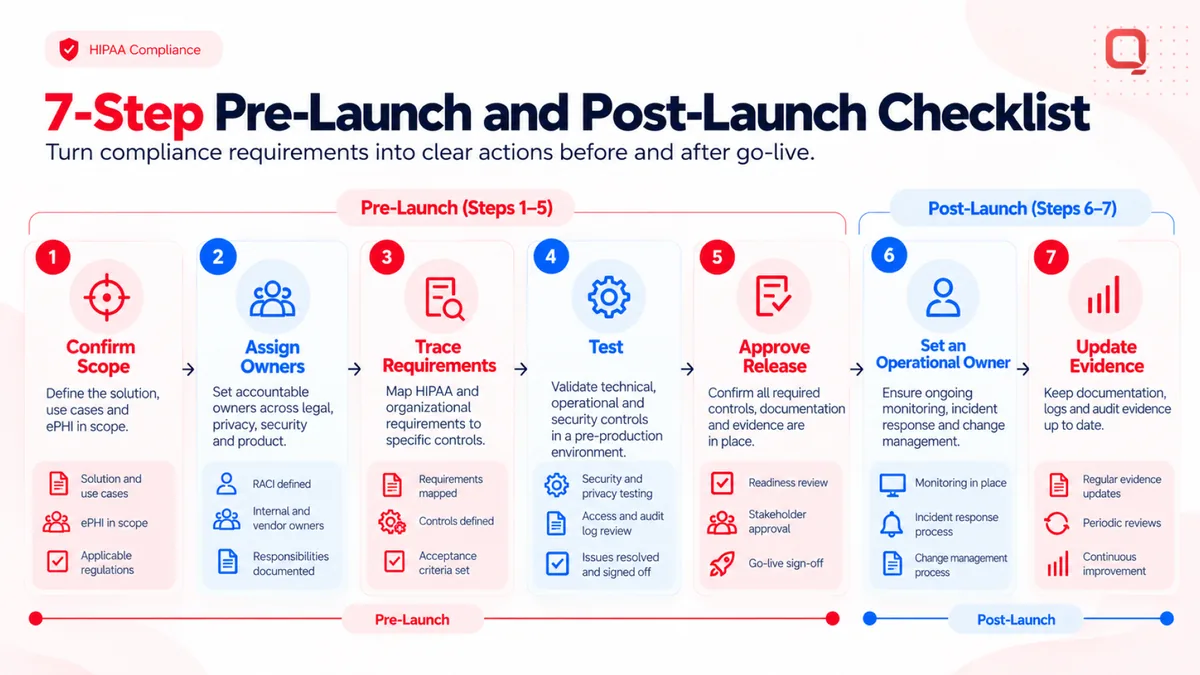
Use this sequence to move from project scope to release readiness and ongoing review. Assign a role to each action, then retain evidence showing what was decided and completed. This checklist supports planning. It doesn’t replace a formal compliance assessment or legal advice from qualified reviewers.
Pre-launch review: confirm scope, ownership, and evidence
- Step 1: Confirm scope. The product owner and technical lead document system boundaries, data flows, user roles, vendors, integrations, and environments. Retain the approved scope and current system diagram.
- Step 2: Assign decision owners. Legal, privacy, security, and product leads confirm who reviews applicability, approves data use, manages access, and evaluates vendor commitments. Keep the responsibility matrix, decisions, and open questions.
- Step 3: Trace requirements to controls. Engineering maps each approved requirement to its implementation location and validation method. Retain the requirements list, design decisions, and links to relevant code or configuration changes.
- Step 4: Test and resolve. The security lead and test owner review results for relevant roles, integrations, and identified risks. Preserve test records, defects, remediation, and retest outcomes.
- Step 5: Approve release or stop. The authorized organizational approver reviews outstanding risks and evidence before launch. If legal, privacy, security, or vendor questions remain unresolved, pause and escalate them to the accountable reviewer. Keep the approval or documented decision not to release.
Post-launch review: maintain controls as software changes
- Step 6: Set an operational owner. The designated service or security owner reviews access, incidents, vendors, integrations, and material system changes. Document the review, findings, and assigned follow-up actions.
- Step 7: Update the evidence. Engineering and operations record configuration changes, testing, approvals, and remediation as the system evolves. Revisit affected controls after significant changes rather than relying on the original launch record.
Healthcare interoperability can add interfaces and responsibility boundaries that deserve their own review. Treat each connection as part of the system’s scope and confirm who configures, monitors, and maintains it. An interface standard doesn’t answer those ownership questions.
A checklist can organize the work, but it can’t determine legal applicability or prove hipaa compliance by itself. QSS Technosoft offers HIPAA-Compliant Software Development Services. If your team needs engineering support to plan or deliver healthcare software controls, discuss your project with QSS.
How QSS supports HIPAA-Compliant Software Development Services
QSS Technosoft offers HIPAA-Compliant Software Development Services. The work starts with the project, not a blanket promise. Compliance-by-design means bringing relevant privacy and security considerations into requirements, architecture, implementation, testing, and maintenance, then documenting decisions and evidence with the project team.
This approach can help translate organizational direction into engineering tasks: define system boundaries, assign control owners, make requirements testable, and review changes that could affect the system. QSS describes its delivery as senior-led and architect-driven. That is a delivery approach, not a certification, legal opinion, or guarantee that a client organization achieves hipaa compliance. Qualified organizational reviewers must assess applicable responsibilities and approve decisions.
What to clarify with an engineering partner before work begins
Ask how the team will document application scope, data flows, integrations, control owners, and unresolved assumptions. Confirm which testing, change management, operational support, and evidence activities are included in the engagement, and which remain with your organization or another vendor. Have counsel and security leaders review relevant responsibilities and agreements. Put the boundaries in writing before work proceeds.
Discuss a software project with QSS
A useful first discussion starts with the facts of the system: what the application does, who uses it, which systems it connects to, and what constraints already exist. Include known risks and decisions still awaiting review. These details help identify what needs clarification before an engineering approach can be scoped. Avoid sharing sensitive patient information in an initial project discussion unless your organization has approved the method and terms for doing so.
If you’re planning a new healthcare application, integration, or modernization effort, discuss your healthcare software requirements with QSS. Bring the scope, risks, and engineering questions so you can identify what needs review and agree on next steps.
Build a defensible path from checklist to practice
HIPAA compliance depends on more than a security feature or vendor promise. Define system boundaries, assign owners, and connect each engineering control to validation and evidence. Keep the process active after launch by reviewing access, vendors, integrations, and material changes.
QSS Technosoft offers HIPAA-Compliant Software Development Services, with work across healthcare software engineering and interoperability. Its delivery approach is senior-led and architect-driven. That support can help teams address compliance considerations through development and maintenance, but it can’t guarantee an organization’s compliance or replace legal and security review.
Have a project to scope, modernize, or connect? Discuss your healthcare software requirements with QSS, including your system boundaries, known risks, and engineering needs. Start with clear questions, involve the right reviewers, and plan the next steps for your healthcare software project.
Scope Your HIPAA-Ready Healthcare Software Project
Bring your system boundaries, data flows, integrations, and open questions to a working session with our engineers. As a custom healthcare software development company and medical software development company, QSS helps teams turn approved privacy and security decisions into testable controls across custom medical software development, integration, and modernization, while your legal, privacy, and security reviewers stay in charge of applicability and approvals. QSS Technosoft Inc. is a software development company in USA, based in Bloomington, Minnesota.
Discuss your healthcare software requirements →