How Do You Build AI Agents That Actually Solve Business Problems?
 By Deepak Rathaur
Sr. Software Engineer, QSS Technosoft
August 12, 2026
12 min read
Updated Aug 12, 2026
By Deepak Rathaur
Sr. Software Engineer, QSS Technosoft
August 12, 2026
12 min read
Updated Aug 12, 2026
Quick Answer
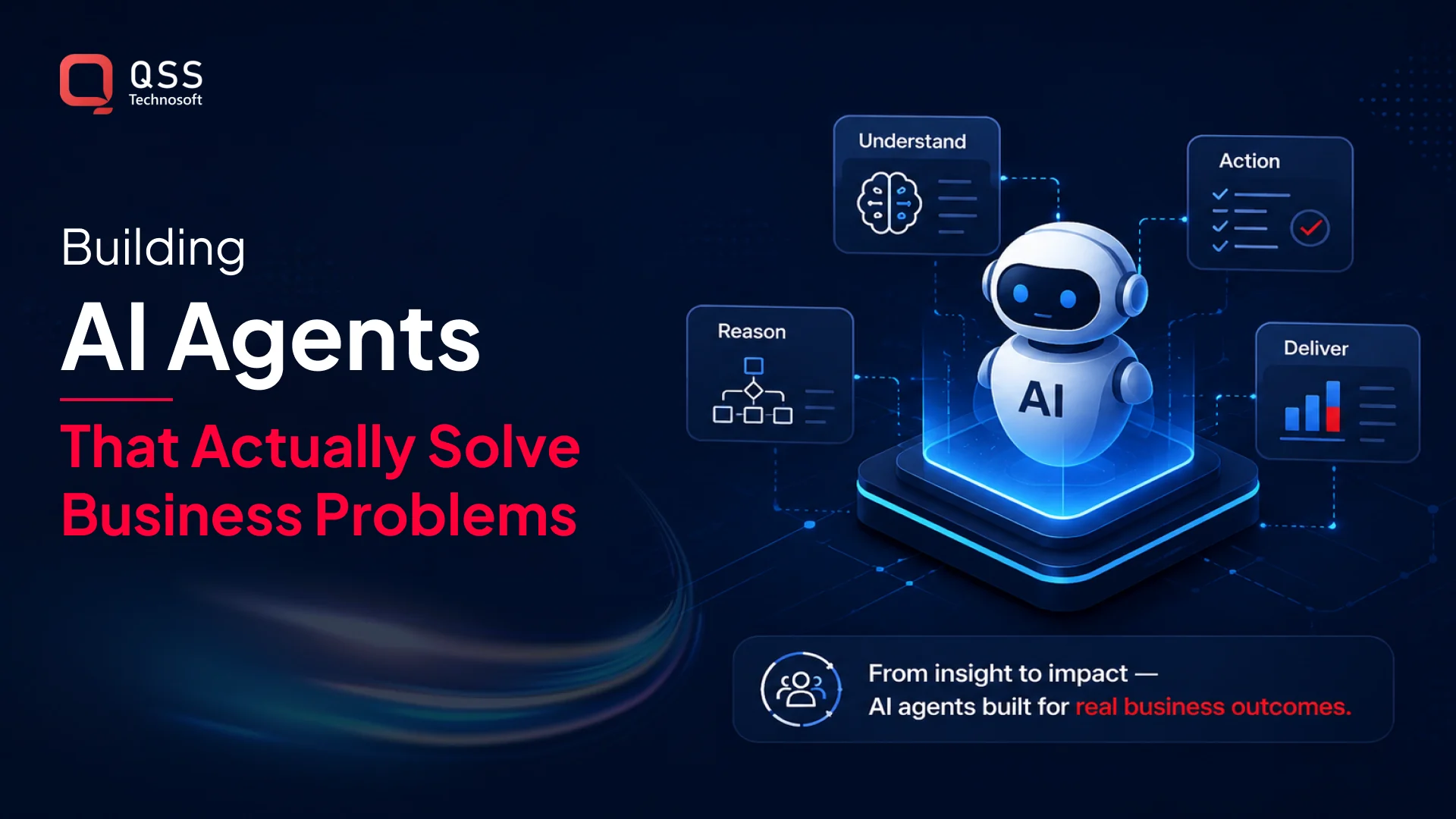
Building an AI agent that actually works is not about the model or a clever architecture. It is about connecting a probabilistic system to a real business outcome. Start with the problem, measure the business result, keep the architecture as simple as it can be, and use observability, guardrails, and evaluation to make it reliable.
Who This Guide Is For
This guide is for AI engineers, technical leaders, and product owners building production-grade AI agents. If you are moving beyond demos and prototypes and need agents that are reliable, measurable, and tied to real business results, this is written for you.
AI agents are one of the most exciting developments in modern software engineering. They can reason through problems, use tools, adapt their approach, and complete tasks in ways that traditional software often cannot.
But there is a catch.
The flexibility that makes AI agents powerful is also what makes them unpredictable.
An agent may take a different path through the system on different runs, produce different outputs, and even consume different amounts of resources. For organizations building production-grade AI systems, this unpredictability is not something we can simply ignore.
The real challenge is therefore not just building an AI agent.
It is building an AI agent that is measurably useful, safe, reliable, and aligned with a real business objective.
1. The Biggest Risk of Agentic AI: Unpredictability
Traditional software generally follows a predefined path.
You write:
Input → Function A → Function B → Function C → Output
An agentic system can behave very differently:
Input
↓
LLM
↓
Tool A?
↓
LLM
↓
Tool B?
↓
LLM
↓
Another decision
↓
Output
The exact path may change depending on the model's reasoning and generated tokens.
As a result:
The execution path can vary.
The output can vary.
The number of LLM calls can vary.
The cost can vary.
The system can behave differently for similar inputs.
This is one of the fundamental characteristics of agentic AI.
So how do we control it?
Two important mechanisms are observability and guardrails.
2. Observability: Know What Your Agent Is Doing
You cannot reliably improve a system that you cannot observe.
Observability means collecting enough information to understand what is happening inside your agent.
For an AI agent, this can include:
- LLM calls
- Prompts and responses
- Tool calls
- Execution traces
- Errors
- Latency
- Token usage
- Costs
- Evaluation results
Instead of simply asking:
"Did my agent work?"
you should be able to ask:
"What did my agent do, why did it do it, how much did it cost, and did that behavior actually produce the desired result?"
This becomes especially important in production.
3. Evaluation Should Be Connected to Business Outcomes
One of the most important ideas when building AI agents is that technical evaluation alone isn't enough.
Suppose you build an AI agent that communicates with potential customers.
You could evaluate:
"Did the LLM produce a good response?"
That's useful, but it isn't the ultimate goal.
A better question is:
"Did the agent generate more qualified leads?"
And an even stronger business metric might be:
"How much revenue did the agent generate?"
This creates a hierarchy:
LLM Output Quality
↓
Agent Performance
↓
Business Metric
↓
Business Outcome
The closer your evaluation is to the actual business outcome, the more meaningful it becomes.
4. LLM-as-a-Judge
Another useful evaluation technique is using an LLM to evaluate another LLM's output.
This is often called LLM-as-a-Judge.
For example:
User Request
↓
Agent
↓
Generated Response
↓
Evaluator LLM
↓
Quality Score / Feedback
The evaluator can assess whether the generated output meets predefined criteria.
This can help measure agent performance at scale.
However, even an LLM-based evaluation should ultimately connect back to the purpose of the system.
A response can be beautifully written and still fail to solve the actual business problem.
Working with LLMs in production?
The right model, prompt, and evaluation setup is what separates a demo from a system that ships. See how QSS designs and deploys LLM solutions.
5. Guardrails: Put Boundaries Around Your Agents
Observability tells you what happened.
Guardrails help control what is allowed to happen.
Guardrails are additional checks and rules placed around an AI workflow.
For example:
User Input
↓
Input Guardrail
↓
Agent
↓
Output Guardrail
↓
Final Response
You can use guardrails to check:
Whether the input is allowed
Whether the output follows required rules
Whether sensitive information is being exposed
Whether the response meets quality requirements
Whether a tool should actually be executed
Whether the agent is operating within its intended boundaries
The key idea is simple:
The fact that an LLM generated something does not mean you have to trust or use it.
You can inspect the output first.
6. Trap #1: "We Need an AI Agent"
One of the biggest mistakes organizations make is starting with the solution instead of the problem.
A business stakeholder might say:
"We need an AI agent."
The natural response from a technology team may be:
"Okay. What kind of agent?"
But the better question is:
"What business problem are we trying to solve?"
This distinction is extremely important.
An AI agent might be the right solution.
But it might also be:
A simple LLM call
A traditional software system
- A database query
- An automation
- A dashboard
- A simple workflow
Or something that doesn't require AI at all
Technology should follow the problem, not the other way around.
7. Start With the Business Problem
Imagine a company asks for a "culture agent."
At first, this sounds like an interesting AI project.
But what does the company actually need?
After asking more questions, you might discover:
"Culture Agent"
↓
Employee morale problem
↓
High employee attrition
↓
Business problem
↓
How do we reduce attrition?
Now you have something measurable.
You can track:
- Employee attrition
- Employee satisfaction
- Engagement
- Retention
- Survey results
Only after understanding the problem should you determine whether an AI agent is useful.
Perhaps the solution is an employee-facing AI assistant.
Perhaps it's an employee survey.
Perhaps it's a management intervention.
Perhaps it's something completely different.
The important thing is that the agent is not the objective.
The business outcome is.
8. LLMs Generate Believable Content — Not Guaranteed Truth
This is one of the most important concepts for AI engineers.
LLMs are extremely good at generating plausible content.
But:
Plausible does not automatically mean correct.
An LLM can produce a response that sounds:
- Intelligent
- Professional
- Confident
- Detailed
- Convincing
…and still be wrong.
This is why simply looking at the output and saying:
"That sounds good."
is not a sufficient evaluation strategy.
You need a measurable way to determine whether the output actually solves the problem.
9. Don't Build a Complex Agent Architecture Too Early
Another common mistake is anthropomorphizing AI agents.
Anthropomorphism means treating AI systems as if they were human beings.
For example, suppose you're building an AI trading system.
You might immediately design:
Market Research Agent
↓
Trader Agent
↓
Risk Manager Agent
↓
Trade Manager Agent
It looks sophisticated.
It feels logical.
It resembles the way a human organization might work.
But that doesn't necessarily mean it's the best architecture.
The LLMs aren't actually people occupying those roles.
They are statistical systems generating likely tokens based on their inputs.
Therefore, the architecture should be justified by performance, not by how human-like it looks.
10. Start Simple
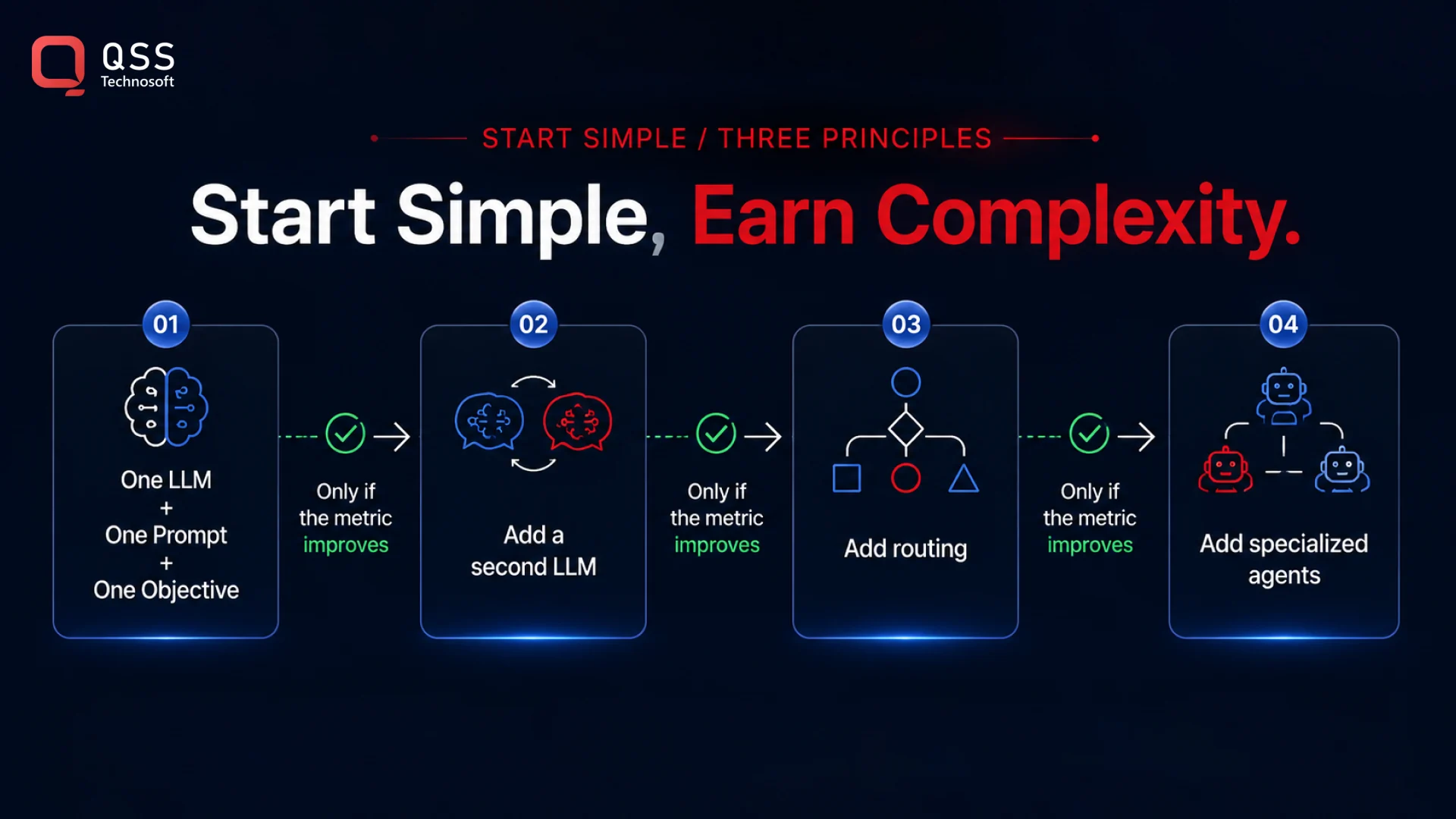
A much better approach is:
One LLM
+
One Prompt
+
One Objective
+
One Business Metric
Start there.
Measure the result.
Then experiment.
Maybe you discover that a second LLM improves the result.
Add it.
Maybe routing between different models improves performance.
Add routing.
Maybe specialized agents improve the outcome.
Introduce them.
The architecture should evolve based on evidence.
In other words:
Don't start with complexity. Earn complexity.
11. Architecture Should Improve the Metric
Suppose your objective is generating sales emails.
You could measure:
- Open rate
- Response rate
- Qualified leads
- Meetings booked
- Revenue generated
Now imagine two architectures.
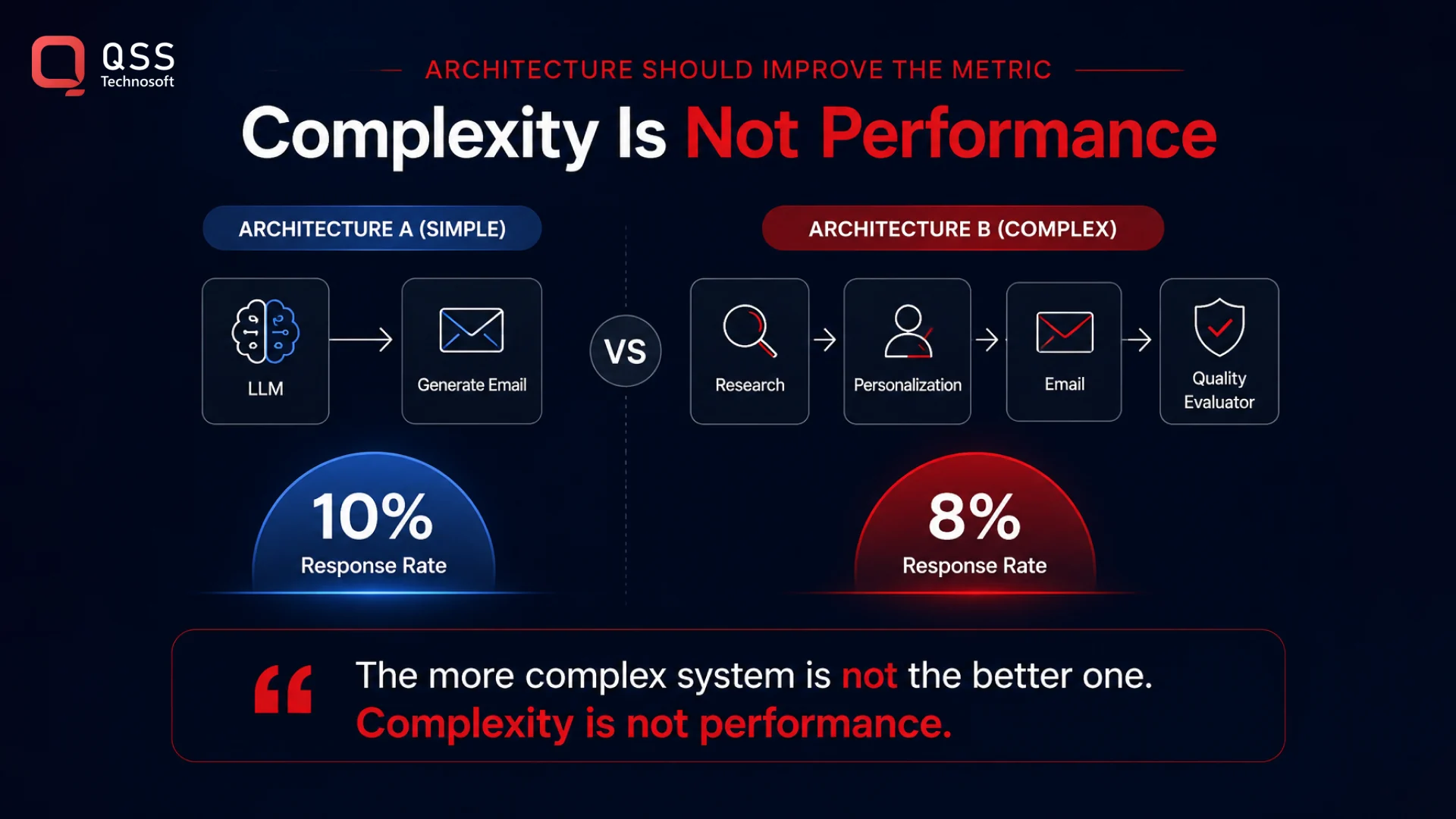
Architecture A
One LLM
→ Generate email
Architecture B
Research Agent
↓
Personalization Agent
↓
Email Agent
↓
Quality Evaluator
Architecture B looks much more sophisticated.
But what if Architecture A produces a 10% response rate while Architecture B produces 8%?
Then the more complicated architecture isn't better.
Complexity is not performance.
The correct architecture is the one that produces better measurable results.
12. Don't Blame Hallucinations
When an AI system produces incorrect information, it is tempting to say:
"The model hallucinated."
But if you're an AI engineer building the system, that isn't the end of the conversation.
The model is doing what it was designed to do: generating likely tokens based on patterns learned from its training data.
Your responsibility is to build a system around that model that can handle its limitations.
That means using:
- Guardrails
- Validation
- Retrieval
- Verification
- Evaluations
- Tool constraints
- Human review where necessary
- Business-level metrics
Instead of asking:
"How do I stop the LLM from ever hallucinating?"
a more useful engineering question is:
"How do I design my system so that incorrect model outputs don't cause unacceptable business consequences?"
That's a much more practical way to think about production AI.
13. The Real Job of an AI Engineer
An AI engineer isn't simply someone who calls an LLM API.
The real job is to take a probabilistic model and connect it reliably to a business objective.
Think about the pipeline:
Business Problem
↓
Measurable Objective
↓
LLM / Agent
↓
Tools + Guardrails
↓
Evaluation
↓
Business Outcome
↓
Iteration
The system continuously improves based on measurable results.
That's where agentic AI becomes genuinely valuable.
14. Three Principles to Remember
If you remember only three things, remember these.
1. Start with the problem
Don't begin with:
"I need an AI agent."
Begin with:
"What problem am I trying to solve?"
2. Measure the outcome
Don't measure success only by whether the LLM produced a good-looking answer.
Measure the business result.
For example:
Sales Agent      → Revenue
Support Agent    → Resolution Rate
Recruiting Agent → Qualified Candidates
Marketing Agent  → Conversion Rate
3. Start simple and earn complexity
Don't design a five-agent architecture just because it looks impressive.
Start with:
- One LLM
- One Prompt
- One Objective
Then experiment and introduce additional agents, routing, tools, or workflows only when they demonstrably improve the outcome.
Final Thought
The excitement around AI agents is justified. They can solve problems in flexible and powerful ways that weren't previously practical.
But that flexibility creates new engineering challenges.
Agents can be unpredictable.
LLMs can generate believable but incorrect information.
Complex architectures can look impressive without actually improving performance.
And organizations can easily become so focused on "building an agent" that they forget why they wanted one in the first place.
The solution is to return to fundamentals:
Start with a real business problem.
Define how success will be measured.
Start with the simplest possible architecture.
Add complexity only when experimentation proves that it improves the outcome.
Use observability and guardrails to make the system reliable.
Ultimately, the job of an AI engineer is not to make an LLM sound intelligent.
It is to turn that intelligence into measurable business value.
And that is the difference between simply building an AI agent and building an AI system that actually works.How QSS Builds AI Agents That Actually Work
How QSS Builds AI Agents That Actually Work
Everything above is how we think about agentic AI, and how we build it. At QSS Technosoft, we design production-grade AI agents the way this article describes:
- Problem first, not tech first: we start with the business outcome and whether an agent is even the right tool.
- Measurable by design: every agent is tied to a metric and instrumented with observability from day one.
- Guardrails built in: validation, checks, and human-in-the-loop so wrong outputs don't become costly.
- Start simple, earn complexity: we prove value lean, then add routing or agents only when the numbers justify it.
- Connected to outcomes: we wire a probabilistic model reliably to your business objective, end to end.
All backed by 16+ years of engineering and ISO 27001 and CMMI Level 3 discipline, and you own the code and IP.
Building AI agents that need to work in production?
QSS builds measurable, reliable, business-aligned AI systems — with the observability, guardrails, and evaluation that turn a probabilistic model into dependable business value.
Talk to an AI Engineer →