Custom Software Guide for Business & Healthcare Leaders
 By Rashmi Kanti
QSS Technosoft
October 7, 2026
14 min read
By Rashmi Kanti
QSS Technosoft
October 7, 2026
14 min read
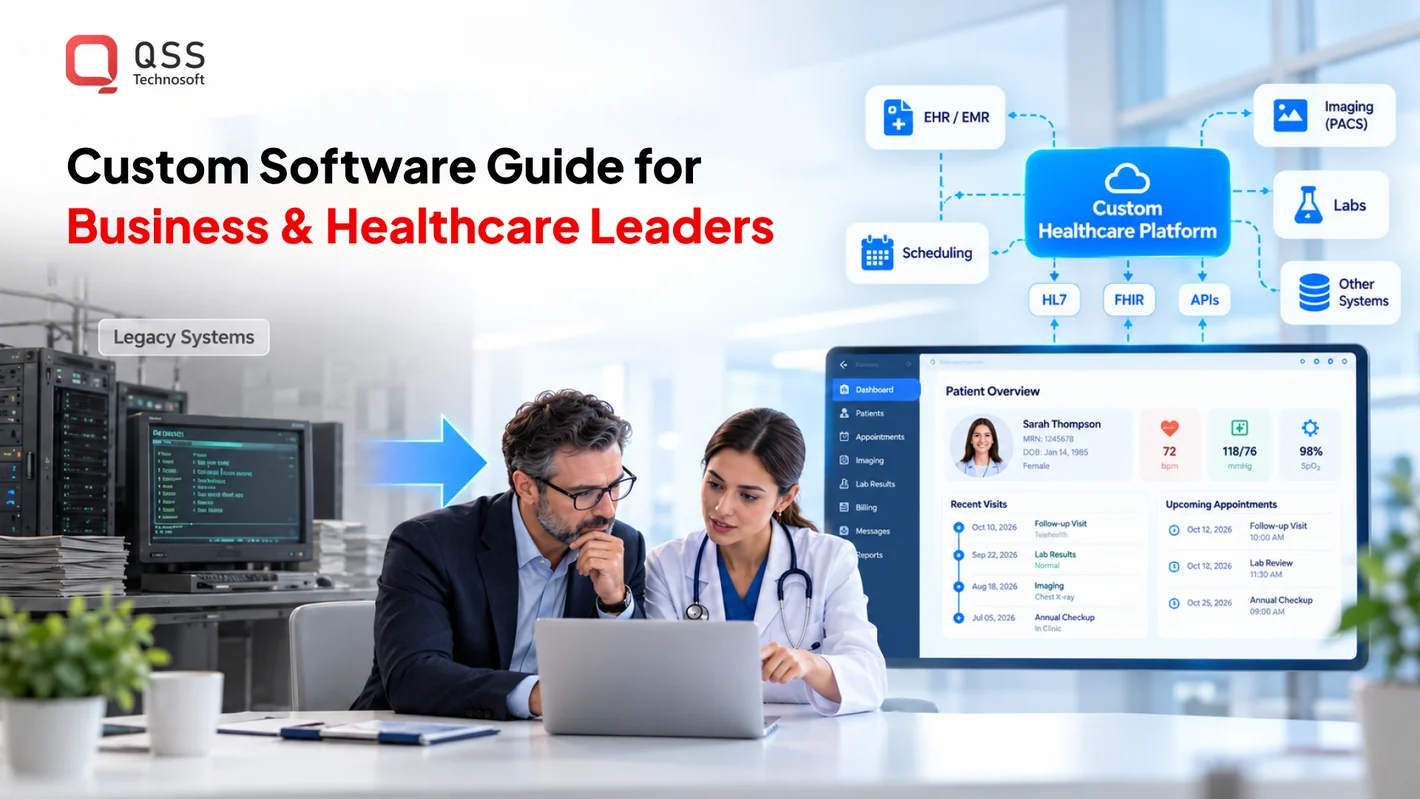
Custom software development can help healthcare enterprises modernize legacy systems when existing platforms no longer support critical clinical or operational workflows, integrations, or product needs. The right approach starts by identifying what must change, what must stay connected, and who will own security, maintenance, and future updates.
Replacing or extending a legacy system brings practical risks, including hidden dependencies, disrupted workflows, and ongoing support responsibilities. This guide explains how to assess whether a custom build fits, move from discovery through delivery, and govern scope and ownership along the way.
Written for U.S. healthcare technology and business decision-makers, this guide draws on the perspective of Pankaj Wadhwa, Founder, President, and CTO of QSS Technosoft, with 20+ years of experience. Published: October 7, 2026. Last updated: October 7, 2026.
Quick Answer
Custom software development fits when a critical clinical or operational workflow, integration, or product requirement can’t be handled well by buying or configuring an existing product. Before committing, map the workflow and its handoffs, list the systems it touches (such as EHRs and HL7/FHIR interfaces), and name owners for product decisions, security, maintenance, and future changes. Compare custom software, configurable platforms, and off-the-shelf products on workflow fit, integration effort, ownership, and maintenance; build only where a material gap remains. Then move through discovery, architecture, development, testing, deployment, and post-launch operation, with a first release scoped around one essential workflow and clear acceptance criteria. For custom healthcare software development, choose healthcare software development services that connect requirements to architecture and long-term ownership, not just launch.
What Is Custom Software Development, and When Does It Fit?
Custom software development is the process of designing, building, and maintaining software for an organization’s specific needs. It fits when important workflows, integrations, or product requirements cannot be handled well by buying and configuring an existing product. For U.S. business and healthcare technology decision-makers, the trade-off is greater control in exchange for responsibility for the software over time.
A packaged product is designed to serve a broad set of customers. Teams can often configure its settings, but may still need workarounds when its assumptions do not match how the organization operates. Custom software can reflect those distinct processes directly. That matters when a workflow is central to service delivery or when several systems need to work together in a way standard features do not support.
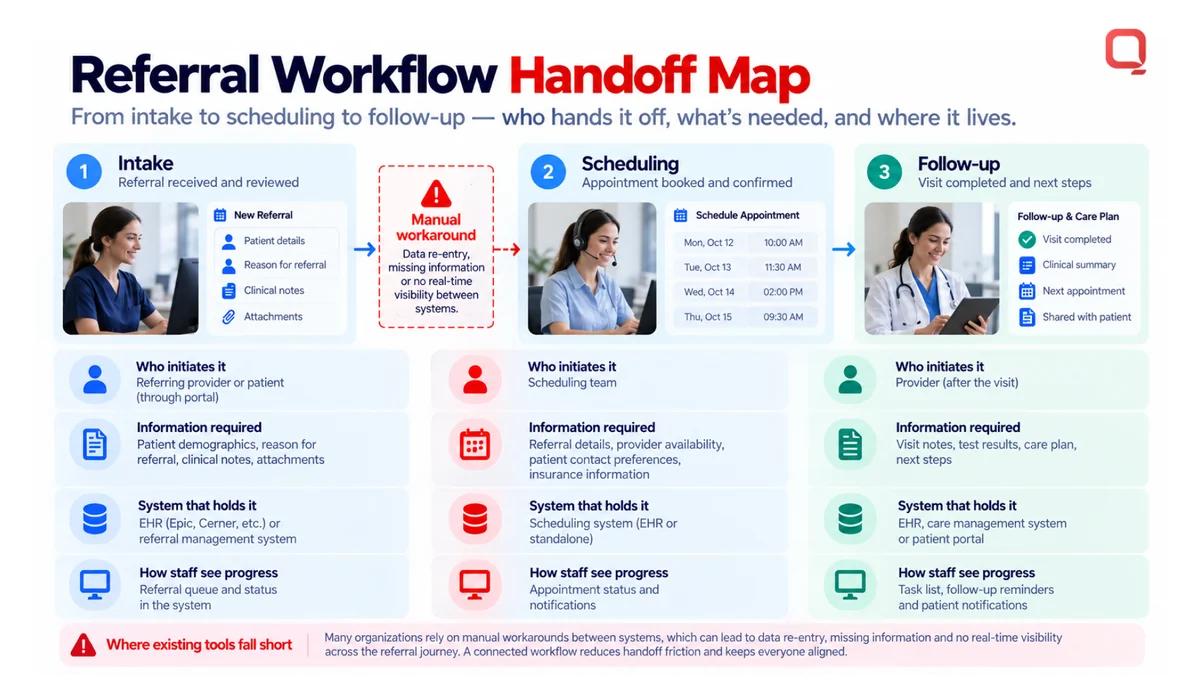
For example, a healthcare organization might need an application that coordinates a referral workflow across intake, scheduling, and follow-up. Before considering a build, map each handoff: who initiates it, what information is required, which system holds that information, and how staff know the referral has progressed. If existing tools do not support the process and teams rely on manual workarounds, a tailored application may be worth evaluating. The decision should be based on the operational need, not simply a desire to build something new. The overview of What is Custom Software? also describes how tailored software differs from off-the-shelf products.
What Does Custom Software Development Include?
Custom software development covers the work needed to define, deliver, and operate a solution. It can include applications, APIs, integrations, and cloud infrastructure. Typical activities include:
- Discovery and requirements: Understand users, workflows, goals, and constraints. Document where the current process breaks down and what the new solution must do.
- Design and engineering: Plan the user experience and architecture, then build the software around agreed requirements.
- Testing and deployment: Check expected behavior, verify integrations, and release the system into its operating environment.
- Ongoing maintenance: Address defects, security needs, and changes in business requirements.
For the referral example, requirements should specify who records each handoff, what information moves between steps, and how staff can see the referral’s status. These workflow details shape the application more than the choice of technology alone.
When Is a Custom Build a Poor Fit?
A custom build is usually a poor fit when the workflow is stable, common, and adequately served by an existing product. Buying or configuring software may avoid building and owning capabilities that do not distinguish the organization’s service. A configurable platform can be a practical middle ground: use its existing features first, then build only where a material gap remains.
Custom software also creates ongoing responsibilities. Before committing, establish who owns product decisions, technical documentation, security work, maintenance, and future changes. Weak requirements make scope difficult to control; no maintenance plan leaves the system’s future unclear. If the organization cannot assign accountable owners or explain the problem the build must solve, clarify those foundations before development begins.
How Does the Custom Software Development Lifecycle Work?
The custom software development lifecycle moves a system from discovery to ongoing operation through connected stages: define needs, design the architecture, build and test, deploy, then maintain. For healthcare technology leaders, each stage should account for users, existing systems, data flows, and operational ownership. Scope and timelines depend on project requirements, so estimates should follow discovery rather than guesswork.
What Are the Main Lifecycle Stages?
- Discovery defines the problem. Turn user needs and business constraints into prioritized requirements. Map current systems, data flows, integrations, and operational dependencies. The outcome is a shared view of the problem, desired results, assumptions, and open questions.
- Architecture sets the technical direction. Decide how the application, APIs, integrations, and infrastructure will work together. Document key choices, risks, dependencies, and trade-offs before implementation. For healthcare modernization, identify which existing systems must remain available during the transition.
- Development builds reviewable increments. Engineers implement prioritized requirements, review code, and demonstrate working changes to stakeholders. Feedback can clarify details while changes are manageable. Keep requirements and architecture as references throughout implementation.
- Testing checks behavior and readiness. Verify that features meet agreed requirements, integrations behave as intended, and defects are addressed. Have stakeholders review workflows so the system works for its users, not just in a test environment.
- Deployment prepares the production release. Confirm release readiness, monitoring, support ownership, and change management. A production release is not the end of the work. Teams need a plan for handling issues and supporting users through the transition.
- Post-launch operation keeps the system useful. Monitor and maintain the application, then prioritize changes as workflows or technical needs evolve. Assign owners for support, security work, and product decisions.
How Do Discovery and Architecture Reduce Delivery Risk?
Discovery and architecture expose dependencies before they become implementation surprises. In a legacy environment, identify where data originates, which applications use it, and which operations rely on the current system. Record unanswered questions and resolve those that could change scope or architecture before building around assumptions. Examples such as custom software for education and healthcare illustrate how tailored experiences and integrations can address specific user needs.
What Happens Between Development and Production?
Work moves through a feedback loop, not a one-way handoff. The team implements, reviews, tests, and gathers stakeholder feedback, then addresses gaps before a release decision. The diagram shows the main path and the decision to refine work that does not meet requirements.
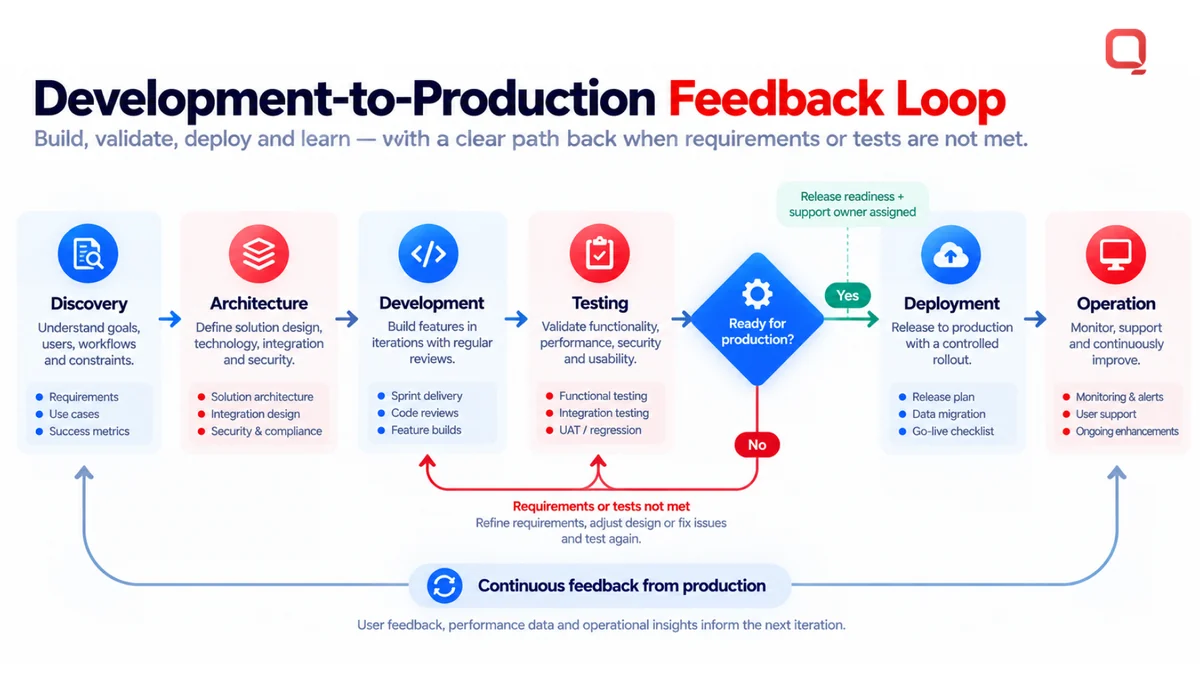
Discovery → Architecture → Development → Testing → Ready for production? → Deployment → Operation If requirements or tests are not met, return to development and testing. If they are met, proceed with release readiness and assigned support ownership.
Before release, confirm that monitoring is in place, the support team understands its responsibilities, and users know what is changing. These operational details connect engineering work to day-to-day use after deployment.
Custom Software vs. Off-the-Shelf Software: How Should You Choose?
Choose based on how well each option supports the required workflow, integrations, and long-term ownership. Off-the-shelf software can suit common needs; a configurable platform may bridge the gap. Custom software development is worth considering when a distinct process or product requirement cannot be met without persistent workarounds. No option is universally best.
Use this comparison to frame the decision. The right fit depends on requirements, existing systems, and the organization’s capacity to operate what it adopts or builds.
| Decision factor | Custom software | Configurable platform | Off-the-shelf product |
|---|---|---|---|
| Workflow fit | Can be designed around specific workflows. | Fits workflows that can be expressed through available settings and modules. | Works well when standard product workflows match the need. |
| Flexibility | Offers control over features and behavior, within the agreed scope. | Allows changes within the platform’s supported options. | Usually limits changes to the product’s built-in capabilities. |
| Integration work | Can be designed for required connections, which must be built and maintained. | May provide connectors or extension options; fit depends on the platform. | May support standard integrations, but unusual needs can require workarounds. |
| Ownership | The organization must assign responsibility for product decisions and ongoing operation. | Ownership is shared across internal configuration and the platform’s capabilities. | The vendor maintains the product; the organization manages its use and vendor relationship. |
| Maintenance | Requires a plan for updates, security, support, and future changes. | Requires configuration upkeep and attention to platform changes. | The vendor updates the product, while customization limits may remain. |
Which Option Fits a Specialized Workflow?
Start with three questions: Is the workflow meaningfully different from a common process? Does it distinguish the organization’s product or service? Do integration constraints prevent existing systems from supporting it cleanly? If the answer is no, configuration may meet the need without creating a new software product.
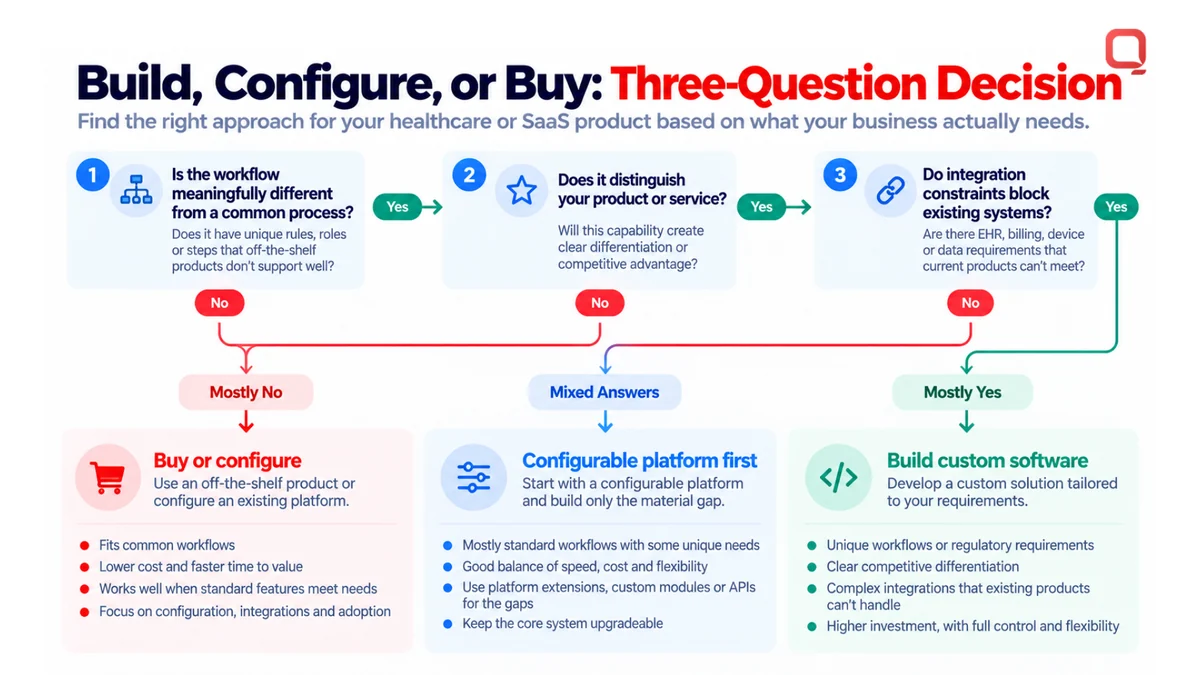
Healthcare teams should examine clinical and operational workflows together. A system may need to support how staff complete a task while fitting the surrounding handoffs and existing applications. A process that looks simpler on paper but adds steps for busy users is not a good fit. Walk through the proposed workflow with the people who will use it and compare it with the current process before finalizing requirements.
What Trade-Offs Come With Building Versus Buying?
A custom build gives an organization more control over behavior and development priorities. It also creates responsibility for architecture, support, updates, security, and long-term maintenance. Without clear ownership, custom software can accumulate technical debt: design shortcuts and neglected upkeep that make future changes harder.
Buying can provide access to existing functions without building them from scratch, but the product may constrain workflow fit and customization. Compare total project cost across the lifecycle, including integration, operation, maintenance, and future change. The decision should follow documented requirements and ownership capacity, not a blanket preference to build or buy.
How Can You Scope and Govern a Custom Software Project?
Scope and govern a custom software project by agreeing on the business objective, users, essential workflows, constraints, and decision owners before implementation. Define how the first release will be accepted and how the system will be supported afterward. This gives delivery teams a practical boundary while leaving room to learn from user feedback.
What Should a Project Brief Define?
A useful brief connects the operational problem to a result the organization can evaluate. For a healthcare enterprise modernizing a legacy workflow, describe who uses the system, what task needs to work better, and how success will be assessed. Avoid broad goals such as “improve efficiency” unless the team defines what evidence would demonstrate progress.
- Users and workflow: Identify user groups, the steps they take, and where delays, duplicate work, or handoff problems occur.
- Business objective: State the intended operational or product outcome and the measure used to assess it.
- Scope: Separate essential first-release capabilities from later enhancements. Record why each item is in or out.
- Technical context: List required integrations, data sources, existing systems, infrastructure constraints, and known assumptions.
- Acceptance criteria: Define observable conditions for each key workflow, such as what information a user can enter, review, or complete.
- Trade-offs: Document what the project is not addressing yet and what risks that decision creates.
A prioritized first release should exercise the essential workflow from start to finish. This can help teams validate assumptions with users before expanding scope, but it does not justify promising a delivery timeline before requirements and dependencies are understood.
How Should Teams Manage Technical and Operational Risk?
Assign a named decision owner for product scope, architecture, security, and release readiness. This prevents unresolved questions from drifting between teams. In custom software development, clear ownership helps keep requirements, technical decisions, and operational plans connected as the system changes.
Plan security, privacy, accessibility, and reliability as design considerations, not final-stage checkboxes. Specify how the team will test critical workflows, prepare deployment, monitor the live system, assign support, and manage future changes. For a healthcare system, engineering decisions can support an organization’s requirements, but software development is not legal or regulatory advice.
Before work advances, review whether acceptance criteria are met, open risks have owners, and support responsibilities are assigned. This governance keeps decisions traceable from the project brief through production and future maintenance.
How Does QSS Technosoft Approach Custom Software Development?
QSS Technosoft is a U.S.-based engineering firm serving U.S. buyers, with a focus on healthcare technology. Its approach to custom software development starts with the workflow and business need, then connects product decisions to architecture, delivery, and ongoing operation. The goal is to align engineering scope with measurable business outcomes, without treating a launch as the end of the work.
QSS has 250+ in-house engineers and has delivered 400+ projects. Its credentials include CMMI Level 3 and ISO 27001:2013. Delivery combines senior-led, architect-driven work with an onshore-offshore model. That structure supports coordinated engineering, but project scope, decisions, and ownership still need to be clear on both sides.
Which Engineering Capabilities Support a Custom Build?
QSS brings together custom software development, product engineering, cloud and DevOps, and mobile app development. These capabilities can support different parts of a solution, from defining how users move through a workflow to building applications and preparing the systems that run them.
For healthcare organizations, the decision framework still applies: identify the workflow gap, understand existing systems, and build only where product configuration does not meet the need. HL7/FHIR work can involve interoperability requirements, while DICOM/PACS work can involve imaging systems. These are examples of healthcare engineering context, not reasons to add complexity without a defined business or user need.
Architect-driven delivery connects requirements to design choices and implementation. Senior technical leadership can help surface dependencies and trade-offs early, while engineering teams build and test against agreed scope. Security and operational needs should be considered alongside architecture, with ongoing responsibilities assigned rather than left implicit.
What Is a Practical Next Step for Decision-Makers?
Before an initial discussion, prepare a short account of the workflow problem, the users involved, the systems it touches, and the constraints the project must respect. Include what a successful outcome would look like and which capabilities are essential for an initial release. These details keep the conversation focused on the problem instead of jumping straight to a technology choice.
An initial conversation can align business outcomes with engineering scope, clarify assumptions, and identify questions that need answers before delivery planning. For healthcare leaders modernizing a legacy system, the useful next step is a grounded discussion of the workflow, dependencies, and ownership involved. Discuss your software project with QSS Technosoft.
Make Your Next Software Decision With Confidence
Custom software development makes sense when a critical workflow, integration need, or product requirement cannot be addressed well by an existing product. The right choice starts with a clear problem and a practical comparison of building, configuring, or buying. It also accounts for the full lifecycle, including security, maintenance, and ownership after launch.
Define the outcome, users, constraints, and acceptance criteria before work begins. Then prioritize the first release around essential workflows and assign owners for product decisions, architecture, and ongoing support. That discipline helps teams make informed trade-offs and build for operation, not just launch.
QSS Technosoft is a U.S.-based engineering firm with 250+ in-house engineers and 400+ projects delivered. Its credentials include CMMI Level 3 and ISO 27001:2013. Consider these details alongside how the firm’s approach fits your requirements and long-term ownership needs.
Ready to define the problem and explore the right path? Discuss your custom software project with QSS. A clear starting point can turn a difficult decision into a workable plan.
Scope Your Custom Healthcare Software Project
Bring the workflow problem, the users involved, and the systems it touches to a working session with our architects. QSS Technosoft is a software development company in USA, based in Bloomington, Minnesota, offering custom healthcare software development and custom medical software development, legacy modernization, and integration work, including EHR software development and HL7 and FHIR integration. We help you decide whether to build, configure, or buy, then scope a first release around your essential workflow.
Discuss your custom software project →