Healthcare IT Consulting Firms: How US Healthcare Buyers Compare Options in 2026
 By Nagender Pratap
QSS Technosoft
October 3, 2026
13 min read
By Nagender Pratap
QSS Technosoft
October 3, 2026
13 min read
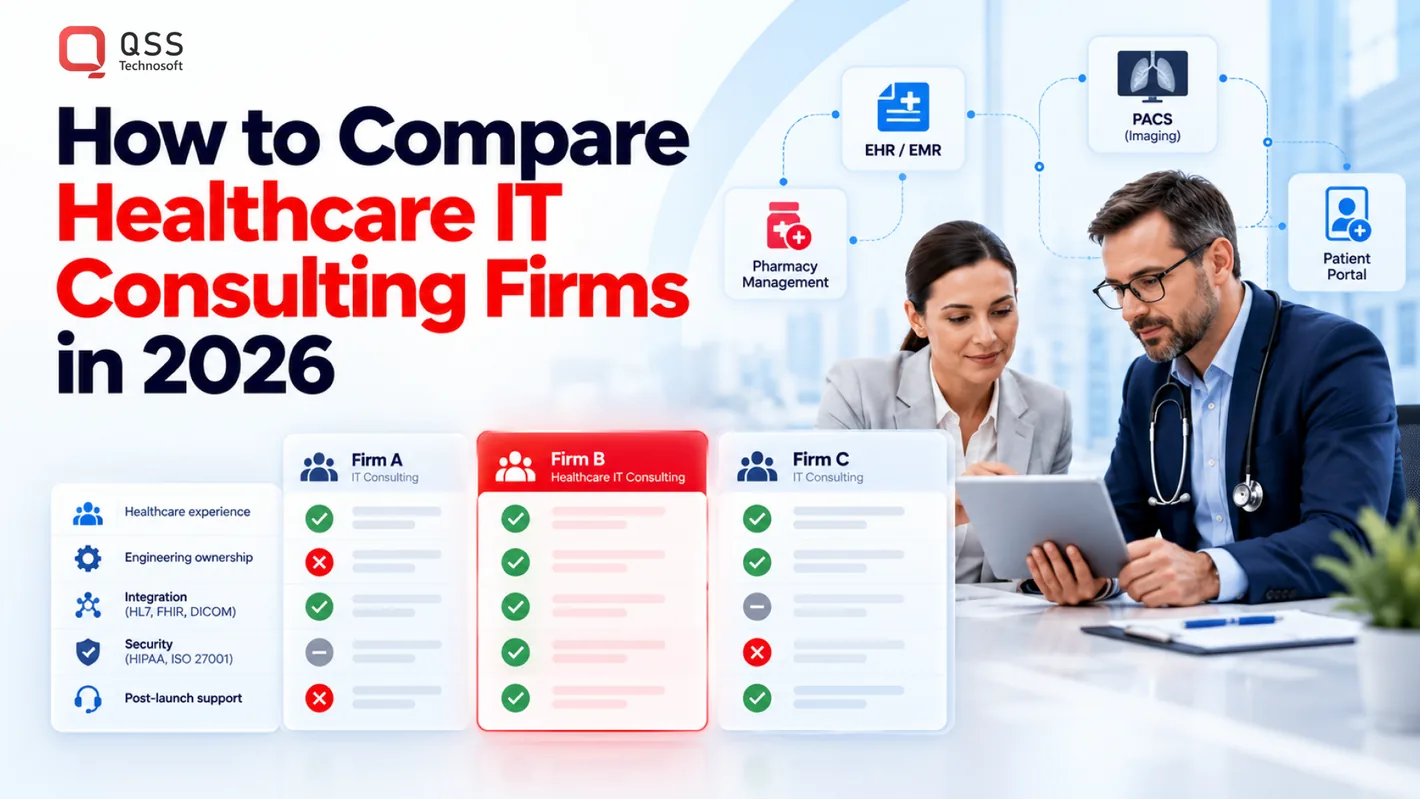
Healthcare IT consulting firms help organizations plan, build, integrate, and maintain technology for clinical and administrative work. Compare them by healthcare workflow knowledge, engineering ownership, interoperability approach, security practices, and post-launch support. A strong fit connects discovery to delivery while accounting for existing systems and the clinical workflows that shape implementation.
“Consulting” can mean business advice, staff augmentation, or hands-on software engineering. These are different roles, so establish which work the engagement covers and who is responsible for delivering it. This guide offers practical criteria for assessing engineering capabilities, interoperability, security, and support.
It also covers the stages from scoping and architecture through integration, deployment, and ongoing engineering support. QSS Technosoft is a US-based engineering partner for healthcare providers and health-tech organizations, with capabilities including EHR/EMR development and integration, HL7/FHIR interoperability, and DICOM/PACS.
Quick Answer
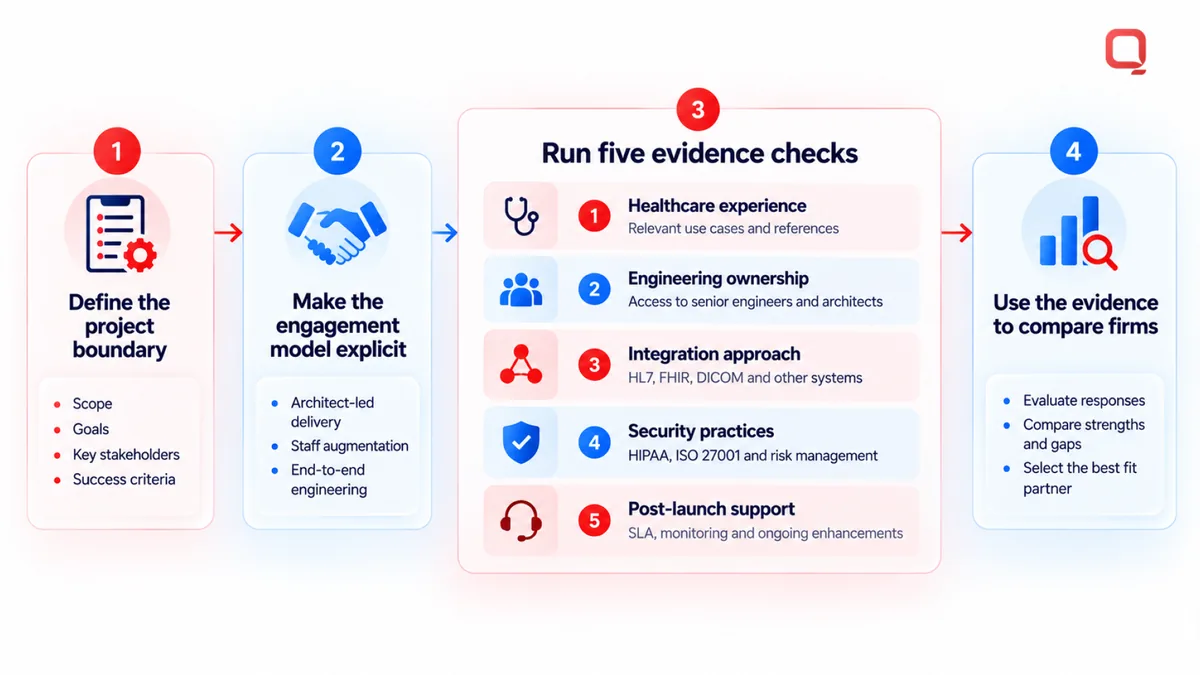
When comparing healthcare IT consulting firms, first decide whether you need business advice, staff augmentation, or end-to-end healthcare software development. Then compare firms on five areas: relevant healthcare workflow experience, named engineering ownership, integration approach (how HL7 and FHIR integration tools for healthcare and DICOM will connect your actual systems), project-specific security practices, and defined post-launch support. Map your workflows, systems, and data flows before comparing proposals, and favor partners who explain and evidence their capabilities over those who only claim them. Whether you need an EHR software development company, a custom healthcare software development company, or healthcare AI consulting for a defined workflow, fit depends on your systems, scope, and internal team capacity.
What do healthcare IT consulting firms actually do?
Healthcare IT consulting firms help healthcare organizations plan, build, integrate, and maintain technology used in clinical and administrative work. Engineering-focused firms may take responsibility for software delivery, from requirements and architecture to integration and production support. Their work can apply to US providers, hospitals, clinics, pharmacies, and health-tech companies.
Definition: Healthcare IT consulting is technical and strategic support for selecting, designing, integrating, developing, or maintaining healthcare software and information systems.
Health information technology (HIT) covers digital systems used to manage health information and support care delivery. An engagement may focus on one part of that environment or connect several systems. The distinction matters: advice can define what should change, while engineering turns a plan into working software.
How does healthcare IT consulting differ from healthcare business consulting?
Healthcare business consulting typically assesses operations and recommends changes. For example, an engagement might examine a clinic’s revenue cycle or workflows and suggest process improvements. That is different from designing and implementing software to support the revised process.
Healthcare IT engineering includes developing an application, connecting an EHR to another system, or modernizing a legacy platform. Some initiatives need both disciplines: operational experts clarify the workflow, while engineers design, build, integrate, and maintain the technology. Define who owns each deliverable before work begins.
Which healthcare technology needs can a consulting firm address?
The scope depends on the project. Common systems include:
- EHR/EMR: Electronic health record or electronic medical record software stores and manages patient and clinical information.
- HIMS: A hospital information management system supports hospital operations and coordinates information across functions.
- RCM: Revenue cycle management software supports financial workflows tied to patient services, from registration through payment processes.
- Pharmacy management: Software that supports pharmacy workflows, such as managing prescriptions and related records.
- Telemedicine platforms: Software that enables remote healthcare visits and related digital care workflows.
- Patient-facing systems: Applications and portals that let patients access services or interact with their care organization.
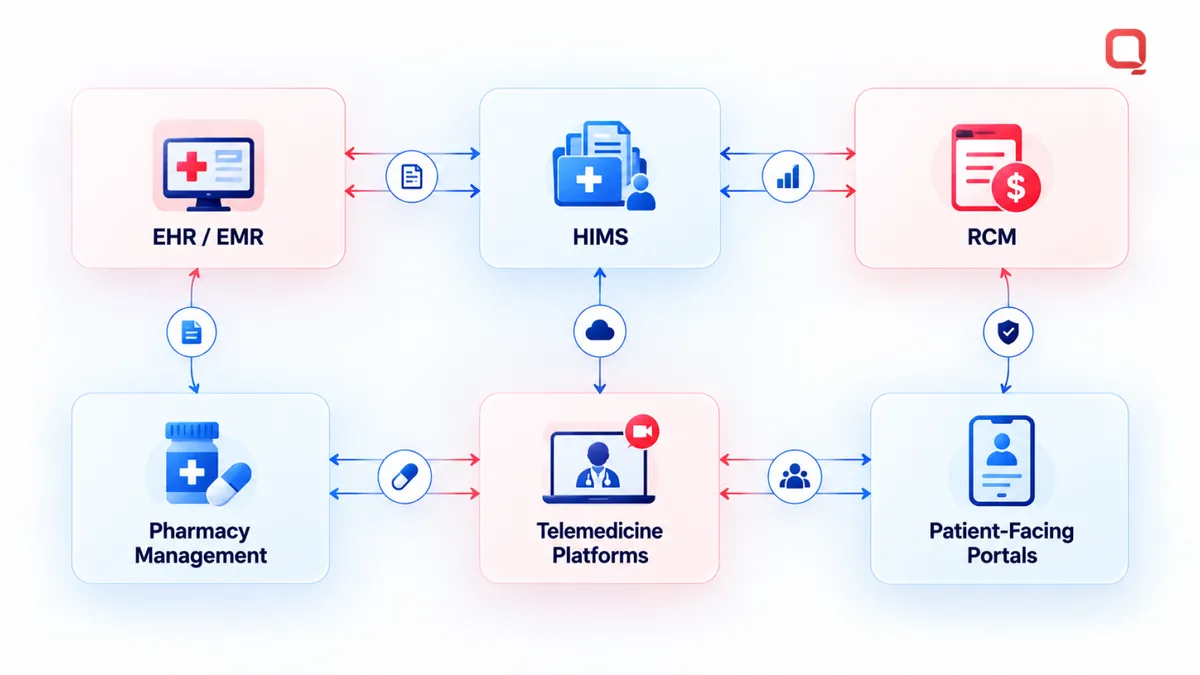
Engineering scope can also include connecting these systems so information moves between them, or applying AI to a defined healthcare workflow. Evaluate whether the proposed work fits the organization’s systems and operating needs. A proposal diagram alone does not establish how a solution will work in practice.
How should buyers compare healthcare IT consulting firms?
Compare healthcare IT consulting firms against the work your organization needs, not broad capability claims. For a US provider or health-tech buyer, useful criteria include relevant healthcare workflows, clear engineering ownership, integration experience, security practices, and defined post-launch support. The right fit depends on your systems, architecture, and internal team capacity.
Evaluation principle: Prefer capabilities a firm can explain and evidence over claims it can only describe. For EHR integration, for example, the team should be able to discuss the systems involved, data flows, interface constraints, testing approach, and maintenance ownership.
| Comparison area | Evidence to look for | Useful distinction |
|---|---|---|
| Healthcare experience | Relevant work with clinical, administrative, imaging, or pharmacy workflows | Healthcare-specific examples are more informative than a general industry list. |
| Engineering ownership | Named responsibilities for requirements, architecture, development, testing, and deployment | Advisory recommendations, added staff, and end-to-end delivery are different engagement models. |
| Integration | Concrete experience with the systems, interfaces, and data flows in scope | Assess how the approach accounts for existing systems and constraints. |
| Security | Documented security processes, relevant certifications, and clear handling of access and data | A general compliance claim is not the same as an explanation of project-specific controls. |
| Post-launch support | Defined ownership for maintenance, issue handling, and future changes | Clarify what the delivery team owns after deployment and what remains with your staff. |
What evidence demonstrates healthcare engineering experience?
Look for examples tied to the workflow your project will touch, then assess whether the firm can explain technical details and limitations. Healthcare Interoperability work should be described in terms of connected systems and data exchange, not just a list of standards. QSS Technosoft’s healthcare capabilities include HL7, FHIR, and DICOM/PACS integrations, alongside EHR/EMR development and integration.
QSS Technosoft is a US-based engineering firm with 15+ years in business and 250+ in-house engineers. Its company credentials include CMMI Level 3 and ISO 27001:2013 certifications, with HIPAA listed among its compliance capabilities. These facts describe the firm, not a project-specific security assessment.
How do delivery ownership and support models compare?
Architect-led delivery connects requirements and technical decisions. Staff augmentation adds people to a buyer’s team, which retains delivery ownership. End-to-end engineering assigns the partner responsibility across agreed delivery stages. Each model can fit, depending on internal capacity and project scope.
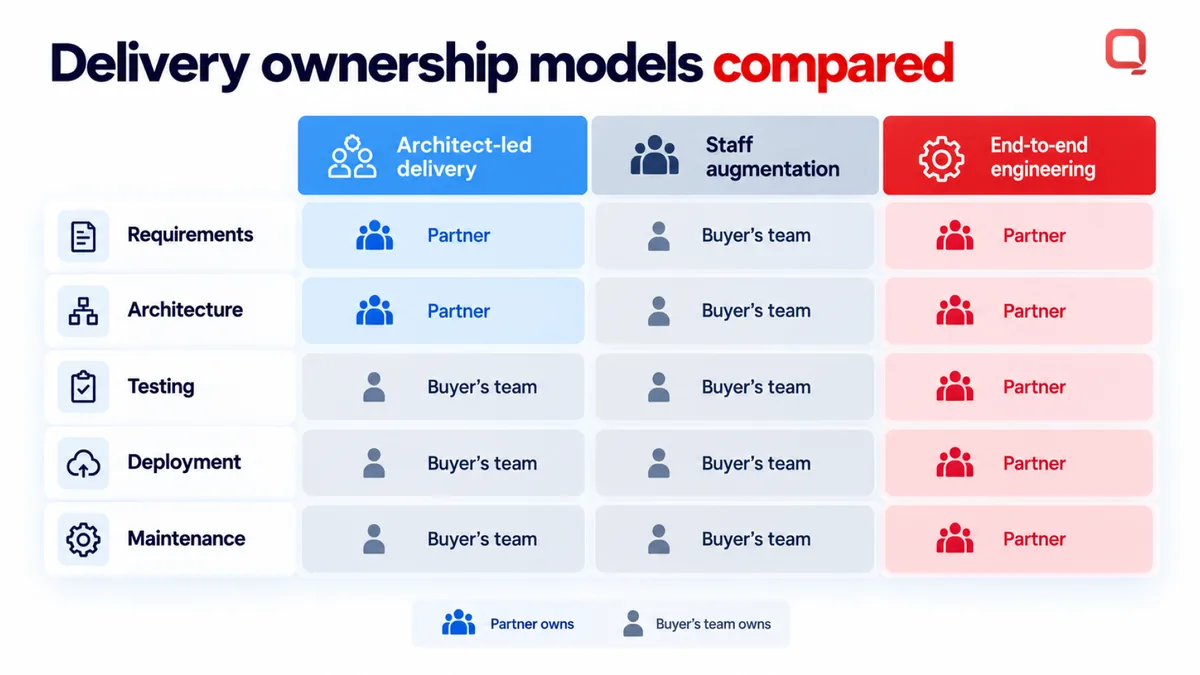
Before selecting a model, map who owns requirements, architecture decisions, testing, deployment, and maintenance. The proposal should make these handoffs visible. For legacy systems, clear ownership matters because older interfaces and operational dependencies may remain after new software launches.
How do interoperability, security, and legacy systems affect firm fit?
Interoperability, security, and legacy constraints should shape a healthcare project’s architecture and delivery plan from the start. For US healthcare buyers, a firm’s fit depends on whether it can explain how systems exchange data, how access is controlled, and how existing technology will be maintained or changed.
Healthcare IT consulting firms should make these decisions visible during discovery. A useful technical discussion identifies the systems involved, the data moving between them, who or what needs access, and the operating dependencies that must remain in place.
What should buyers assess about HL7, FHIR, and DICOM integrations?
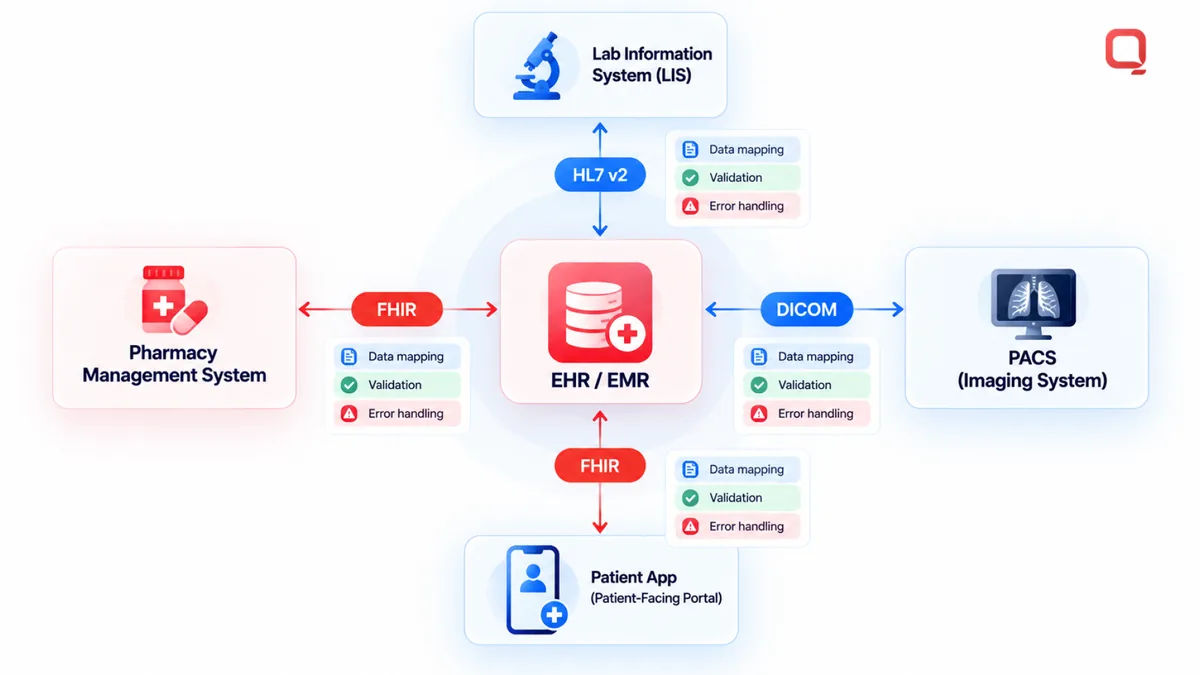
HL7 is a family of standards for exchanging healthcare information between systems. FHIR is an HL7 standard for exchanging health information through defined resources and interfaces. DICOM is the standard for handling and exchanging medical imaging information. See the HL7 standards overview, the FHIR overview, and the DICOM standard.
For evaluation, focus on how the firm will connect the systems in scope. Ask how interface development will handle data mapping, message or resource validation, errors, and changes to upstream or downstream systems. Existing interfaces, vendor constraints, and clinical workflows can limit what a technically neat design can achieve.
QSS Technosoft’s healthcare interoperability capabilities include HL7, FHIR, and DICOM/PACS integrations. For a specific project, assess how those capabilities apply to its systems and data flows.
How should a firm approach HIPAA and legacy healthcare systems?
Security should be considered through design, development, testing, and operations. Compare firms on how they account for access controls, data handling, environment separation, testing, and maintenance. The US Department of Health and Human Services describes the Security Rule’s scope and safeguards in its HIPAA Security Rule guidance. A technology choice by itself does not establish that an organization or system is compliant.
QSS lists HIPAA among its company compliance capabilities. That is relevant context, not a promise of a particular project outcome. Security responsibilities and controls still need to be defined for the system and engagement.
Legacy modernization is usually a staged engineering problem, not a simple platform swap. A delivery plan should account for dependencies, data movement, interface continuity, testing, and ongoing maintenance. Replacing a system without understanding what relies on it can shift risk rather than remove it.
- Map: Document systems, interfaces, data flows, and operational dependencies.
- Control: Identify access needs and security responsibilities across environments.
- Maintain: Define who handles interface changes, defects, and technical upkeep after deployment.
What evaluation process helps narrow healthcare IT consulting firms?
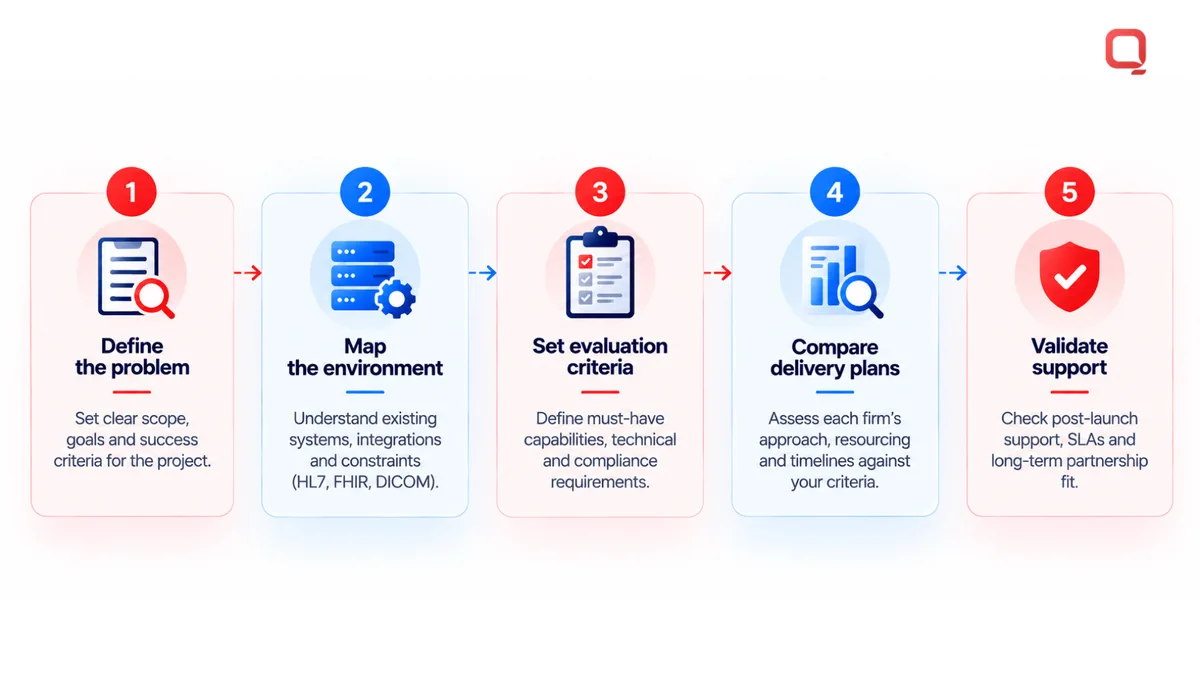
Narrow healthcare IT consulting firms by defining the operational problem first, mapping the systems and workflows involved, then comparing delivery plans and support responsibilities. This sequence helps US healthcare buyers judge proposals against real needs instead of choosing architecture or scope before understanding how staff and patients use the current process.
- Define the problem. Identify the user groups, workflow friction, and operational change the project should support.
- Map the environment. Document relevant applications, interfaces, data exchanges, dependencies, technical debt, and internal system owners.
- Set evaluation criteria. Separate essential requirements from future enhancements. Include the healthcare expertise, integration, security, and support needs that matter for this project.
- Compare delivery plans. Review how each proposal handles discovery, architecture, implementation, testing, deployment, and maintenance.
- Validate support. Clarify who owns production issues, system changes, and ongoing technical upkeep after launch.
Which questions should buyers resolve before comparing proposals?
Start with the people and work, not a preferred technology. Document which staff roles use the workflow, what information they need, where that information originates, and what should change in daily operations. Then record known interfaces, dependencies, and who on your team owns each system.
Keep the initial scope understandable. Mark requirements as essential or future enhancements so proposals address the same problem rather than bundling unrelated transformation work. A focused integration or legacy modernization engagement may fit when the main need is a defined connection or system constraint. A broader transformation may fit when several workflows and platforms need coordinated change.
What should a credible delivery plan make clear?
A credible plan names responsibilities and exposes assumptions. It should explain how requirements will be refined, who makes architecture decisions, how the solution will be tested, what deployment involves, and who maintains it afterward. Risks and dependencies should be stated plainly, including the systems or decisions that could affect the work.
Use this short proposal checklist:
- Does the plan begin with business and clinical workflows?
- Are the systems, interfaces, and dependencies in scope identified?
- Are requirements, architecture, testing, deployment, and maintenance ownership clear?
- Are assumptions and risks explicit rather than buried in broad promises?
- Does the proposed scope match your internal team’s capacity?
Compare proposals by fit and transparency, not unsupported claims about speed or savings. A clear plan should show how the partner intends to address the workflow, technical constraints, and support needs.
Why consider QSS Technosoft for healthcare IT consulting?
QSS Technosoft is a US-based engineering partner for healthcare providers and health-tech organizations that need software built, connected, or modernized. Its healthcare capabilities span interoperability, clinical systems, and imaging, supported by 250+ in-house engineers and 15+ years in business. Fit depends on the project’s workflows, systems, and delivery needs.
For buyers comparing healthcare IT consulting firms, the practical question is whether a partner’s capabilities match the technical work. QSS connects discovery and architecture with implementation and ongoing engineering, helping teams define scope around existing systems rather than assuming every project starts from scratch.
Which healthcare engineering capabilities align with common buyer needs?
Explore QSS’s healthcare engineering capabilities.
- System-to-system data exchange: Healthcare Interoperability and HL7 Interface Development address projects that connect healthcare systems and exchange information.
- Imaging workflows: DICOM Viewer / PACS Solutions support medical imaging projects, while EHR/EMR development and integration can connect clinical systems with related workflows.
- AI initiatives: Generative AI Solutions and enterprise AI integration are relevant when AI is part of the defined project scope, not a substitute for understanding the workflow and data involved.
What should a first conversation about a project establish?
Start with the operational facts: which users encounter the problem, what workflow is affected, which systems are involved, and what change the organization intends to achieve. Bring known interfaces, dependencies, and internal ownership into the discussion. That context helps separate essential work from future enhancements.
QSS can use that picture to discuss architecture options, integration needs, delivery responsibilities, and ongoing support. The aim is to establish a practical engineering scope, including the constraints that could affect implementation and maintenance.
Discuss your healthcare technology project.
Choose a Partner Built for the Work Ahead
Choose healthcare IT consulting firms by how well they connect healthcare expertise with engineering ownership, integration, security, and production support. Start with the workflow and systems you need to change, then compare how each firm will deliver and maintain that work. Clear responsibilities matter, especially when legacy technology and clinical processes are part of the project.
QSS Technosoft is a US-based engineering partner with 15+ years in business and 250+ in-house engineers. Its company profile lists CMMI Level 3 and ISO 27001:2013 certifications. Assess those credentials alongside the proposed architecture, integration approach, and ongoing support plan.
Bring the problem, users, and systems into focus before committing to a delivery scope. A grounded first discussion can turn a broad technology goal into clear engineering questions and next steps. Discuss your healthcare technology project with QSS. Start with the real workflow, define the work, and build from there.
Comparing Healthcare IT Consulting Firms? Start With Your Workflow
Bring the workflow, users, and systems you need to change to a working session with our architects. QSS Technosoft is a software development company in USA, based in Bloomington, Minnesota, and a custom healthcare software development company covering EHR software development, HL7 and FHIR integration, DICOM/PACS, and healthcare AI consulting for defined workflows. We’ll help you turn a broad goal into a clear engineering scope, with ownership for delivery and post-launch support spelled out.
Discuss your healthcare technology project →