Healthcare Cloud Migration Guide for 2026
 By Vineet Bhardwaj
QSS Technosoft
October 1, 2026
14 min read
By Vineet Bhardwaj
QSS Technosoft
October 1, 2026
14 min read
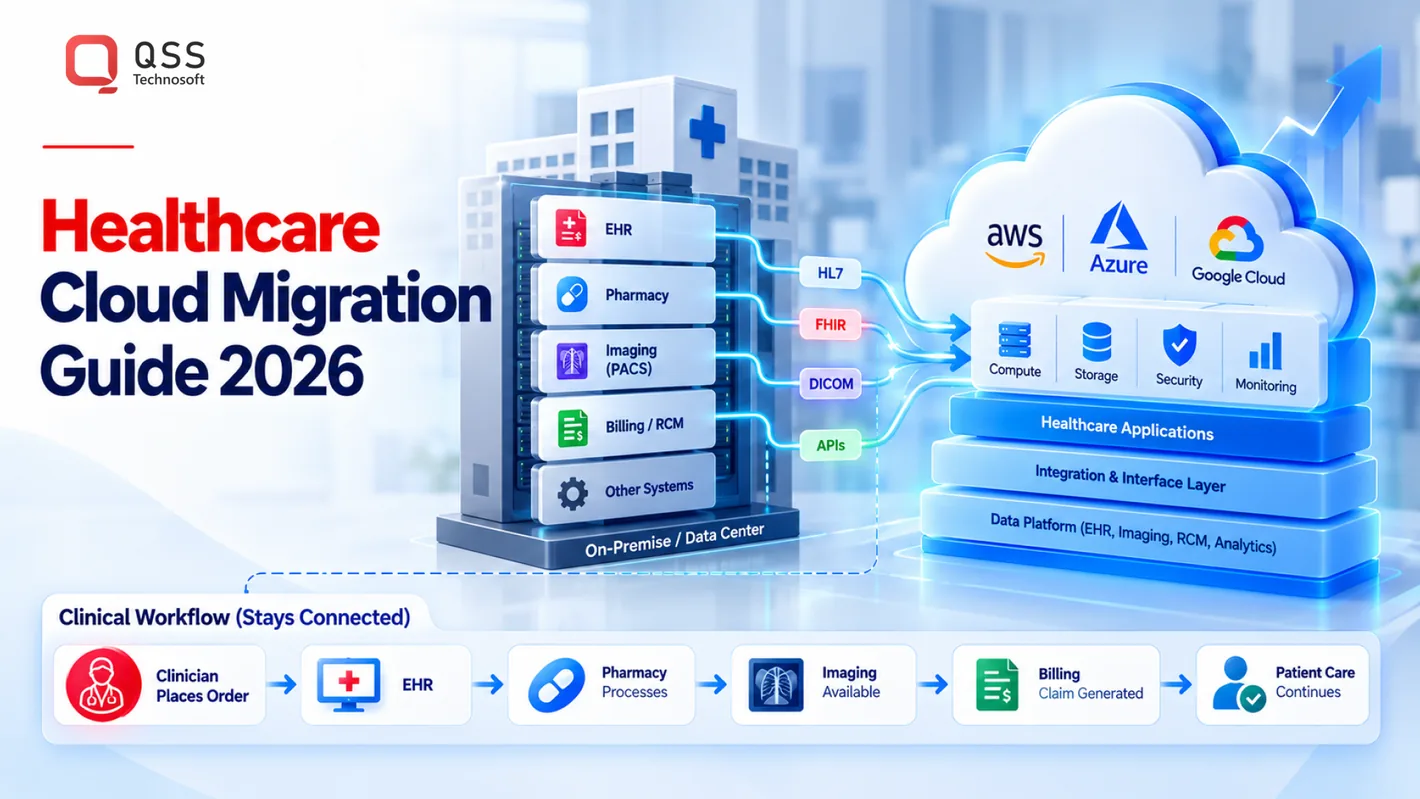
What if the biggest risk in a healthcare cloud migration isn’t the cloud, but a dependency no one documented? Legacy systems often connect clinical workflows, EHRs, billing, and data exchange in ways that only become clear when something breaks. Effective healthcare cloud migration services start by mapping those connections, not by moving workloads on a schedule.
Downtime and the protection of sensitive health information are reasonable concerns. A cloud platform alone won’t resolve either one. Teams need to understand how applications depend on one another, how data moves between systems, and how each workload will be validated before production changes.
This guide covers the stages of healthcare cloud migration, from workload assessment and integration mapping to data protection, platform fit, testing, and post-migration ownership. You’ll learn how to plan a controlled transition that accounts for clinical dependencies and interoperability, rather than treating migration as a simple infrastructure move. QSS Technosoft is a USA-based software engineering company offering healthcare engineering, cloud, and legacy modernization services across AWS, Azure, and GCP. The focus is practical: map the connections, move in a controlled way, and keep care and operations in view.
Quick Answer
Healthcare cloud migration moves or modernizes applications, data, and supporting workloads, such as EHR/EMR, pharmacy, imaging, and billing systems, to run in a cloud environment. Cloud computing in healthcare doesn’t make a system HIPAA compliant or secure on its own, so healthcare cloud migration services start by setting business and clinical goals and mapping every application, data store, HL7/FHIR interface, owner, and dependency. Choose a path per workload (rehost, replatform, refactor, replace, or retain), pair each risk with a planning control and a validation step, and define acceptance criteria for data, integrations, access, performance, and user workflows before cutover. Then move in phases, rehearse cutover and rollback, and assign clear ownership for monitoring and issues after go-live.
What makes healthcare cloud migration different from a standard cloud move?
Healthcare cloud migration means moving or modernizing applications, data, and supporting workloads so they can run in a cloud environment. The work is shaped by what those systems do: support clinical decisions, handle sensitive health information, and exchange data with other tools. A move that looks successful at the infrastructure level can still fail if clinicians lose access to a workflow or an interface stops passing information.
Cloud adoption alone doesn’t establish HIPAA compliance or guarantee secure operations. Teams still need to define how access, data protection, monitoring, and operational responsibilities will work in the new environment. The choice of infrastructure, platform, or software services also affects the design. Reviewing cloud computing models can help clarify the differences between IaaS, PaaS, and SaaS, as well as public, private, and hybrid deployments.
Separate the work before planning the move. Infrastructure migration changes where systems run. Application modernization changes how software is built or maintained. Integration redesign changes how systems exchange data. A project may involve one or all three, but each has different dependencies, testing needs, and operational impact. Healthcare cloud migration services should account for those distinctions rather than treating every workload as a server relocation.
Which healthcare systems and workloads might move?
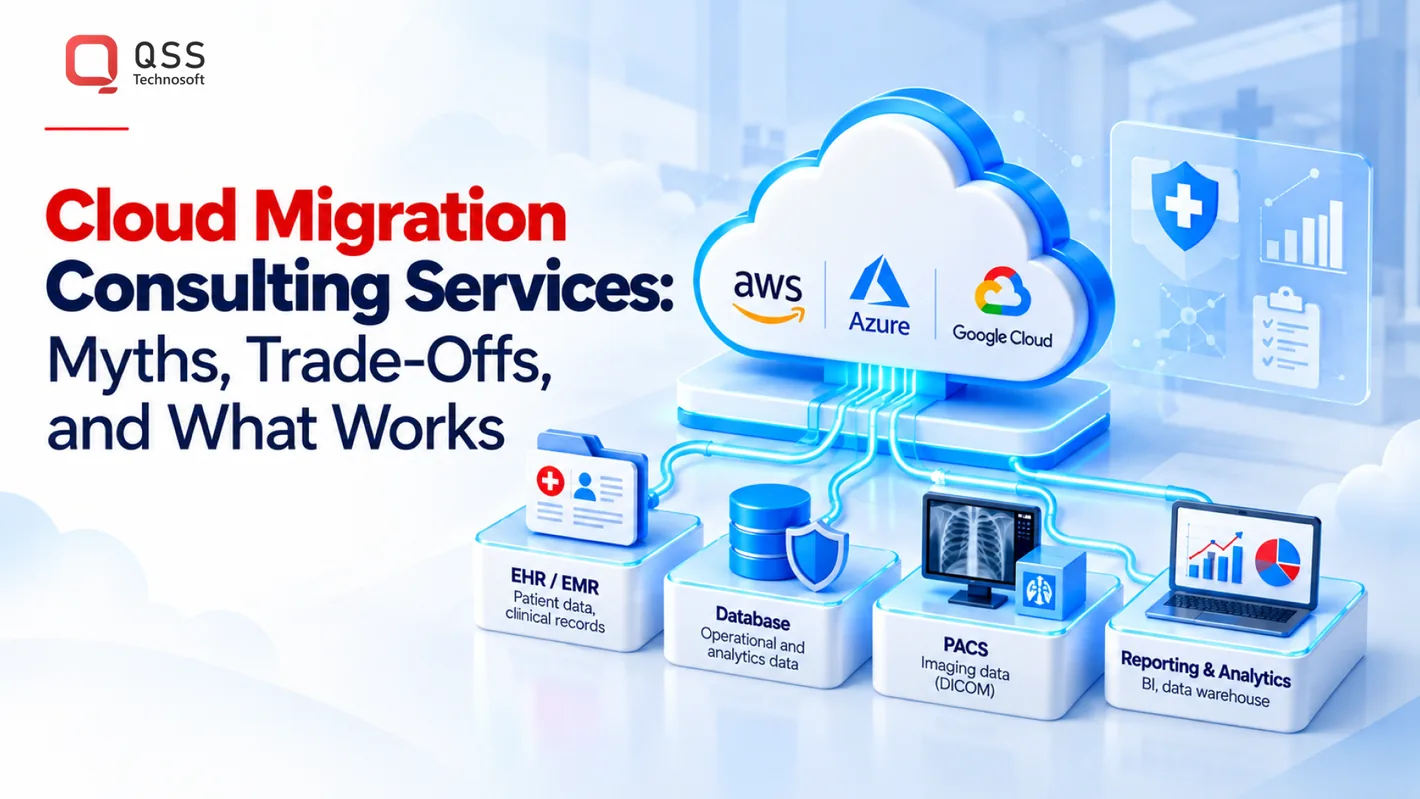
Workloads may include EHR/EMR platforms, hospital information systems, pharmacy applications, imaging systems, databases, and supporting services. Each has its own users, data flows, connections, and operational needs. Moving an application doesn’t automatically move its database, interfaces, or underlying infrastructure. List these components separately, then record which ones must move together and which can be handled independently.
Why clinical workflows and integrations change the plan
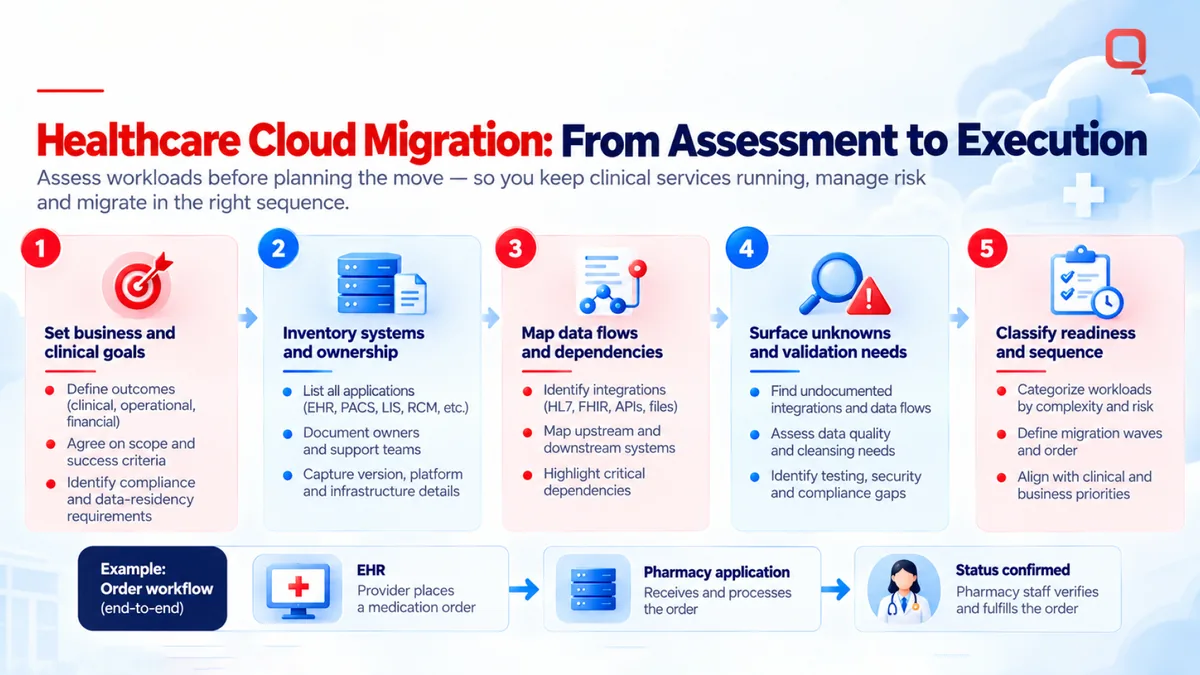
A clinical workflow can cross several systems. An order may begin in an EHR, pass to a pharmacy application, and return with status information through an interface. If a connection, data exchange, or system owner is missed, the cutover plan may stall or disrupt operations. Trace the workflow end to end, including the handoffs that are easy to overlook.
Clinical continuity depends on migrating connected workflows, not just individual systems.
Start by identifying what users need to do, which systems support each step, and how teams will verify the workflow after the move. For example, a workflow map can show where an order is created, which interface carries it, and where staff confirm its status.
Assessing Healthcare Workloads for Cloud Migration
Start with the reason for the move, not a list of servers. Is the goal to improve resilience, modernize a legacy application, support new services, or simplify operations? Clinical leaders, IT teams, security stakeholders, and application owners may define success differently. Agree on business and clinical goals first, then use them to guide workload scope, sequencing, and validation.
- Set business and clinical goals. Identify the workflows that must remain available and the outcomes the migration should support. Turn broad goals into practical checks, such as whether the relevant users can complete the required workflow after cutover.
- Inventory systems and ownership. Record each application’s purpose, users, data types, technical owner, and operational owner. Include databases, interfaces, infrastructure, and supporting services, not just the visible application.
- Map data flows and dependencies. Trace connections between EHR/EMR systems, HL7/FHIR interfaces, imaging, pharmacy, and other applications. The Office of the National Coordinator for Health Information Technology describes healthcare interoperability standards and related work that can help teams frame how information is exchanged and used across systems.
- Surface unknowns and validation needs. Flag undocumented interfaces, legacy dependencies, unclear ownership, and workflows that need testing. Identify who will verify data, integrations, user access, and operational readiness.
- Classify readiness and sequence. Group workloads by dependency, modernization need, and business priority. A system with unresolved interfaces may need investigation before it can sensibly move alongside connected applications.
Build a workload and dependency inventory
Make the inventory useful to engineers and clinical stakeholders. For each workload, capture who uses it, what data it handles, what it sends or receives, and who supports it in production. Draw connections between systems rather than listing interfaces in isolation. An undocumented message flow or legacy database link can change the migration order, so mark gaps for investigation before committing to a cutover sequence.
A practical inventory can use one row per application or service, with fields for its owner, connected systems, data flows, migration decision, and validation owner. Use it to identify shared dependencies, such as an interface used by several applications, and to make sure the right teams are involved before sequencing the move.
Choose a migration path for each workload
There’s no single route for every system. Rehosting moves a workload with limited changes; replatforming adjusts its underlying platform; refactoring changes the application more substantially. Replacement may make sense when an existing system no longer fits the goal, while retaining a workload can be reasonable when dependencies or constraints make a move premature. Weigh each option against application condition, integration impact, modernization goals, and the team’s ability to test and operate the result.
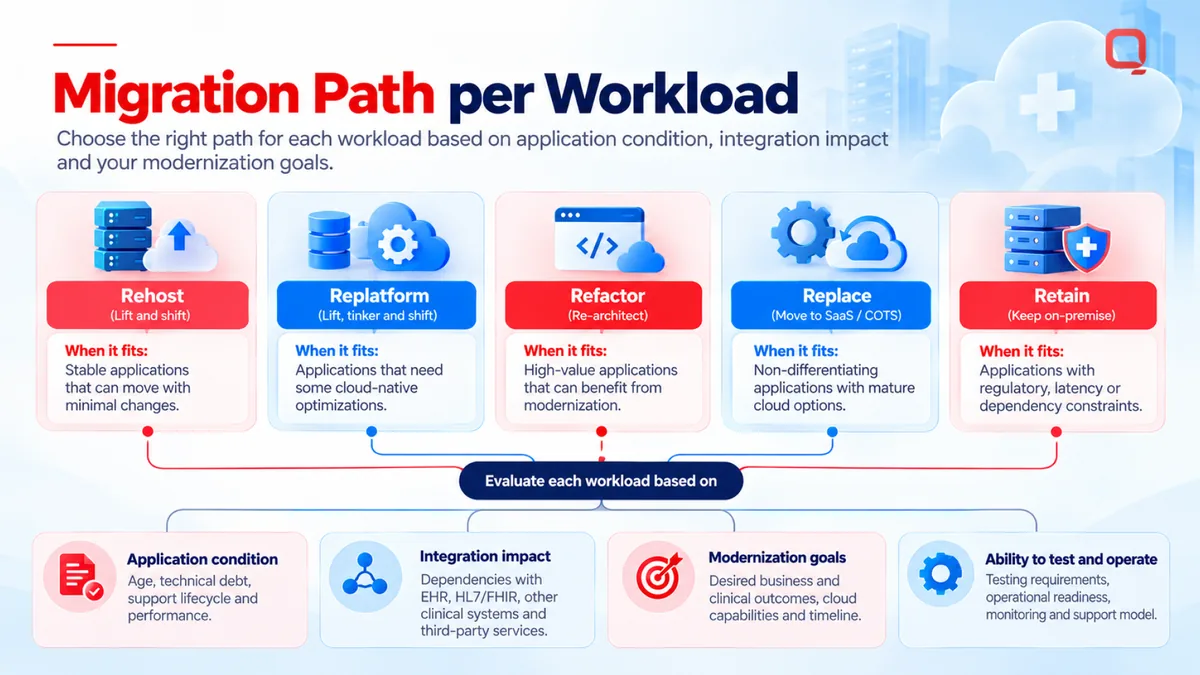
A disciplined assessment gives healthcare cloud migration services a grounded starting point: a workload map, named decision owners, and a sequence that reflects real dependencies. Teams can use those findings to shape an implementation plan; QSS’s migration planning contact page provides a place to discuss project goals.
How to address security, interoperability, and downtime risks
A cloud platform doesn’t automatically make a healthcare workload secure, compliant, or continuously available. Those outcomes depend on how the environment is configured, how data moves, and who owns operations after go-live. Treat each risk as an engineering task with a named control and a way to verify it. That keeps security and continuity in the plan from data transfer through production support.
| Risk | Planning control | Validation step |
|---|---|---|
| Unintended or excessive access | Define user roles, access boundaries, and account ownership for each environment. | Test representative user roles and confirm each can access only the functions and data intended. |
| Exposure or loss of sensitive data | Plan data protection for transfer, storage, test environments, and cutover. Document how data is handled in each stage. | Verify the agreed protection settings and reconcile migrated data against project-defined checks. |
| Broken HL7/FHIR interfaces | Map connected systems, interface owners, message flows, and dependencies before sequencing the move. | Run end-to-end scenarios across sending and receiving systems, checking message handling and workflow results. |
| Disruption during cutover or recovery | Set a cutover sequence, decision points, recovery approach, and accountable operational owners. | Rehearse the transition and test recovery steps against project-defined scenarios before production change. |
| Issues missed after go-live | Define monitoring coverage, alert ownership, and escalation paths for the migrated workload. | Generate test events and confirm alerts reach the people responsible for response. |
Protect sensitive health information throughout migration
Access management, encryption, monitoring, and environment configuration need attention at every stage, not just in the final production setup. A test environment can create risk if it uses sensitive data without the protections planned for the project. Document the intended settings, restrict access to people who need it, and verify the configuration before data transfer, testing, cutover, and ongoing operations.
A cloud provider’s platform or a certification on its own doesn’t establish that an individual system is compliant. The organization’s design, configuration, and operating practices matter too. Make those responsibilities explicit in the migration plan, including who approves access, reviews the environment settings, and responds to alerts.
Keep interfaces and clinical workflows working
Before moving connected systems, map the HL7/FHIR interfaces and identify which workflows depend on each exchange. Test both ends of an interface, not just whether a connection responds. Use project-defined scenarios that reflect how users and systems exchange information, then conduct user-acceptance checks with the relevant teams. Prepare cutover and rollback steps in advance, including who makes the decision and how teams will confirm the workflow is stable. This validation is a core part of healthcare cloud migration services, not a final check to squeeze in after the move.
How to plan the migration, test systems, and manage go-live
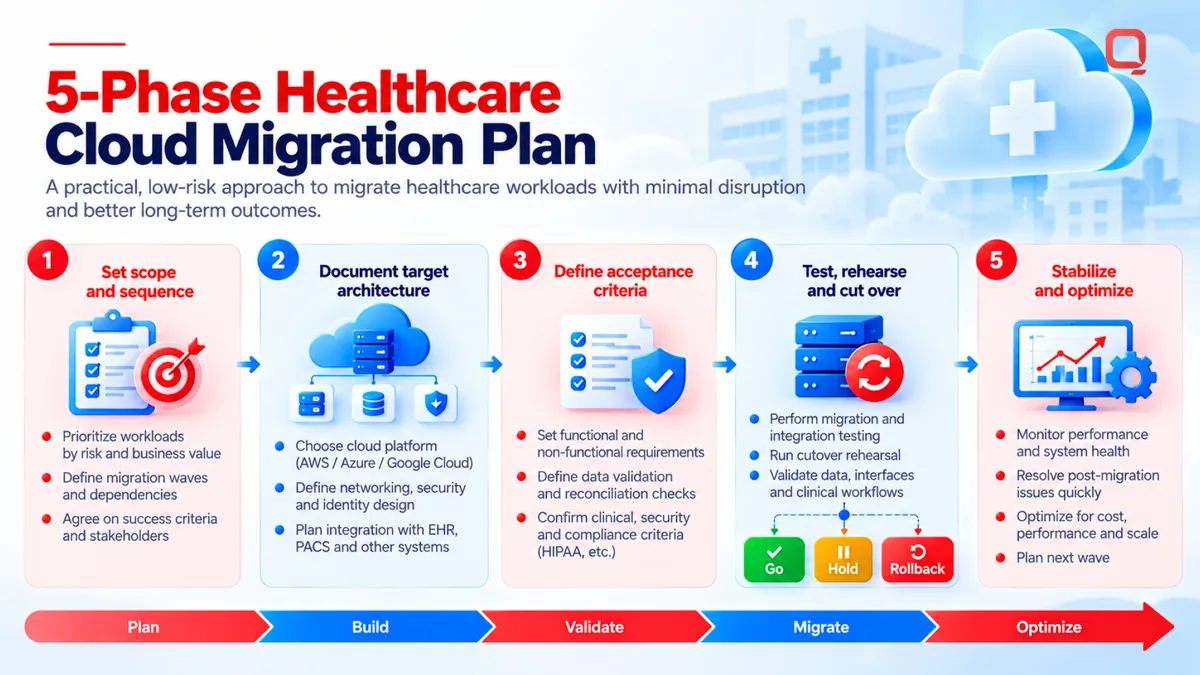
A controlled migration is a sequence of decisions, not a single cutover event. Define the scope, architecture, test evidence, and go-live authority before moving production workloads. For healthcare cloud migration services, the plan should connect technical readiness to the workflows people rely on, while making ownership clear from project start through ongoing operations.
- Set scope and sequence. Confirm which applications, databases, interfaces, and environments are included. Group workloads by dependency and operational risk. A phased approach can limit the scope of each transition, provided connected systems and data exchanges are sequenced together where needed.
- Document the target architecture. Record the environment configuration, data flows, access approach, dependencies, and release responsibilities. Assign owners for each workload and interface so decisions don’t stall when an issue crosses team boundaries.
- Define acceptance criteria. Agree in advance how the team will verify migrated data, integration behavior, permissions, performance, and representative clinical or operational workflows. Criteria should be specific to the workload and its users, not copied from a generic migration checklist.
- Test, rehearse, and cut over. Validate the target environment before production changes. Rehearse the release sequence, confirm who can approve go-live, and document the conditions that would pause the transition or trigger rollback.
- Stabilize and optimize. Monitor the workload after launch, resolve issues against assigned ownership, and use operational findings to guide configuration changes and further optimization.
Prepare environments and validate before cutover
Testing should cover more than whether an application starts. Compare migrated data against agreed checks, test interfaces in both directions where applicable, verify user permissions, and run realistic end-to-end workflows with the relevant teams. Record results and unresolved issues so decision-makers can see what passed and what still needs attention.
Go-live readiness should have clear decision owners and defined criteria, including when to proceed, hold, or roll back. For example, if a critical interface fails its end-to-end test, the team should know who can pause the release and what needs to be resolved before proceeding. That discipline matters when production timelines meet real clinical operations.
Stabilize operations after migration
After cutover, track application behavior, interface activity, access issues, and reports from users. Make sure each signal has an owner who can investigate, prioritize, and resolve it. Assign responsibility for defects, configuration changes, and ongoing cloud operations before the project team moves on. For broader planning considerations, see the Cloud Migration Strategy for Large Health Systems article.
QSS Technosoft brings cloud migration, Cloud Engineering & DevOps, and legacy system modernization together with healthcare interoperability experience. The project discussion can cover the migration scope, dependencies, and operational needs through QSS’s contact page.
How QSS Technosoft approaches healthcare cloud migration
QSS Technosoft is a USA-based engineering company serving healthcare organizations and health-tech teams. Its approach connects cloud engineering to the systems that need to keep working: applications, data, interfaces, and the workflows around them. A technically successful move can still create problems if an EHR/EMR integration breaks or operational ownership becomes unclear after launch.
Healthcare cloud migration services at QSS bring together Cloud Migration, Cloud Engineering & DevOps, and Legacy System Modernization. The right mix depends on the workload. Some projects focus on moving existing systems; others also need application changes, integration work, or a clearer operating model. The engineering plan should reflect the project’s dependencies and validation needs, rather than forcing every system through the same migration path.
Connect cloud engineering with healthcare systems
Cloud work often reaches beyond infrastructure. A migration may involve application behavior, data stores, HL7/FHIR interfaces, EHR/EMR integrations, and the workflows that connect them. QSS’s healthcare interoperability experience helps bring those technical connections into the migration plan, while its cloud expertise spans AWS, Azure, and GCP. Platform choice and implementation scope should follow the workload’s needs and the organization’s architecture, not assumptions about one cloud fitting every use case.
Cloud architecture also needs an operating plan. Environment configuration, deployment practices, monitoring, and ownership all affect how a workload behaves after cutover. For related guidance, see the Cloud Consulting and DevOps for Healthcare Compliance pillar, which connects cloud engineering decisions with healthcare operating considerations.
Turn migration planning into a project conversation
The practical work begins by understanding the systems, clarifying the interfaces, validating the target environment, and defining who owns the transition. The migration plan should make dependencies visible, set project-specific acceptance criteria, and identify decision owners before production changes begin.
Useful preparation includes a current architecture view, known integration constraints, and a clear description of clinical or operational priorities. Those details help frame the work around the actual scope rather than a generic cloud checklist.
Move forward with a migration plan built for care
A healthcare cloud migration involves more than infrastructure changes. Map dependencies before selecting a sequence, protect sensitive data through each stage, and validate connected systems and user workflows before production cutover. Clear ownership after go-live matters too. Without it, issues can linger after the migration team moves on.
QSS Technosoft combines healthcare engineering with cloud migration, legacy system modernization, and HL7/FHIR interoperability. That experience can inform a practical approach to healthcare cloud migration services, from assessing legacy dependencies to planning validation and ongoing operations.
Bring your goals, known constraints, and system dependencies into the planning conversation. Discuss your healthcare cloud migration with QSS Technosoft and take the next step toward a controlled transition. A clear plan can turn a complex move into manageable, testable work.
Map Your EHR and Clinical Dependencies Before You Move
Bring your application inventory, HL7/FHIR interfaces, and clinical priorities to a working session with our engineers. QSS Technosoft is a software development company in USA, based in Bloomington, Minnesota, offering healthcare cloud migration services alongside healthcare software development services. As an EHR software development company with custom healthcare software development and HIPAA-compliant software development experience, we help teams sequence workloads, define acceptance criteria, and plan cutover with your security and compliance teams in the loop.
Discuss your healthcare cloud migration →