Healthtech Software Development: A Practical Guide to Resilient Healthcare Products
 By Nagender Pratap
QSS Technosoft
October 12, 2026
14 min read
By Nagender Pratap
QSS Technosoft
October 12, 2026
14 min read
Healthtech software development is the work of engineering healthcare products around clinical workflows, existing systems, data exchange, security, and ongoing operations. A product can work in a demo and still fail in a clinic if it does not account for those conditions. They shape decisions from the first requirements through production support.
Clinical needs can get diluted between planning and implementation. Integrations and compliance requirements can also complicate choices that look simple on a roadmap. A workable plan accounts for how clinicians and operations teams use the software, and how it will behave alongside the systems already in place.
This guide explains how to plan, build, integrate, and operate healthcare software for the US market. It covers practical decisions in product design and architecture, common delivery risks, and the roles of interoperability, security, reliability, and maintainability. The goal is to help teams make informed technical decisions before committing to a product roadmap.
Quick Answer
Healthtech software development means engineering healthcare products around real clinical workflows, the systems already in place, data exchange, security, and ongoing operations, not just features. Start by mapping roles, handoffs, exceptions, and existing tools, then turn that map into requirements and acceptance criteria. Decide whether to buy, extend a platform, or pursue custom healthcare software development by comparing workflow fit, integration needs, control, maintenance, and differentiation. Plan HL7 and FHIR interfaces (including SMART on FHIR apps where the EHR supports them) with clear data mapping and error behavior, and address HIPAA-related requirements during discovery with qualified compliance input. Then deliver in stages, from discovery and design through integration, validation, deployment, and maintenance, with named owners for operations after launch.
What Does Healthtech Software Development Include?
Healthtech software development is the planning, design, engineering, integration, and ongoing support of software used to deliver or manage healthcare. It connects clinical, administrative, and patient-facing work with healthcare data and existing systems. The scope varies by product, but this definition applies to US providers, health-tech companies, and technology decision-makers building new products or improving systems already in use.
Unlike general business software, healthcare software must fit care delivery, handle sensitive health information, and work with established clinical and operational platforms. A clean interface or feature set is not enough if staff must duplicate data, interrupt a handoff, or leave a familiar system to complete routine work. The broader context of Health Technology explains how technology supports healthcare. Product engineering must also account for the specific workflows and systems the software will serve.
Which Products and Workflows Fall Under Healthtech Software?
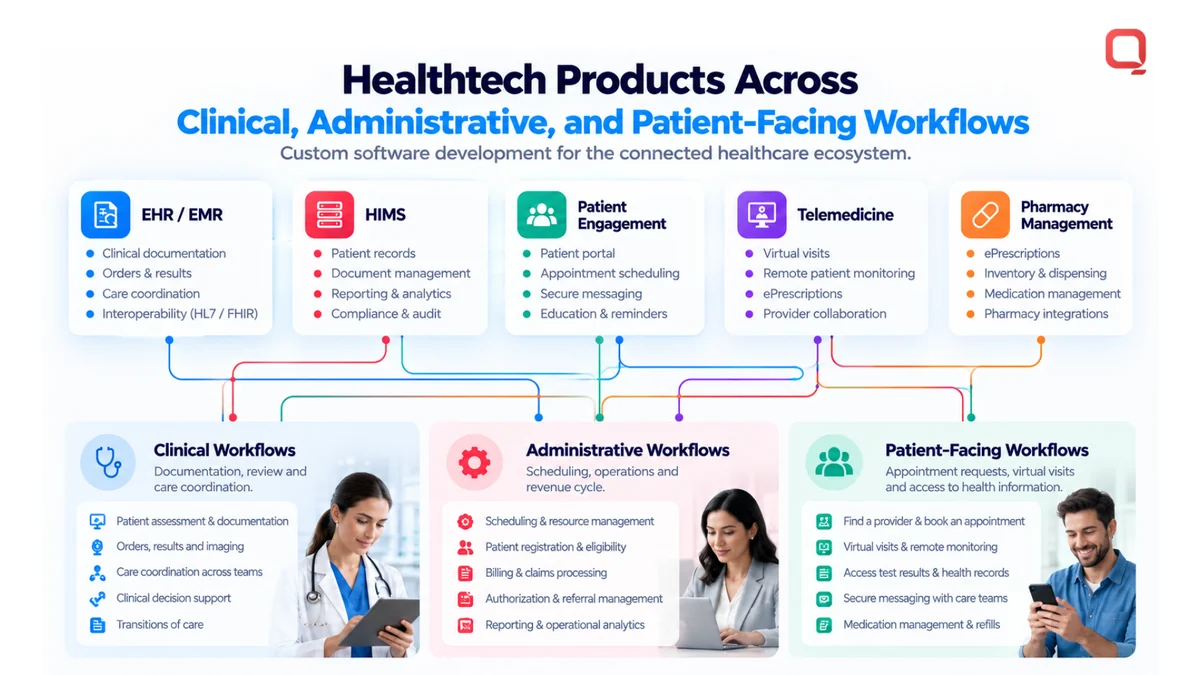
Healthtech software includes products that support care, healthcare operations, or patient access. Examples include electronic health record and electronic medical record systems (EHR/EMR), hospital information management systems (HIMS), patient engagement tools, telemedicine platforms, and pharmacy management software.
A single product can support several connected tasks. A patient appointment request may enter an administrative queue, prompt clinical review, and update an EHR. Pharmacy management software may connect prescription workflows with dispensing and patient communication. Each handoff raises practical design questions: who acts, what information needs to move, and which system is the source of truth?
- Clinical workflows: Documentation, review, care coordination, and access to relevant patient information.
- Administrative workflows: Scheduling, operational coordination, and revenue cycle processes.
- Patient-facing workflows: Appointment requests, virtual visits, and access to health information.
Set the product scope according to its intended users, the workflow it supports, and the systems already in place. Define those boundaries before treating the product as a standalone app. An integration can be as important as a new feature when the workflow depends on information held elsewhere.
Who Is Healthtech Software Development For?
Healthtech software development serves providers, hospitals, clinics, health-tech startups, and established healthcare product teams. A project may involve launching a SaaS product, modernizing a legacy platform, or connecting existing systems so information can support a workflow across organizational boundaries.
Different decision-makers bring different constraints to the same project:
- CIOs and CTOs assess architecture, security, technical risk, and long-term ownership.
- CMIOs and clinical leaders focus on whether the product fits care delivery and clinical responsibilities.
- Product and engineering leaders shape scope, sequencing, maintainability, and user experience.
- Interoperability teams define how data moves between the product and existing healthcare systems.
Start by identifying the problem. Build when users need a distinct product or workflow, modernize when an existing system blocks change, and integrate when the core need is reliable information exchange. These approaches can overlap, but each needs a clear purpose and an understanding of how healthcare work gets done.
How Is Healthtech Software Designed for Real Clinical Workflows?
Design healthtech software by examining the work it needs to support before settling on features or architecture. Map roles, tasks, handoffs, exceptions, and existing tools, then turn those observations into requirements and tests. Treat this as a project method, not an assumption that every clinical setting follows the same workflow.
How Should Teams Map Clinical and Operational Workflows?
Start with the people involved in a specific workflow. Record who initiates each task, what information they need, where decisions occur, and who receives the next handoff. For example, a team mapping appointment intake can trace how a request moves from a patient to administrative review and then to clinical follow-up. Validate the map with people who perform those tasks.
Document exceptions as well as the expected path. Ask users what they do when information is incomplete, a response is delayed, or they are interrupted before finishing a task. These cases help the team identify requirements to test instead of leaving unusual conditions out of the design.
- Identify actors: Record the roles involved and the tasks each role performs.
- Trace information: Note what information each step needs and where it comes from.
- Mark handoffs and decisions: Show when responsibility changes or a user must make a choice.
- Define acceptance criteria: Specify observable results for both the expected path and selected exceptions.
Use the workflow map as a shared working document for clinical, product, design, and engineering discussions. Research can inform design decisions, while implementation reviews may expose assumptions that need another conversation with users. This feedback loop helps teams adjust requirements before they become difficult to change.
Workflow fit is a product requirement, not visual polish. An attractive interface cannot compensate for a task sequence that fails to support the work.
How Does Architecture Support Usability and Reliability?
Architecture describes how a software product’s interfaces, application services, data stores, and integrations are organized. These boundaries help teams identify where a user action is processed, which system owns a data element, and what the product should show if a dependency is unavailable. The right design depends on the product’s context and existing systems.
Bring accessibility, performance expectations, and failure behavior into design discussions early. For a task that depends on retrieving information, define what the user sees if retrieval is delayed or fails. For an interrupted session, decide how the product represents unsaved work and what action the user can take next. These decisions should be specified and tested, not left until release.
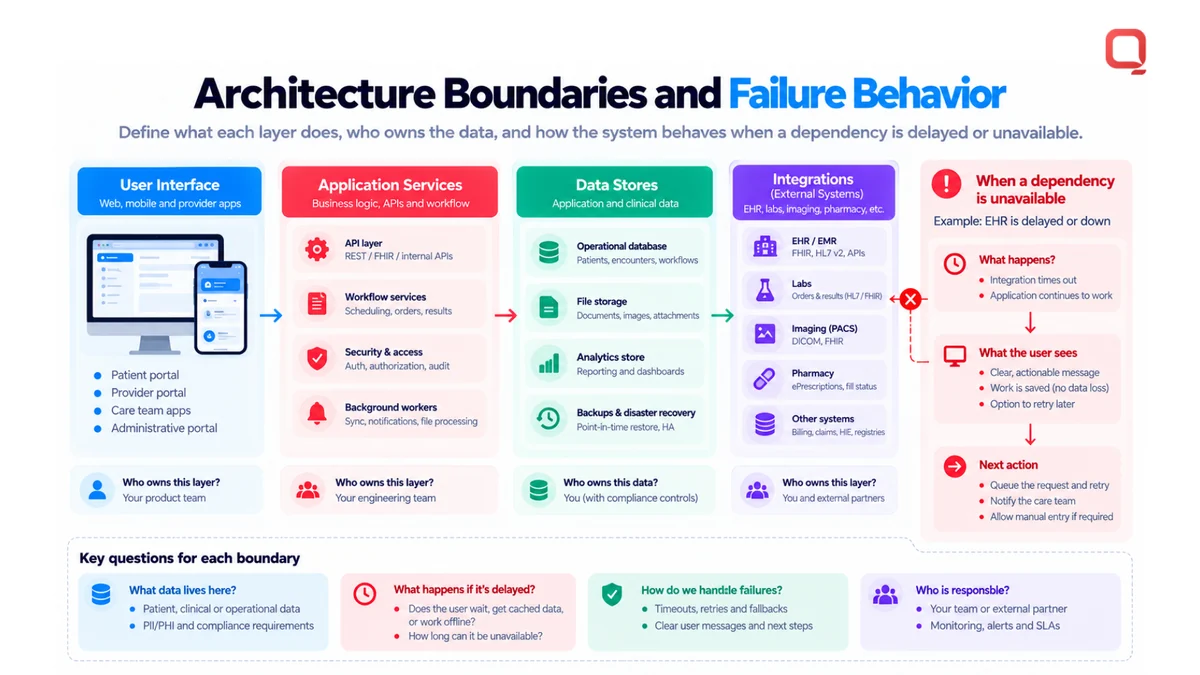
Connect each architecture decision to a workflow requirement. If the product displays information from another system, identify the source, define expected behavior when data is unavailable, and determine how the result will be validated. This gives product and engineering teams concrete criteria for comparing options without prescribing one architecture for every healthcare product.
Should Healthcare Teams Build, Buy, or Extend Software?
Healthcare teams should buy software when its established capabilities fit the workflow, extend a platform when targeted changes can close a gap, and build custom software when requirements or product goals demand greater control. Compare workflow fit, integration needs, ownership, maintenance, and differentiation before choosing. Custom development is not automatically the right answer.
| Decision factor | Buy existing software | Extend a platform | Custom development |
|---|---|---|---|
| Workflow fit | Strong when current workflows match available capabilities. | Can adapt existing workflows through configuration or added functions. | Can be shaped around distinct requirements and user tasks. |
| Integration needs | Depends on supported connections and data exchange options. | Must work with the platform’s extension points and existing systems. | Integration patterns can be designed for the product’s specific context. |
| Control | Product capabilities and roadmap are largely set by its owner. | Control is shared between platform limits and configured changes. | The product team has more influence over functionality and roadmap. |
| Maintenance | Relies on the vendor’s product and support model. | Requires attention to both platform changes and extensions. | The team owns ongoing software maintenance and operations. |
| Differentiation | Usually limited to configuration and product choices. | Supports focused differentiation within platform boundaries. | Can support a distinctive product experience and capabilities. |
When Can Existing Software or an Extension Be the Practical Choice?
Buying can be practical when an established product supports the required workflow and its data exchange options align with the surrounding systems. Extending a platform can make sense when the foundation works but needs a focused capability, configuration, or integration. In either case, map the gaps first. Replacing a system can add complexity without solving the underlying workflow problem.
Consider ownership, too. A vendor’s roadmap may determine when a requested capability changes, while platform extension points can limit how far teams can adapt the system. Identify these constraints alongside workflow and integration needs before committing.
When Does Custom Healthcare Software Make Sense?
Custom healthcare software can be a fit when core workflows, product requirements, or differentiation needs cannot be met by available products or platform extensions. Evaluate user needs, data flows, interoperability, and operational ownership together. A tailored experience still depends on reliable connections to surrounding systems.
The trade-off is responsibility. Custom development gives the product team more control, but also makes it accountable for maintaining, securing, testing, and operating the software over time. In healthtech software development, choose custom engineering because the requirements justify that ownership, not because building from scratch sounds more flexible.
Use a decision sequence: document the essential workflow, identify integration and ownership constraints, test whether a product or platform can meet them, and define the remaining gap. Build for that gap. This keeps the decision grounded in what the healthcare product must do rather than assumptions about which approach is inherently superior.
How Do Teams Build and Operate Healthtech Software?
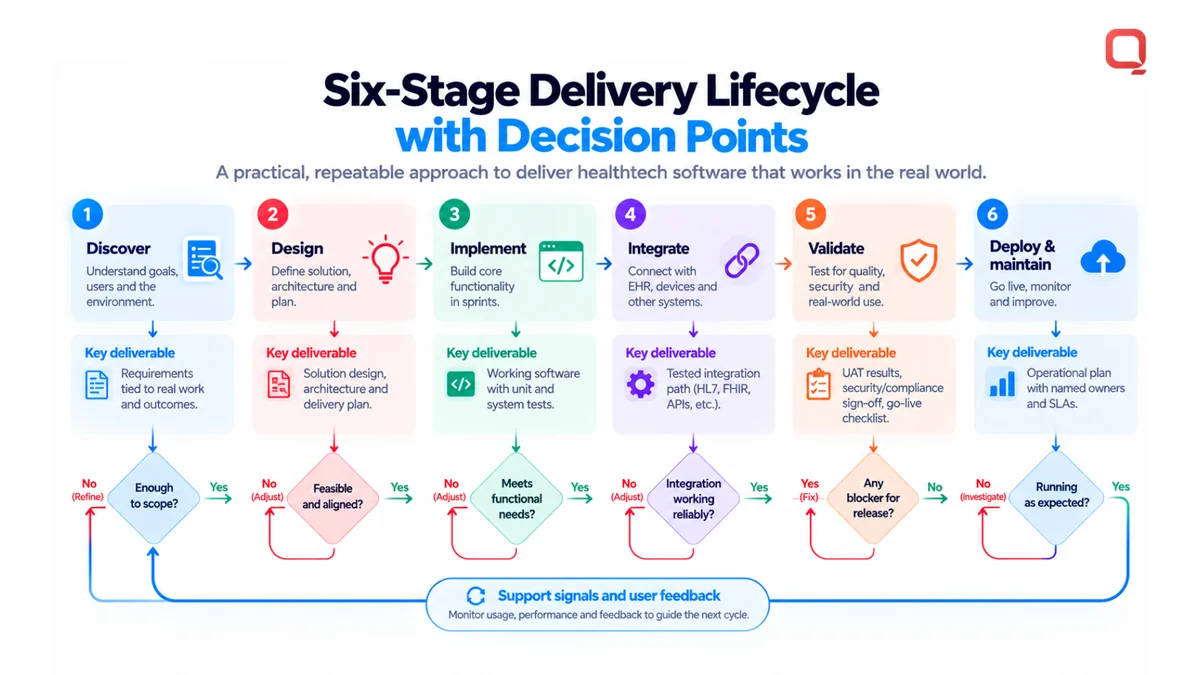
Teams build and operate healthtech software through a lifecycle that moves from discovery and design to implementation, integration, validation, deployment, and maintenance. Treat each stage as a decision point with a defined deliverable. Plan security, privacy, testing, and operational readiness throughout, and verify project-specific obligations with the appropriate compliance and legal stakeholders.
A practical sequence makes responsibilities and open questions visible before they become release blockers.
- Discover the workflow. Document user needs, product goals, system dependencies, and constraints. The deliverable is a set of requirements tied to actual work. Decide whether the team has enough information to define the product’s scope.
- Design the product and boundaries. Translate requirements into interface behavior, data models, and system boundaries. The deliverable is a design that shows how users and connected systems interact. Decide which functions belong in the product and which depend on existing platforms.
- Implement in reviewable increments. Build and review working slices against acceptance criteria. The deliverable is software that stakeholders can inspect in context. Decide whether feedback or technical constraints require a change to scope or design.
- Integrate with connected systems. Specify data exchange, mapping, validation, and error behavior. The deliverable is an integration path tested against expected and failure conditions. Decide how the product should respond to delays, rejected data, or an unavailable dependency.
- Validate before release. Test key workflows, integrations, access behavior, and failure scenarios. The deliverable is documented evidence against project requirements. Decide whether unresolved defects or operational risks should block deployment.
- Deploy and maintain. Prepare deployment steps, monitoring, incident handling, and maintenance ownership. The deliverable is an operational plan with named responsibilities. After release, use support signals and user feedback to guide fixes and future changes.
What Happens During Discovery, Design, and Implementation?
Discovery turns user and system needs into requirements. Design converts those requirements into product behavior and technical boundaries. Implementation tests those choices in working software. Review progress with clinical, product, and engineering stakeholders so they can identify mismatches while requirements can still be adjusted.
What Should Teams Plan for Before Production and After Launch?
Production readiness includes deployment, monitoring, support, and maintenance planning. A prototype can demonstrate an idea, but a production product also needs defined failure handling, data protections, and ongoing ownership.
For projects involving protected health information, determine which HIPAA obligations apply to the organizations and services involved. The U.S. Department of Health and Human Services describes the Security Rule’s requirements for protecting electronic protected health information in its HIPAA Security Rule guidance. Use that primary reference and work with qualified compliance and legal stakeholders to assess how requirements apply to the specific project. Engineering practices alone do not establish a compliance outcome.
How Can QSS Technosoft Support Healthtech Software Development?
QSS Technosoft is a US-based software engineering company serving the US market, with a focus on healthcare software and SaaS solutions. Its engineering capabilities include product development, interoperability, and legacy modernization, helping healthcare teams connect technical decisions to real workflows and existing systems.
The choice between buying, extending, or building software depends on the product’s users, integration boundaries, and ownership needs. QSS supports that assessment with healthcare engineering capabilities including EHR/EMR development and integration, HIMS, HL7 and FHIR interoperability, DICOM/PACS, and Revenue Cycle Management (RCM) software. These capabilities are relevant when a product must fit into a connected environment rather than operate as an isolated application.
Which Healthcare Engineering Capabilities Can Support a Product?
Different product goals call for different technical work. An EHR/EMR or HIMS initiative may involve clinical and administrative workflows. An interoperability project may focus on HL7 or FHIR data exchange. A DICOM/PACS product may need to account for medical imaging workflows, while RCM software must support revenue cycle operations. Evaluate each capability in relation to the product’s intended users and systems.
- Product development: Build or extend EHR/EMR, HIMS, or healthcare SaaS capabilities around defined product requirements.
- Interoperability: Design HL7 and FHIR interfaces that account for data mapping, system boundaries, and exchange behavior.
- Modernization: Address legacy constraints while planning how existing workflows and connected systems will continue to function.
- Specialized platforms: Align DICOM/PACS and RCM engineering with the operational context each product serves.
These disciplines intersect. Modernizing an EHR/EMR product, for example, may involve changes to user workflows, integration patterns, and underlying system design. QSS’s senior-led, architect-driven delivery addresses these connected decisions rather than treating each feature as a separate build task.
What Should a First Project Discussion Clarify?
A useful first discussion turns a broad product idea into a clearer view of scope and constraints. Establish who will use the product, which workflow problem it addresses, and which existing systems it must work with. This gives product, clinical, and engineering stakeholders a shared starting point.
- Users and workflows: Define roles, critical tasks, handoffs, and the problems the product should address.
- Systems and integrations: Identify current platforms, expected data flows, and the boundaries of each connection.
- Operational constraints: Surface security, privacy, deployment, maintenance, and support considerations.
- Outcomes and ownership: Clarify what success should mean and who will own decisions, product changes, and ongoing operations.
Clarifying these points gives the team a grounded starting place for product scope, architecture, and delivery decisions.
Turn the Next Decision Into a Clear Starting Point
Turn product intent into a focused decision brief. Name the user, the problem the product should solve, the outcome that would matter, and the constraints that could change the plan. Keep the brief concise enough for clinical, product, and engineering stakeholders to review together.
Then identify the first unresolved decision that could affect scope or delivery. It might involve ownership of a connected system, access to necessary data, or who will maintain the product after launch. Assign an owner and determine what information is needed to move forward. This gives the team a practical basis for choosing what to validate first.
QSS Technosoft works with US healthcare organizations on software and SaaS products, including connected systems and modernization initiatives. A project conversation can help frame goals, constraints, and next steps.
Start a healthtech project conversation to discuss your product goals, integrations, and delivery needs.
Plan a Resilient Healthtech Product With Our Engineers
Bring your users, the workflow you want to change, and the systems your product must connect to. QSS Technosoft is a software development company in USA, based in Bloomington, Minnesota, offering healthcare software development services, custom healthcare software development, and EHR software development company expertise, from HL7, FHIR, and SMART on FHIR integration to HIPAA-compliant software development practices and long-term product support.
Start a healthtech project conversation →