How Do You Build a HIPAA-Compliant Mobile Health App? Architecture, Security & Compliance Checklist (2026)
 By Rashmi Kanti
Sr. Marketing Specialist
June 23, 2026
16 min read
Last Updated on June 30, 2026
By Rashmi Kanti
Sr. Marketing Specialist
June 23, 2026
16 min read
Last Updated on June 30, 2026
Quick Answer
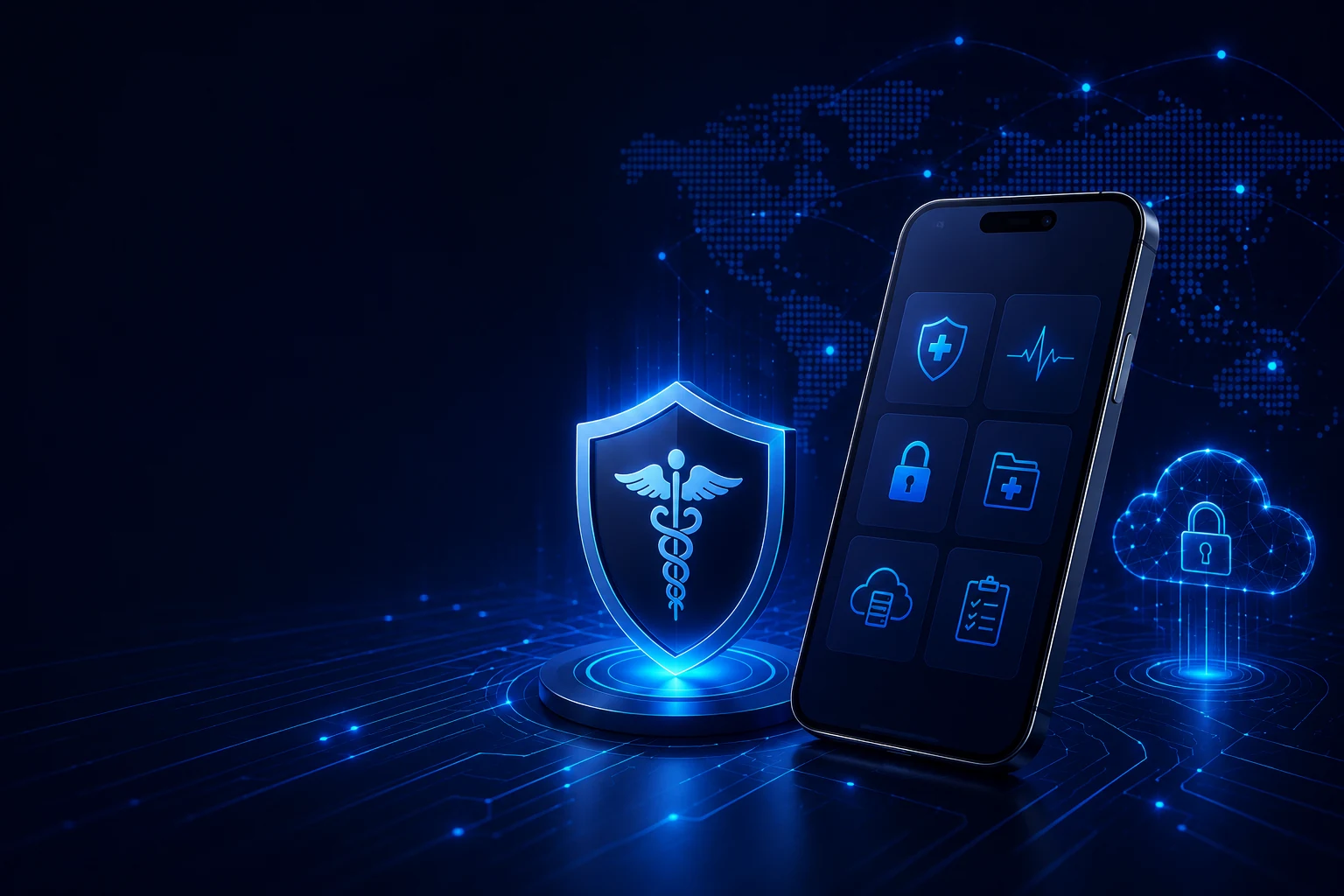
A HIPAA-compliant mobile health app protects electronic Protected Health Information (ePHI) through three pillars: encryption (AES-256 at rest, TLS 1.2+ in transit), strict access controls with audit logging, and a signed Business Associate Agreement (BAA) with every vendor that touches PHI, including your cloud provider.
Compliance is an architecture decision, not a feature added later.
Who this guide is for
This guide is for healthcare CTOs and product owners, founders building digital-health or telehealth apps, engineering leads scoping a HIPAA project, and compliance officers validating a mobile build. If you handle US patient data on iOS or Android, this is for you.
Introduction
"How do you build a HIPAA-compliant mobile health app?" It's one of the first questions every digital-health team asks, and one of the easiest to get wrong. HIPAA isn't something you bolt on at the end. It's a set of decisions about how your app stores, moves, and protects patient data, built in from the start. This guide breaks it down layer by layer, with a checklist you can act on today.
What does "HIPAA-compliant" actually mean for a mobile app?
It means your app, and everyone who touches its data, meets the HIPAA Security Rule's safeguards for protecting patient health information (PHI). In practice that comes down to four things: encrypt the data, control who can access it, log what they do, and sign agreements with any vendor in the chain. And no, there's no official "HIPAA certified" stamp. You demonstrate compliance, you don't get awarded it.
What are the core architecture layers of a HIPAA-compliant mobile health app?
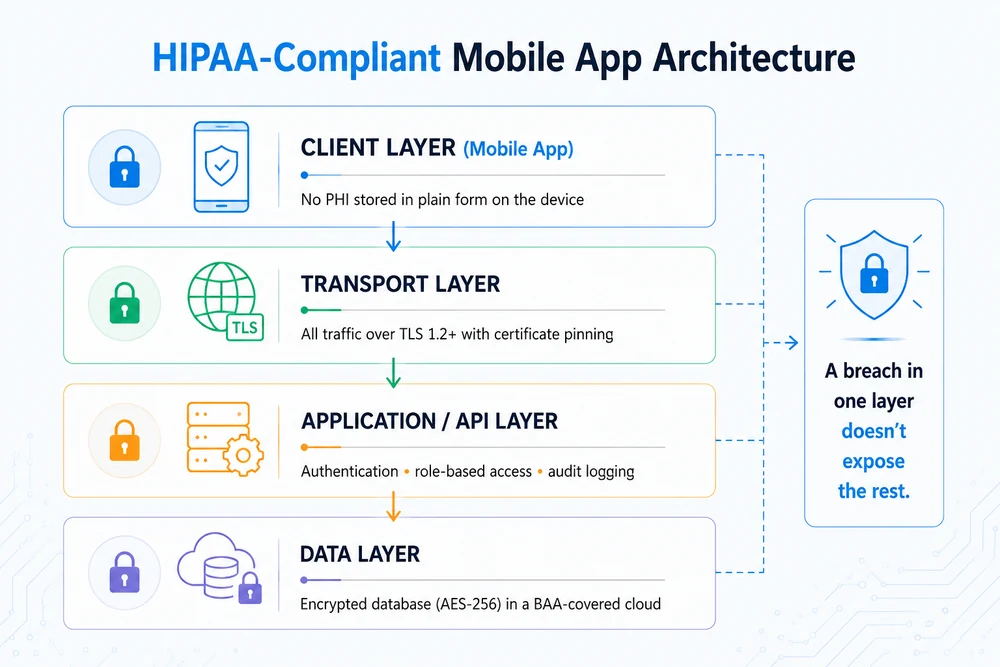
Think of a compliant app in four layers. The app on the phone shouldn't hold patient data in plain form. The connection carrying that data should be encrypted with TLS 1.2 or higher. The API in the middle decides who's allowed in and logs what they do. And the database sits in a secure, BAA-covered cloud. Each layer only gets the access it needs, so a problem in one place doesn't expose everything.
How do you protect patient data, at rest and in transit?
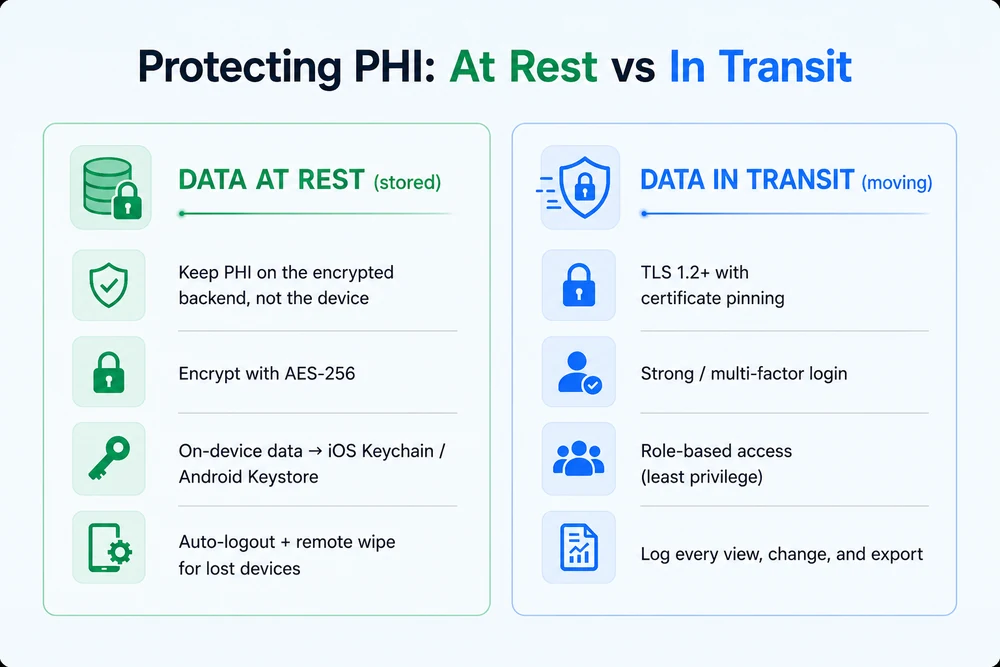
You're really protecting data in two states. When it's stored, keep it on your encrypted backend rather than the phone, use AES-256, and lock any on-device data in the iOS Keychain or Android Keystore — with auto-logout and remote wipe for lost devices.
When it's moving, send it over TLS 1.2+ with certificate pinning, require strong (ideally multi-factor) login, give each role only what it needs, and log who viewed or changed what. Simplest rule of all: if a screen doesn't need a piece of patient data, don't load it.
Do you need a Business Associate Agreement (BAA) with your cloud provider?
Yes. Any vendor that stores, handles, or moves PHI for you counts as a Business Associate, and they need to sign a BAA. AWS, Google Cloud, and Azure all offer them, but a BAA only covers specific services set up the right way. Using a "HIPAA-eligible" platform without a signed BAA and proper setup doesn't make you compliant.
What are the most common HIPAA compliance mistakes in mobile apps?
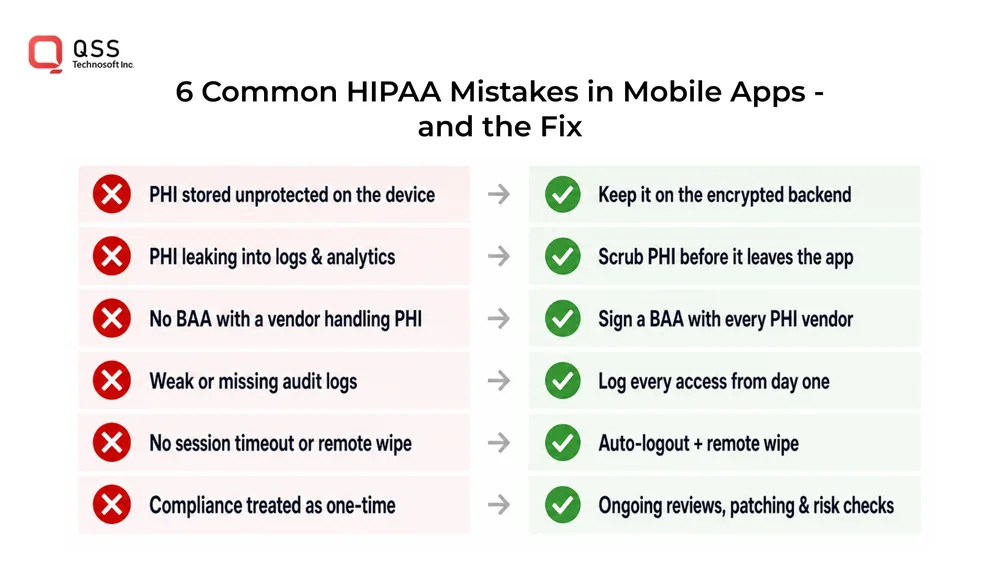
Most HIPAA slip-ups aren't dramatic hacks. They're small, avoidable gaps. The ones we see most often:
- Storing data on the device unprotected — If PHI sits in plain text in local storage, anyone with the phone can read it. Keep it on the encrypted backend instead.
- Leaking PHI into logs and analytics — Patient data often slips into crash reports or third-party SDKs without anyone noticing. Scrub it before it ever leaves the app.
- Forgetting the BAA — Any cloud, email, or messaging tool that handles PHI needs a signed Business Associate Agreement. No agreement, no compliance.
- Weak or missing audit logs — If you can't show who viewed or changed a record, you can't prove compliance. Log every access from day one.
- No session timeout or remote wipe — A lost phone shouldn't mean lost patient data. Auto-logout and remote wipe close that gap.
- Treating compliance as a one-time task — HIPAA isn't a launch-day checkbox. It needs ongoing reviews, patching, and the occasional risk assessment.
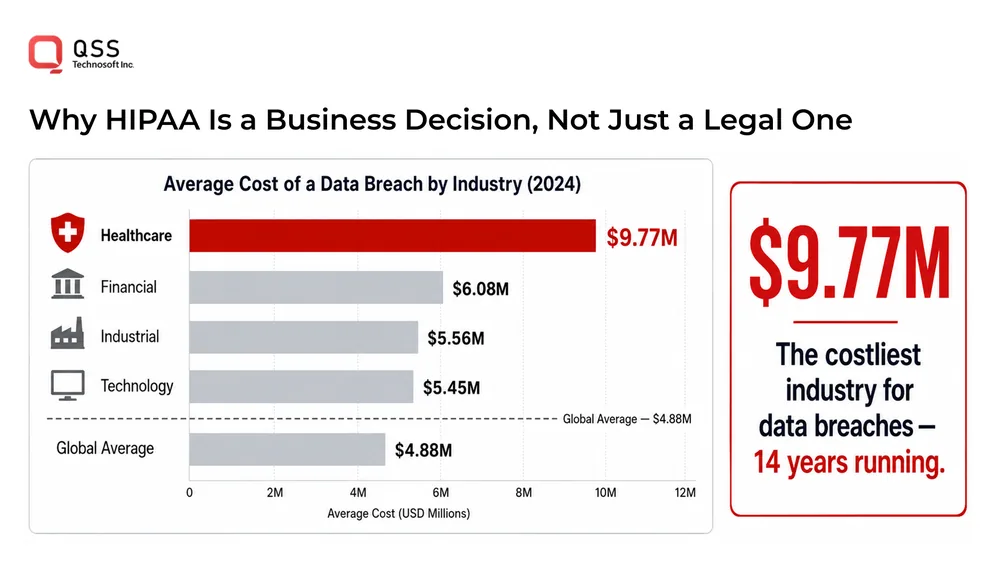
KEY STATS & FACTS
$9.77M
Average healthcare data-breach cost — costliest industry, 14 years running. (IBM, 2024)
500+
The HHS OCR Breach Portal publicly lists every breach affecting 500+ individuals. (HHS)
$137+
HIPAA civil penalties scale from ~$137 to over $68,000 per violation. (HHS)
Real-world examples and use cases
HIPAA-compliant mobile architecture powers a wide range of digital-health products. Common use cases include:
- Telehealth & virtual visits — encrypted video, e-prescriptions, and visit notes synced to the EHR.
- Remote patient monitoring (RPM) — wearable and device vitals streamed securely to clinicians.
- Point-of-care / bedside charting — caregivers logging assessments at the bedside, offline-capable and paperless.
- Patient engagement & portals — secure messaging, lab results, appointments, and care plans.
- e-Prescribing (eRx) — secure medication ordering and pharmacy routing.
- Medication adherence & reminders — dosage tracking with protected health data.
- Chronic disease management — diabetes, cardiac, and oncology monitoring apps.
- Mental & behavioral health — therapy, mood tracking, and tele-counseling apps.
- Clinical trials & eConsent — secure participant data capture and digital consent.
- Home health & senior-care coordination — caregiver scheduling, work orders, and family updates.
- Secure clinician messaging — HIPAA-compliant care-team collaboration and on-call handoffs.
- Mobile medical imaging — DICOM image viewing and sharing on tablets and phones.
- Wearables & IoT health sync — continuous data ingestion from connected devices.
- Billing, claims & secure payments — PHI-aware payment capture and insurance workflows.
Planning a healthcare app?
We’ll review your data flows in a free 30-minute architecture call.
Talk to a healthcare engineer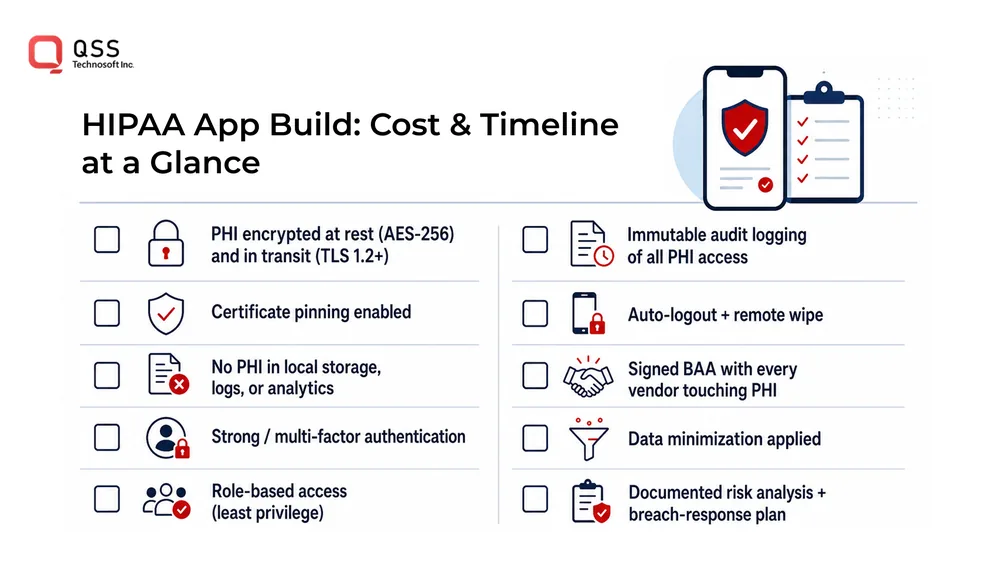
QSS expertise and proof
QSS Technosoft builds security-first healthcare software — and has done so since 2011. Why healthcare teams choose us:
- 14+ years engineering healthcare and HIPAA-aware software since 2011.
- 250+ engineers across mobile, cloud, AI/ML, and quality engineering.
- Delivery inside ISO 9001, ISO 27001, and CMMI Level 5 quality and information-security frameworks.
- Deep healthcare specialization: mobile health apps, DICOM-PACS, EHR/FHIR/HL7 integration, and AI/ML for clinical workflows.
- AWS cloud engineering with HIPAA-eligible, BAA-backed architectures.
- Native iOS / Android and React Native mobile delivery with encryption and audit-ready design.
- Proven paperless, compliance-driven outcomes for US senior-living and healthcare clients.
- End-to-end teams: engineers, QA, DevOps, and compliance-aware architects under one roof.
Our Similar Work for the Healthcare Industry: Case studies and portfolio
Case Study 1 — AI-Enabled Point of Care for Senior Living
- Problem: US senior-living communities faced manual paperwork, documentation errors, and disconnected caregiver workflows.
- Solution: A mobile-first Point of Care platform on React Native + Node.js with an AWS backend, delivering electronic assessments, work-order routing, and secure payments — offline-capable for the bedside.
- Impact: 100% paperless clinical documentation · 40% higher care-delivery efficiency · 25% more service-revenue capture.
View this project in the QSS portfolio →
Case Study 2 — HIPAA-Compliant Cloud Storage App
- Problem: Senior-living facilities relied on paper-based records — risking errors, loss, and security gaps — with faxing, mailing, and manual approvals slowing everything down.
- Solution: A hybrid cloud storage app with HIPAA-compliant secure document storage and retrieval, digital e-signatures, multi-platform access (Android, iOS, web), and scanner/desktop/mobile upload — fully paperless workflows.
- Tech stack: Node.js, Express.js, C#/.NET, PHP, Xamarin, MySQL, MSSQL, AWS.
- Impact: 40% cut in administrative time · 60% reduction in paper-storage costs · stronger document security and compliance.
View this project in the QSS portfolio →
How QSS helps you (service mapping)
A HIPAA-compliant health app rarely needs just one skill — it touches mobile, cloud, system integration, and security all at once, which is exactly where projects stall when they are stitched together across separate vendors. QSS brings these capabilities under one roof, so compliance, engineering, and clinical workflows move together from day one. Here is how our services map to what your build actually requires:
| You Need | QSS Service |
|---|---|
| Compliant mobile build (iOS / Android) | Healthcare mobile app development (React Native / native) |
| Secure, scalable backend | Cloud engineering on AWS with HIPAA-eligible architecture |
| Connect to hospital systems | EHR / FHIR / HL7 integration |
| Medical imaging workflows | DICOM-PACS engineering |
| Smarter clinical workflows | AI/ML services |
| Security validation | Architecture and security review |
Read more: Top 10 Great Hospital Mobile Apps for Modern Healthcare in 2026 Read article →
Conclusion and recap
Building a HIPAA-compliant mobile health app comes down to designing for protection from the first commit: encrypt at rest and in transit, enforce least-privilege access with full audit trails, minimize the PHI you handle, and sign a BAA with every vendor in your data path. Treat compliance as an ongoing program — and partner with a team that has shipped it before.
Read More: DICOM vs PACS: Key Differences in Medical Imaging Solutions Read article →
Ready to build securely?
QSS Technosoft designs and ships HIPAA-aware mobile health apps — from architecture to App Store.
Book a free discovery call →