Vibe Coding and Prompt-Driven Development: From Hype to Real Engineering Practice
 By Nikita
Senior Resource at QSS
August 14, 2026
7 min read
Updated Aug 14, 2026
By Nikita
Senior Resource at QSS
August 14, 2026
7 min read
Updated Aug 14, 2026
Quick Answer
Vibe coding means building software by describing what you want in natural language and letting AI generate much of the code. It is genuinely powerful for speed: it turns ideas into working experiments fast. But writing code was never the whole job. Reliability, security, architecture, and judgment still belong to the engineer. The real shift is from code-first to intent-first development, and the people who benefit most are the ones who know what to build, why, and how to evaluate what AI produces.
Who This Guide Is For
This guide is for software engineers, technical leaders, product managers, and founders trying to make sense of vibe coding and AI-assisted development. If you want to use AI to move faster without sacrificing reliability, security, and engineering judgment, this is written for you.
What exactly is vibe coding?
Vibe coding is essentially a way of building software by describing what you want in natural language and allowing AI tools to generate much of the code.
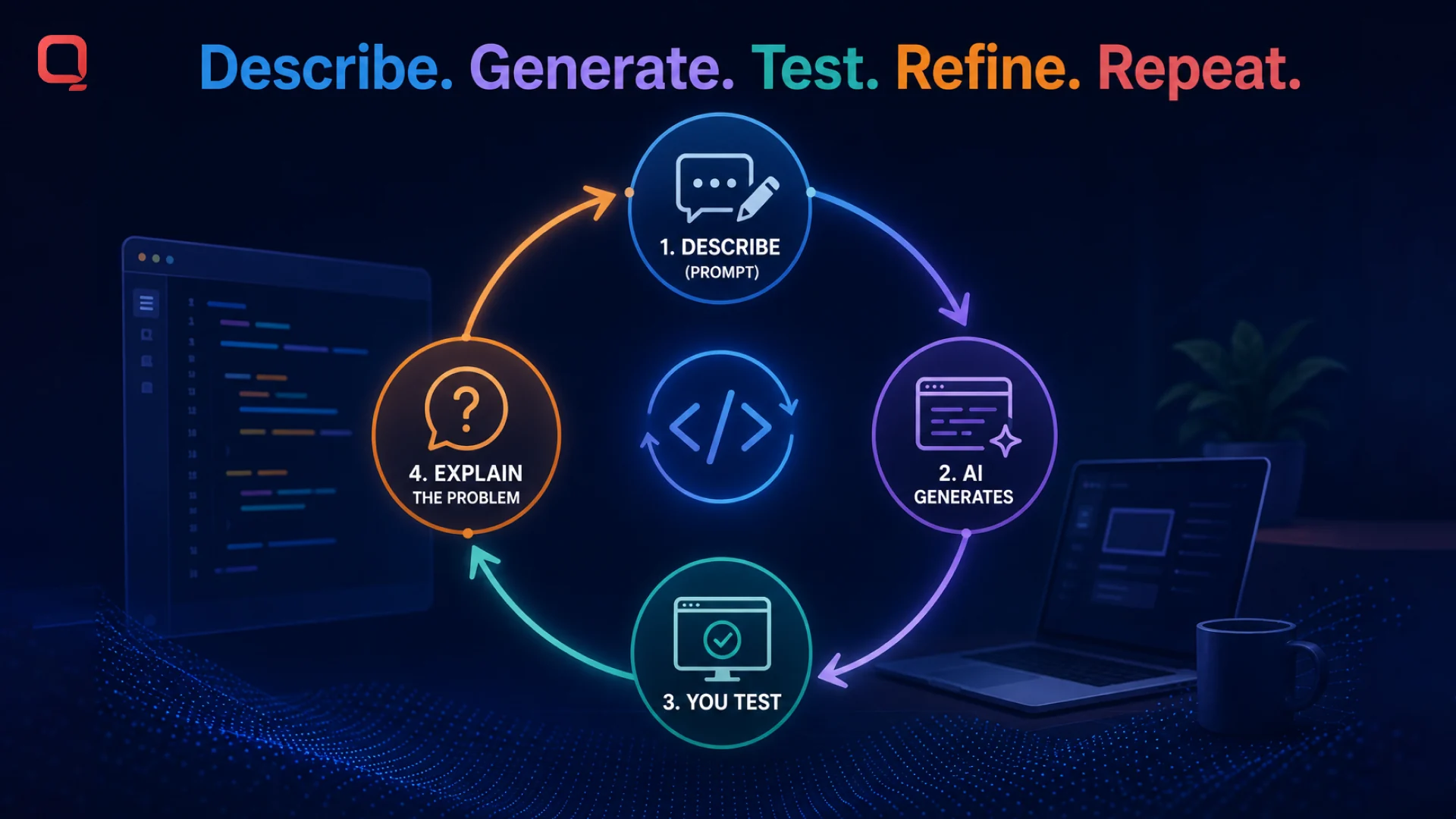
Instead of spending hours writing every function yourself, you might say: "Build a login page with email and password authentication. Add validation and show an error message when the credentials are wrong."
The AI generates the code. You test it. Something doesn't work, so you explain the problem. The AI changes the code. You repeat the process.
For prototypes and small applications, this can feel almost magical. And that's probably why the idea became so popular so quickly.
But here's where the hype gets complicated
Writing code has never been the only job of a software engineer.
A good engineer also needs to understand what problem we are actually solving, what happens when thousands of users use the system, what happens when something fails, whether the data is secure, whether the architecture will scale, and whether the solution can be maintained over time.
AI can help with many of these questions. But it doesn't automatically take responsibility for them.
AI can generate code. Engineering is about making decisions.
The real value of prompt-driven development
I don't think the biggest advantage of AI-assisted development is simply that it writes code faster.
The bigger advantage is that it reduces the friction between an idea and a working experiment.
A developer can quickly test an idea that previously might have taken days. A product manager can create a rough prototype. A startup founder can validate an idea before spending heavily on development.
That is a meaningful change.
But speed without understanding can create a different problem.
You can now build the wrong thing much faster.
From "make it work" to "make it reliable"
This is probably where vibe coding needs to mature.
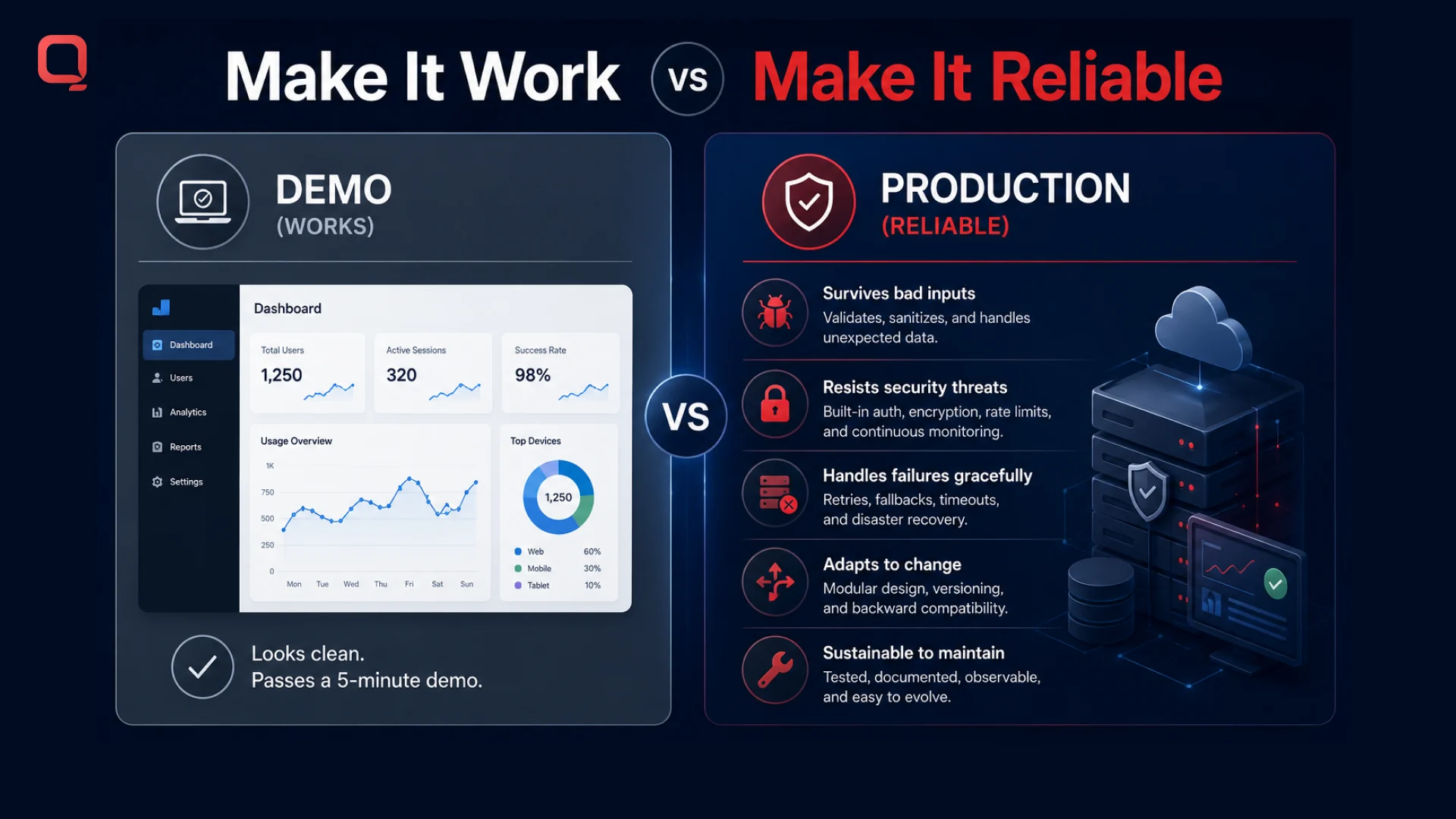
The first version of an AI-generated application might work perfectly during a quick demo. But production software is rarely judged by a five-minute demo.
Production software has to survive bad inputs, unexpected users, security threats, changing requirements, system failures, performance problems and maintenance.
That's where engineering discipline comes in.
The workflow shouldn't simply be:
Problem → Prompt → Prototype → Review → Test → Improve → Secure → Deploy → Monitor
The AI can participate in almost every stage. But humans still need to own the process.
Prompting is becoming a technical skill
Another interesting shift is happening here.
Developers aren't simply learning how to "ask AI questions." They're learning how to communicate requirements precisely.
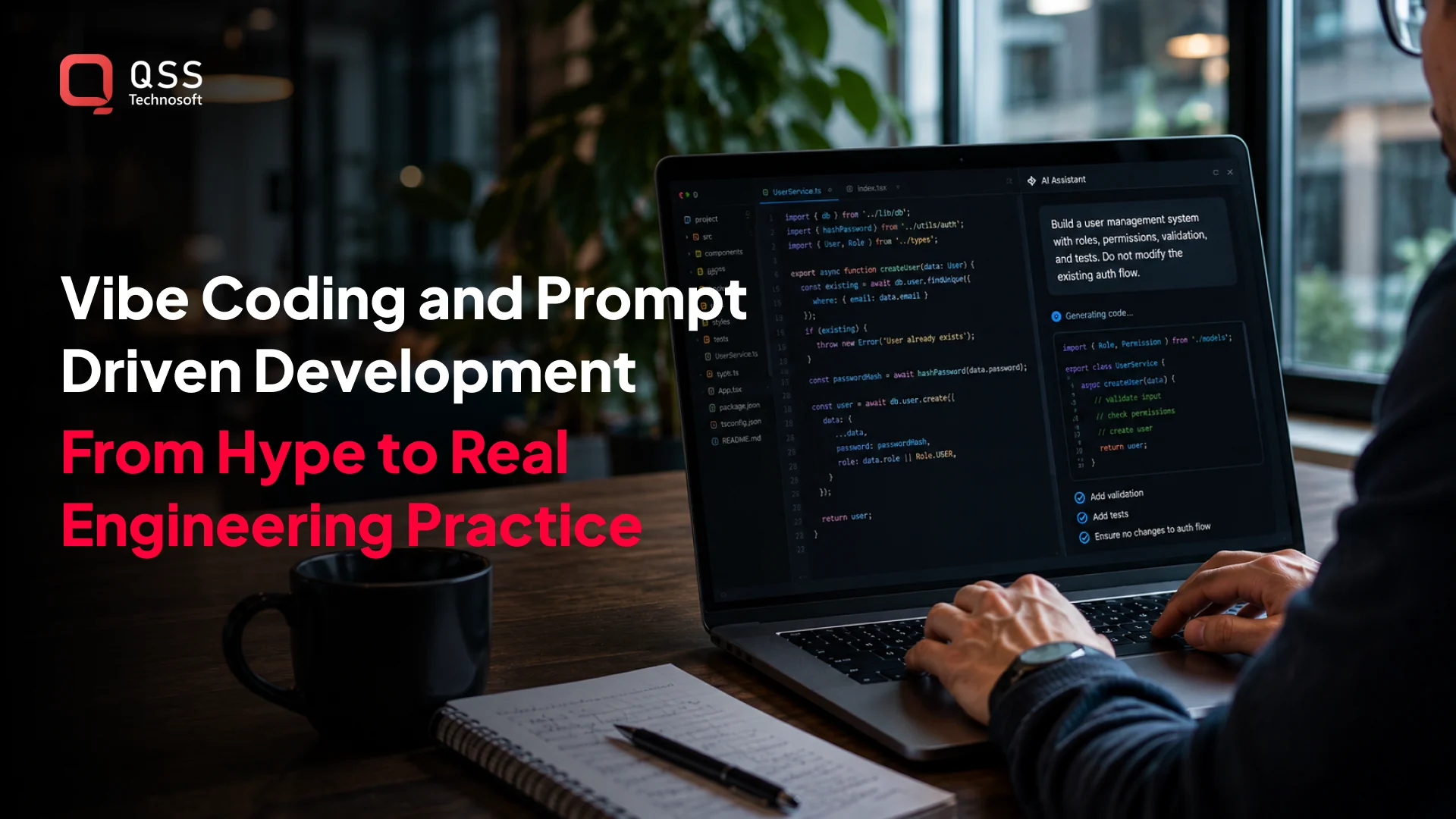
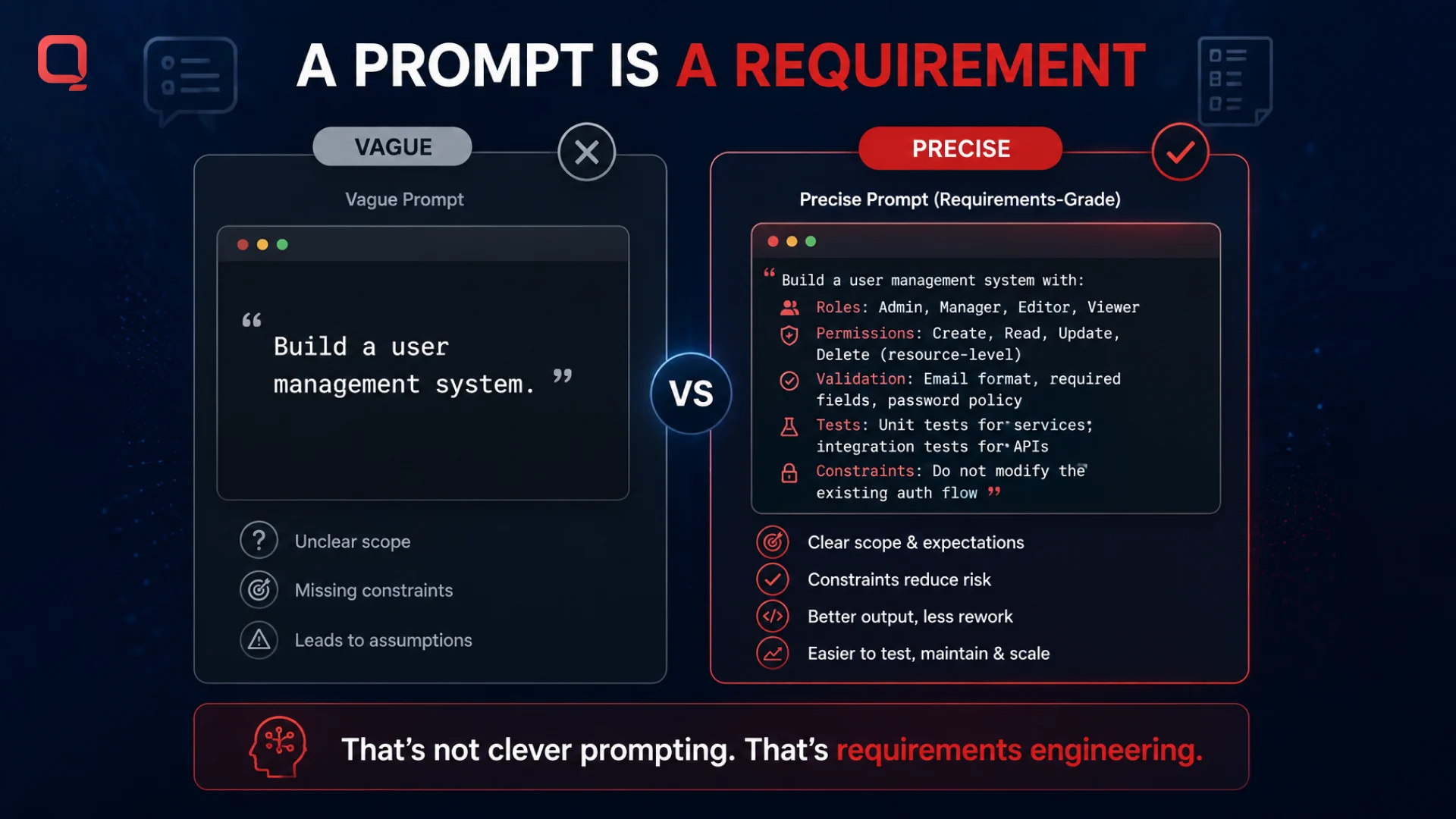
For example, instead of "Build a user management system," a better prompt might explain: "Build a user management module using the existing authentication structure. Users should have admin and standard roles. Admins can create, deactivate and update users. Standard users can only view their own profile. Add validation, error handling and tests. Do not modify the existing authentication flow."
The second prompt provides context, constraints and expectations.
That's not just clever prompting. That's requirements engineering.
And the better we become at describing problems, constraints and expected outcomes, the more useful AI becomes.
The engineer's role is changing
I don't think AI makes software engineers less important. But it does change what makes someone a good engineer.
If AI can generate a large amount of code, then simply knowing how to type code quickly becomes less valuable.
Understanding architecture, trade-offs, security, debugging, product requirements and system behaviour becomes more important.
The developer increasingly becomes someone who can say: "This is what we need to build, this is why we should build it this way, these are the risks, and here's how we're going to make sure it works."
AI becomes a very powerful implementation partner. But the engineer remains the person responsible for the decisions.
There is also a danger of "AI-generated confidence"
One thing I have noticed with AI-generated code is how convincing it can look.
The code may be clean. The explanation may sound confident. The application may even work.
And that can make it tempting to assume that everything is fine.
But software doesn't become correct because it looks professional.
You still need to question it: Why was this approach chosen? What assumptions does it make? What happens in an edge case? Is there a simpler solution? Is sensitive information exposed? Will this still work when the system grows?
Those questions haven't disappeared. If anything, they're becoming more important.
Vibe coding isn't the enemy of engineering
I don't think we need to choose between vibe coding and traditional software engineering.
There is a much better option.
Use vibe coding for speed. Use engineering discipline for reliability.
Let AI help you create the first version. Let it generate boilerplate. Let it explain unfamiliar code. Let it write tests. Let it help debug an issue. Let it suggest alternatives.
But review the output. Test it. Understand it. Improve it.
And most importantly, take ownership of what eventually goes into production.
How QSS Builds in the Age of AI-Assisted Development
This is exactly how we work at QSS Technosoft. We use AI to move fast, and engineering discipline to make sure what we ship actually holds up.
- AI for speed, engineering for reliability: we use AI-assisted development to accelerate first versions, boilerplate, and tests, then apply real engineering to make the result production-ready.
- Intent first, not code first: we start with what needs to be built and why, so the speed goes into the right thing, not just more code faster.
- We own the hard decisions: architecture, trade-offs, security, and system behaviour stay with experienced engineers, not left to whatever the AI generated.
- Reviewed, tested, and secure by default: every output is questioned, tested, and hardened, backed by ISO 27001 and CMMI Level 3 discipline.
- Built to last and yours to keep: we deliver software another team can maintain and grow, and you own the code and the IP.
The result is the best of both worlds: the speed of AI-assisted development, with the reliability, security, and ownership that real products demand.
The future isn't "AI writes all the code"
At least, that's not the part of the future I find most interesting.
The more interesting future is one where developers can spend less time fighting repetitive implementation details and more time thinking about the actual problem.
Instead of asking "How do I write this function?", we can spend more time asking "Is this the right function to have in the first place?"
That's a much more valuable question.
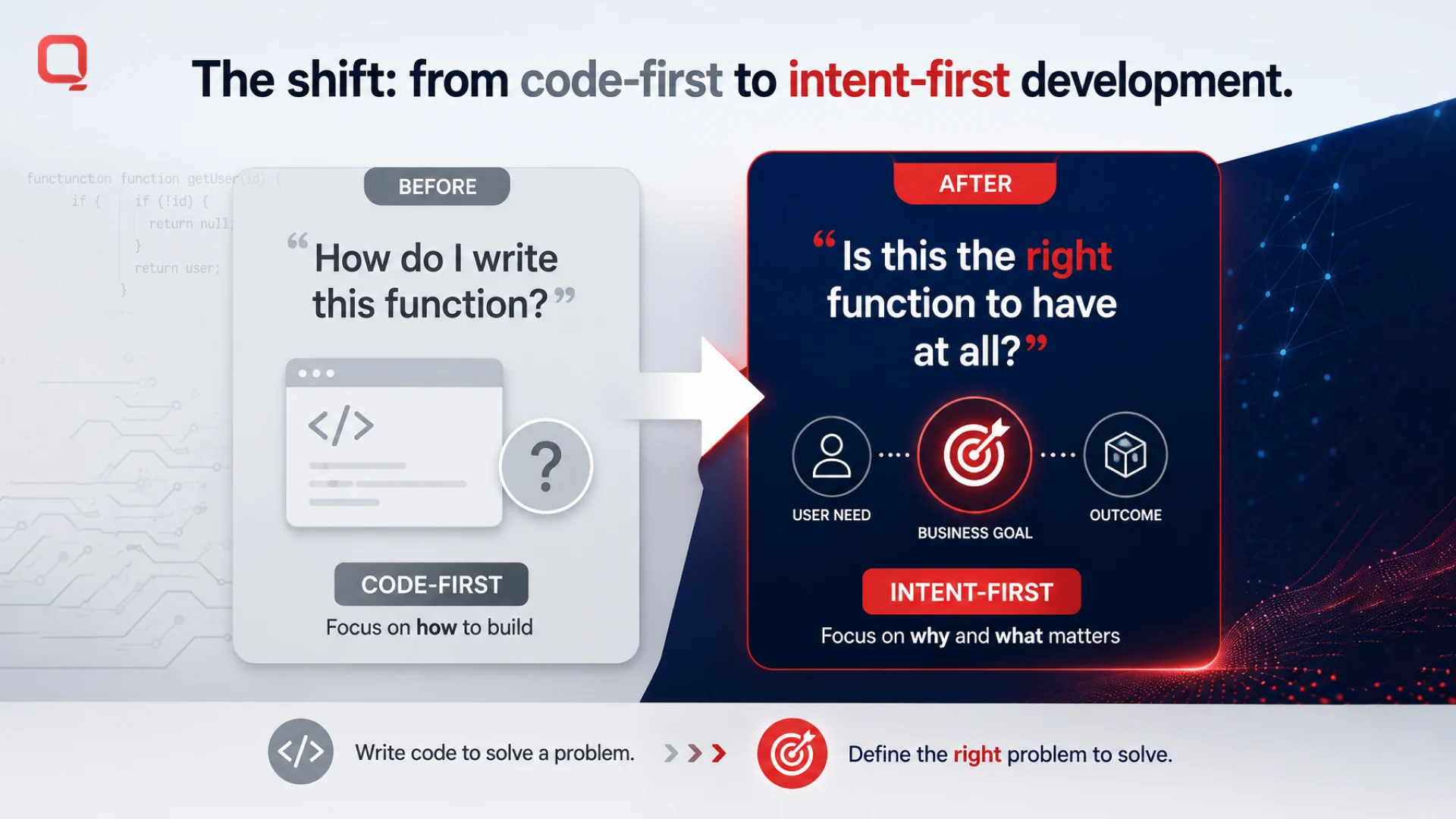
Vibe coding may have started as a hype-driven idea, but the underlying shift is real.
We're moving from code-first development toward intent-first development.
The people who benefit most won't necessarily be the ones who write the most prompts.
They'll be the ones who understand what to build, why to build it, how to evaluate what AI produces, and when human judgment needs to take over.
Because at the end of the day, AI can help us write the code.
But building good software still requires engineering.
Want AI-assisted speed with engineering you can trust?
QSS pairs modern AI-assisted development with real engineering discipline: reliable, secure, maintainable software from first prototype to production.
Talk to Our Engineering Team →