Telemedicine Platform Development: Architecture, Interoperability, and Delivery
 By Rashmi Kanti
QSS Technosoft
October 14, 2026
14 min read
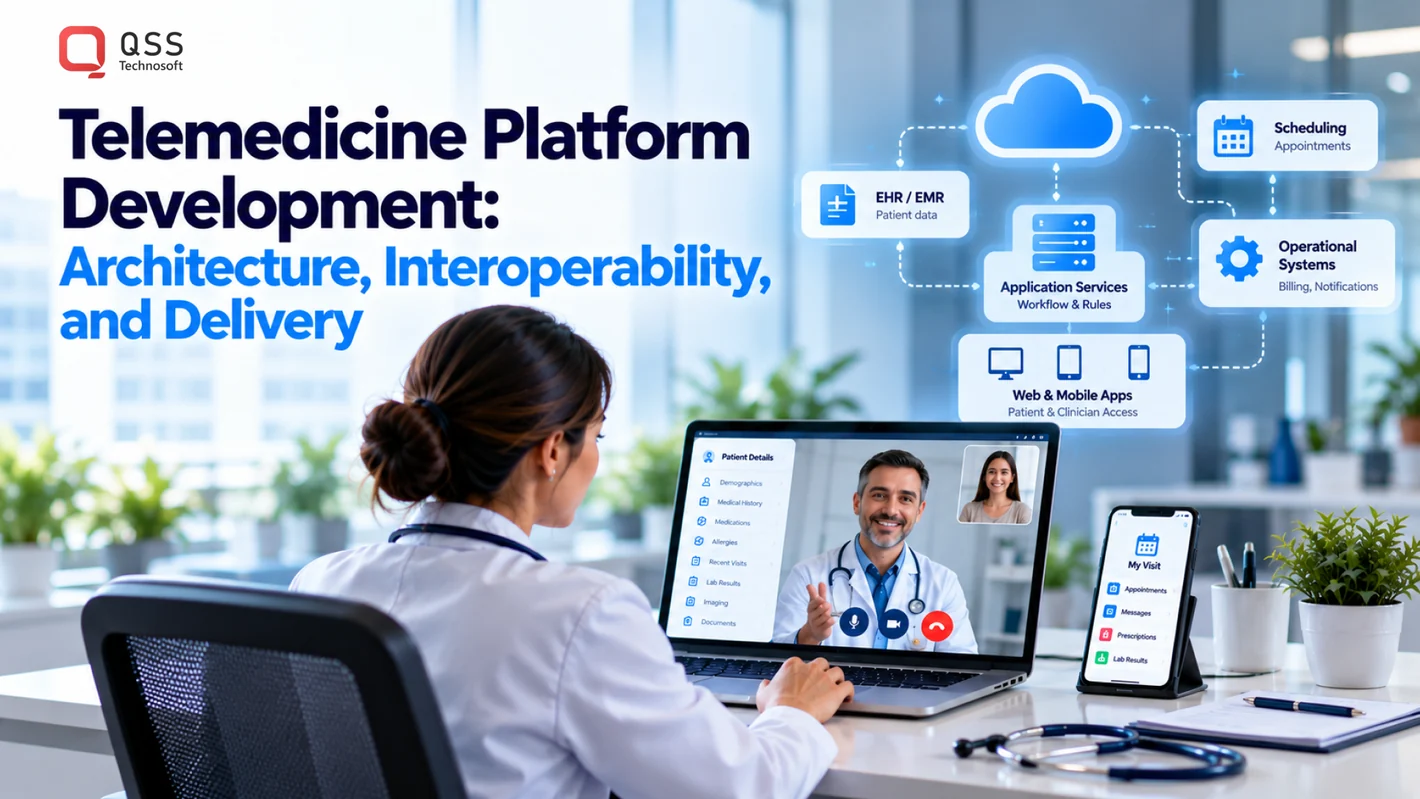
Telemedicine platform development is the design and engineering of software that supports remote care across patient, clinician, and operational workflows. A successful platform does more than connect a video call. It fits the care model, exchanges information with the right systems, protects access to sensitive data, and has a clear plan for ongoing support.
The hard part is connecting patient, clinician, and back-office needs without splitting clinical information across disconnected systems. This guide explains how to define scope, make architecture and interoperability decisions, and plan for security and operations before development begins.
It is for U.S. healthcare providers, health-tech teams, and product decision-makers planning a secure, maintainable service. QSS Technosoft develops telemedicine platforms and works on healthcare interoperability and EHR/EMR development and integration. The aim is to plan for real users, existing systems, and operational constraints, not just a successful demo.
Quick Answer
Telemedicine platform development means engineering software that supports remote care end to end, from patient access through the consultation to follow-up, not just a video call. Start by mapping patient, clinician, and operations workflows. Then give each part of the architecture a clear job: interfaces for users, application services for workflow rules, identity and access for permissions, integration services for EHR and other systems, and data stores for platform records. Choose HL7 interfaces or FHIR APIs based on the systems and data flows involved, and plan for versioning, errors, and access controls. Compare custom telehealth software development with existing software on workflow fit, integration needs, adaptability, and ownership, and build privacy and security in from the start with your compliance team, alongside validation, maintenance, and support.
What is telemedicine platform development, and who needs it?
Telemedicine platform development is the work of designing and building software for remote care, from patient access through clinical consultation and follow-up. A platform coordinates these workflows and the systems behind them. It is more than a standalone video call, and its scope depends on the care service it needs to support.
This guide is for U.S. healthcare providers, health-tech teams, and technology, clinical, and product leaders. The first decision is not which features to build. Define the care workflow that needs to work better, who uses it, and the setting in which it will be used. A platform for scheduled outpatient consultations has different requirements from one designed to support ongoing care coordination.
For a broader overview of the field, Telemedicine describes remote healthcare delivery and its applications. Product planning goes further: translate the intended care model into clear requirements for patients, clinicians, and operations.
Which care workflows can a telemedicine platform support?
A telemedicine platform can coordinate appointment access, virtual consultations, and follow-up. Each workflow serves different users, so define its purpose and requirements separately.
- Patient workflow: Find or request an appointment, receive visit information, join a consultation, and understand what happens next. Map each handoff, including how the patient gets the information needed to attend and follow through.
- Clinician workflow: Review relevant patient information, conduct the consultation, document the encounter, and determine follow-up actions. Design around the clinician’s tasks rather than making them navigate unrelated screens.
- Operations workflow: Coordinate schedules, manage visit status, and support administrative processes around the encounter. Specify which roles handle each step and what information they need.
The intended users and care setting determine which capabilities belong in scope. A provider organization may need the platform to fit established clinical and administrative processes. A health-tech product may need to support workflows across multiple customer organizations. Define the care journey first, then map the required capabilities to it.
When does custom platform development make sense?
Custom development can make sense when existing software cannot support required care workflows, integrations, or product changes. It gives a team more control over the experience and system connections, while creating ongoing responsibilities for maintenance, testing, and support.
Existing software may be a practical fit when its workflows and integration options align with the care model. Custom software becomes more relevant when teams must work around persistent product limitations or need a distinct platform experience. Neither approach is automatically better. Compare the actual workflow and system requirements, not just a feature checklist.
Before choosing, document the users, care setting, handoffs, and systems involved. Separate essential needs from optional capabilities. Then weigh the work of maintaining custom software against the constraints of adopting an existing product. Build only where the workflow requires it.
How should teams design a telemedicine platform architecture?
Design the architecture around the clinical workflows the platform must support. Give user interfaces, application services, integrations, and data stores clear responsibilities. This creates a defined path from patient and clinician applications to backend workflows, while accounting for existing healthcare systems and who will operate the platform.
Text-described architecture: Patient and clinician interfaces connect to application services. Those services handle workflow rules and identity and access. Integration services exchange information with external systems, while data stores retain platform records according to defined data responsibilities. Clear boundaries help teams trace a workflow and identify which component needs attention when a system or process changes.
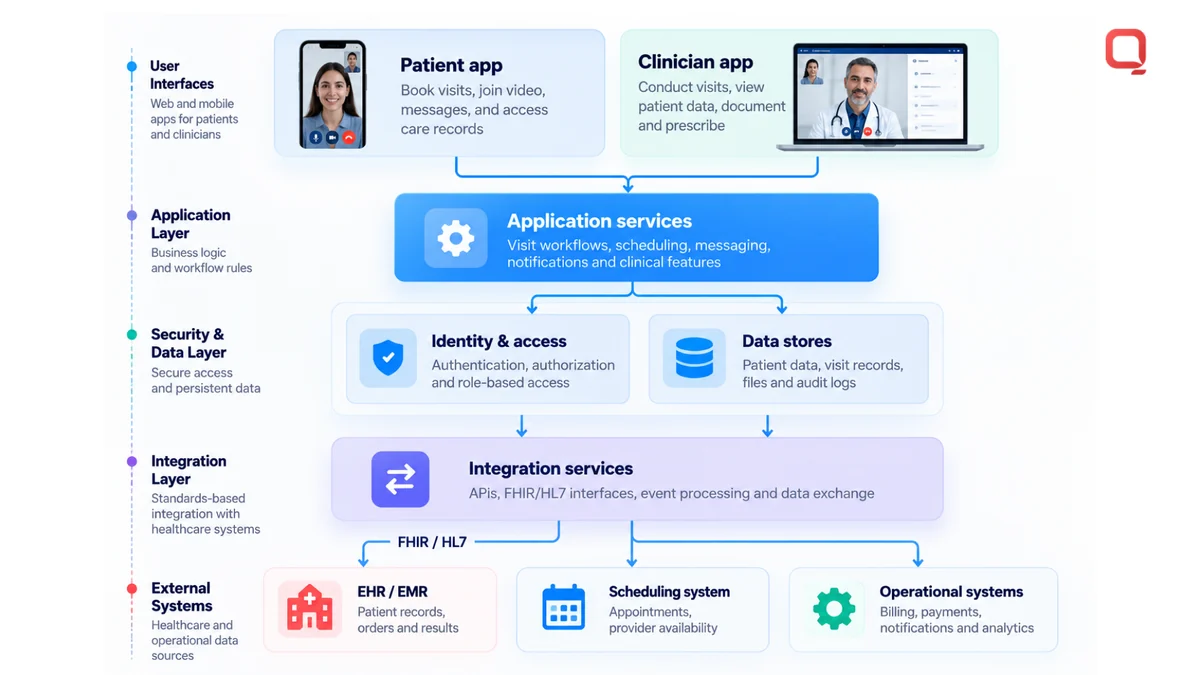
Architecture summary: Interfaces serve users, application services coordinate care workflows, identity controls access, integration services exchange data, and data stores manage platform information.
Which platform components belong in the initial design?
Start by mapping each interface to the work its user must complete. The patient experience may support account access, appointment details, and joining a visit. The clinician experience may help prepare for and conduct a consultation, then record its outcome. Define each workflow before translating it into screens or services.
Separate backend responsibilities, even if the first release uses a relatively simple deployment:
- Application logic: Coordinates platform workflows and applies product rules.
- Identity and access: Manages authentication and determines which users can access specific functions and information.
- Integrations: Connects platform workflows with external healthcare and operational systems.
- Data: Defines which information the platform stores, uses, and exchanges.
These boundaries can help teams isolate changes, but they do not remove the need to test dependencies or maintain interfaces. Modular design is a way to manage change, not a promise that future changes will be effortless.
How should teams plan cloud and mobile delivery?
Choose deployment and mobile technologies based on the organization’s environment, team capabilities, integration needs, and operating model. AWS, Azure, and GCP are cloud options, not mandatory choices. A legacy environment may require a hybrid approach or staged migration. The right design depends on how existing systems can connect and who will operate each part.
For mobile delivery, teams can build separate iOS and Android applications or assess cross-platform approaches such as React Native and Flutter. The choice affects development, testing, and release planning. Base it on product requirements, including device needs and the experience patients and clinicians must have.
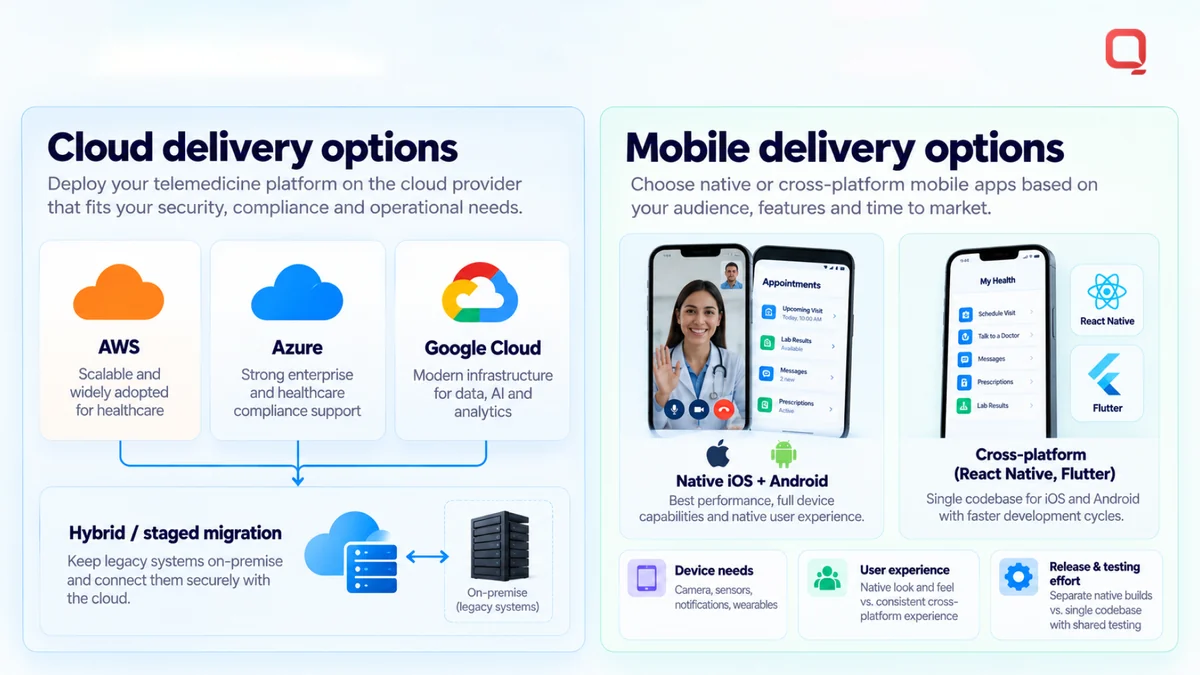
Plan for reliability before launch. Decide how the platform will detect and handle service interruptions, manage application releases, and route operational issues to the people responsible for support. Test the full workflow, not just the interface. A visit can fail at the connection to a backend service or an external system.
These architecture decisions give teams a practical basis for telemedicine platform development. Document component boundaries, technology choices, and operational responsibilities so the design remains understandable as the product changes.
How do interoperability and security shape telemedicine platform decisions?
Interoperability and security determine what a telemedicine platform can exchange, who can access information, and how workflows behave across connected systems. HL7 and FHIR are standards used to structure and exchange healthcare data. Planning connections before designing interfaces helps teams specify what information is available at each step and how it should be handled.
HL7 is a set of standards for exchanging healthcare information between systems. FHIR, or Fast Healthcare Interoperability Resources, is an HL7 standard that organizes data into resources that can be exchanged through modern interfaces. Choose an approach based on the systems involved and the data flow required, not simply because one standard sounds newer.
Plan interoperability before interface development: identify what data must move, where it comes from, and when it is needed. Those decisions determine what the user interface can reliably show.
| Integration need | Relevant standard or approach | Implementation consideration |
|---|---|---|
| Exchange clinical messages with an existing system | HL7 interfaces | Define message content, triggering events, and how errors are handled. |
| Retrieve or update structured clinical information | FHIR APIs | Map required resources and confirm how the connected system exposes them. |
| Connect with a system using older or local interfaces | Existing interface specifications and mapping | Document field meanings and transformations; inconsistent data may need careful handling. |
How can a platform connect with EHR/EMR systems?
Start by identifying the EHR or EMR systems involved, the information each workflow needs, and the direction and timing of each exchange. Document interface specifications, map data fields, and assign testing responsibilities across the platform and connected system teams.
For example, a virtual visit may need relevant patient information before the consultation and may produce documentation that must return to an EHR. Legacy interfaces, inconsistent field values, and differences in how systems represent data can complicate this exchange. Test expected data, missing data, and failed exchanges, not only the successful path.
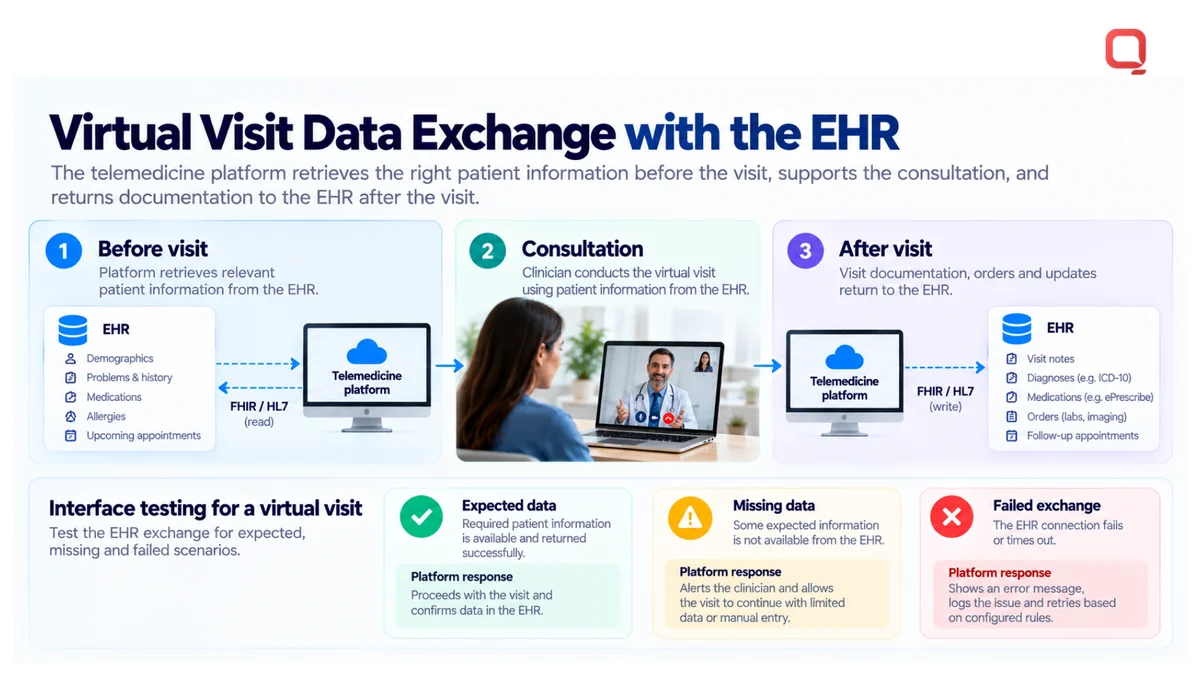
QSS Technosoft develops healthcare interoperability solutions and EHR/EMR software and integrations, including HL7 and FHIR integration work. Design the integration around the systems and workflows in scope.
What does compliance-by-design mean for platform engineering?
Compliance-by-design means considering privacy and security during architecture and development, rather than treating them as final review items. Teams can define access roles, limit data exposure to workflow needs, and plan how security decisions will be tested and maintained.
QSS works on HIPAA-compliant digital health solutions. HIPAA is not a certification, and an engineering approach alone does not determine an organization’s compliance. Healthcare organizations should align design and implementation decisions with their own compliance and security teams, including decisions about access, data handling, and operational controls.
How should buyers evaluate scope, trade-offs, and delivery risks?
Evaluate a telemedicine platform by moving from workflow discovery to scope, integration, validation, and operational ownership. Custom development offers more control over product behavior, but it also brings maintenance and quality assurance responsibilities. Existing software may require less custom engineering, while its workflows and integration options can constrain change.
Use a deliberate sequence before committing to a delivery approach:
- Discover the workflow. Document who uses the platform, what each person needs to do, and where handoffs occur.
- Set boundaries. Identify the systems involved, the data exchanged, and the capabilities essential to the first release.
- Assess fit. Compare custom development with existing software against workflow needs, integration dependencies, and expected product changes.
- Define validation. Specify how teams will test usability, clinical workflows, integrations, and security decisions before wider release.
- Assign ownership. Name who will handle maintenance, quality assurance, releases, and support after go-live.
What should teams define before development begins?
Document users, workflows, system boundaries, integration dependencies, and measures of success. A useful scope describes what a patient or clinician must be able to complete, not just which screens to build. Separate essential capabilities from speculative features so broad product ambitions do not obscure the workflow the first release must serve.
Include post-launch work in the delivery plan. Software needs ongoing maintenance, quality assurance, and operational ownership. If responsibility for those activities is unclear, the project plan is incomplete.
| Evaluation area | Custom development | Existing software |
|---|---|---|
| Control | More control over product behavior and workflow design. | Capabilities depend on the product’s available configuration and features. |
| Integration fit | Integration behavior can be designed around project requirements. | Fit depends on supported connections and available customization. |
| Maintenance | The organization takes on ongoing responsibility for the custom platform. | Maintenance responsibilities depend on the product and its operating arrangement. |
| Change needs | Changes can be planned around product priorities, with engineering and testing effort required. | Changes may be limited by product capabilities or vendor release decisions. |
Which delivery risks deserve early attention?
Unclear clinical workflows, legacy integration constraints, and late security decisions can force teams to revisit design choices. Custom work can address a specific gap, but it adds complexity: more decisions to govern, more software to test, and more maintenance to own. Existing software can reduce that engineering burden while requiring compromises in fit.
Use staged validation to test one workflow at a time with intended users. Check whether people can complete the task, whether connected systems exchange the expected information, and whether exceptions are handled clearly. Address issues before widening release. This reduces uncertainty, but it does not guarantee delivery times, outcomes, or cost savings.
Record unresolved assumptions, decision owners, and dependencies alongside the delivery plan. Review them at each validation stage so teams can address a blocked integration or workflow mismatch before it becomes a late-stage surprise.
How can QSS support telemedicine platform development?
QSS Technosoft is a U.S.-based healthcare software engineering company that develops telemedicine platforms for healthcare providers and health-tech teams. Its related capabilities include healthcare interoperability, EHR/EMR development and integration, and mobile app development. Bringing these needs into the same planning process helps teams address the product workflow and its technical dependencies together.
What healthcare engineering experience can QSS bring?
QSS develops HIPAA-compliant digital health solutions. HIPAA-related decisions still need to align with each organization’s compliance and security teams; software engineering cannot replace that review.
Relevant capabilities include:
- Healthcare interoperability: Design and implementation involving HL7 and FHIR data exchange, with attention to how information moves between the telemedicine platform and connected systems.
- EHR/EMR development and integration: Engineering for connections between virtual care workflows and clinical systems, including the data and interface decisions those connections require.
- Mobile app development: Patient and clinician mobile experiences designed around the tasks each user needs to complete.
A virtual consultation is only one part of a working platform. Teams also need to consider what information users need before and after the visit, how connected systems participate, and who supports the software once it is in production. QSS’s senior-led, architect-driven delivery approach brings these engineering decisions into project planning rather than leaving them until implementation.
QSS’s healthcare engineering work covers connected areas such as interoperability and EHR/EMR integration. These capabilities provide context for project planning, but they do not replace defining the requirements, responsibilities, and constraints of a specific platform.
What is a practical next step for a telemedicine project?
Start with the care workflow that needs attention. Describe the problem, the people involved, the existing systems it touches, and the constraints those systems create. A patient access issue, for example, may involve more than a mobile screen if appointment information or follow-up depends on another system.
Then shape the project scope and architecture around those requirements. Distinguish essential capabilities from later possibilities, identify integration questions, and clarify who will own testing, maintenance, and operational support. This keeps planning grounded in delivery realities rather than a feature wish list.
QSS works with U.S. healthcare organizations and health-tech teams on telemedicine platforms and related engineering needs. Project information is available through the QSS contact page.
Turn platform requirements into a clear first move
Turn your telemedicine platform development goals into a decision brief that clinical, product, and engineering teams can use. Identify the decisions that need alignment, the assumptions that still need testing, and the people responsible for resolving open questions.
Keep the brief focused on what the organization needs to learn before committing to a larger release. A limited validation stage lets stakeholders review the proposed direction and surface concerns while the plan is still adjustable. The aim is not to remove every uncertainty. It is to make important uncertainties visible and assign ownership.
QSS Technosoft works with healthcare organizations on telemedicine platforms and related engineering needs. To discuss your project’s priorities and potential scope, share your telemedicine platform requirements with QSS.
Start with a clear decision brief, then move forward one grounded decision at a time.
Plan Your Telemedicine Platform Architecture With Our Engineers
Bring the care workflow you want to improve, the users involved, and the systems it touches. As a telemedicine software development company offering healthcare software development services and custom healthcare software development, QSS Technosoft scopes custom telehealth software development around your architecture, HL7 and FHIR integration tools for healthcare, and EHR software development company expertise in EHR/EMR integration, with validation and support planned from day one.
Share your telemedicine platform requirements →