Low-Level Design: From Requirements to Maintainable Software
 By Chirayu Brijwani
Senior Software Developer, QSS Technosoft
August 19, 2026
16 min read
Updated Aug 19, 2026
By Chirayu Brijwani
Senior Software Developer, QSS Technosoft
August 19, 2026
16 min read
Updated Aug 19, 2026
Quick Answer
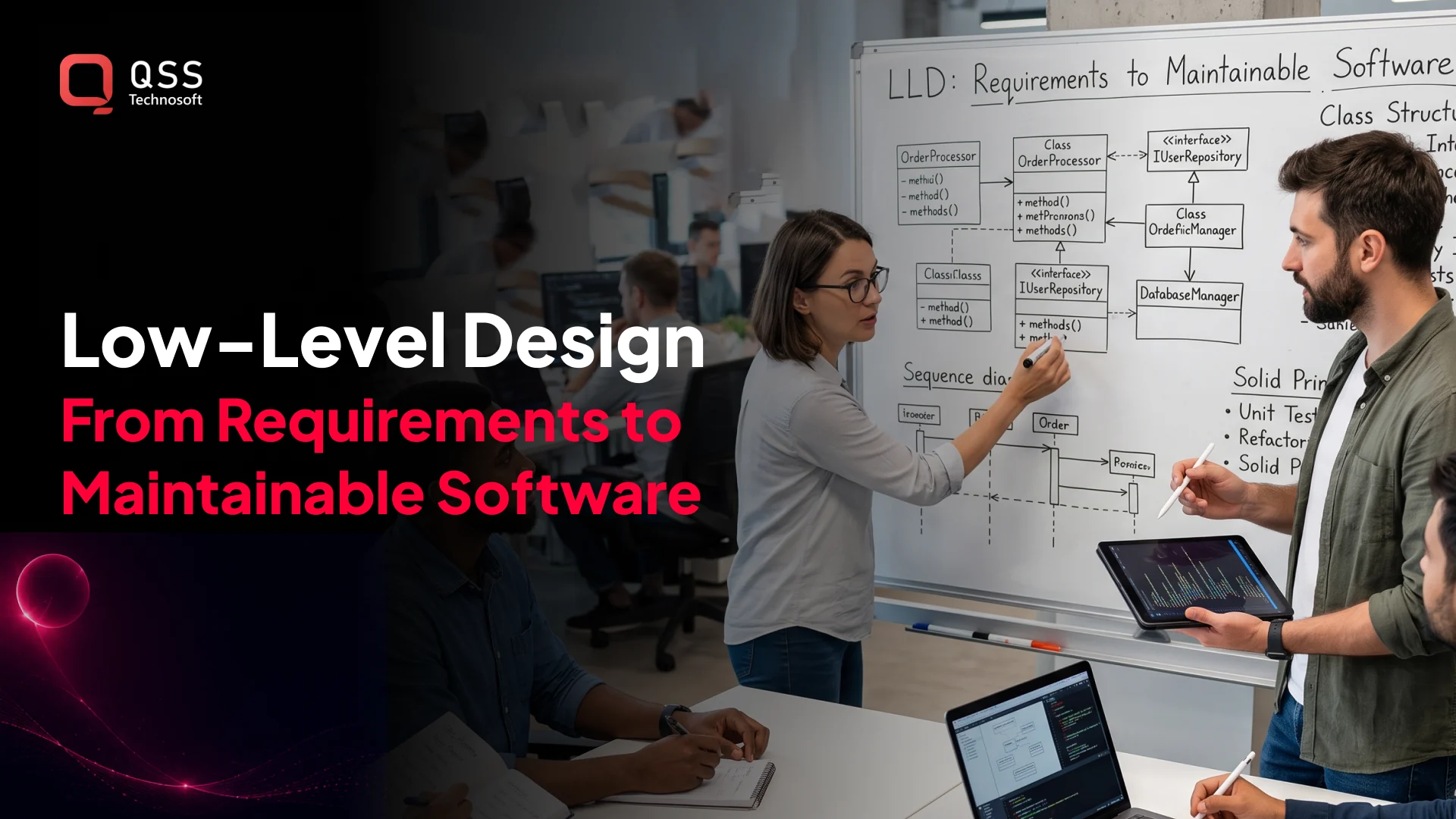
Low-Level Design (LLD) is the practice of deciding the internal structure of a software system: what each component is responsible for, how components interact, where business logic lives, and how dependencies are controlled. While High-Level Design deals with architecture, services, infrastructure and system boundaries, LLD moves closer to implementation. Good LLD is not about producing the largest class diagram or using the most design patterns. It is about establishing clear responsibilities and meaningful boundaries so that today's solution can absorb tomorrow's change.
Who this guide is for
This guide is for software engineers, technical leads, architects and engineering managers who want to move beyond making a feature work and toward building software that stays understandable, testable, secure and adaptable as it grows. It is equally useful for developers preparing for design discussions and for teams reviewing how design decisions are made day to day.
Introduction
Software development is not simply about making a feature work.
As applications grow, the structure of the software becomes increasingly important. A solution that works well today can become difficult to maintain tomorrow if responsibilities are unclear, dependencies are tightly coupled, or business logic is scattered across the codebase.
This is where Low-Level Design (LLD) becomes an important part of software engineering.
At QSS Technosoft, our engineering approach focuses on delivering reliable, customer-focused, and long-term software solutions. From that perspective, we see Low-Level Design as more than a technical exercise.
It is a way of thinking about software before and during implementation:
"How can we structure the software so that it solves the current problem while remaining understandable, testable, secure, and adaptable to future requirements?"
What is low-level design?
Low-Level Design focuses on the internal structure of a software system.
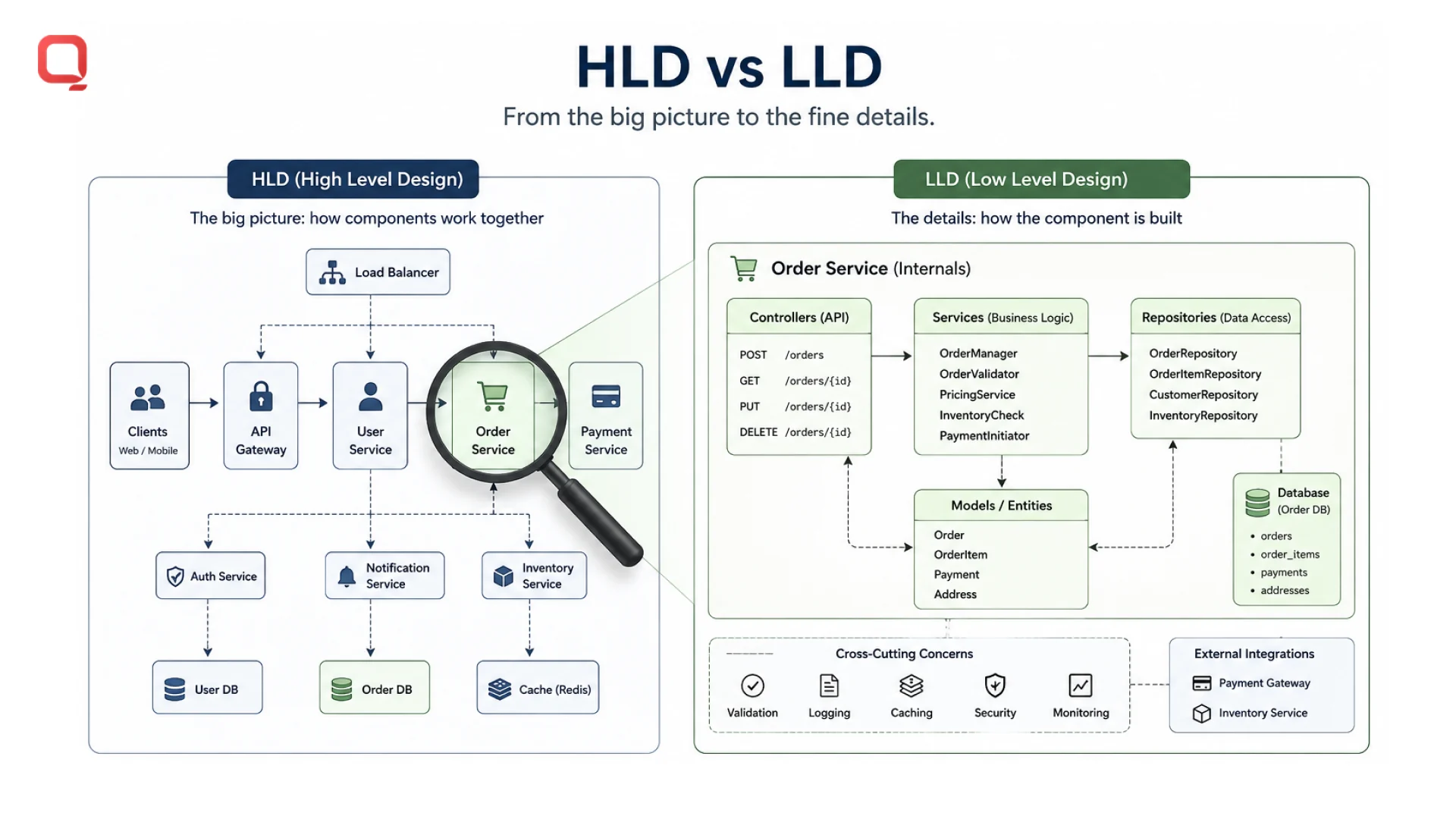
While High-Level Design generally deals with architecture, services, infrastructure, databases, communication, scalability, and system boundaries, LLD moves closer to implementation.
It addresses questions such as:
- What responsibilities should each component have?
- What classes or modules should exist?
- How should those components interact?
- Which interfaces should be introduced?
- Where should business logic live?
- How can dependencies be controlled?
- How can the design handle future changes?
- How can individual components be tested?
For example, a high-level design may tell us that an application has an Order Service.
LLD asks what happens inside that service.
We may need to determine how order validation, pricing, payment, inventory, notifications, and persistence are separated and how they communicate.
The objective is not to create more classes.
The objective is to create clear boundaries and meaningful responsibilities.
High-level design vs low-level design
| Aspect | High-Level Design (HLD) | Low-Level Design (LLD) |
|---|---|---|
| Primary focus | Architecture and system boundaries | Internal structure of components |
| Typical concerns | Services, infrastructure, databases, communication, scalability | Classes, modules, interfaces, responsibilities, dependencies |
| Example question | What services does the application need? | What happens inside the Order Service? |
| Distance from code | Further from implementation | Closer to implementation |
| Key output | System architecture and boundaries | Component responsibilities and contracts |
Start with the requirement, not the classes
One of the most important habits in software design is to avoid jumping directly into implementation.
Before designing classes, we first need to understand the problem.
What problem are we solving?
We need to understand the actual business requirement rather than designing around assumptions.
What is in scope?
Not every possible feature belongs in the first version. Clearly defining scope helps prevent unnecessary complexity.
What is likely to change?
Some requirements are stable, while others may evolve frequently. Those potential change points should influence our abstractions.
What constraints exist?
Performance, security, concurrency, compliance, reliability, and operational requirements can all influence the design.
A requirement-first approach helps us focus on solving the right problem before deciding how to implement it.
Design around responsibilities
A good design starts by asking:
"What should this component be responsible for?"
Consider an order-processing class that handles:
- Order validation
- Pricing
- Discounts
- Payment
- Inventory
- Notifications
- Database operations
Such a class may initially appear convenient because everything is in one place.
Over time, however, it becomes difficult to understand, test, and modify.
A better approach is to separate responsibilities according to meaningful business behavior.
For example:
Order
├── OrderValidator
├── PricingService
├── DiscountPolicy
├── PaymentService
├── InventoryService
└── NotificationService
This does not mean every small operation requires its own class.
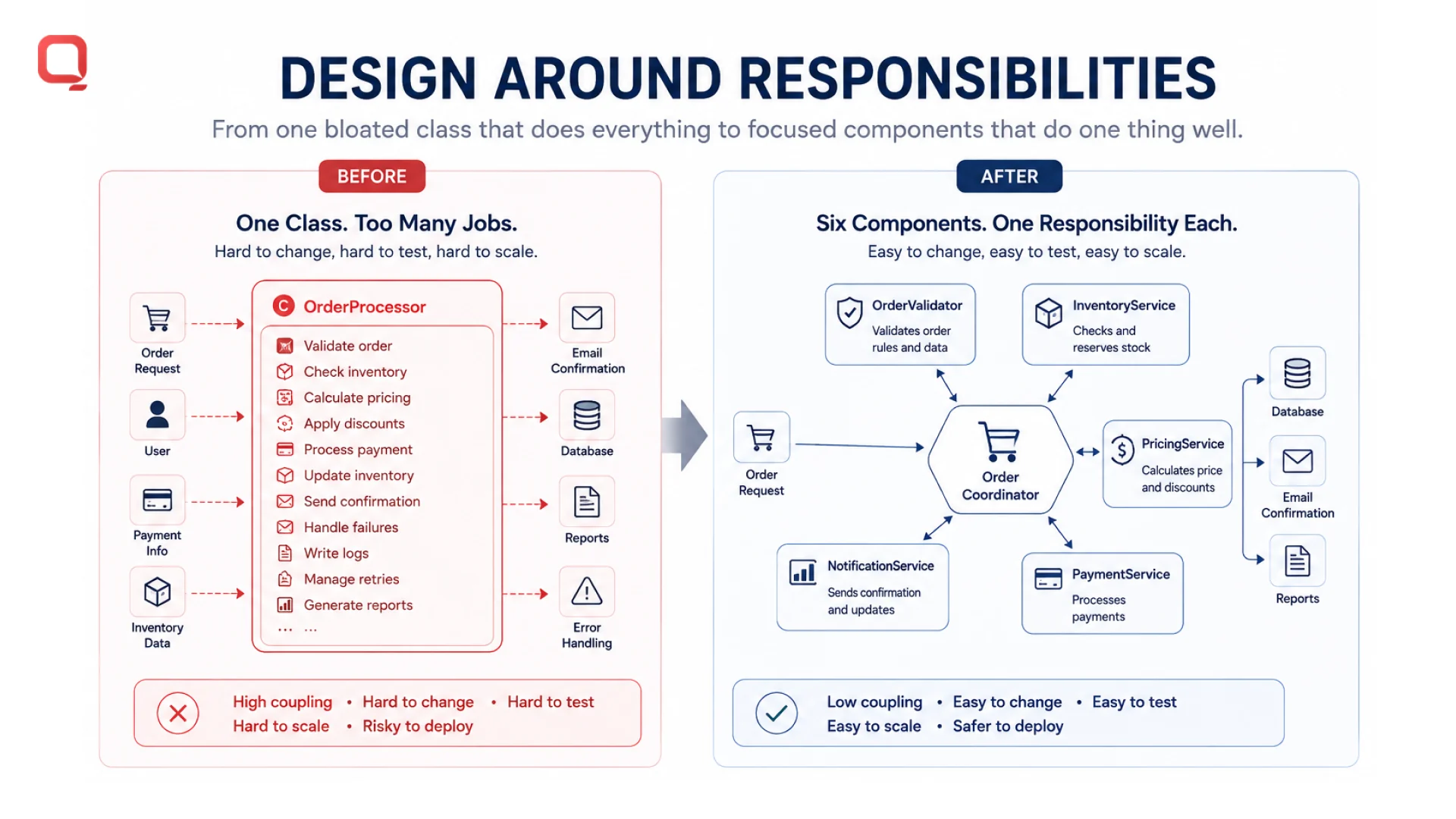
The goal is to establish logical boundaries that make the system easier to understand and maintain.
Cohesion and coupling
Two concepts are particularly useful when evaluating component boundaries: cohesion and coupling.
Cohesion
Cohesion describes how closely related the responsibilities within a component are.
A highly cohesive component has a clear purpose.
For example, a component responsible for calculating shipping charges should not also be responsible for sending emails.
Coupling
Coupling describes how strongly components depend on one another.
When components are tightly coupled, a change in one area can unexpectedly affect many other areas.
Our goal is therefore to build components that:
- Have focused responsibilities
- Expose clear contracts
- Minimize unnecessary dependencies
- Hide implementation details
- Can evolve independently where practical
Good LLD is often less about the number of classes and more about the quality of the boundaries between them.
OOP is the foundation
Object-oriented programming provides many of the building blocks used in LLD:
- Classes
- Objects
- Encapsulation
- Abstraction
- Interfaces
- Inheritance
- Polymorphism
- Composition
However, knowing these concepts individually does not automatically produce good design.
The important skill is knowing when and why to use them.
For example, encapsulation helps protect an object's internal state.
Abstraction allows consumers to work with behavior without depending on implementation details.
Polymorphism allows different implementations to satisfy the same contract.
Composition allows behavior to be assembled from independent components.
The engineering decision matters more than the terminology.
Prefer composition when it makes change easier
Inheritance is useful in appropriate situations, but it should not be introduced simply because two objects appear related.
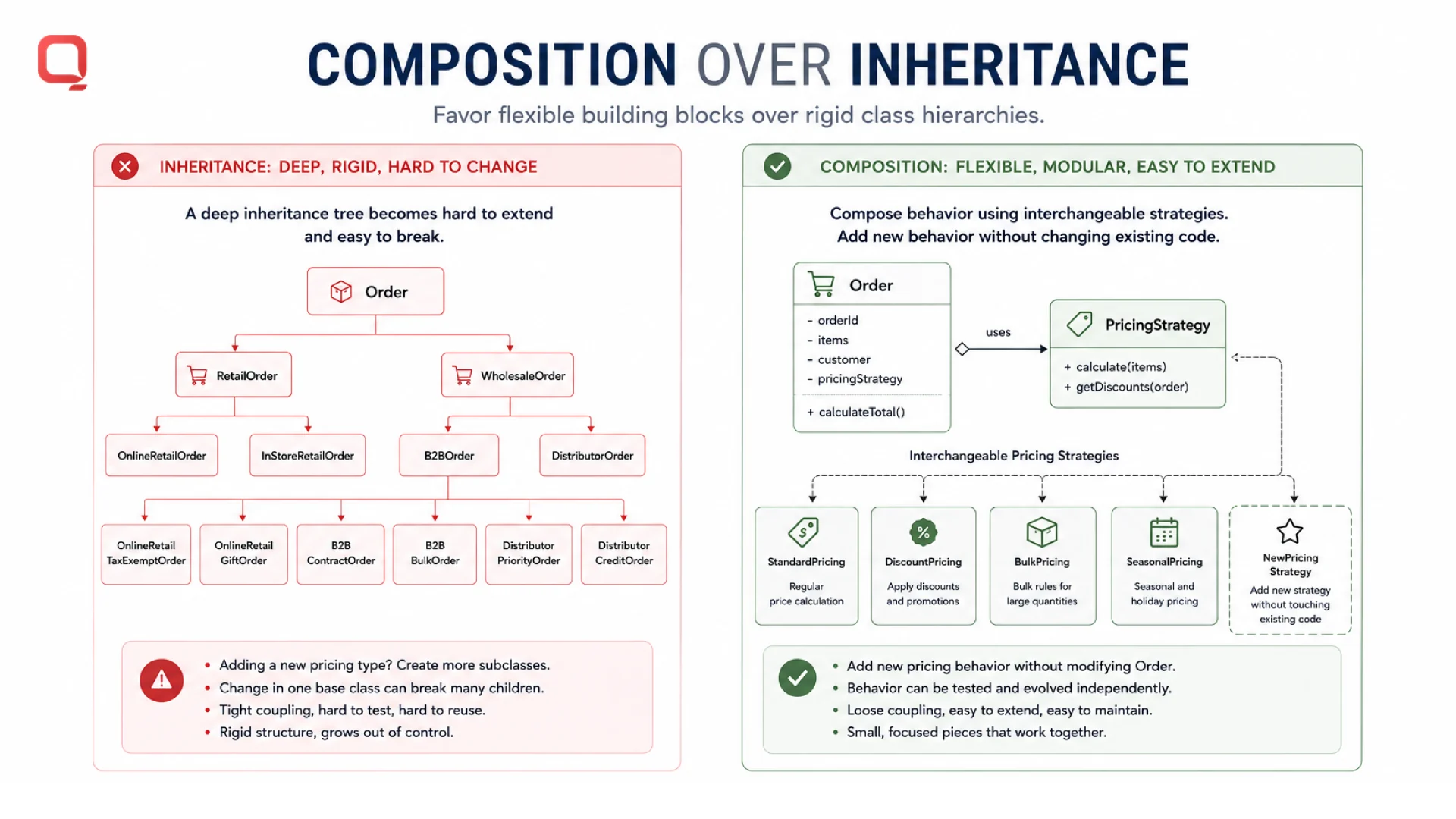
Consider an application with multiple pricing strategies.
Instead of creating a large inheritance hierarchy, pricing behavior can be represented independently:
Order
   |
   +---- PricingStrategy
            |
            +---- StandardPricing
            +---- PremiumPricing
            +---- PromotionalPricing
The order-processing logic does not need to understand the internal implementation of each pricing strategy.
This makes it easier to introduce or modify pricing behavior without unnecessarily changing unrelated code.
Composition can therefore provide a practical way to build flexible software without creating complex inheritance structures.
SOLID principles as engineering questions
SOLID principles are valuable, but memorizing their definitions is less useful than understanding the problems they help identify.
Single Responsibility Principle
Ask:
"Does this component have a clear reason to change?"
If unrelated business concerns cause the same class to change, its responsibilities may be too broad.
Open/Closed Principle
Ask:
"Can we introduce new behavior without repeatedly changing stable code?"
This becomes particularly useful when business rules are expected to evolve.
Liskov Substitution Principle
Ask:
"Does an implementation genuinely satisfy the behavior expected from its abstraction?"
An inheritance relationship should represent more than a superficial type relationship.
Interface Segregation Principle
Ask:
"Are consumers being forced to depend on functionality they do not need?"
Focused interfaces can reduce unnecessary dependencies.
Dependency Inversion Principle
Ask:
"Is important business logic unnecessarily tied to implementation details?"
Depending on appropriate abstractions can improve flexibility and testability.
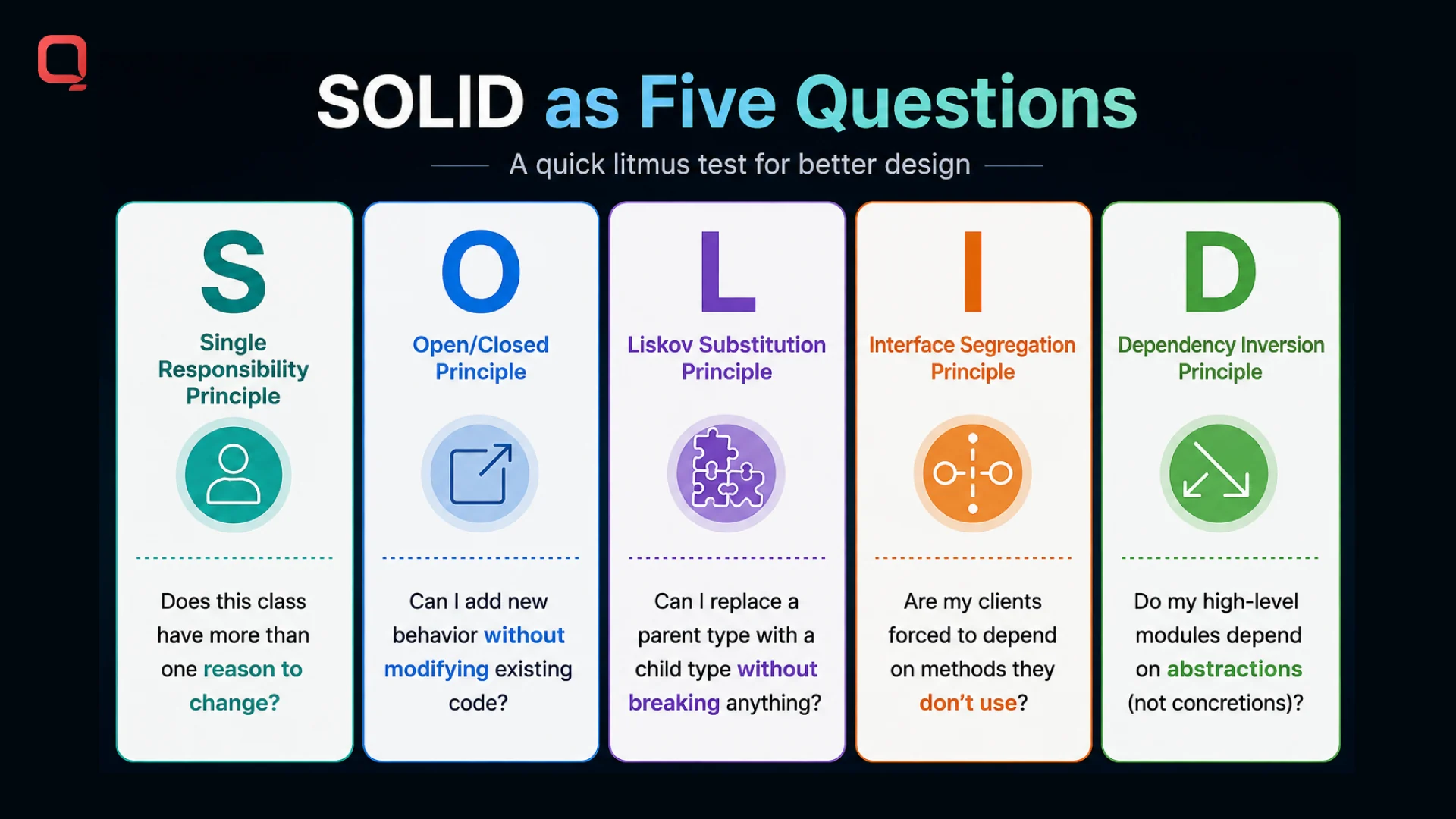
The important point is that SOLID principles should guide engineering decisions rather than become a checklist applied mechanically.
Keep the design simple
Good design does not mean maximum abstraction.
Complexity has a cost.
Every additional abstraction introduces something developers have to understand and maintain.
That is why principles such as KISS, YAGNI, and DRY are useful.
KISS - Keep It Simple
Keep the solution understandable and avoid complexity that does not provide meaningful value.
YAGNI - You Aren't Gonna Need It
Do not implement functionality simply because it might be useful in the future.
DRY - Don't Repeat Yourself
Avoid duplicated business knowledge where duplication would create maintenance problems.
These principles must also be balanced.
Removing every repeated line of code can sometimes create an abstraction that is harder to understand than the original implementation.
The objective is not minimum code.
The objective is appropriate complexity.
Design patterns are tools
Design patterns can provide useful solutions to recurring design problems.
Common patterns include:
- Strategy
- Factory
- Observer
- State
- Decorator
- Command
- Facade
- Chain of Responsibility
- Template Method
- Composite
But there is one principle worth remembering:
"Do not begin with the pattern. Begin with the problem."
If multiple interchangeable algorithms exist, Strategy may be useful.
If behavior changes according to an object's state, State may be appropriate.
If a complex subsystem needs a simpler entry point, Facade may help.
The pattern should make the design easier to understand or evolve.
If introducing a pattern makes a simple solution harder to follow, it may not be the right choice.
Interfaces should represent real contracts
Interfaces are valuable because they define what a component promises to do without exposing how it does it.
However, creating an interface for every class does not automatically improve a system.
Before introducing one, we can ask:
- Is there a meaningful abstraction?
- Could there be multiple implementations?
- Does the interface reduce coupling?
- Does it improve testability?
- Does it represent a stable contract?
A useful abstraction makes change easier.
An unnecessary abstraction creates another layer that developers have to understand.
Design for change
One of the best ways to evaluate a design is to imagine a realistic requirement change.
Suppose a system initially supports email notifications.
Later, the business requires:
- SMS
- Push notifications
If notification logic is tightly coupled to the order-processing flow, adding another channel may require modifying several parts of the system.
If notification behavior has been appropriately abstracted, adding a new implementation can be much more localized.
This leads to an important design question:
"If this requirement changes tomorrow, how much of the system will I need to modify?"
Good design does not attempt to predict every future requirement.
Instead, it identifies realistic areas of change and creates sensible boundaries around them.
Testability is part of design
Testing should influence the way components are designed.
A class with too many responsibilities and dependencies is usually difficult to test.
For example, if pricing logic directly communicates with databases, payment systems, and external services, testing a simple pricing rule becomes unnecessarily complicated.
Separating business logic from infrastructure concerns can make testing significantly easier.
We should be able to ask:
"Can this important behavior be tested independently?"
If the answer is no, it may indicate that the component boundary needs to be reconsidered.
Testability is therefore not something that should be considered only after implementation. It is part of good design.
Concurrency requires deliberate design
When multiple operations can access shared state at the same time, the design must account for concurrency.
Consider inventory.
If only one item remains and two requests attempt to purchase it simultaneously, the application must prevent both operations from incorrectly succeeding.
This introduces questions such as:
- What state is shared?
- Who can modify that state?
- Can operations execute concurrently?
- Where should synchronization happen?
- What consistency guarantees are required?
- Could locking create contention?
- Could incorrect synchronization cause deadlocks?
Concurrency should therefore be considered whenever shared mutable state exists.
The correct solution depends on the requirements and execution environment.
UML as a communication tool
Design diagrams are useful because they allow engineers to communicate ideas before implementation.
We do not need complex UML documentation for every feature.
A simple class diagram can communicate:
- Important classes
- Responsibilities
- Relationships
- Dependencies
- Interfaces
A sequence diagram can help explain how components interact during a particular workflow.
The purpose is not to produce perfect diagrams.
The purpose is to make the design easier for engineers, architects, QA teams, and stakeholders to understand and discuss.
From design to implementation
A practical design process can look like this:
Requirement
     ↓
Clarify Scope
     ↓
Identify Core Responsibilities
     ↓
Define Component Boundaries
     ↓
Identify Relationships
     ↓
Choose Appropriate Abstractions
     ↓
Consider Edge Cases
     ↓
Consider Security & Concurrency
     ↓
Implement
     ↓
Test
     ↓
Review
     ↓
Refine
This process is iterative.
The first design does not always need to be perfect.
Implementation can expose assumptions that were not visible during initial analysis.
Engineering is therefore a continuous feedback loop between requirements, design, implementation, testing, and review.
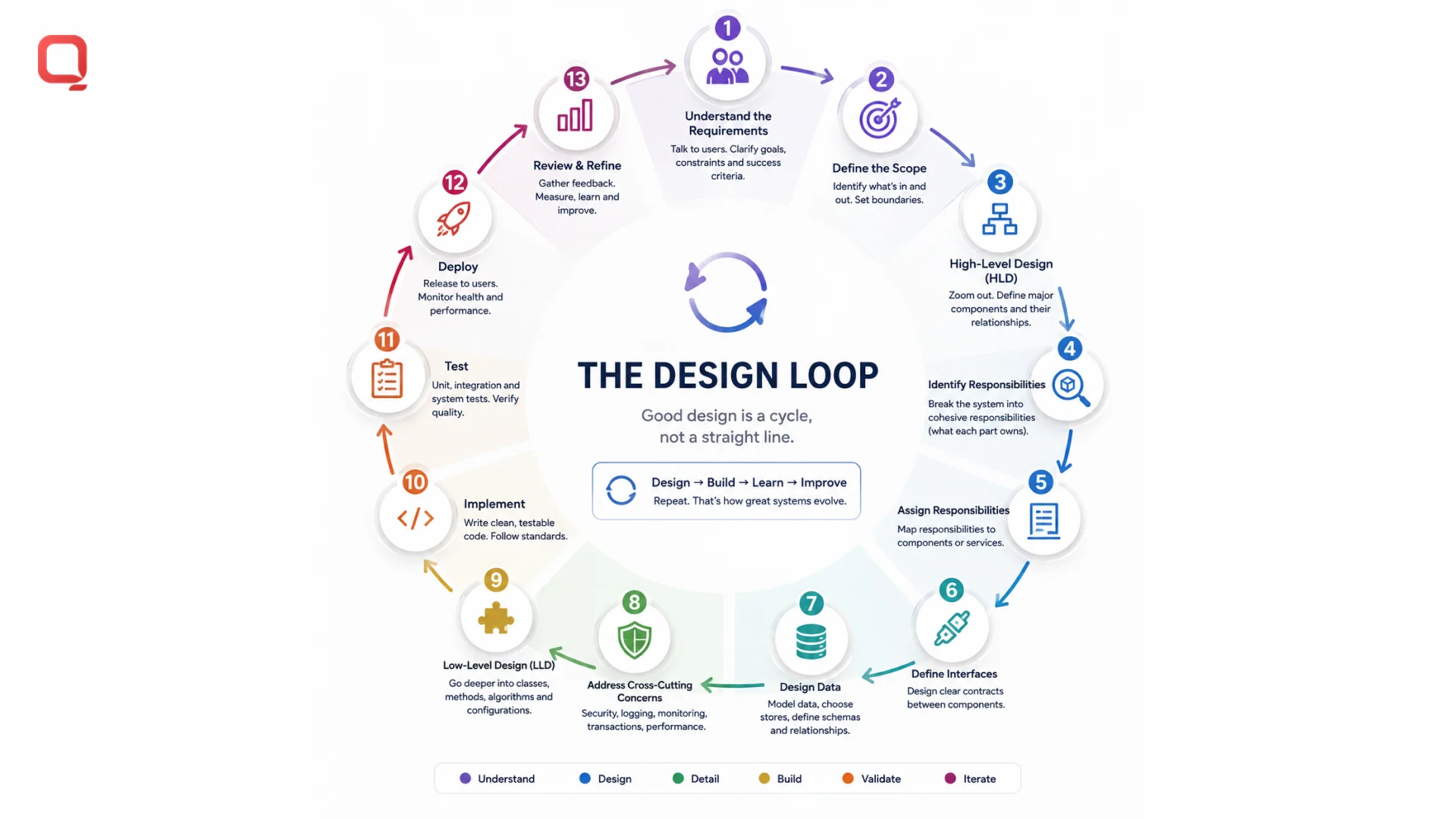
An iterative approach also helps teams adapt as requirements and technical understanding evolve.
Reviewing a design that is becoming hard to change?
Our engineering teams run design reviews on live codebases, mapping responsibilities, dependencies and change points before the next release is planned.
Book a 30-Minute Design Review →Security should influence design
Security should not be treated as a final checklist item.
Design decisions can directly influence security.
When designing components, we should consider:
- Who is allowed to perform an operation?
- What data does each component need access to?
- Where should authorization happen?
- How should sensitive information be handled?
- What should be logged?
- Which dependencies are trusted?
- What happens when an operation fails?
Security requirements should influence component boundaries and interactions from the beginning.
A secure design is generally easier to maintain when security considerations are incorporated into the development process rather than added after implementation.
Practice design, don't memorize it
LLD becomes easier through repeated problem solving.
Useful practice scenarios include:
- Parking management
- Vending machines
- Elevator systems
- Cache implementations
- Order management
- Inventory systems
- Notification systems
- Booking systems
- Logging frameworks
- Board games
However, memorizing a solution is not the objective.
For every problem, ask:
1. What are the requirements?
2. What is in scope?
3. What are the core entities?
4. What responsibility belongs to each entity?
5. What behavior is likely to change?
6. What abstractions are actually useful?
7. What are the important edge cases?
8. How will concurrent operations behave?
9. How will the design be tested?
10. What happens if the requirements change?
These questions develop engineering judgment.
LLD beyond interviews
Low-Level Design is often associated with technical interviews.
But its value in real software development is much broader.
Developers make LLD decisions every day:
- Where should business logic live?
- Should this behavior belong to an existing component?
- Should a new abstraction be introduced?
- How should dependencies be managed?
- How can a new feature be added safely?
- How should the code be tested?
- How should security requirements be enforced?
- What happens when the system grows?
These are real-world design questions.
Production systems also introduce additional constraints:
- Existing legacy code
- Customer requirements
- Performance expectations
- Security requirements
- Deployment constraints
- Operational support
- Technical debt
- Changing business priorities
Therefore, strong LLD skills are useful far beyond interview preparation.
The QSS Technosoft engineering perspective
At QSS Technosoft, our engineering philosophy is centered around delivering technology solutions that create meaningful value for customers.
This perspective provides a useful lens through which to view software design.
Customer First
Technical decisions ultimately need to support customer outcomes.
A technically elegant design that does not solve the actual business problem is not a successful design.
Integrity
Engineering decisions should be transparent and responsible.
We should understand the consequences of technical choices rather than hiding complexity behind terminology or unnecessary abstractions.
Accountability
Good design includes ownership.
We should be able to explain why a particular architectural or implementation decision was made and take responsibility for maintaining it.
Innovation
Innovation is valuable when it creates meaningful improvement.
New technologies, architectures, and patterns should be adopted because they solve real problems and improve outcomes, not simply because they are new.
Quality
Quality should be considered throughout the development lifecycle.
Good design, clean implementation, testing, security, and continuous review all contribute to building dependable software.
What good LLD means to us
From an engineering perspective, good Low-Level Design means:
Clear Responsibilities
Every component should have a meaningful purpose.
Appropriate Abstraction
Use abstractions where they provide real value.
Controlled Dependencies
Avoid unnecessary coupling between components.
Simplicity
Do not introduce complexity without a reason.
Testability
Important business behavior should be straightforward to validate.
Security
Security requirements should influence design from the beginning.
Scalability
Components should be designed with realistic growth requirements in mind.
Maintainability
Future developers should be able to understand and safely modify the code.
Customer Alignment
Engineering decisions should ultimately contribute to the intended business outcome.
Continuous Improvement
Design should evolve as we learn more about the problem and the system.
Conclusion
Low-Level Design is not about producing the largest class diagram or demonstrating knowledge of the greatest number of design patterns.
It is about thinking clearly about software structure.
A good design helps us establish responsibilities, manage dependencies, isolate change, improve testability, consider security and concurrency, and keep the system understandable as it grows.
For us, Low-Level Design is part of a broader engineering mindset focused on customer value, quality, accountability, innovation, and long-term maintainability.
The most important lesson is simple:
"Good software design is not about predicting every future requirement. It is about building today's solution in a way that makes tomorrow's change manageable."
That is the mindset we should carry into every feature, every code review, and every system we build.
Building software that has to last?
QSS Technosoft builds reliable, secure and maintainable software for healthcare, finance, retail and enterprise clients, with design discipline applied from the first sprint rather than retrofitted later.
Talk to Our Engineering Team →