HIPAA-Compliant Mobile App Development Guide
 By Rashmi Kanti
QSS Technosoft
October 21, 2026
14 min read
HIPAA compliant mobile app development means designing, building, and operating an app around its workflows, data, and healthcare relationships. Start by defining the app’s purpose, mapping where sensitive information moves, and assigning responsibility across the app, cloud services, vendors, and healthcare organization. Security and privacy should shape the design from the beginning.
If you’re responsible for a healthcare app, you may have questions about integrations, data access, and what happens after launch. A well-designed app must fit real clinical or operational workflows and account for connected systems and service providers. No single technical control makes an app compliant, and development alone can’t guarantee compliance.
This guide outlines a practical path from scoping and data mapping to architecture, testing, launch, and maintenance. It explains how to compare custom development with configuring an existing platform, plan integrations such as EHR and FHIR connections, and make responsibilities explicit before they become production problems.
Quick Answer
HIPAA-compliant mobile app development starts with scope: who operates the app, what PHI or ePHI it handles, and which covered entity, business associate, cloud service, or vendor is responsible for what. Map every data flow, including offline storage, push notifications, analytics, and crash reporting. Then design authentication, authorization, encryption, audit logging, and error handling around those flows, keeping EHR systems behind controlled APIs using HL7 and FHIR integration tools where they fit. Choose custom healthcare software development, platform configuration, or a hybrid based on workflow fit and long-term ownership, and run delivery through gated phases with retained evidence. A healthcare app development company can build the technical safeguards, but compliance decisions stay with the healthcare organization.
What does HIPAA-compliant mobile app development actually involve?
HIPAA-compliant mobile app development is the work of designing, building, and operating a mobile app with safeguards suited to its purpose, data, and healthcare relationships. It can support an organization’s security and compliance efforts, but no app feature set or development project can guarantee that an organization complies with HIPAA.
Protected health information (PHI) is individually identifiable health information held or transmitted by a covered entity or business associate, subject to exceptions in the Privacy Rule. Electronic protected health information (ePHI) is PHI transmitted or maintained electronically. These definitions appear in the HHS-administered HIPAA Privacy Rule, established in 2000. The HHS HIPAA Privacy Rule guidance provides the official regulatory context for applying them to a product.
App-level controls address how the software handles information, including access permissions, data storage, and audit records. The healthcare organization remains responsible for its broader privacy and security program, including policies, workforce practices, risk management, and decisions about how the app is used. HHS’s HIPAA Security Rule, adopted in 2003, addresses safeguards for electronic PHI. Responsibilities can also involve vendors that handle data. The app is one part of the system, not the whole compliance posture.
When does a mobile health app fall within HIPAA scope?
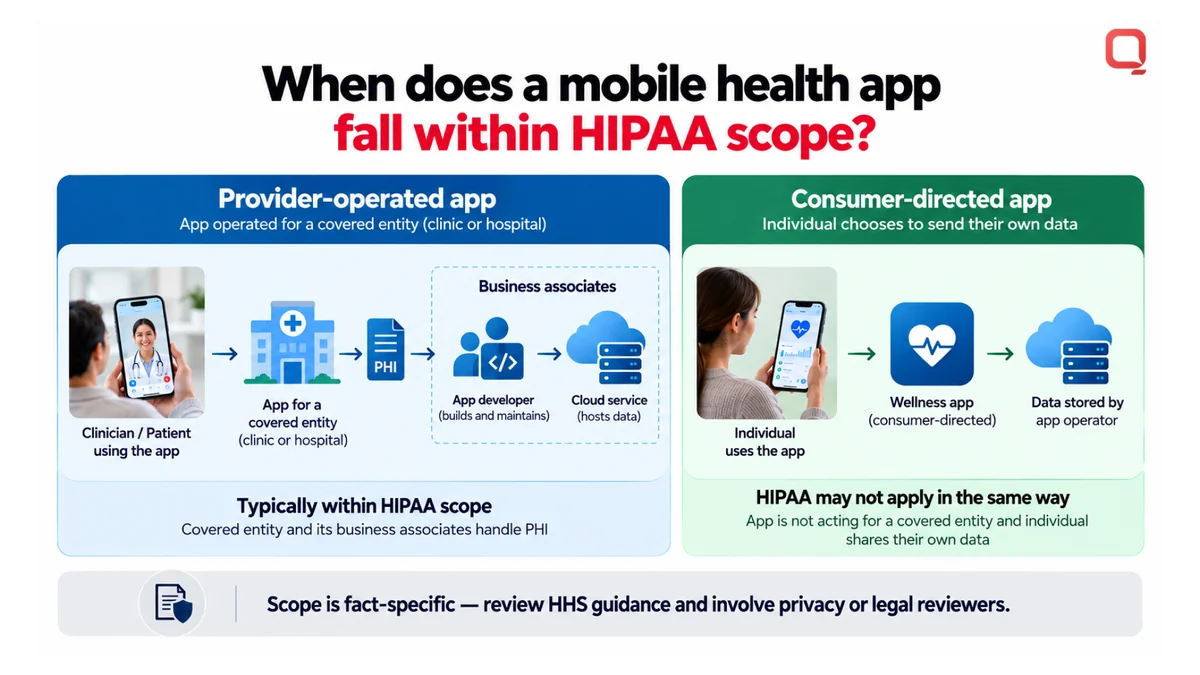
HIPAA scope depends on who operates the app, what information it handles, and whether it performs work for a regulated organization. An app used by a healthcare provider may involve PHI when it collects or displays identifiable patient information as part of care. If a developer or cloud service handles that information on the provider’s behalf, its role and business relationship matter too.
A consumer-directed app presents a different context. If an individual chooses to send information to an app that is not acting for a covered entity or business associate, HIPAA may not apply to the app in the same way. That distinction is fact-specific, so don’t assume all health apps are outside HIPAA. Review current HHS HIPAA guidance for scope questions, and involve appropriate privacy or legal reviewers when the app’s role is unclear.
What does HIPAA-conscious engineering mean in practice?
HIPAA-conscious engineering means translating an organization’s requirements into design choices, implementing and testing those controls, retaining evidence, and maintaining them as the app changes. A checklist can help teams track work, but it cannot establish compliance by itself. Controls must fit actual data flows and the operating environment, including connected services and user workflows.
For product and engineering leaders, that means treating compliance as an ongoing process rather than a launch milestone. Development support can help build and document technical safeguards, but it doesn’t replace the organization’s risk analysis, operational decisions, or legal review. Define ownership early, document assumptions, and revisit them when integrations, data use, or vendors change.
How should teams design a mobile app architecture for protected health data?
Design the architecture around the full path health data takes, from the mobile device to services, storage, and connected clinical systems. For HIPAA-compliant mobile app development, define each boundary and its owner before selecting controls. NIST’s 2019 publication, Guidelines for Managing the Security of Mobile Devices in the Enterprise, provides technical guidance relevant to mobile-device risks. Apply it to the app’s actual workflows and environment.
Reference flow: Mobile client → identity layer → API → application services → protected storage → healthcare integrations.
An API, or application programming interface, is a defined way for software systems to exchange requests and data. Keep clinical and administrative systems behind controlled API boundaries rather than connecting them directly to the mobile interface. This gives the team a place to validate requests, enforce access decisions, limit returned data, and record relevant activity. NIST’s guidance supports managing mobile devices as part of the organization’s security environment, not as isolated endpoints.
Turn security requirements into explicit design decisions:
- Authentication: Decide how the app establishes a user’s identity and handles session expiry, recovery, and device changes.
- Authorization: Restrict each request to the data and actions permitted for that user and workflow.
- Encryption: Protect data in transit and assess where data may be stored on the device or in backend systems.
- Audit logging: Record useful access and change events while limiting sensitive information in logs.
- Error handling: Return messages that help users recover without exposing health details, credentials, or internal system information.
Mobile features can create less obvious data paths. Include offline storage, push notifications, analytics, crash reporting, and third-party software development kits in the threat review. For example, a notification that displays a patient name or appointment detail on a lock screen may expose information outside the app’s intended screen. Review what each component collects, where it sends data, and whether the feature can work with less sensitive information. The IEEE conference resource titled IEEE Framework for HIPAA-Aware mHealth App Development is another reference for considering security during development; its linked page does not state a publication year.
How should teams map mobile app data flows?
Create a data-flow diagram that names each data category, its source, destination, purpose, and access role. Trace information through capture, transit, processing, storage, display, and deletion. Include device caches, logs, notifications, and vendor services, not just the main app screens. Record assumptions beside the diagram so security and privacy reviewers can see what the design depends on.
How do integrations affect mobile app security?
HL7 and FHIR are healthcare data exchange standards that can support integrations when they fit the systems and workflow. They don’t make two systems interoperable by themselves. Define how records are matched, which fields the app needs, how failed or delayed requests behave, and what events are logged at each boundary. Minimize the data exchanged, then test mismatched identities and incomplete responses.
Should you build a custom HIPAA-conscious app or configure an existing platform?
Choose custom development when the product depends on workflows, integrations, or controls that an existing platform cannot support well. Configure a platform when its standard workflows and supported integrations meet the need. A hybrid approach can bridge the two. None removes the need to evaluate privacy, security, vendor roles, and operational ownership for your organization.
Use this comparison to frame the decision. The right fit depends on what the app must do and who will maintain it after launch.
| Approach | Workflow fit and integrations | Control and maintenance | Change requirements |
|---|---|---|---|
| Custom development | Can be shaped around differentiated workflows and specific integration needs. | Offers direct control over the application design, while the organization and engineering team must plan ongoing maintenance. | Product changes can be built into the application, with corresponding engineering and testing work. |
| Platform configuration | Fits workflows that align with the platform’s available features and supported integrations. | Responsibility is shared across the organization and platform vendor, according to their roles and agreements. | Changes depend on configuration options, platform limits, and vendor release processes. |
| Hybrid approach | Combines configured platform capabilities with custom components for specific workflow or integration gaps. | Requires clear ownership across the platform, custom components, and their connections. | Changes may involve both platform configuration and application engineering. |
Evaluate each option against the same requirements. Document the user workflows, data exchanged, connected systems, and who operates each component. Then assess how the vendor handles information, where integration boundaries sit, and what happens when the product or vendor changes. A platform description alone won’t answer those questions.
When is custom healthcare app development a better fit?
Custom healthcare app development can make sense when a product has a distinct care or administrative workflow that standard configuration cannot represent, or when it needs specific connections to EHR or EMR systems. For example, a patient-facing app may require a tailored sequence for collecting information and routing it into an organization’s existing workflow. More control also means ongoing responsibility for engineering, testing, and operational changes.
When can platform configuration reduce unnecessary complexity?
Configuration may be a practical fit when the required workflow is standard and the platform’s supported integrations cover the use case. Assess the platform’s data handling, available controls, integration limits, and division of responsibilities. If a workflow exceeds those limits, a hybrid design may add a custom component. Reassess the fit as requirements evolve.
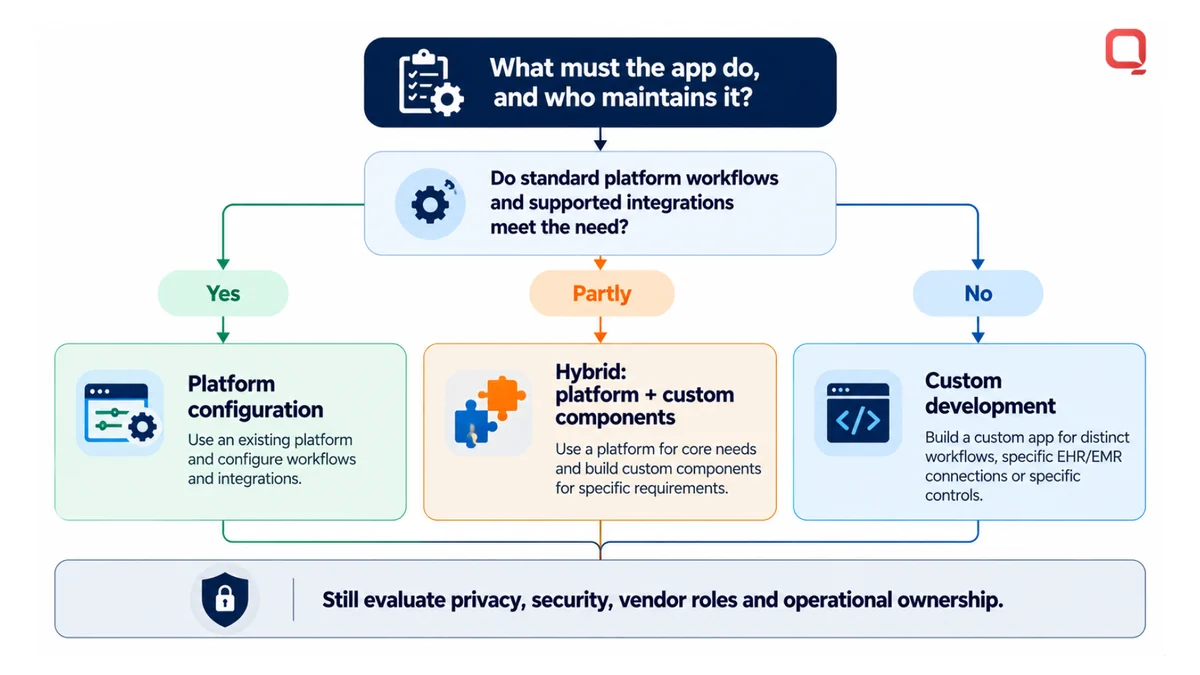
For HIPAA-compliant mobile app development, the decision is not simply build versus buy. It is a choice about workflow fit, technical control, and long-term ownership. Keep the organization’s privacy and security evaluation tied to the implementation, including vendor relationships and custom components. That clarity helps teams avoid unnecessary engineering and platform constraints that surface too late.
What steps should a team follow to deliver and maintain the app?
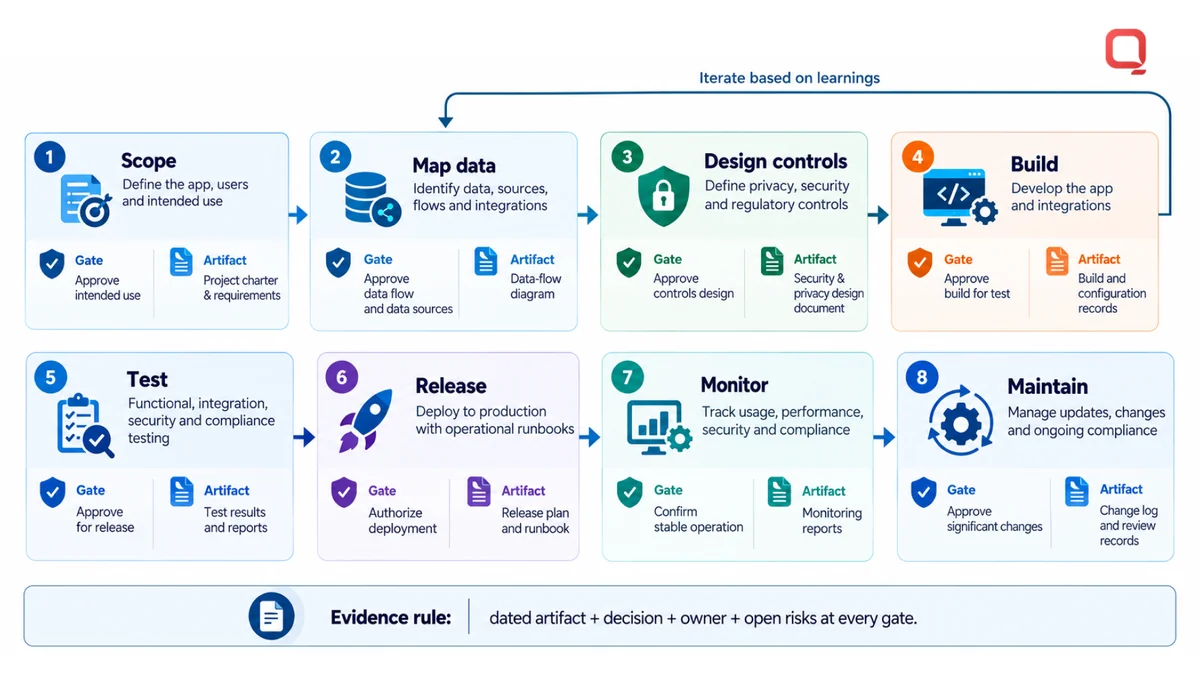
Delivering a mobile health app takes more than building features and passing a final test. A practical HIPAA-compliant mobile app development process moves through defined phases, each with a decision gate, an owner, and a record of what was reviewed. This structure helps teams catch gaps before release and manage changes after launch.
Evidence rule: At each gate, retain a dated artifact, the decision made, the accountable owner, and any unresolved risks or follow-up actions.
What should happen before development begins?
Start by defining who will use the app, which workflows it supports, and what information and systems those workflows touch. Assign accountable stakeholders across product, engineering, security, privacy, clinical operations, and integration teams. Record vendor dependencies and assumptions that need review. Agree on acceptance criteria for security, usability, accessibility, interoperability, and operational support before implementation begins.
- Scope: Confirm users, workflows, boundaries, and stakeholders. Gate: Approve the intended use. Artifact: Product scope and responsibility matrix.
- Map data: Identify data categories, purposes, destinations, and access roles. Gate: Review the documented flows. Artifact: Data-flow diagram with assumptions and dependencies.
- Design controls: Translate requirements into technical and operational decisions. Gate: Resolve or assign design risks. Artifact: Security and privacy design record.
- Build: Implement the approved workflows and controls. Gate: Review changes against requirements. Artifact: Build record linked to requirements and code changes.
- Test: Validate security, usability, accessibility, and integrations, including failed or incomplete responses. Gate: Triage defects and document accepted risks. Artifact: Test results and defect record.
- Release: Confirm approval, support ownership, and readiness for known operational scenarios. Gate: Authorize deployment. Artifact: Release approval and rollback plan.
- Monitor: Review operational signals and route issues to named owners. Gate: Confirm escalation paths work. Artifact: Monitoring and incident records.
- Maintain: Review changes to software, vendors, integrations, and data use. Gate: Approve updates before deployment. Artifact: Change log and updated risk decisions.
How should teams validate and operate the app after release?
Testing doesn’t end at launch. Plan security and integration testing, review user access, and establish who approves releases and handles incidents. Assign owners for monitoring, escalation, patching, and change management. Reassess third-party services and data flows when a vendor, integration, or feature changes. A technically sound app can still fail users if support ownership is unclear or an integration error has no defined response.
QSS Technosoft’s healthcare engineering work supports teams planning delivery gates and ongoing responsibilities. Discuss your mobile app delivery plan.
How can QSS Technosoft support HIPAA-compliant mobile app development?
QSS Technosoft is a U.S.-based software engineering company serving U.S. healthcare providers and health-tech organizations. Its HIPAA-Compliant Software Development Services can be combined with Healthcare Interoperability and EHR / EMR integration to support project-specific needs. Engineering supports the technical work, while organizational compliance decisions remain with the responsible healthcare organization.
What healthcare engineering capabilities can support the project?
A healthcare mobile app often depends on systems beyond the phone. QSS can bring together Healthcare Mobile App Development Services, HL7 and FHIR interoperability, and EHR / EMR integration when the product requires those capabilities. Architecture, quality assurance, and Cloud & DevOps work can be planned around the app’s workflows, dependencies, and operational needs.
The practical value is coordination across system boundaries. A mobile workflow may need to exchange information with an existing EHR / EMR, preserve the intended meaning of that information, and handle integration errors without leaving users guessing. The right design depends on the systems and requirements, so define integration scope and assumptions early.
QSS lists CMMI Level 3 and ISO 27001:2013 among its company credentials. These are organizational credentials, not a government endorsement or a guarantee that a particular app or healthcare organization complies with HIPAA. A project still needs technical review, operational ownership, and appropriate organizational assessment.
What should a buyer bring to an initial project discussion?
Bring enough context to make the first conversation concrete. A complete specification isn’t necessary, but clear constraints help the team separate core requirements from assumptions and identify who needs to make decisions.
- Users and workflows: Identify who will use the app and what they need to accomplish.
- Data use: Describe the information involved, its intended purpose, and where it needs to move.
- Existing systems: List relevant EHR / EMR platforms, interfaces, and known integration dependencies.
- Product scope: Share required capabilities, planned phases, and important usability or accessibility needs.
- Operational ownership: Identify who will oversee releases, support, security decisions, and vendor relationships.
Include product, engineering, clinical operations, and security stakeholders where possible. Early alignment helps surface competing needs, such as a clinical workflow that depends on an integration the product team has not yet scoped. Clarify responsibilities at this stage, before implementation decisions become difficult to change.
QSS Technosoft’s healthcare engineering capabilities support projects shaped around app scope and integration needs. Discuss your mobile health app project.
Turn your app requirements into a workable project plan
Make open decisions visible. Identify which workflow needs the most clarification, which integration carries the greatest uncertainty, and who can approve changes to the product’s security and operating model. A shared project brief can give product, engineering, clinical operations, and security teams a common starting point.
The brief doesn’t need to answer every technical question. It should distinguish confirmed requirements from assumptions, name the decisions that need owners, and show how the team will revisit them as the app evolves. This keeps HIPAA-compliant mobile app development connected to care delivery and software operations, not just a launch deadline.
QSS Technosoft works with U.S. healthcare and health-tech organizations on engineering projects shaped around their product and integration needs. A project discussion can help clarify scope, dependencies, and next decisions without treating development as a substitute for your organization’s compliance responsibilities.
Discuss your healthcare mobile app project with QSS Technosoft. A clear starting point makes the next step easier to take.
Map Your App’s PHI Before You Build
Bring your users and workflows, the PHI your app will touch, and the EHR / EMR systems it must connect to. As a healthcare app development company and EHR software development company, our engineers provide healthcare mobile app development services and custom healthcare software development, from HL7 and FHIR integration tools for healthcare to secure APIs, cloud computing in healthcare, and the testing and delivery evidence your compliance team will review.
Discuss your healthcare mobile app project →