
Key Takeaways
- The software development outsourcing market reaches $618B in 2026, growing 9.6% annually through 2031 — partner selection now compounds across multi-year roadmaps.
- 44% of outsourcing contracts now include AI and automation components; AI-augmented delivery is no longer optional.
- 70% of software projects exceed initial cost estimates — vendor maturity (CMMI, ISO) directly correlates with cost predictability.
-
The right partner evaluation has five dimensions:
- Certifications
- Delivery maturity
- Domain depth
- AI capability
- Commercial alignment
- Mid-sized specialist firms ($1B–$5B revenue) are growing 3x faster than the Big Four — agility now outperforms scale.
Who This Guide Is For
Mid-market CTOs, VPs of Engineering, and procurement leaders at companies with $50M–$5B revenue who are currently evaluating 2–5 vendors for:
- A custom software build
- AI modernization initiatives
- Healthcare IT integration
- Platform engineering engagements
…and want a defensible, repeatable framework to make the right decision.
Introduction
Choosing a custom software development partner used to be a procurement decision.
In 2026, it is a strategic one.
The global software development outsourcing market is now $618 billion and projected to reach $977 billion by 2031, growing at 9.6% annually.
The US alone entered 2025 with 1.4 million unfilled technology roles — meaning most CTOs are no longer outsourcing to save money. They are outsourcing because they cannot hire fast enough to execute their roadmap.
That changes the evaluation criteria.
The right partner is no longer:
- The cheapest bid
- The largest brand
It is the vendor whose:
- Delivery model
- Certifications
- AI maturity
- Domain expertise
…match your business and technology outcomes.
This article gives technology leaders a structured framework for evaluating custom software development partners — what to ask, what to verify, and what to walk away from.
Why We Wrote This
At QSS Technosoft, we sit on both sides of this conversation.
We've:
- Been the partner CTOs shortlisted
- Been the one they didn't pick
- Inherited codebases from failed vendors
We hold:
- CMMI Level 3 certification (since 2021)
- ISO 27001:2013 certification
- Official AWS Partner status
…and operate with 250+ engineers across:
- Healthcare
- BFSI
- AI engineering practices
The framework below is the one we wish more buyers used — because buyers who use it choose better partners, and partners who pass it deliver better outcomes.
Why Vendor Selection Matters More in 2026
Three major forces have raised the stakes of partner selection.
1. AI Has Changed Delivery Economics
Studies from McKinsey show 20–45% productivity gains in software engineering when GenAI is embedded into delivery processes.
A partner using AI-augmented delivery competently can:
- Deliver in 9 months what others deliver in 12
- Maintain the same cost structure
- Increase feature velocity
The reverse is also true.
A vendor claiming AI capability without:
- Methodology
- Guardrails
- Review processes
…will generate technical debt your team eventually inherits.
2. Talent Scarcity Makes Vendor Stability a Strategic Risk
There are now 4.8 million unfilled cybersecurity roles globally.
AI/ML expertise remains critically scarce.
This creates a common risk:
- The vendor promises senior architects during sales
- Mid-level engineers quietly replace them after kickoff
Resource integrity is now an evaluation criterion — not an afterthought.
3. 70% of Software Projects Exceed Initial Cost Estimates
This remains one of the most consistent findings across procurement research.
The variance is not random.
Cost overruns strongly correlate with:
- Vendor process maturity
- Requirements rigor
- Senior engineering involvement during scoping
4. Outcomes-Based Contracting Is Replacing T&M
Boards increasingly expect CIOs and CTOs to tie vendor compensation to measurable outcomes such as:
- Feature velocity
- Defect density
- Uptime SLA
- Time-to-production
Traditional time-and-materials models are being challenged at the executive level.
Your evaluation process must identify which vendors can actually price outcomes — because most still cannot.
What Is Custom Software Development?
Custom software development is the:
- Design
- Build
- Deployment
…of bespoke applications tailored to a specific business’s:
- Workflows
- Integrations
- Compliance requirements
- Business outcomes
This differs from configuring off-the-shelf software.
Typical services include:
- Discovery
- Architecture
- UI/UX design
- Full-stack engineering
- QA
- DevOps
- Deployment
- Post-launch support
Companies choose custom development when packaged software cannot satisfy:
- Integration complexity
- Compliance needs
- AI requirements
- Competitive differentiation
The Five-Dimension Vendor Evaluation Framework
Use this framework for:
- RFP evaluations
- Vendor demos
- Final shortlist decisions
Dimension 1: Certifications & Process Maturity
What to Verify
-
ISO 27001:2013
- Information security management
- Essential for customer data, PHI, or PCI projects
-
CMMI Level 3 or higher
- Demonstrates defined, repeatable engineering processes
-
SOC 2 Type II
- Important for SaaS or enterprise data handling
-
Cloud Partner Status
- AWS Partner
- Microsoft Solutions Partner
- Google Cloud Partner
-
Domain Certifications
- HIPAA
- HITRUST
- PCI-DSS
- GDPR DPO certifications
Why It Matters
Certifications are the cheapest filter you have.
Most Tier-3 outsourcing firms cannot pass these gates.
A certified vendor has already self-selected into a more mature operational class.
Dimension 2: Delivery Model & Engagement Maturity
What to Ask
-
What engagement models do you offer?
- Dedicated team
- T&M
- Fixed-price
- Staff augmentation
- Build-Operate-Transfer
- What is your developer-to-manager ratio?
-
Will senior engineers participate in:
- Scoping
- Architecture
- Technical planning
…or only in the sales process?
- What is your average resource swap rate during a 12-month engagement?
-
How do you handle:
- Scope changes
- Change requests
- Timeline adjustments
-
Show your:
- CI/CD pipeline
- Code review process
- Definition of done
The Hidden Question
Will the people in the sales meeting actually be on the project?
Insist on named senior resources and CVs before signing.
Dimension 3: Domain & Industry Depth
A generalist vendor may spend six months learning your regulatory environment.
A specialist already understands it.
What to Verify
- Three recent case studies in your industry within the last 24 months
-
Familiarity with standards such as:
- HL7/FHIR (healthcare)
- PCI-DSS (payments)
- GxP (life sciences)
- ISO 13485 (medical devices)
- Reference calls with two domain-specific clients
Why It Matters
Industry depth compounds.
A vendor that has completed:
- 10 EHR integrations
- Multiple fintech compliance projects
- Several regulated cloud migrations
…will avoid mistakes a generalist learns at your expense.
Evaluating Partners Now?
Use this framework on QSS.
We’ll:
- Walk through your scoping requirements
- Introduce the actual engineers and architects assigned to your engagement
- Share our CMMI process documentation before contract signature
Schedule a 30-Minute Fit Conversation →
Dimension 4: AI Capability & Delivery Methodology
This is the most under-evaluated dimension today.
What to Ask
-
Which AI tools do your engineers use?
- GitHub Copilot
- Cursor
- Claude Code
- Internal LLMs
-
What guardrails exist for AI-generated code?
- Human review
- Security scanning
- License compliance checks
- Can you show measurable productivity gains from AI-assisted delivery?
-
How do you protect:
- IP
- Confidentiality
- Client code
…when using third-party LLMs?
-
What is your approach to:
- Agentic AI
- Autonomous QA
- CI/CD agents
- AI code-review bots
The Key Insight
A vendor saying “we use AI” without methodology is doing marketing.
A vendor showing:
- Tooling
- Processes
- Governance
- Measurable outcomes
…is operating at the maturity level enterprise buyers should expect in 2026.
Dimension 5: Commercial Alignment & Pricing Transparency
What to Evaluate
-
Is pricing aligned with project uncertainty?
- Fixed-price → well-scoped projects
- T&M → evolving requirements
- Dedicated teams → long-term platform engineering
- Does the vendor provide transparent role-based pricing?
- What contingency assumptions exist in fixed-price estimates?
- How are payment milestones tied to deliverables?
-
Who absorbs the cost if:
- Scope expands
- Timelines slip
- Rework increases
Important Reality
The cheapest bid is rarely the cheapest project.
A vendor charging:
- 20% less
- But creating 40% more rework
…is significantly more expensive long-term.
Composite Case: When Cheap Becomes Expensive
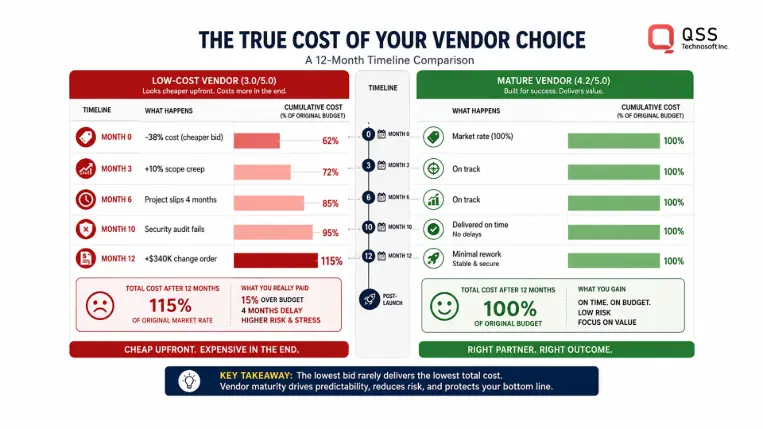
A US mid-market health-tech firm shortlisted three vendors for a HIPAA-compliant patient portal rebuild.
Vendor A submitted a proposal 38% below the median bid.
However:
- No CMMI certification
- No ISO 27001 evidence
- The lead sales engineer disappeared two weeks after signing
By month six:
- The project slipped four months
- A security audit failed
- The client absorbed a $340K change order
The company eventually re-tendered the engagement to a CMMI Level 3 vendor at the original market rate.
Composite illustrative example based on common patterns observed in QSS intake conversations (2022–2025).
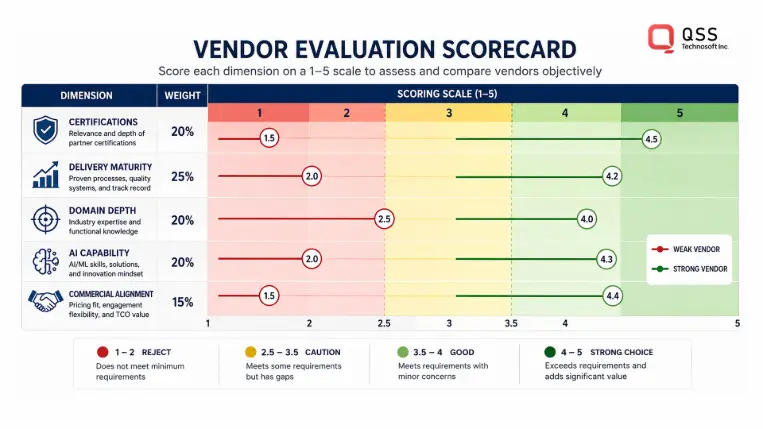
The Vendor Evaluation Scorecard
| Dimension | Weight | What to Score (1–5) |
| Certifications & process maturity | 20% | ISO, CMMI, SOC 2, cloud partner status |
| Delivery model & engagement maturity | 25% | Senior involvement, engagement flexibility, resource stability |
| Domain & industry depth | 20% | Case studies, references, regulatory fluency |
| AI capability & methodology | 20% | AI tooling, guardrails, measurable outcomes |
| Commercial alignment | 15% | Pricing transparency, scope handling, milestone clarity |
Scoring Guidance
- Below 3.5/5.0 → Reject
- Above 4.0/5.0 → Strong, defensible choice
Red Flags to Walk Away From
- Vendor cannot name senior engineers before signing
- “We use AI” with no methodology or tooling documentation
- Case studies older than five years
-
No:
- CMMI
- ISO 27001
- SOC 2
…despite handling enterprise data
- Proposal pricing is 20%+ lower than peers
- No defined change-management process
- Senior leadership absent during kickoff
- Vendor refuses to share CI/CD or code-review workflows
Where Mid-Sized Specialists Outperform Large Firms
The assumption that “bigger is safer” is weakening.
Mid-cap IT services firms grew at 3x the rate of the Big Four in FY25, driven by:
- Faster GenAI adoption
- Leadership stability
- Deal flexibility
- Specialized expertise
For most mid-market buyers, a:
- CMMI Level 3 specialist
- AI-mature delivery partner
- Domain-focused engineering firm
…will outperform a Tier-1 brand reserving its best teams for $50M+ accounts.
Choose the partner that treats your engagement as top-tier work.
Frequently Asked Questions
Q. What is the difference between custom software development and SaaS?
Custom software is built specifically for one company’s:
- Workflows
- Integrations
- Compliance requirements
SaaS products are multi-tenant platforms configured to fit many businesses.
Custom development is chosen when configuration alone cannot satisfy:
- Differentiation
- Integration complexity
- Regulatory requirements
Q. How long does custom software development take?
Typical ranges:
- Simple web applications → 4–6 weeks
- Mid-complexity enterprise apps → 4–9 months
- Platform-scale regulated systems with AI → 9–18 months
Vendor maturity is the strongest predictor of timeline reliability.
Q. What is CMMI Level 3 and why does it matter?
CMMI Level 3 indicates a vendor follows:
- Defined
- Documented
- Organization-wide engineering processes
It is one of the few certifications strongly correlated with:
- Cost predictability
- Timeline reliability
- Delivery consistency
Most small outsourcing firms do not hold it.
Q. How much should custom software development cost in 2026?
Typical rates:
- Offshore India/SEA → $25/hr+
- US/UK senior engineers → $200+/hr
Mid-market enterprise buyers should expect blended rates of:
- $55–$110/hr
The cheapest rate rarely produces the cheapest outcome.
Q. Should AI be used in software development?
Yes.
Studies consistently show 20–45% productivity gains when GenAI is integrated responsibly into engineering workflows.
The better question is:
“Show me your AI methodology, tooling, governance, and measurable outcomes.”
Q. Is offshore development still cost-effective in 2026?
Yes — but the primary driver is now talent access, not labor arbitrage.
Offshore and nearshore models provide access to:
- AI engineers
- Cloud architects
- Security specialists
…that many domestic markets cannot supply fast enough.
Q. What is the biggest mistake CTOs make in vendor selection?
Optimizing for hourly rate instead of process maturity.
The visible number is the rate card.
The hidden numbers are:
- Rework
- Scope creep
- Change orders
- Resource instability
These are directly correlated with:
- CMMI maturity
- ISO discipline
- Senior engineering involvement
Paying 10–20% more upfront often avoids 40–80% overruns later.
Conclusion
Choosing a software development partner in 2026 is no longer about:
- Lowest hourly rates
- Biggest global brands
It is about selecting a partner whose:
- Process maturity
- Domain expertise
- AI capability
- Commercial alignment
…match your roadmap.
The five-dimension framework gives CTOs and procurement leaders a defensible evaluation model:
- Certifications
- Delivery maturity
- Domain expertise
- AI capability
- Commercial alignment
Use it during your next RFP process and you dramatically improve the odds of avoiding the project overruns that still affect 70% of software initiatives.
The best vendor is rarely the one with the most polished sales deck.
It is the one whose:
- Senior engineers join the kickoff
- AI methodology is clearly documented
- CI/CD workflows are transparent
- Process maturity is visible before the contract is signed
How to Evaluate a Custom Software Development Partner in 2026: A CTO's Framework