
Key Takeaways
- Only 17% of organisations have deployed AI agents, even though 60%+ plan to (Gartner, 2026).
- 4 in 5 enterprises have an AI pilot — but only 1 in 7 has scaled one to organisation-wide use.
- Pilots stall on integration, quality at volume, monitoring, and governance — almost never on the model itself.
- Only 1 in 5 enterprises has a mature governance model for autonomous AI (Deloitte).
- The race that creates value isn't building AI — it's shipping it reliably to production.
Who this is for: CIOs, CTOs, VPs of Engineering, and Chief Data/AI Officers at mid-market and enterprise firms with at least one AI pilot in or near production — and the executive leaders deciding whether to scale them.
Somewhere in your organisation right now, there is probably an AI demo that impressed everyone in the room. A chatbot that answered HR questions flawlessly. A model that summarised a quarter's worth of support tickets in seconds. An agent that drafted a contract while the leadership team watched. The room nodded. A budget line appeared. And then, for most companies, very little else happened.
This is the quiet crisis of enterprise AI in 2026. Not that the technology doesn't work — it demonstrably does — but that so few organisations can get it out of the demo room and into the daily, governed, revenue-affecting reality of their operations. The industry even has a name for where these promising projects go to die: pilot purgatory.
For business leaders deciding where to place their technology bets this year, understanding this gap — and what it actually takes to cross it — is the single most valuable thing you can do.
The numbers tell an uncomfortable story
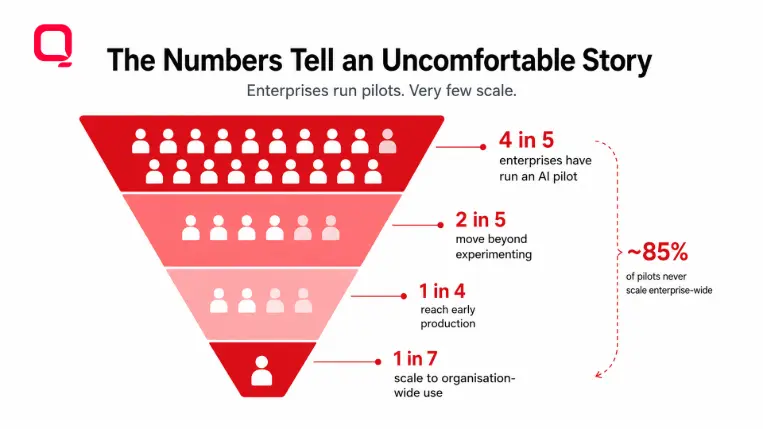
The enthusiasm for AI has never been higher, and neither has the gap between intent and execution. According to Gartner's 2026 work on agentic AI, only around 17% of organisations have actually deployed AI agents so far, even though more than 60% expect to within two years — among the steepest adoption curves the analyst community has ever recorded.
The pattern repeats everywhere you look. An industry survey of 650 enterprise technology leaders in early 2026 found that running an AI pilot has become nearly universal — roughly four in five organisations have at least one — yet only about one in seven has scaled an agent into genuine organisation-wide use. McKinsey's State of AI research has shown that, despite enormous investment, the majority of organisations still haven't scaled AI meaningfully across the enterprise. And KPMG's 2026 AI Pulse research found that fewer than a third of enterprises report significant ROI from their AI initiatives — even as the majority plan to increase spending.
Read those figures together and a clear picture emerges. The bottleneck in 2026 is not ambition, budget, or even model capability. It is the unglamorous, deeply organisational work of turning something that works once, in a controlled setting, into something that works a thousand times a day, safely, inside a real business.
Why pilots stall — and it's rarely the technology
The instinct, when a pilot stalls, is to blame the model. In our experience, that's almost never the real reason. The foundation models are reliable. The orchestration tooling has matured. The failure happens in the space between the prototype and the production system, and it tends to cluster around the same four recurring gaps.
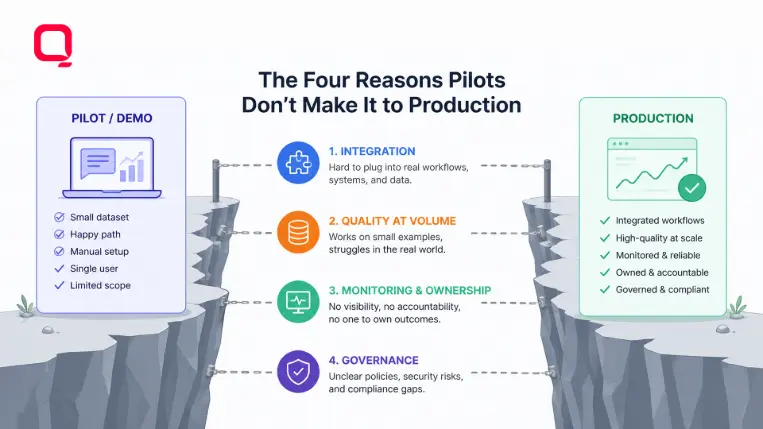
Integration with the systems you already run.
A demo lives in a sandbox. Production lives inside decades of legacy software, half-documented APIs, and data that sits in formats no one fully remembers choosing. Wiring an AI agent into that reality — securely, reliably, without breaking the things that already work — is an engineering problem, not a prompt-engineering problem.
Quality that holds up at volume.
A model that's right 95% of the time is delightful in a demo and dangerous at scale. The difference between a pilot and a product is everything you build around the model to catch, correct, and contain that remaining margin of error before it reaches a customer.
The absence of monitoring and ownership.
Many pilots are built bottom-up by an enthusiastic team, in isolation, with no one accountable for what happens after launch. When marketing builds an agent on one framework and operations builds another on a different stack, you don't have an AI strategy — you have a maintenance liability. Without observability and clear ownership, quality problems stay invisible until they compound into something expensive.
Governance that was never designed in.
This is the deepest issue of all. Deloitte's State of Generative AI in the Enterprise research has found that only about one in five companies has a mature governance model for autonomous AI. The moment a pilot edges toward production, hard questions surface: What can this system do without human approval? Who is accountable when it gets something wrong? What happens when it fails? Organisations that haven't answered these questions stall while they scramble to — and the project quietly dies in committee.
None of these is a model problem. All of them are engineering, architecture, and discipline problems. Which is precisely why the companies that win in 2026 will be the ones treating AI as a digital engineering challenge rather than a science experiment.
Is your AI pilot stuck? Book a 30-minute Production-Readiness Assessment with QSS engineering leaders — no pitch deck, just findings on the four failure modes above. Book your assessment →
The shift that defines 2026: from "Can AI do this?" to "Can we operationalise it?"
What makes this year genuinely different from the hype cycles that preceded it is maturity. The question on the table has changed. In 2023 and 2024, leaders asked whether AI could perform a task. In 2026, the only question that matters is whether your organisation can operationalise it before a competitor does.
That shift has consequences for how you choose a technology partner. The skill that's now scarce — and valuable — is not the ability to produce an impressive proof of concept. Anyone can do that. The scarce skill is the engineering rigour to take that concept and make it production-grade: integrated with your stack, observable, governed, compliant, and resilient when something inevitably goes wrong.
This is the difference between a vendor who hands you a clever model and a partner who hands you a working capability your business can actually rely on.
What the companies that escape pilot purgatory do differently
Across the small minority of organisations successfully scaling AI, the same habits show up again and again. They are worth internalising whether you build in-house or work with a partner.
They build governance in from day one rather than bolting it on at the end.
They decide what an autonomous system is and isn't allowed to do before it touches a live process, not after an incident forces the conversation.
They treat integration and data readiness as first-class work, not an afterthought.
They understand that an AI agent is only as good as its access to clean, relevant, domain-specific data — and that connecting it to legacy systems is where most of the genuine effort lives.
They assign clear ownership and instrument everything.
Someone is accountable for each deployed system, and that system is monitored the way any other piece of critical infrastructure would be.
And critically, they pair technical capability with deep domain expertise. An AI solution for a hospital has to respect HIPAA and clinical reality; one for a financial platform has to satisfy auditors and regulators; one for a logistics operation has to survive the messy edge cases of the real physical world. Generic AI fails in regulated, high-stakes environments precisely because it lacks this grounding. Compliance frameworks such as HIPAA, GDPR, and SOC 2, and engineering process maturity such as CMMI and ISO 27001, stop being box-ticking exercises and become the very things that let an AI system go live at all.
Where this leaves you
If you are a leader weighing how to invest in AI this year, the takeaway is liberating rather than discouraging. The crowded, competitive race to demonstrate AI is largely over. The race that actually creates value — the race to deploy it reliably, safely, and at scale — has barely started, and most of your competitors are stuck at the starting line right alongside you.
That is the opening. The organisations that pull ahead in 2026 won't be the ones with the flashiest prototypes. They'll be the ones with the engineering discipline, domain depth, and governance maturity to turn AI from a slide in a board deck into a dependable part of how the business runs.
At QSS Technosoft, this is the work we care about most. As an AI-first digital engineering company, we've spent years building software that has to survive contact with the real world — in healthcare, fintech, logistics, eLearning, and beyond — under the kind of compliance and quality standards that production demands. We don't think the interesting question is whether AI works. We think the interesting question is whether your organisation can make it work, in production, before your competitors do.
If your AI ambitions are still living in the demo room, the next move isn't a bigger demo. It's a serious conversation about engineering, governance, and the path to production.
Frequently asked questions
Q. What is "pilot purgatory" in enterprise AI?
Pilot purgatory is the gap between AI experiments that work and AI systems that actually ship. Gartner data shows only 17% of enterprises have deployed AI agents — most are stuck in this gap.
Q. How long does it take to move an AI pilot into production?
A typical mid-market AI pilot takes 4–9 months to reach production once integration, governance, and quality controls are properly engineered. Pilots that skip these foundations often stall for 18+ months or get cancelled.
Q. What's the difference between an AI demo and a production AI system?
A demo proves the model works once; a production system makes it work safely a thousand times a day. The model itself is usually less than 10% of the total engineering work.
Q. Why do most enterprise AI pilots fail to scale?
Pilots fail on engineering and governance, not on model capability. The four recurring failure modes are integration, quality at volume, monitoring, and governance that was designed in too late.
Q.How should organisations govern autonomous AI?
Define what an AI system can and cannot do without human approval before it touches a live process — not after. Mature governance includes tiered review, policy-as-code guardrails, audit trails, and named human accountability.
Q. Should we build production AI in-house or partner with an external firm?
Partner first if your engineering team is under 30 people. A partner can bring MLOps, governance, and compliance capability in weeks; building it in-house realistically takes 12–18 months.
Q. What ROI should enterprises expect from production AI in 2026?
Reliable wins look like 20–45% productivity gains on well-scoped tasks. Production AI ROI compounds over 12–24 months, not three — and tracks more closely to engineering discipline than to model choice.
Q. What's the biggest mistake CIOs make with AI in 2026?
Investing in more pilots instead of investing in the engineering discipline that gets one pilot to production. Adding a fifth or sixth pilot when none have shipped is a signal that the bottleneck is execution, not capability.
Ready to get unstuck?
Book a 30-minute Production-Readiness Assessment →
QSS Technosoft is an ISO 27001-certified, CMMI Level 3 digital engineering company helping enterprises move from AI experimentation to reliable, production-grade systems.
Sources: Gartner 2026 Agentic AI research; an early-2026 industry survey of 650 enterprise technology leaders; McKinsey State of AI; KPMG 2026 AI Pulse research; Deloitte State of Generative AI in the Enterprise. (Link each citation to its primary source report when publishing, for E-E-A-T trust signals.)
Stuck at the Demo Stage: Why 2026 Belongs to Companies That Can Actually Ship AI