3 SaaS Product Engineering Company Capabilities to Compare
 By Ashwani Rana
QSS Technosoft
November 3, 2026
14 min read

When comparing a SaaS product engineering company, assess three capabilities: automation and integration, agile delivery, and engineering tools. For US healthcare products, examine how the team connects systems, manages product changes, and ensures production quality. These capabilities help you judge whether its approach fits your workflows, technical environment, and delivery priorities.
Choosing an engineering partner involves more than matching technology stacks. You need to know how the team handles changing requirements, system dependencies, and software operating in real-world conditions.
This article explains what to compare across these capabilities, how they affect product delivery, and which practical details reveal how an engineering team works. It is for US healthcare and health-tech decision-makers evaluating SaaS product engineering needs.
Quick Answer
Compare a SaaS product engineering company on three capabilities: automation and healthcare system integration, agile software delivery, and the SaaS engineering tools that make changes testable and safe to release. Ask the team to trace one real HL7 or FHIR transaction through mapping, error handling, and monitoring; to follow one feature from request to tested release; and to walk one change from ticket to code review, testing, deployment, and monitoring. For healthcare SaaS development, also compare proposals on the same scope, integrations, quality work, and ongoing maintenance, because pricing is quoted per project. These walkthroughs show healthcare software quality in practice better than a tool list, and help US healthcare technology leaders judge whether a team fits their workflows.
1. Automation, integrations, and data management
A SaaS product engineering company should bring automation, integrations, and data management together in a dependable operating model. A workflow can fail if one service sends incomplete data to another. For healthcare products, assess whether information moves correctly between cloud applications, clinical systems, and operational tools. Test the complete transaction, not just a diagram showing successful data exchange.
Automation means software performs a defined task when a known event occurs. For example, a patient registration workflow might validate required fields, create a record, and notify a scheduling service. Map each trigger, action, failure state, and human handoff. If an interface receives a duplicate message, define how it should respond instead of letting a duplicate record appear unnoticed.
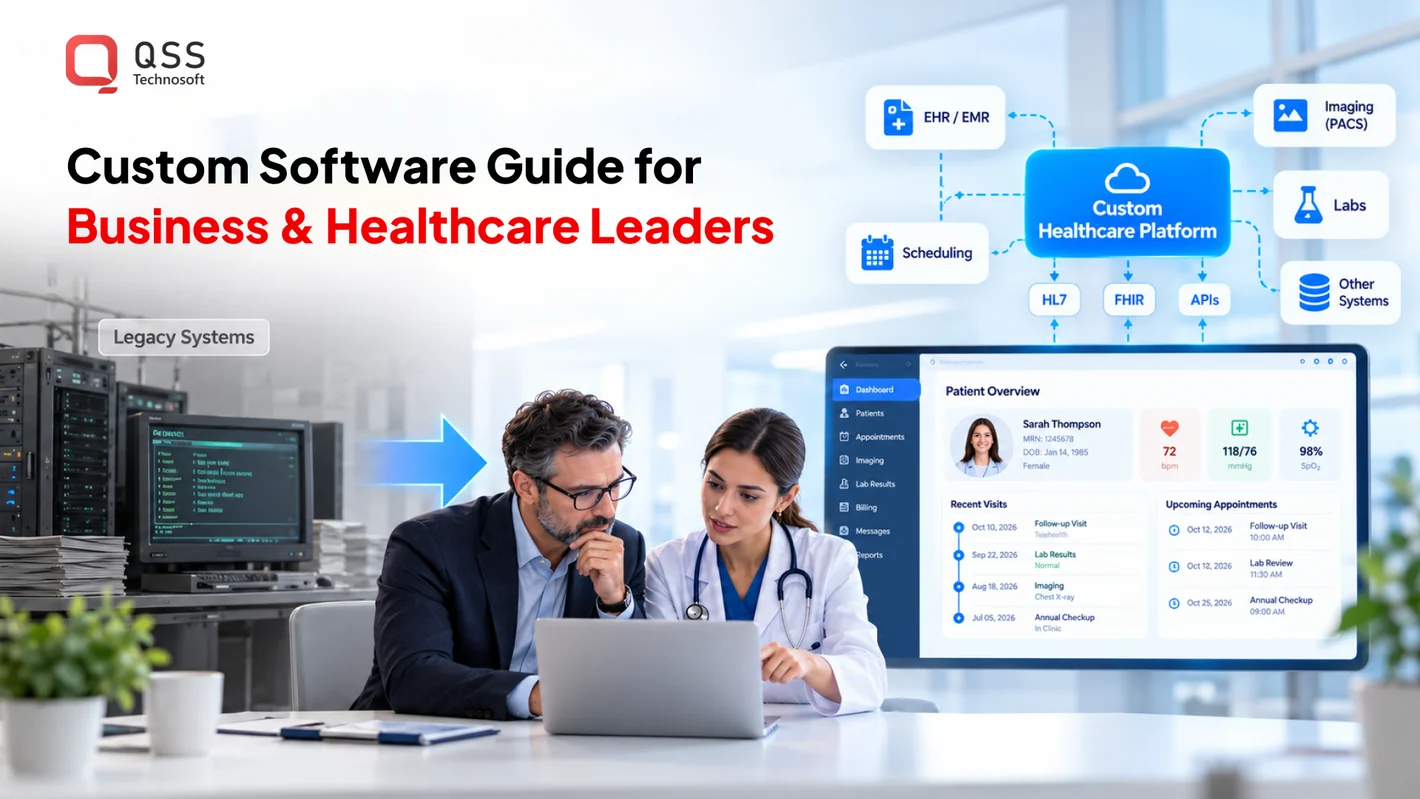
API integrations let separate applications exchange data through documented requests and responses. A healthcare product might connect a patient-facing application to an EHR, then use HL7 or FHIR interfaces where the receiving system supports them. Trace one transaction: identify its source, map fields, authenticate the request, handle errors, and confirm the destination result. This can expose mismatched identifiers before production.
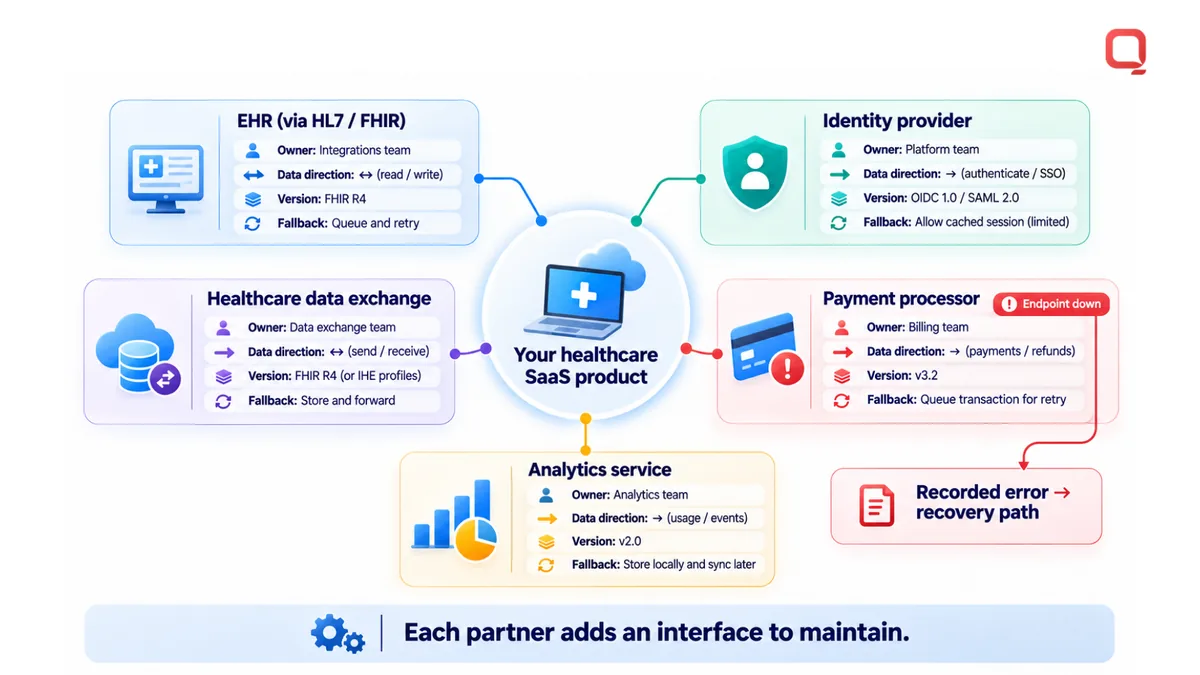
Partner ecosystems add services beyond the product’s own code. A SaaS platform might rely on an identity provider, payment processor, analytics service, or healthcare data exchange. Each partner adds an interface to maintain. Document ownership, data direction, version changes, and fallback behavior. If a partner’s endpoint fails, the product needs a recorded error or recovery path, not an unexplained interruption.
Cloud integration connects application components and data services across a cloud environment. Specify where each service runs, how systems communicate, and which component owns each record. Use a practical sequence:
- Map data: identify source systems, destination systems, and shared identifiers.
- Define contracts: document API fields, formats, authentication, and error responses.
- Automate carefully: set triggers, retries, duplicate handling, and manual review paths.
- Monitor transactions: log failures and trace messages across connected services.
Data management keeps information usable throughout its lifecycle. For an EHR integration, define which system is authoritative for each field, how updates are reconciled, and how archived records remain traceable. Test schema changes against existing integrations before release. This helps prevent a data-model update from disrupting partner workflows or downstream reports.
Compare engineering teams through a real integration walkthrough, not a tool list. Ask them to trace an HL7 or FHIR message through validation, mapping, error handling, and monitoring. The walkthrough should show what staff see when automation cannot safely continue.
With 94% of businesses already use cloud services, teams should account for cloud dependencies when assessing data flows, integrations, and operational reliability.
2. Agile development and time to market
Agile development organizes product work into short cycles, allowing teams to review progress and adjust priorities as they learn. Its value lies in delivering usable changes and responding to feedback, not adding meetings. For healthcare SaaS, define each release around a user task that can be tested in its actual workflow.
For example, a product team could first let clinicians review a patient record, then refine the screen using feedback from clinical users. Each increment needs a clear owner, acceptance criteria, and a way to verify that it works. Avoid implementing broad requests such as “improve the workflow” until the team can define the intended user action.
Decision-making affects delivery. A product owner who can resolve questions about roles, screen behavior, or release priorities helps keep work from stalling in review. If a feature depends on an EHR interface, involve the integration lead when defining acceptance criteria. Late decisions can cause rework, even after developers have completed their assigned tasks.
Compare delivery practices by tracking a feature from request to release. See how the team handles changing priorities, technical dependencies, and user feedback. A product roadmap should distinguish launch-critical work from improvements that can follow. This helps decision-makers make trade-offs without treating every requested feature as a release blocker.
- Refine the request: turn a broad goal into a user action and testable outcome.
- Plan the work: identify dependencies, decision owners, and the intended release result.
- Build and review: test the feature against its acceptance criteria and affected workflows.
- Learn from release: capture user feedback and decide what changes next.
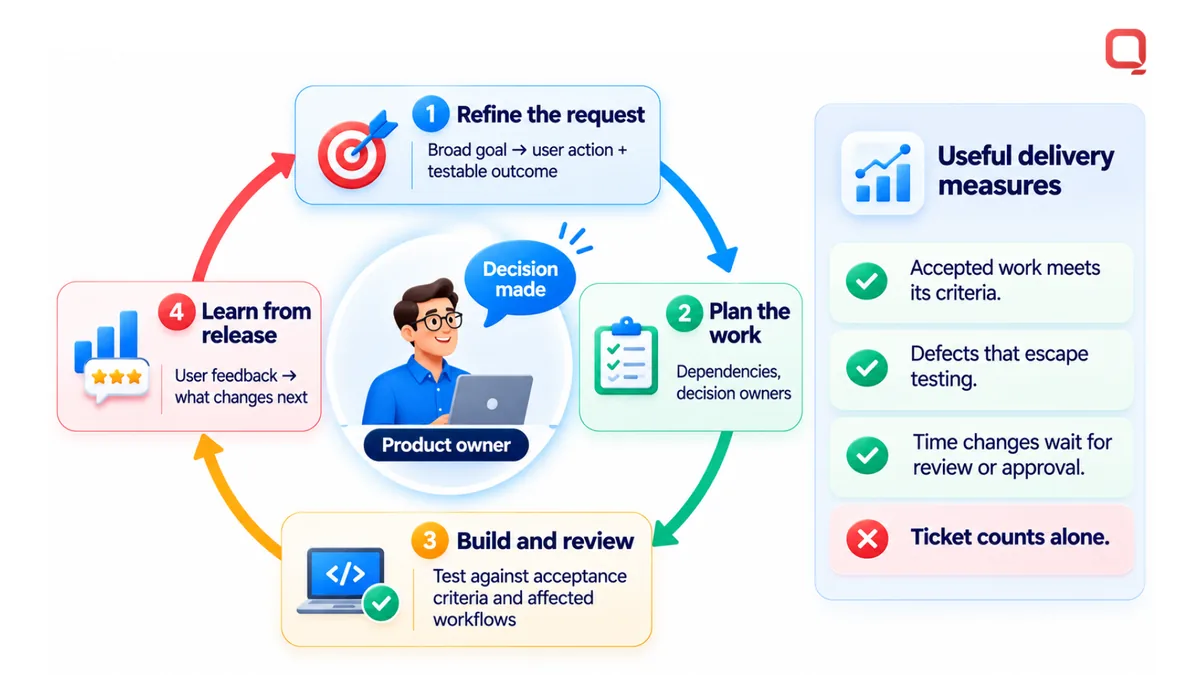
Useful delivery measures include whether accepted work meets its criteria, whether defects escape testing, and how long changes wait for review or approval. Ticket counts alone can obscure blocked decisions or recurring rework. Ask the engineering team how it uses delivery data to improve its process, rather than treating a dashboard as proof of progress.
Agile can be harder to apply when decision-makers are unavailable or product requirements are still evolving. Sprints can move uncertainty forward without resolving it. Agree on the release objective, identify open decisions, and make the product owner available to answer questions as work proceeds.
For a healthcare product team aligning delivery practices with real workflows, discuss product engineering needs and release priorities.
Companies implementing Agile methodologies see an average 37% reduction in time to market. McKinsey reports that companies bringing products to market faster achieve up to 60% higher revenue growth than slower competitors. Together, these findings underscore why teams may weigh speed alongside usable releases, user feedback, and timely decisions.
3. Engineering technologies and tools
A capable engineering team uses tools that make code changes testable, traceable, and safe to release. Compare tools by how they support your product’s architecture, team workflow, and maintenance needs, not by the number of software names on a list.
Engineering technologies include the programming languages, frameworks, cloud services, and data stores used to build and operate an application. Tools support the surrounding work, including source control, automated testing, deployment, and production monitoring. For example, Git tracks code changes, while a continuous integration pipeline can run tests whenever developers submit changes.
Ask how a feature moves from a developer’s machine into production. A practical workflow links source control, build automation, test environments, approval, and deployment. Docker can package an application consistently, while Kubernetes can orchestrate containerized workloads. They solve different problems, and Kubernetes may add operational overhead if a simpler deployment model meets the product’s needs.
For a healthcare SaaS product, testing tools should reflect real workflows. A team might test whether an EHR screen displays updated information after an interface change. Automated tests can catch regressions, but they cannot replace reviews of usability, data mapping, or clinical context. Ask which checks run automatically and which require human review.
In-house teams retain product knowledge and can collaborate closely with internal stakeholders. An external engineering partner can add capacity or specific technical experience, but requires deliberate coordination and knowledge transfer. A hybrid model can keep product decisions in-house while assigning defined engineering work to an external team.
Outsourcing risks include unclear ownership, communication gaps, inconsistent coding practices, and reliance on knowledge held by the external team. Reduce these risks with shared repositories, documented decisions, agreed review processes, and regular handoffs. For example, require architecture notes with each new service rather than waiting until a team member leaves.
No single US-wide rating identifies the right engineering company for every SaaS product. Ratings vary by review platform, project scope, and client experience. Compare evidence relevant to your needs, such as healthcare integrations, product maintenance, and delivery practices.
Use these questions to assess the toolchain and operating model:
- Code: Which languages and frameworks support the product, and why?
- Testing: Which tests run before a change can be released?
- Deployment: How are releases approved, rolled back, and monitored?
- Ownership: Can your internal team access repositories, documentation, and build pipelines?
A clear walkthrough is more useful than a list of technologies. Ask the team to trace one change from ticket to code review, testing, deployment, and monitoring. This reveals whether the tools work together as a maintainable system or are simply a collection of familiar names.
4. How much does SaaS product engineering cost in the US?
SaaS product engineering has no single fixed price in the US. Pricing depends on the project and is provided after a quote request. Key cost factors include product scope, integrations, security needs, team composition, and ongoing maintenance.
A focused minimum viable product costs less to build than a mature platform with multiple user roles, reporting, and external connections. For example, a patient scheduling product with one user workflow differs in scope from a platform linking scheduling, billing, and electronic health records. The number of workflows and systems involved shapes the work more than the product label.
Architecture choices also affect an estimate. A team building a new application can design its data model around current requirements. Modernizing a legacy platform may require understanding existing code, preserving established workflows, and migrating records before adding features. Include this discovery and transition work in the project plan, even when users will not see it.
Integration effort depends on each system’s interface, data format, and error behavior. Connecting to one well-documented API differs from supporting several partner systems with different field mappings. In healthcare, an EHR integration may involve interface development, testing with representative data, and clear handling of rejected or delayed messages.
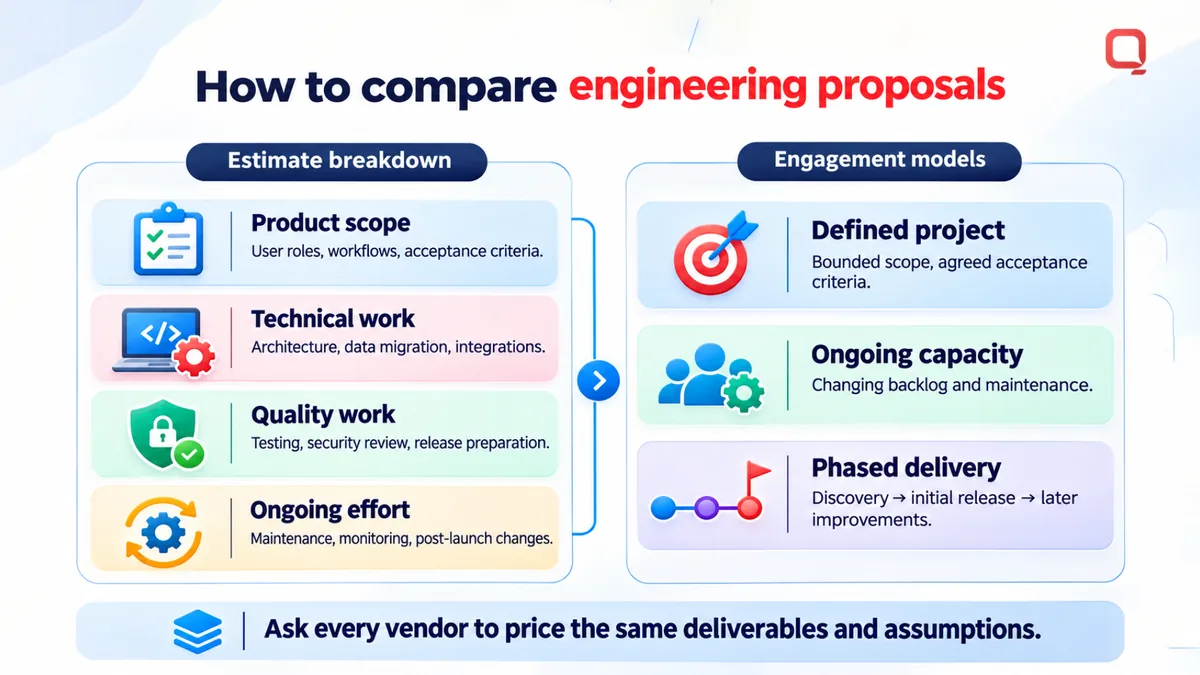
Teams can structure work as a defined project, ongoing capacity, or phased delivery. A defined project suits a bounded scope with agreed acceptance criteria. Ongoing capacity can support a changing backlog and maintenance. Phased delivery separates discovery, an initial release, and later improvements, helping decision-makers prioritize investment as requirements become clearer.
To compare proposals fairly, ask each team to describe the same deliverables and assumptions. Separate implementation from recurring cloud operations and post-release support. Identify who owns testing, deployment, documentation, and integration maintenance. For example, a proposal covering an EHR interface should specify which workflows it includes and how data exchange will be validated.
Build an estimate around visible work, not a single headline total. A useful breakdown includes:
- Product scope: user roles, workflows, and acceptance criteria.
- Technical work: application architecture, data migration, and integrations.
- Quality work: testing, security review, and release preparation.
- Ongoing effort: maintenance, monitoring, and changes after launch.
For a healthcare SaaS product, a key cost decision is how much existing infrastructure the new application must accommodate. A clean-slate build may avoid some legacy constraints, while replacing established systems can involve migration and compatibility work. Define the first release carefully, document excluded features, and link each planned expense to a deliverable.
5. What factors affect SaaS development pricing and timelines?
SaaS development pricing and timelines depend on scope, technical complexity, integration work, and delivery decisions. A patient portal for appointment requests has different requirements from a platform that also handles records, billing workflows, and multiple user roles.
Start by defining product scope. Each user role, workflow, and reporting requirement adds design, implementation, and testing work. For example, clinicians, administrators, and patients may need different screens and permissions. Define what the first release must do, then distinguish later enhancements from launch requirements.
Integration complexity can affect both the estimate and delivery sequence. Connecting to one documented API differs from an EHR workflow that must map fields, handle rejected messages, and coordinate testing with another system. List each dependency and its owner. Work awaiting external access or decisions can delay otherwise complete features.
Existing software matters, too. A new product can start with a purpose-built architecture, while modernization must account for legacy code, existing data, and established workflows. For example, migrating medication records requires planning how the old and new systems represent them. Discovery helps identify this work before delivery commitments are made.
Quality requirements also affect effort. A healthcare application may need additional reviews of access controls, audit records, and sensitive data flows. These are design and testing tasks, not final-stage additions. Define the expected checks early so the team can include them in feature acceptance criteria and release planning.
Delivery timelines depend on team capacity and decision speed. A product owner who can approve a workflow keeps implementation moving; unresolved choices can block developers. Phased releases can reduce initial scope, but each phase still needs integration testing, deployment preparation, and feedback review.
Use these factors to make a proposal easier to compare:
- Scope: List launch features, user roles, and excluded work.
- Dependencies: Identify APIs, data access, and partner decisions.
- Quality: Define testing, security review, and acceptance criteria.
- Delivery: Specify milestones, decision owners, and release responsibilities.
Ask for the assumptions behind each estimate. If an EHR interface depends on access to a test environment, include that dependency in the plan. A clear estimate links each work item to a deliverable and makes scope changes visible before they disrupt the schedule.
Planning a healthcare SaaS build or modernization? Discuss your project scope and delivery plan.
QSS Technosoft: Generative AI Solutions
QSS Technosoft helps healthcare and health-tech teams assess where Generative AI Solutions can fit within a SaaS product. This is useful when a product needs AI capabilities and the work must account for existing systems, data flows, and operational workflows.
For example, a team exploring AI-assisted information retrieval can map the intended workflow, identify data sources, and define how users review outputs. Healthcare IT Engineering and Legacy System Modernization can also address needs related to healthcare platforms or older applications. The right starting point depends on the product’s users, technical environment, and delivery priorities.
Bring a specific use case, such as a workflow bottleneck or a legacy application constraint, to the conversation. Contact QSS Technosoft to discuss your SaaS product engineering needs.
Turn your product priorities into a delivery plan
Turn your product requirements into decisions your team can act on. Identify the first user problem to solve, the systems the product must work with, and the engineering work that could slow delivery. This gives your team a practical basis for comparing a SaaS product engineering company and aligning the engagement with business priorities.
For healthcare organizations, priorities may include introducing Generative AI Solutions, improving Healthcare IT Engineering, or addressing legacy platform constraints through Legacy System Modernization. QSS Technosoft offers these capabilities to teams developing or evolving healthcare software. Start with the specific workflow, platform, or product challenge you need to address.
Bring your goals and constraints into the conversation, then shape the next step around the product’s users and technical environment. Contact QSS Technosoft to discuss your project. A clear first step can make a complex build easier to move forward.
Put Your Shortlisted Engineering Teams to a Real Test
Bring one workflow, the systems it must connect to, and your first-release priorities. As a SaaS product engineering company focused on US healthcare technology, QSS Technosoft supports healthcare SaaS development from discovery to release: healthcare system integration with HL7 and FHIR, agile software delivery with clear decision owners, SaaS engineering tools for testing, deployment, and monitoring, and the reviews that protect healthcare software quality after launch.
Discuss your SaaS product engineering needs →