Health Information Exchange Solutions: How Development Works
 By Rashmi Kanti
QSS Technosoft
October 28, 2026
15 min read

Health information exchange is more than moving a file between systems. It securely shares electronic patient information across healthcare organizations. Health information exchange solutions development makes that possible across EHRs, laboratory systems, and other platforms. The goal is to deliver usable information within the right workflow, not just transmit it successfully.
For U.S. healthcare leaders, HIE planning means aligning technical design with clinical operations. Teams need to consider how systems identify patients, route information, and respond when an interface fails. A connection may pass a technical test yet create extra work if staff cannot find or interpret the information they need.
This guide explains how HIE works and how to plan EHR and laboratory integration, interoperability, and implementation. It examines exchange architectures, the roles of HL7 v2, FHIR, and DICOM, and the organizational decisions that shape deployment. You’ll come away with a clearer basis for defining scope, identifying implementation risks, and turning integration requirements into a workable plan.
Quick Answer
Health information exchange solutions development builds the interfaces, routing, terminology mapping, identity matching, and access controls that let EHRs, laboratories, pharmacies, imaging systems, and public health agencies share patient information in a usable form. Start with one defined exchange workflow (such as discharge summaries or lab results), map each data element to the receiving EHR, and choose HL7 v2, FHIR, DICOM, or IHE profiles (with HL7 FHIR integration tools for healthcare where they fit) based on the systems involved. Pick directed or query-based exchange and a centralized, federated, or hybrid architecture to match the workflow. Build in HIPAA-compliant software development practices and state privacy rules, then test the full path from source system to clinician screen before expanding.
What Is Health Information Exchange?
Health information exchange (HIE) is the secure electronic sharing of patient information among healthcare organizations. It helps authorized users make clinical information available across separate records and systems.
Clinical Data and Workflow Integration
Discrete clinical data consists of individual items, such as a diagnosis, medication, allergy, or laboratory result. Its value depends on whether clinicians can interpret and use it in their work. For example, a diagnosis without its date or source may be less useful during a visit. Clinical workflow integration connects information to the task at hand instead of leaving it buried in a separate record.
For product and clinical leaders, this distinction shapes what an HIE should exchange and how recipients will use it. Define each item’s clinical meaning, context, and intended workflow. Otherwise, connected systems may deliver information that is difficult to act on.
Fragmented Data and Legacy Systems
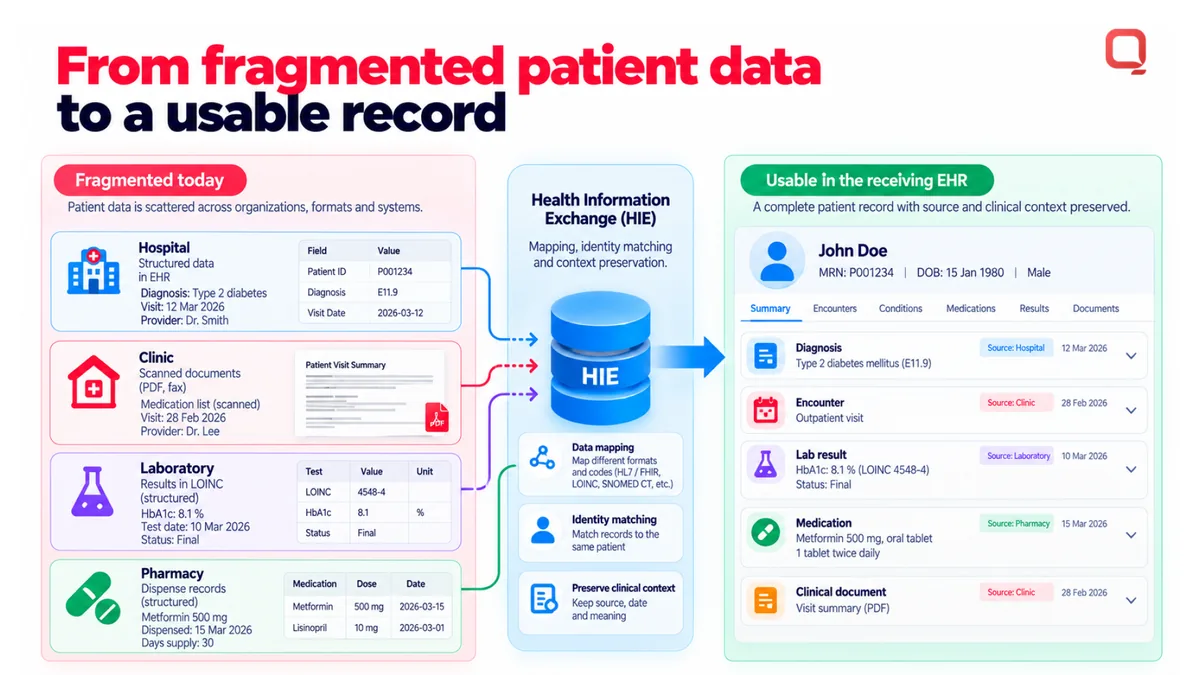
Data fragmentation occurs when information about a patient is spread across organizations, records, or applications. Legacy systems can preserve valuable history while making it harder to share consistently. For example, one system may store a medication as a structured entry, while another keeps it in a scanned document. The information exists, but its format and accessibility differ.
This matters when assessing what an HIE can realistically bring together. Identify which systems hold relevant records, how the records are represented, and where staff currently look for them. This inventory helps distinguish a missing connection from deeper problems, such as outdated data or inconsistent record practices.
Standardized Data in EHRs
Standardized data follows a consistent structure that helps receiving systems recognize the information and its meaning. When standardized health information is integrated into an EHR, it can become part of the recipient’s electronic patient record. A medication, for instance, is more useful when its name and status remain clear after exchange.
Standardization supports consistent interpretation, but clinical context still matters. Teams must define how data elements map to the receiving EHR’s fields and workflows. This helps prevent information from arriving under an unclear label or in an unexpected part of the record.
Healthcare Data Complexity
Healthcare data includes patient demographics, medical history, laboratory results, medication lists, diagnoses, and procedures. These categories differ in structure, detail, and clinical meaning. Healthcare data accounts for about 30% of data generated worldwide. An HIE must handle this variety while preserving the context that makes each item useful.
Consider a patient record containing a diagnosis, a procedure, and a medication list. Each item has a different meaning and may come from a different source. Treating them as interchangeable fields can remove important context. Effective exchange design therefore starts with the intended use of each data type.
Health Information Exchange and Health Data Utilities
A health data utility uses shared health information to support defined functions across a healthcare community. Maryland Chapter 296, House Bill 1127, requires the State-Designated HIE to operate as a health data utility for certain purposes effective October 1, 2022. This illustrates how an HIE can serve organized community needs beyond transferring information between individual systems.
When assessing this model, distinguish the utility’s defined functions from the technical platform that supports them. Roles, data sources, and intended uses shape which information must be available. Clear boundaries help align HIE design with its community purpose and operational responsibilities.
EHR and laboratory information system integration
HIE solutions connect EHRs, laboratory systems, pharmacies, and public health agencies to exchange patient information. For example, a laboratory can send a result to an EHR, while a pharmacy system contributes medication data. Health information exchange solutions development maps these connections to operational workflows and system capabilities.
In the U.S., HIEs must comply with HIPAA and applicable state privacy laws, according to the U.S. Department of Health and Human Services Office for Civil Rights. Integration planning must account for these requirements as well as data formats and user access.
APIs and Interface Engines
An API defines how software requests or exchanges information, while an interface engine routes and transforms messages. Together, they connect systems with different formats or workflows. An engine can route a laboratory result to an EHR and map incoming fields to the destination structure. The mapping must preserve the result’s clinical meaning.
For an EHR and laboratory information system, map the order, patient identifiers, test, result, units, and status. Test how the receiving EHR displays each field. A result without its test name or status can confuse staff, even if transmission succeeds. HIE access to records can also reduce repeated testing and time spent tracking information.
Real-Time Record Access
API integration can let an authorized application request available records when needed. Scheduled transfers may leave information waiting in a queue. For example, an emergency department system could query clinical sources for a patient’s medications or recent results. Access depends on source availability and how the response appears to users.
HIEs can use existing IHE profiles to support real-time patient data access under TEFCA. Five Qualified Health Information Networks began nationwide electronic health information exchange on Dec. 12, 2023. Network connectivity still requires local workflow mapping and testing so records appear in a usable form.
Mobile applications and third-party software can connect through APIs when their workflows require patient information. A patient-facing application might display records retrieved from an EHR, while an external clinical application might request information for a specific care task. Limit each integration to the necessary data, request, response, and access controls.
For implementation, document each source, format, destination, and failure path. Test valid results, missing fields, duplicate messages, and delayed responses before production. These checks expose gaps that specifications alone can miss. Health information exchange solutions development teams can align EHR, laboratory, pharmacy, and public health workflows with healthcare integration requirements.
Interoperability across HL7 v2, FHIR, and DICOM
In the United States, HIE requirements depend on applicable federal and state privacy laws, network participation, and the purpose of the exchange. According to the U.S. Department of Health and Human Services Office for Civil Rights, HIEs must comply with HIPAA and applicable state privacy laws.
HL7 and FHIR Standards
HL7 v2 and FHIR are healthcare data standards that support exchange between systems using different technical approaches. HL7 v2 commonly carries messages between operational systems, while FHIR supports exchange through structured resources and APIs. An HIE platform may need to receive one format and deliver another. Mapping must preserve meaning, not just translate fields.
For example, an HL7 v2 laboratory message can carry a result from a lab system, while a FHIR API can make clinical information available to an application. Define the data elements, identifiers, and workflow before building the connection. A field labeled “status” can mean different things across systems unless teams establish how each value maps.
HIE Architecture and Platforms
HIE architecture comprises the components that route, translate, secure, and make health data available across participating systems. A platform may include source-system interfaces, message routing, terminology mapping, identity matching, and access controls. Each component has a specific role. Separating these functions makes it easier to trace whether a problem originated at the source, during transformation, or at the destination.
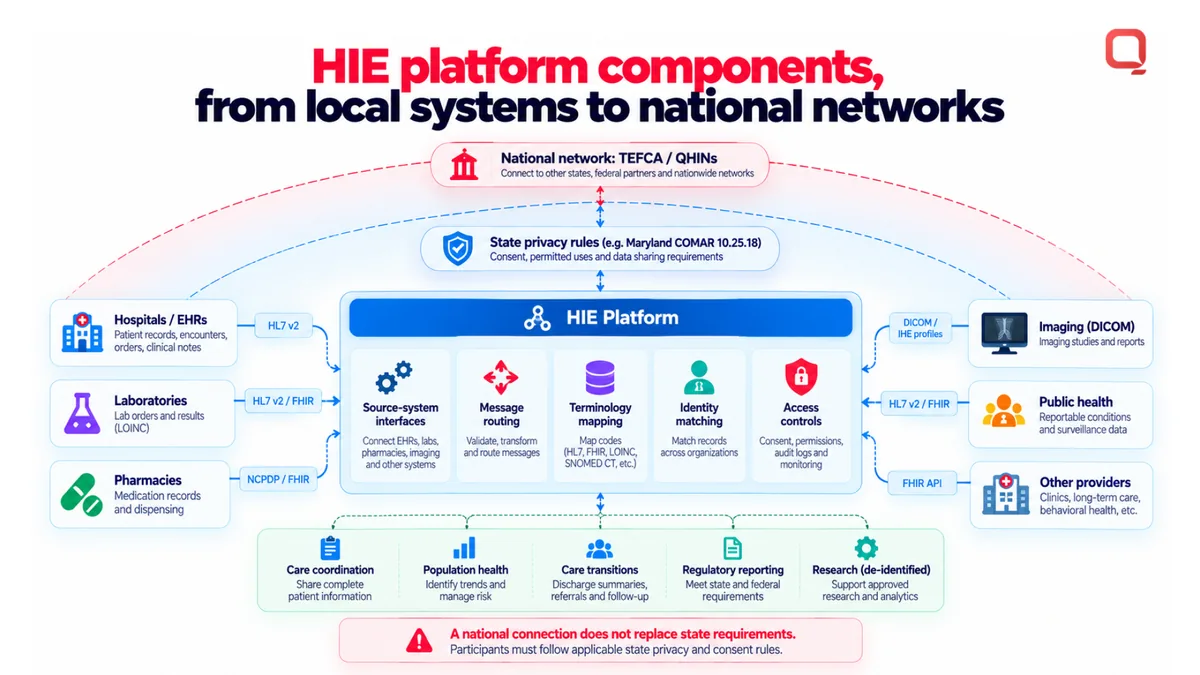
DICOM supports the exchange of medical imaging information, including images used by imaging systems. An HIE supporting imaging workflows must account for both the image and its related clinical context. A radiology result without a clear link to its originating study can leave providers with incomplete information. Treat DICOM exchange as a distinct workflow, not simply another text message.
At the national level, TEFCA provides common rules for secure exchange of treatment and other health information. It permits exchange for treatment, payment, healthcare operations, public health, government benefits determination, and individual access services. Five Qualified Health Information Networks began nationwide exchange under TEFCA on Dec. 12, 2023. HIEs may operate as QHINs or participate in them.
State-specific rules add another layer. Maryland’s COMAR 10.25.18 sets privacy and security regulations for protected health information exchanged through HIEs. Maryland law also requires the Maryland Health Care Commission to adopt regulations governing privacy and security for protected health information obtained or released through an HIE. These provisions show why a national network connection does not replace state-level requirements.
Participation requirements also depend on an organization’s role and the exchange workflow it joins. Before connecting, identify the purpose, participating providers, data sources, and applicable state rules. Then align the architecture with the chosen network’s technical and operational requirements. Public health reporting, individual access, and treatment exchange can involve different data flows, permissions, and receiving systems.
Organizational readiness and implementation planning
HIE implementation starts with assessing infrastructure, data workflows, privacy requirements, and staff readiness. Identify gaps before choosing technical capabilities or connecting systems.
Funding can combine participant contributions, service-based business models, and public funding. States may request 90/10 HITECH administrative funding for eligible health information exchange activities under State Medicaid Director Letters #11-004 and #10-016. The Medicaid EHR Incentive Program authorized a 90% federal match for certain state HIE activities through 2021.
Readiness means more than confirming that an interface can transmit data. Map who shares information, why they share it, and how staff will use it. A hospital and a community clinic may need different workflows for referrals, discharge information, and follow-up. Assign operational owners to each workflow, then document how exceptions are handled.
Interoperability challenges often arise in data mapping, privacy and security controls, and legacy infrastructure. A message may arrive but fail to appear where clinicians expect it. Test the complete path from source system to user workflow, including authentication, access controls, and data in transit. Staff education and change management matter too, because inconsistent use can undermine a new exchange process.
Build the implementation plan around capabilities and dependencies. Inventory systems, data owners, interface methods, and support teams. Then prioritize a defined use case, such as sending discharge information to a receiving care organization. Validate the workflow with clinical and technical users before expanding data sharing to other organizations.
- Assess infrastructure: document existing systems, interfaces, and technical gaps.
- Set governance: define permitted use, access roles, and data ownership.
- Test workflows: verify message delivery, display, and exception handling.
- Prepare staff: explain workflow changes and provide role-specific training.
Implementation costs depend on the number and condition of connected systems, interface complexity, data transformation, security controls, testing, and ongoing support. A legacy platform with limited integration capabilities may need more remediation than a system with usable interfaces. Estimate each workstream separately, including post-launch maintenance, rather than treating the HIE platform as the whole project.
Progress reporting should track technical completion and operational readiness. Maryland HIEs and electronic health networks submitted an affirmation of compliance or implementation plan for legally protected health information requirements in January 2024. Their next implementation update is due October 2, 2026. For other projects, report milestones such as tested connections, resolved data issues, trained users, and approved workflows.
Electronic health information exchange
Electronic health information exchange lets healthcare professionals and patients appropriately access and securely share vital medical information. For a care provider, the practical value is access to useful records across organizations, not simply another electronic destination. A fuller record can bring together past history, current medications, and other information relevant to patient care.
Directed exchange sends patient information directly and securely to another healthcare professional over the internet. Providers can use it to send a referral, laboratory order, laboratory result, or discharge summary. For example, a hospital can send discharge information to a receiving care provider, supporting a more informed transition to home care or another facility.
Query-based exchange lets providers search for and discover accessible clinical sources about a patient. An emergency room physician may use it to find medications, recent radiology images, or problem lists before making a treatment plan. This is useful when the care team needs information from multiple sources but does not know which organization holds each record.
These exchange patterns serve different needs. Directed exchange sends information to a known recipient; query-based exchange retrieves available information when a provider searches. Choose the pattern that fits the workflow: a referral has a known destination, while an emergency visit may require discovery across accessible sources.
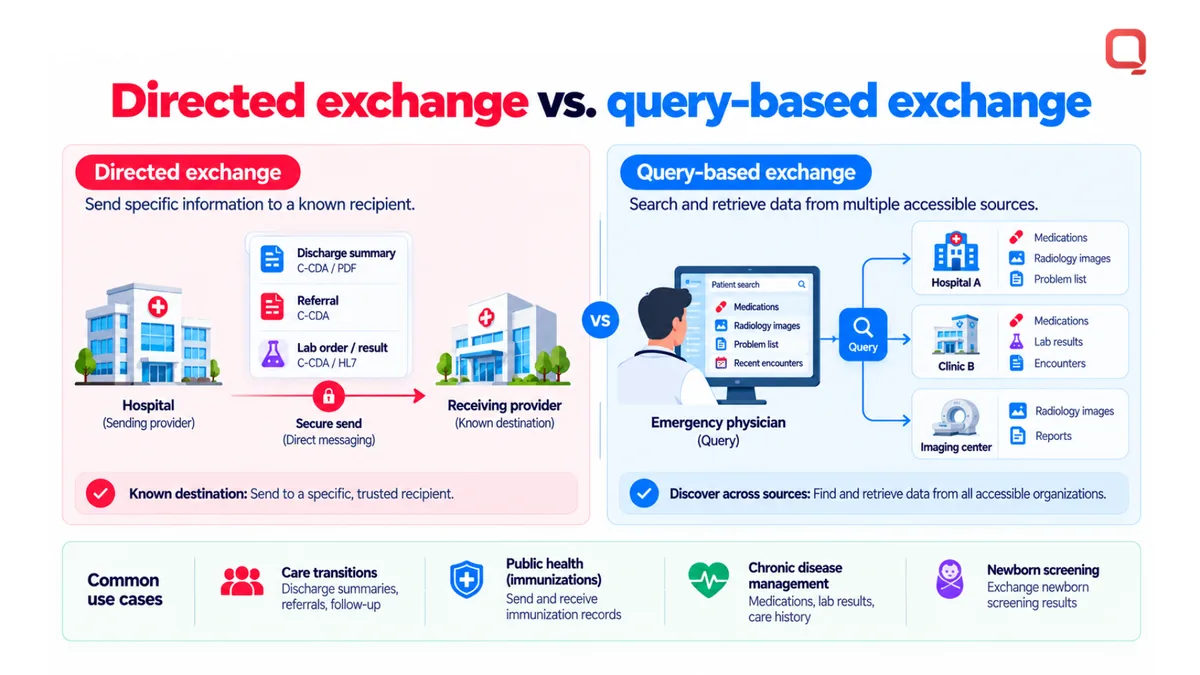
- Care transitions: share discharge information with a home care team or receiving facility.
- Public health: send immunization data to public health organizations through directed exchange.
- Chronic disease management: make relevant information available to the medical teams involved in a patient’s care.
- Newborn screening: support secure information exchange and follow-up when screening identifies a potential issue.
Electronic exchange can also support population health management by giving providers and public health authorities access to broader sets of health data. HIEs have been used to monitor infections and vaccination status, including identifying patients who remain unvaccinated. These uses depend on gathering information that helps organizations address a defined care or public health need.
Timely access to patient information can help providers avoid readmissions, but the exchange must fit the workflow. Information arriving after a care decision cannot inform it. Define which event triggers sharing, who receives the information, and where it appears in the recipient’s workflow. Then test a complete example, such as a discharge summary reaching the next care team.
For U.S. health information exchange, privacy and security are part of the operating model. According to the U.S. Department of Health and Human Services Office for Civil Rights, HIEs must comply with HIPAA and applicable state privacy laws. Build access controls and secure information handling into every exchange workflow instead of treating them as separate technical tasks.
Planning an exchange around real clinical workflows can clarify the required data, recipients, and delivery paths. Discuss health information exchange implementation with a team that works on healthcare systems and interoperability.
QSS Technosoft: Generative AI Solutions
QSS Technosoft supports healthcare organizations’ HIE engineering needs through Healthcare IT Engineering, Healthcare Interoperability, and Legacy System Modernization. These services suit teams connecting EHRs and laboratory systems, adapting older applications, or planning data exchange across clinical workflows.
Generative AI Solutions may support healthcare workflows where AI is appropriate, but they do not replace reliable data integration, access controls, and validation. Start with the operational problem, the systems involved, and the information users need. Then define how the solution will fit existing infrastructure and processes.
If your organization is planning an HIE integration or modernizing healthcare software, contact QSS Technosoft to discuss the project.
Turn Your HIE Plan Into an Implementation Roadmap
The next step is to turn the exchange design into a roadmap your clinical, product, and engineering teams can execute. Define the first workflow, assign owners, and agree how you will validate that information reaches the right users in a usable form. This keeps health information exchange solutions development focused on operational needs, not connection counts alone.
QSS Technosoft offers Healthcare IT Engineering and Legacy System Modernization to help organizations address integration needs across existing healthcare software. Its Generative AI Solutions can support projects where AI fits a defined healthcare use case. Start with the problem your team needs to solve, whether that means modernizing a system, strengthening interoperability, or shaping a new workflow.
Bring your priorities and current technical constraints into the planning conversation. Contact QSS Technosoft to discuss your HIE project and identify a practical path from requirements to delivery. A clear first milestone gives your team a solid place to start.
Define Your First HIE Workflow
Bring the exchange you need first, such as lab results or discharge summaries, plus the systems and participants involved. Our engineers provide health information exchange solutions development and healthcare software development services, from custom healthcare software development and HL7 FHIR integration tools for healthcare to HIPAA-compliant software development practices, as an EHR software development company that tests every path from source system to clinician screen.
Discuss your HIE project →