Healthcare Data Warehouse Development Costs and Timelines
 By Vineet Bhardwaj
QSS Technosoft
November 10, 2026
16 min read
The database is rarely the hard part. Healthcare data warehouse development brings information from systems such as EHRs, labs, and radiology into a governed foundation for analytics. Implementation commonly takes 3 to 12 months. Price depends on scope, source systems, data quality, security needs, and integration complexity.
If you’re considering a healthcare data warehouse development project, you’re likely facing a familiar challenge: healthcare data is spread across systems that don’t always speak the same language. Connecting them is only part of the work. The data must also be reliable, secure, and useful to the people making clinical and operational decisions.
This article explains healthcare data warehousing, how its architecture moves and organizes information, and which choices shape delivery and cost. It also covers how a warehouse can support care, reporting, and operations, and where development, consulting, and modernization fit. The focus is on building a system that remains useful beyond launch.
Quick Answer
Healthcare data warehouse development brings EHR, claims, laboratory, and radiology data into one governed environment for analytics. Implementation is commonly estimated at 3 to 12 months, but the healthcare data warehouse timeline depends on scope: the article’s estimates run from 2–4 months for a department data mart with one or two sources to 9–18+ months for an enterprise warehouse or lakehouse, and each additional source can add 4–12 weeks of pipeline work. Healthcare data warehouse costs are quoted per project and driven by the number of sources, data quality, historical migration, security, analytics scope, and architecture (CDR, EDW, data lake, lakehouse, or a cloud data warehouse such as Snowflake or BigQuery). Plan healthcare data integration, governance, and access controls alongside the data model, and tie every dataset to a decision so healthcare analytics produce outputs teams can act on.
What is data warehousing in healthcare?
A healthcare data warehouse is a system that brings information from clinical and operational sources into a governed environment for analysis. A clinical data warehouse can connect EHR, laboratory, and radiology records, but useful results depend on data quality, integration, and security.
Data Quality and Governance
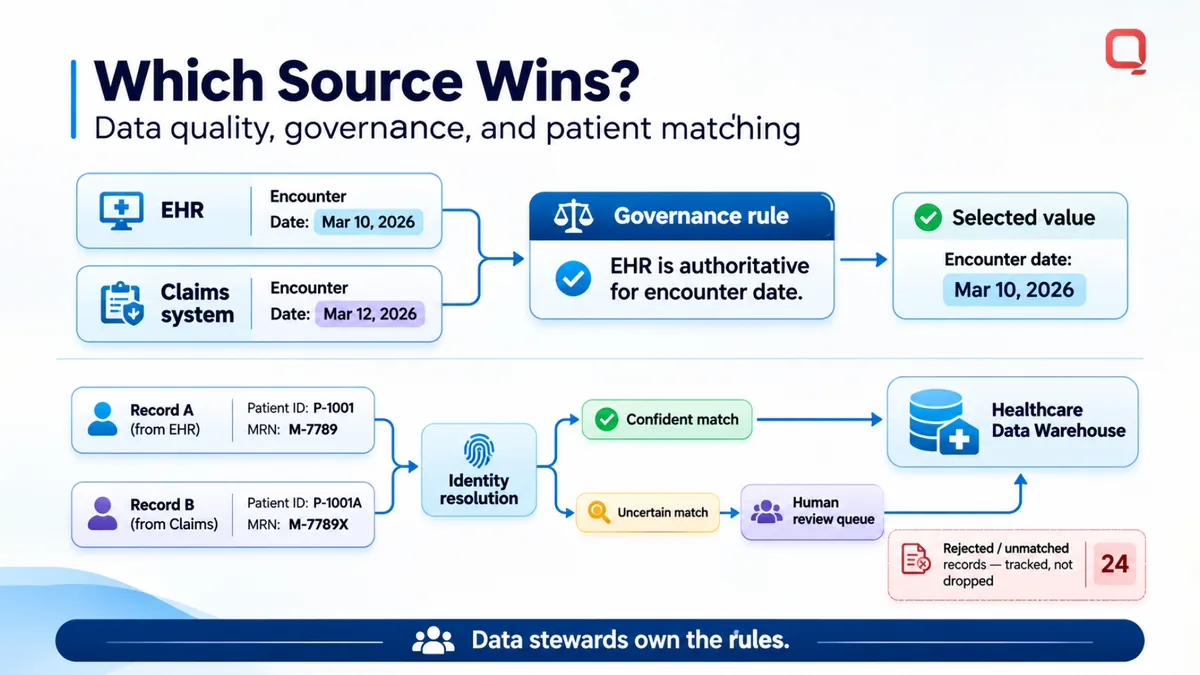
Data quality means information is accurate, complete, and consistent; governance defines how an organization manages it. Together, they help analysts interpret patient records without mistaking missing values or mismatched identifiers for real clinical changes. For example, a governance process can specify which source provides an encounter date when an EHR and claims system disagree. Track source systems and integration pipelines so teams can identify incomplete incoming data and support interoperability.
Healthcare Data Source Integration
Healthcare data integration connects systems such as EHRs, claims platforms, laboratories, and radiology databases through managed pipelines. Integration typically maps fields, reconciles identifiers, transforms formats, and checks incoming records before loading them into the warehouse. HL7 and FHIR can support exchange between healthcare systems, while source-by-source validation helps preserve meaning. The main project risks are incomplete feeds, inconsistent definitions, poor data quality, and integration gaps that disrupt reporting or interoperability.
Privacy, Security, and Access Control
Privacy and security controls determine who can use patient data and how the warehouse protects it. In the United States, the U.S. Department of Health and Human Services says HIPAA sets baseline requirements for storing, sharing, and auditing healthcare data. Use encryption in transit and at rest, multifactor authentication, role-based access controls, and audit logs. For disaster recovery, encrypt backups, restrict access to them, and test restoration procedures so teams can recover data and verify its integrity.
Cloud data management does not remove the need for governance. A cloud-based warehouse still needs documented data ownership, defined access roles, monitored pipelines, and auditable lineage showing how records move from source to report. Studies from 2011 to 2021 reported cloud-based healthcare data warehousing benefits, including easier access and improved data security. Those benefits depend on the organization’s configuration and controls, not simply on choosing cloud infrastructure.
For healthcare data warehouse development, plan privacy and compliance alongside the data model and pipeline design. Apply encryption to stored data and backups, and protect transfers between healthcare systems and analytics tools. AES-256 for protected health information at rest and TLS 1.3 for transmission are specified security approaches. Keep permissions narrow, record access events, and review whether each analytics use requires identifiable patient information.
These controls work together: governance defines approved use, access controls enforce it, and audit logs record activity. A warehouse combining EHR, claims, and laboratory data can provide a broader patient view, but inconsistent identifiers or untracked transformations can undermine it. Document data lineage and validate incoming records before they feed clinical or operational reports.
Healthcare data warehouse architecture and components
Healthcare data warehouse architecture defines how information moves from source systems into storage, processing, and analytics layers. Snowflake and BigQuery are examples of cloud platforms used in healthcare warehouse implementations. Choose a platform based on data volume and formats, access needs, and intended workloads.
Core Architecture and Features
A healthcare data warehouse architecture comprises the components that ingest, store, transform, and serve healthcare data. Its design matters because reports depend on how these components work together. A typical flow takes records from source systems through ingestion, storage, and transformation, then into curated datasets for analytics.
Each layer has a distinct role. Ingestion captures batch files or system feeds. Storage retains source and transformed records. Transformation applies mappings and business rules. A serving layer supports dashboards, reports, and analytical queries. For example, a clinical team could query a curated dataset that combines encounters and laboratory results for a defined reporting task.
CDR, EDW, Lake, and Lakehouse Choices
A clinical data repository (CDR) organizes clinical information; an enterprise data warehouse (EDW) consolidates structured data for analysis across an organization. A data lake stores varied formats, while a lakehouse combines lake-style storage with warehouse-style querying. The choice affects which workloads the architecture can support directly.
| Architecture | Typical use |
|---|---|
| CDR | Focused clinical data access |
| EDW | Shared enterprise reporting |
| Data lake | Flexible storage for varied formats |
| Lakehouse | Mixed data with warehouse-style querying |
Apache Iceberg supports snapshot isolation, atomic commits, and distributed metadata management, capabilities that are relevant to lakehouse design. These features can help teams manage changes to data and metadata as workloads evolve.
Cloud Platforms for Healthcare Warehousing
A cloud data warehouse uses cloud infrastructure to store and process data. Snowflake and BigQuery are examples used in healthcare warehouse implementations. Compare platforms based on data formats, query patterns, integration requirements, and the organization’s operating model. Cloud infrastructure changes how resources are provisioned, but it does not determine the warehouse pattern.
Tie the design to actual workloads. Structured clinical reporting may need a different processing approach from a lakehouse handling varied data for advanced analytics. Separate ingestion, transformation, and serving responsibilities so teams can update one component without rebuilding every layer.
Architecture planning should connect intended users and decisions to the selected pattern. Analysts may need consistent report definitions, while clinical teams may need datasets organized around specific workflows. Map those needs to a CDR, EDW, lake, or lakehouse, then define how data enters and leaves the platform.
For teams assessing how platform and integration choices fit together, discuss healthcare data architecture in the context of your systems and analytics workloads.
Healthcare DWH implementation costs and timelines
Healthcare data warehouse implementation generally takes 3 to 12 months, depending on scope, integrations, and validation needs. Cost depends on project requirements, source complexity, data history, security controls, and the architecture selected.
Implementation Stages and Project Planning
Implementation planning defines the use case, scope, delivery stages, and resources required to launch a warehouse. It matters because unclear priorities can expand pipeline and analytics work before teams agree on what the system must deliver. Start by eliciting goals, then develop a business case and roadmap, select the architecture, connect sources, validate outputs, and prepare for operations.
Goals elicitation is estimated at 3-20 days, while creating a business case and project roadmap is estimated at 2-15 days. Treat those as distinct planning activities. For example, a claims analytics project needs agreed measures and reporting definitions before teams build transformation logic. A plan should identify owners for source data, access control, testing, and operational handoff.
Project Costs and Ongoing Maintenance
Project cost reflects the engineering and infrastructure needed to meet the agreed scope; maintenance covers ongoing operation and updates. The price depends on the project and is provided after a quote request. Key factors include the number of sources, data quality, historical migration, analytics requirements, security, and architecture.
Each additional healthcare data source is estimated to add 4 to 12 weeks of pipeline development, making integration scope a practical planning factor. Ongoing work can include pipeline monitoring, fixing source changes, maintaining access control, and adjusting structured datasets as reporting needs evolve. A maintenance agreement helps keep the system functional and current with new technologies and healthcare regulations.
Project Timelines
Project timelines vary with scale and source complexity. A US healthcare department data mart with one or two source systems, limited history, and basic BI reporting is estimated to take 2-4 months. A mid-sized warehouse with 3-6 sources, historical migration, and BI integration is estimated at 5-9 months.
An enterprise warehouse or lakehouse with 7 or more sources and advanced analytics is estimated at 9-18+ months. A foundational clinical data repository is estimated to take 4 to 9 months to build, while an AI-ready healthcare data lakehouse is estimated at 15 to 28 months. These ranges reflect different scopes, not interchangeable delivery plans.
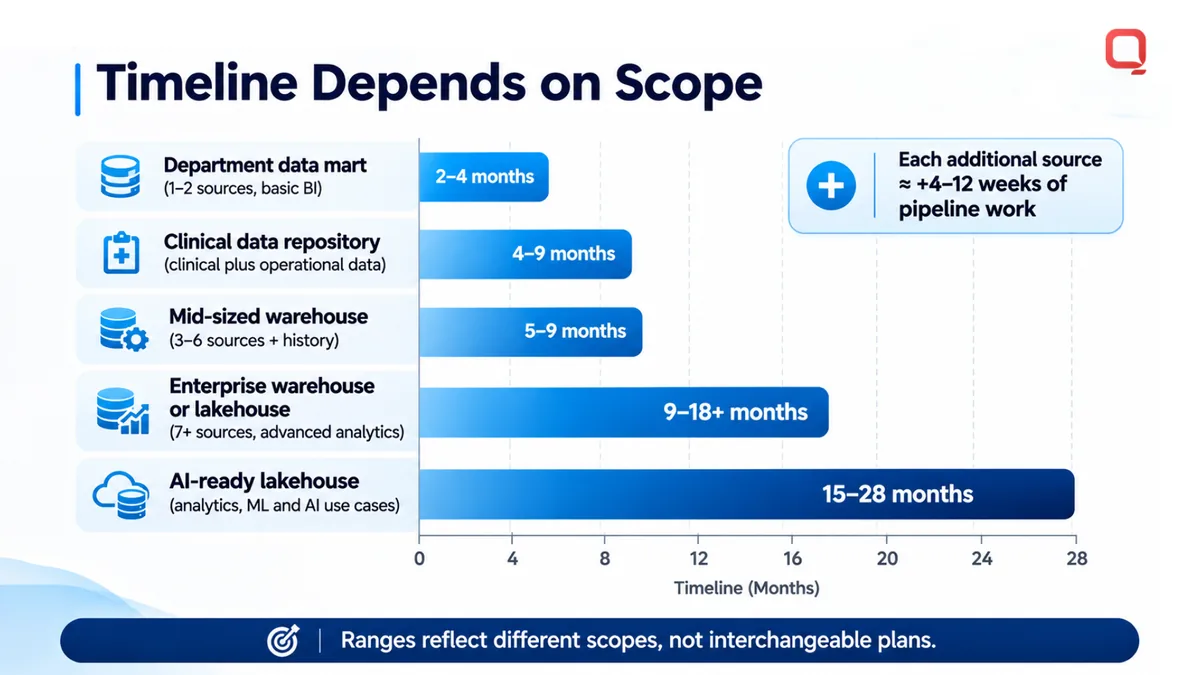
Use the ranges to plan sequencing, not to assume every implementation is identical. For a focused data mart, teams can prioritize a small set of operational reports and sources. Enterprise projects require broader coordination across claims, clinical, and administrative systems, as well as more extensive historical data handling. Each source adds mapping, pipeline development, and validation work.
Build a delivery plan around testable milestones. Define which structured datasets must be available first, who approves their meaning, and how analysts will validate the outputs. Then schedule source onboarding, access-control reviews, user acceptance, and operational handoff. A launch date is meaningful only when these dependencies are visible and resourced.
Data warehouse benefits and healthcare use cases
A healthcare data warehouse brings information from multiple sources together for reporting, operational analysis, and research. Its value comes from applying consistent definitions to the data and connecting each analysis to a decision teams can act on.
Healthcare Data Warehouse Benefits
A healthcare data warehouse is a shared data environment for analyzing clinical and operational sources. It is useful when separate systems make it difficult to identify patterns across care, utilization, or service delivery.
For example, a data warehouse and BI reporting project serving 200 US healthcare facilities helped providers identify care-process issues, including missed medications and hospital readmissions. A consistent view can help teams locate where a workflow needs closer review, then compare findings across facilities or reporting periods.
Timely access to information from multiple sources can improve healthcare service efficiency. The warehouse does not make decisions by itself. It gives analysts and leaders a common basis for examining what happened, where it happened, and which process may need attention.
Financial Benefits and Success Factors
Financial value comes from using analytics to inform operational choices, not simply from storing more data. Success depends on linking each use case to a decision, selecting relevant sources, and validating transformation rules before reports guide action.
For instance, a supply chain team can use consumption trends to set automated reorder thresholds. This can help reduce waste and support better purchasing negotiations. The value depends on usable inventory and consumption data, along with a process for acting on the analysis.
Set a baseline before launching a use case. A finance team reviewing claims can define the operational measure it wants to monitor, identify the required source data, and compare future reports using the same definition. This makes the analysis easier to interpret and keeps the project focused on an observable business question.
Enterprise Warehouse Benefits
An enterprise warehouse consolidates data across an organization for shared reporting and analysis. It is useful when teams need a consistent view across departments rather than separate extracts with conflicting definitions.
Organizations with 50 or more disparate systems and no unified analytics layer are a potential use case. An enterprise view can help analysts examine relationships across clinical, administrative, and operational data, provided source definitions and transformations are understood.
Use cases can span care-process monitoring, resource planning, and research analysis. During the early stages of the COVID-19 pandemic, some organizations used supply chain data to forecast PPE usage and avoid shortages. This illustrates how connected sources can inform operational planning when timely information matters.
Choose scope based on the decision, not the data volume. Start with a defined reporting need, identify its source systems, and agree on the measures users will interpret. Extend the model when another department has a clear use case. This keeps enterprise reporting tied to practical outcomes instead of producing ownerless dashboards with no resulting action.
Healthcare data warehouse consulting, development, and modernization
Healthcare data warehouse consulting turns business needs into architecture, delivery priorities, and measurable outcomes. Development builds or extends the platform, while modernization updates storage and data flows that no longer meet hospital or department needs. The right approach depends on current systems, target use cases, and implementation constraints.
Snowflake and BigQuery are common platform examples. Implementation partners assess source systems, design integrations, and deliver the warehouse around clinical and operational requirements. Platform vendors provide the underlying data services; implementation partners connect those services to an organization’s workflows and legacy environment.
Start with the decision the warehouse must support. A hospital may need research datasets, compliance reporting, or operational analytics. A department may need a focused view of claims or resource use. Each use case affects which data sources matter, how records should be transformed, and who will use the resulting information.
A consulting phase can make these dependencies visible before development begins. Map the current platform, identify data owners, document source formats, and define target outcomes. Then compare retaining existing components with replacing them. A legacy system may hold valuable historical data, so modernization often requires planned migration rather than a clean break.
For example, a modernized data lake platform at an academic medical center eliminated the need for a separate research data platform and saved millions of dollars in research costs. It also supported collaboration between the research division and FHIR-based solutions, as well as compliance reporting, data archiving, AI and machine learning processes, and real-time disease surveillance.
That example shows why modernization involves more than moving storage. The architecture must serve active workloads while preserving access to historical information. A research team may need flexible datasets, while a hospital reporting group needs stable, clearly defined outputs. One platform can support both, but only with clear data ownership and processing suited to each purpose.
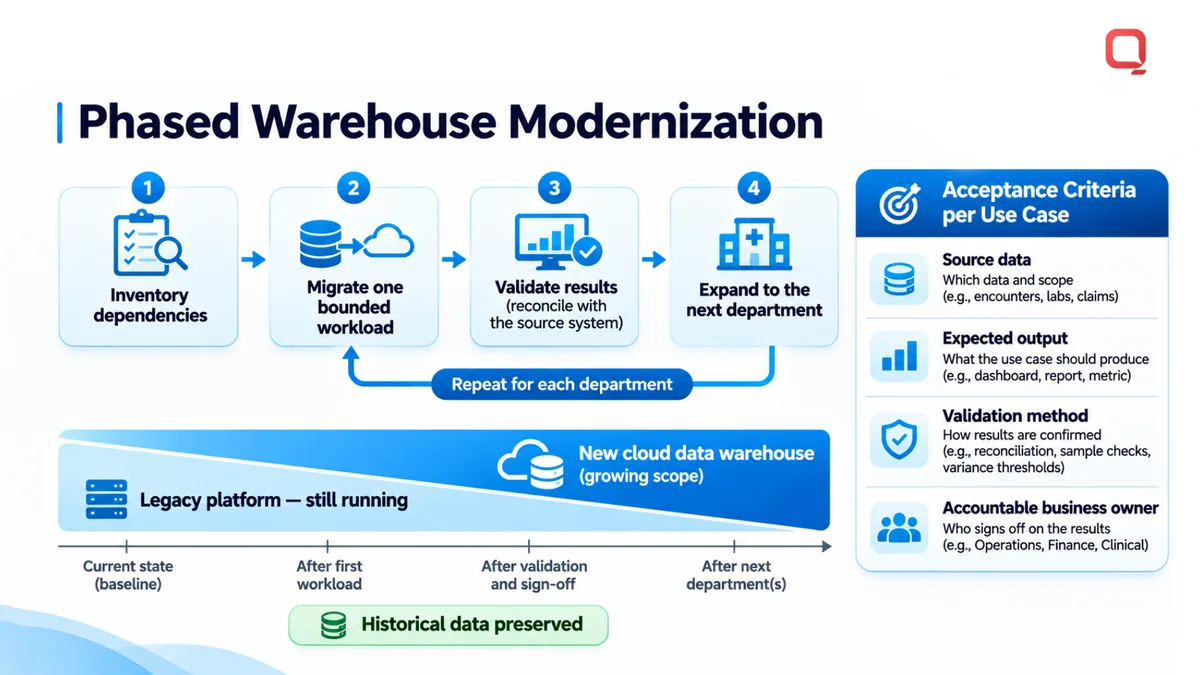
Implementation partners should connect technical work to practical acceptance criteria. For each use case, define the source data, expected output, validation method, and accountable business owner. A claims report, for example, should use agreed definitions and include a way to reconcile results with its source system. This makes acceptance about usable outcomes, not just completed software.
Modernization also requires careful sequencing. Inventory dependencies, migrate a bounded workload, validate the results, and then expand to the next department. This helps teams isolate issues in source mappings or transformation logic before they affect broader reporting. A phased plan is useful when a hospital must keep existing systems running during migration.
Choose a platform and partner based on workload fit, integration needs, and the organization’s ability to operate the result. Snowflake or BigQuery can provide cloud data capabilities, but neither removes the need for healthcare-specific modeling, interoperability, and governance. The practical takeaway is to modernize around defined outcomes, not platform migration alone.
QSS Technosoft: Generative AI Solutions
QSS Technosoft is a US-based technology company supporting healthcare organizations with Healthcare IT Engineering, Legacy System Modernization, and Generative AI Solutions. These capabilities are relevant when warehouse work must connect with clinical software, older platforms, or a defined AI use case.
Generative AI Solutions can support organizations exploring AI applications that use healthcare data. The underlying data and workflows still need careful design: AI does not correct inconsistent source records or unclear access rules. Mobile App Development can also support a healthcare product that needs a mobile interface.
Start by defining the intended use case, systems involved, and operational constraints. This gives QSS Technosoft a practical basis for discussing how its healthcare technology capabilities may fit your project.
Turn the architecture into a workable next step
The next step is to turn your data warehouse ambition into a clearly scoped project decision. Identify the first workflow it should support, the systems it depends on, and the team responsible for using its outputs. This gives technical and clinical leaders a shared basis for prioritizing the work.
QSS Technosoft offers Healthcare IT Engineering for healthcare software needs, Legacy System Modernization for aging platforms, and Generative AI Solutions for organizations assessing AI use cases. These capabilities can support different parts of a broader data strategy, but the starting point is the problem your organization needs to solve. A focused plan makes healthcare data warehouse development easier to scope and align with operational goals.
Contact QSS Technosoft about your project to discuss a practical path from the current environment to the capabilities your teams need. Start with the use case, then build from there.
Scope Your Healthcare Data Warehouse Around One Decision
Bring the first workflow your warehouse must support, the source systems behind it, and the team that will use its outputs. QSS Technosoft helps US healthcare organizations plan healthcare data warehouse development end to end: healthcare data integration from EHR, claims, laboratory, and radiology feeds; CDR, EDW, lakehouse, or cloud data warehouse architecture; governance and access controls reviewed with your privacy and compliance teams; and phased delivery that makes healthcare data warehouse costs and the healthcare data warehouse timeline visible before the build starts.
Discuss your data warehouse project →