Healthcare Interoperability Solutions and How They Support Patient Care
 By Shreyak Chakraborty
QSS Technosoft
November 10, 2026
16 min read
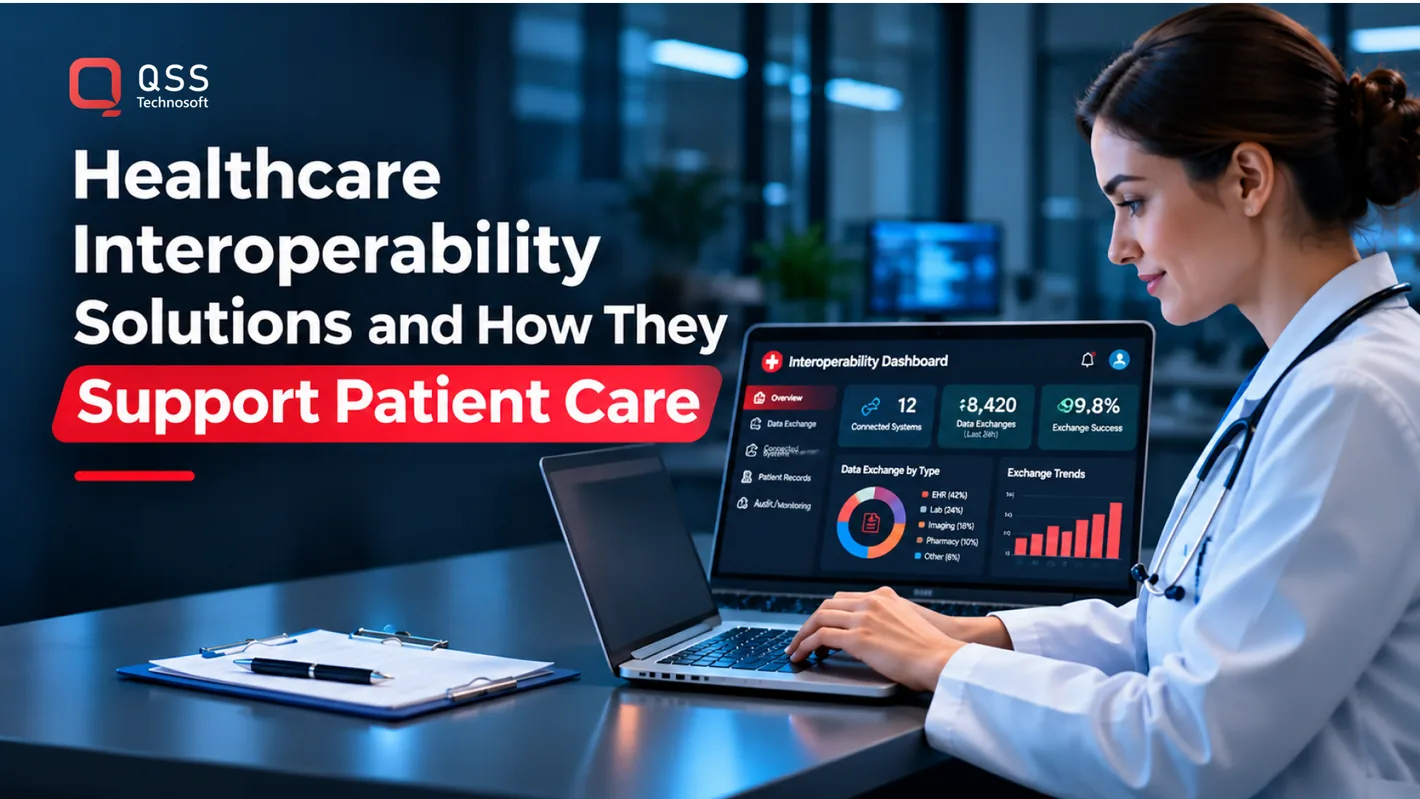
Four types of interoperability determine whether healthcare systems can exchange information, interpret it, and use it in care: foundational, structural, semantic, and organizational. Healthcare interoperability solutions connect these layers, but a technical connection alone does not ensure that information arrives in a useful form or follows appropriate access rules.
For healthcare leaders working across EHRs, clinical applications, and partner organizations, the distinction is practical. A data feed can connect successfully and still leave clinicians searching records or re-entering details. The challenge is making information usable across existing systems while accounting for privacy, security, and technical constraints.
This article explains the four types of interoperability, how US regulations and health information exchanges shape data sharing, and where standards such as FHIR fit. It also covers implications for patient care and practical ways to assess interoperability partners. The focus is on how exchange works in real environments, not on promises of frictionless integration.
Quick Answer
Healthcare interoperability solutions work across four layers: foundational (data moves), structural (compatible formats), semantic interoperability (shared codes and meaning), and organizational (agreed policies and workflows). Patient care improves only when all four hold. In practice that means HL7 Version 2 feeds for legacy systems and HL7 FHIR APIs for newer applications, EHR interoperability built on consistent profiles, terminology, and identity matching, and healthcare data exchange through a regional or vendor network, a health information exchange, or TEFCA. US rules such as the 21st Century Cures Act, CMS access requirements, and USCDI shape what must be shared. Judge any solution or partner by whether information arrives in a usable form at the point of care, with failures traced and access controlled.
What role do regulations play in healthcare data exchange?
Organizations can assess interoperability ROI by tracking failed exchanges, staff rework, data quality, and whether information supports the intended workflow. In the United States, regulations and technical standards shape how organizations govern access and exchange.
Competing Standards and Data Volume
Competing standards use different structures, codes, and rules to represent clinical information. A laboratory may send a result using one code system, while the receiving EHR maps it differently. This matters because data can be delivered successfully and still be unusable.
Large files create another operational constraint. Imaging studies and device observations can compete with routine messages for network and processing capacity. Define the information each workflow needs, test representative payloads, and monitor queue delays. These steps help teams distinguish format mismatches from throughput problems.
Provider and Payer Data Exchange
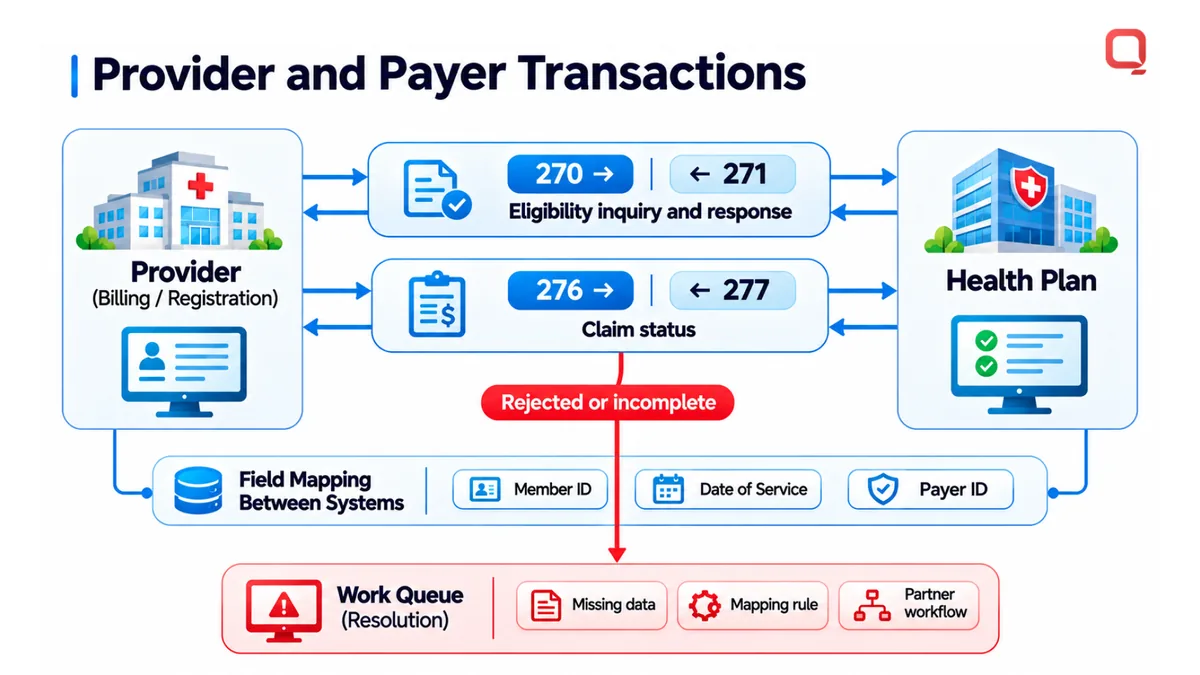
Provider and payer data exchange moves clinical and administrative information between care organizations and health plans. Eligibility checks, claim status, and supporting clinical details each have distinct transaction requirements.
For example, X12 EDI 270/271 supports eligibility inquiries and responses, while 276/277 supports claim-status exchange. Map the required fields between systems and record how rejected or incomplete transactions are routed. This gives operations teams a way to identify whether a failure comes from missing data, a mapping rule, or a partner workflow.
Privacy, Auditability, and Copy-Out Risk
Privacy controls govern who can access patient information, while auditability records that access. The U.S. Department of Health and Human Services identifies HIPAA as relevant to secure healthcare data exchange.
Role-based permissions can limit access by job function, while audit logs record access or export activity. Copy-out risk arises when authorized users move records into downloads or external workspaces. Review export events against approved purposes, and document how teams handle records copied outside the primary system.
Measure performance and data quality together. Track delivery failures, processing delays, duplicate patient identities, and missing fields. A successful connection does not prove that the receiving system interprets information correctly. Compare source and destination records during testing, then review recurring exceptions with the teams responsible for each interface.
Imaging, laboratory, and device exchanges need format-specific validation. For a DICOM study, verify that the receiving workflow can associate the image with the correct patient and metadata. For laboratory results, check identifiers, units, and timestamps. Device observations also need consistent patient and time references before teams rely on them in clinical workflows.
Federal rules and frameworks affect access requirements. The 21st Century Cures Act, signed in 2016, requires EHR systems to provide a patient-facing API to maintain federal certification. The 2020 Centers for Medicaid & Medicare Services rule required health plans and providers receiving federal program funds to take steps to make health information easier to access. The Office of the National Coordinator for Health Information Technology identifies USCDI as relevant to data exchange. TEFCA establishes common technical and governance standards for nationwide exchange through QHINs, according to the Assistant Secretary for Technology Policy/Office of the National Coordinator for Health Information Technology.
What are the four types of interoperability in healthcare?
Healthcare interoperability has four types: foundational, structural, semantic, and organizational. Together, they determine whether systems can transmit clinical data, interpret its meaning, and use it under shared rules.
Healthcare interoperability is the ability of different systems and organizations to exchange and use health information. It relies on technical connections, agreed data formats, shared meaning, and policies governing access and use.
- Foundational: Systems can send and receive data. A network connection may deliver a message without ensuring the receiving EHR can interpret it.
- Structural: Systems organize data in compatible formats. A standard structure helps an application identify fields such as patient, medication, or observation.
- Semantic: Systems interpret the same data consistently. Shared codes and definitions help prevent a laboratory result from being misunderstood.
- Organizational: Participants align policies and workflows. Agreements define who can exchange information, for what purpose, and under which procedures.
HL7 standards support exchange between healthcare applications. HL7 Version 2 remains relevant for legacy clinical feeds, while Fast Healthcare Interoperability Resources (FHIR) organizes information into resources such as Patient, Condition, and Medication. Healthcare interoperability solutions often need to support both standards because older systems and newer applications coexist.
FHIR APIs expose these resources to connected applications. For example, an application can request a patient’s allergies and observations through a defined interface, rather than parsing an entire record. FHIR R4 provides a specified version to target, but implementations still need consistent profiles, terminology, and field mappings.
Legacy integration often requires an interface layer that translates older messages into formats modern applications can use. Assess source systems, map fields and codes, test representative messages, and monitor errors in production. Preserve the original clinical meaning during transformation. These steps help teams identify where healthcare interoperability solutions need custom mappings or additional validation.
Third-party applications can use SMART on FHIR for authorization and scoped access. An application requests only the information its workflow needs, while the EHR controls permitted access. This enables integration without giving every partner application unrestricted access.
For regional exchange, the Office of the National Coordinator for Health Information Technology identifies USCDI as a standard relevant to healthcare data exchange. TEFCA establishes common technical and governance standards for nationwide exchange through QHINs, according to the Assistant Secretary for Technology Policy.
Implementation time depends on the number of systems, interface readiness, data mapping, testing, and governance decisions. Plan in stages: assess workflows and systems, define exchange requirements, build and map interfaces, validate data, then deploy and monitor.
Connecting EHRs, laboratories, pharmacies, and health information exchanges requires agreed identifiers, formats, terminology, access rules, and tested interfaces. Use HL7 feeds or FHIR APIs where appropriate, then validate each workflow with the organizations exchanging the data.
Implementation cost in the United States depends on integration scope, legacy-system complexity, data volume, security controls, and ongoing operations. Compare options based on the interfaces and workflows they must support, not just the number of connections.
For a project involving legacy connections, FHIR APIs, or regional exchange, discuss interoperability implementation needs with the team supporting your project.
Health information exchanges
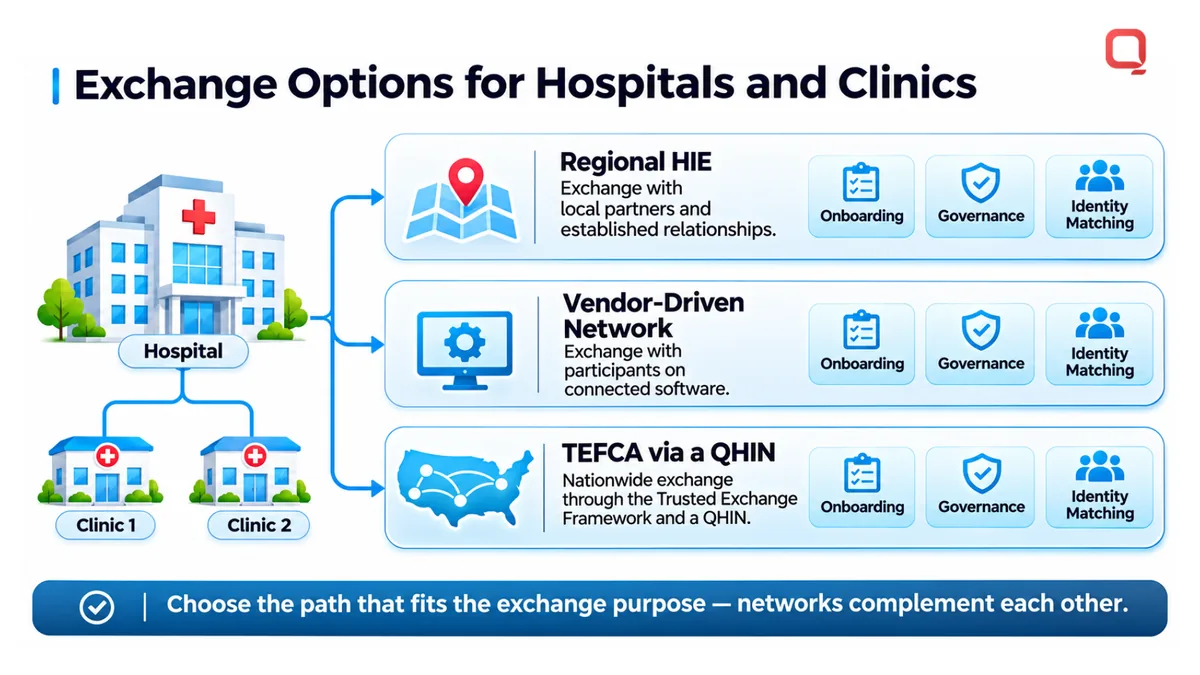
Health information exchanges (HIEs) are specialized networks that securely share electronic health information across organizations. Hospitals and clinics can use local, state, and regional HIEs, vendor-driven networks, or nationwide exchange through TEFCA.
Longitudinal Patient Records
A longitudinal patient record brings information from different care settings together over time. HIEs can help clinicians find records from another hospital, clinic, or participating organization, rather than relying only on the local EHR. That broader history matters when patients receive care from multiple providers.
For example, an emergency department can request available history from a connected HIE. Matching patient identity and interpreting outside records remain essential: an exchange can surface information, but it cannot resolve every mismatch automatically.
Secure Information Exchange
Secure information exchange uses network rules and technical controls to share health information with authorized participants. HIE governance defines permitted participants and exchange purposes, while system controls support access management and traceability.
Before connecting, organizations define which records can move, which users or systems can access them, and how exceptions are handled. A clinical summary sent to a treating provider differs from information shared for another purpose. Clear agreements and access policies help ensure exchange workflows follow their intended use.
Exchange Options for Hospitals and Clinics
HIE options include local, state, and regional networks, vendor-driven networks, and national frameworks. The right fit depends on participating partners and whether the need is routine care coordination, broader record access, or another exchange purpose.
A hospital working with nearby clinics may use a regional HIE for local information exchange. A clinic serving patients across jurisdictions may need broader network reach. Organizations can combine HIEs, vendor-driven networks, and TEFCA to expand access, while managing separate onboarding, governance, and technical workflows.
TEFCA provides common technical and governance standards for nationwide healthcare data exchange through QHINs, according to the Assistant Secretary for Technology Policy/Office of the National Coordinator for Health Information Technology. The Common Agreement is part of TEFCA. CommonWell Health Alliance is a designated Qualified Health Information Network under TEFCA, as identified in the available network information.
These national capabilities complement rather than replace local exchange arrangements. A QHIN connection can broaden a participant’s reach, while a regional HIE may support established relationships and workflows. Define the required participants and exchange purpose first, then map how each network handles identity matching, record requests, and responses.
Vendor-anchored HIEs can make exchange practical within connected software environments. Their reach and capabilities depend on network participation and supported workflows. They are not optimized for every use: a five-million-row population analysis, for example, differs from retrieving an individual patient’s clinical history. Choose the exchange path that fits the task, and keep manual review available for incomplete or mismatched records.
How does interoperability affect patient care?
Interoperability can help patients and care teams use relevant information across connected organizations. Its value depends on accurate data, clear workflows, and access controls suited to each care task.
Benefits Across Care and Administration
Shared clinical information can support patient care and reduce avoidable handoffs between physicians, pharmacies, administrative staff, and insurers. The practical benefit is that each participant can work from relevant information instead of repeatedly requesting or entering it.
A physician can review an outside medication list, while a pharmacy can use transmitted prescription details. Administrative staff can use payer responses to process a claim, and insurers can receive clinical information for related workflows. Each exchange still depends on correct patient matching and usable data.
Patient-Centered Care and Unified Records
A unified record brings relevant information from different care settings into a view that supports decisions about the patient. This matters when care spans organizations, because one EHR may not contain the full clinical history.
Medicare’s Blue Button 2.0 initiative is based on FHIR and provides a platform for patient access to healthcare information. A patient can use access to review information across care experiences, while a clinician can use available records to inform a visit. Healthcare interoperability resources help structure data, but teams still need to reconcile conflicting entries and outdated medication details.
Security, Privacy, and Patient Consent
Secure data sharing combines technical safeguards with rules for authorized access and patient choice. Broader connectivity should not mean unrestricted access to sensitive health information.
Encryption, role-based access controls, and continuous monitoring can help protect patient information. Organizations should define which users and applications can access each data type, record access events, and provide consent workflows suited to the exchange. For example, a patient-facing application should request only the information its stated function needs.
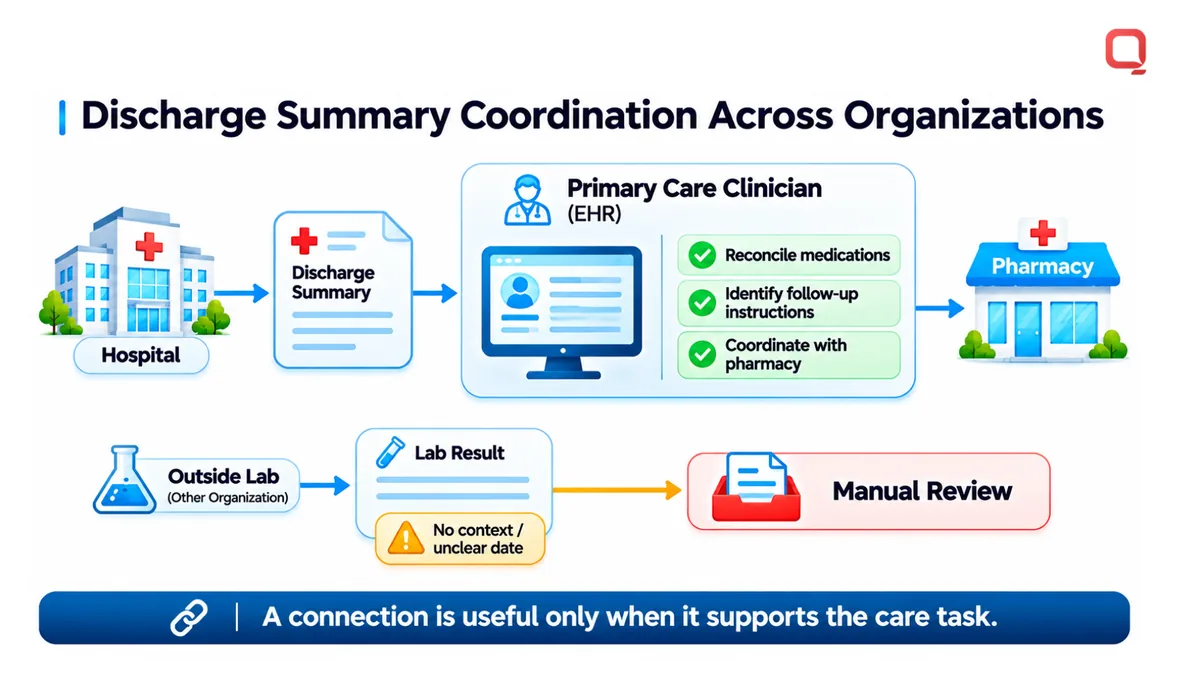
Coordination works best when connected systems support a defined care workflow. A primary care clinician reviewing a hospital discharge summary can reconcile medications, identify follow-up instructions, and coordinate with a pharmacy. If an outside result arrives without context or has an unclear date, staff may still need to review it manually.
The operational impact extends beyond the exam room. The average frontline healthcare worker spends 56% of their time in front of computers, according to the cited research. Better-organized data sharing can help teams locate information, though it does not remove documentation or review work.
Two out of three older Americans have at least two chronic behavioral or physical conditions. Treatment for people with multiple chronic conditions accounts for an estimated 66% of US healthcare costs. These figures underscore why continuity across organizations matters: care teams need relevant history to coordinate complex treatment.
For patients and providers, measure the effect using practical indicators: whether records are available at the point of care, whether staff can reconcile them, and whether the right information reaches the next participant. A connection is useful only when it supports the care task.
Leading healthcare interoperability companies
Healthcare interoperability companies differ in the systems they connect and the operational work they support. Compare integration engineering partners, exchange networks, and platform vendors based on how they handle your actual workflows, data formats, governance, and production support. A broad product demonstration is not enough. Ask how each approach responds when a message fails or a partner changes its interface.
Separate the options by their primary role. An integration engine routes and transforms messages between systems. A health information exchange network connects participating organizations. An interoperability platform may manage APIs, data transformations, or monitoring. Some providers cover multiple roles, but implementation still needs clear ownership of mappings, access rules, and issue resolution.
| Approach | Primary capability | Often fits | Key trade-off |
|---|---|---|---|
| Integration engine | Routes and transforms system messages | Connecting existing clinical applications | Mappings and monitoring need ongoing ownership |
| HIE network | Exchanges information among participants | Sharing records across connected organizations | Reach depends on participant coverage |
| Interoperability platform | Supports APIs, data exchange, or management | Coordinating multiple interfaces | Fit depends on supported standards and workflows |
Use a representative workflow to evaluate each company. A hospital might need existing clinical feeds, a FHIR application interface, and DICOM imaging exchange. Ask the provider to show how it maps fields, detects failures, and reports exceptions. Confirm which team maintains mappings when a source system changes. These details reveal operational fit better than a general claim of seamless exchange.
Network reach also matters. TEFCA and QHINs support nationwide exchange, while regional HIEs can serve established local relationships. CommonWell Health Alliance is a designated QHIN. Compare each option against the organizations your workflows must reach, the exchange purposes involved, and how participants manage identity matching and access.
Before selecting a provider, test the proposed approach with sample messages and realistic exceptions. Check whether a rejected record produces a clear error, whether staff can trace its source, and whether the receiving system interprets the data as intended. For FHIR, examine profiles and terminology mappings. For an HIE connection, assess participant coverage and the information available for your use case.
Choose based on demonstrated fit, not a promise of universal connectivity. A focused pilot can surface missing interfaces, unclear ownership, and governance gaps before broader deployment. If your team is assessing an exchange architecture or integration partner, discuss your healthcare interoperability requirements.
QSS Technosoft: Generative AI Solutions
QSS Technosoft supports healthcare teams that need to connect systems, modernize legacy software, or build digital health products. Its Healthcare IT Engineering and Healthcare Interoperability services can address integration gaps across clinical applications, while Legacy System Modernization helps teams adapt older platforms to current exchange needs.
Generative AI Solutions may suit organizations assessing AI use cases alongside their data architecture. Start with the workflow and data access requirements, then define how the solution will operate within existing systems. Mobile App Development can support patient- or clinician-facing applications that rely on connected health information.
Turn to QSS Technosoft when interoperability work requires engineering across existing healthcare software and newer applications. Contact QSS Technosoft to discuss your healthcare technology needs.
Make the Next Interoperability Decision Practical
Choose one workflow where missing or delayed information creates friction, then define what a useful exchange must deliver. Map the systems involved, the people who use the data, and the decisions it supports. This gives your team a clear scope for improving healthcare interoperability solutions without turning the effort into an open-ended platform project.
Before expanding the workflow, agree on measures that reflect real operations. Track whether information arrives in a usable form, whether staff can act on it, and where exceptions still require manual work. Review the results with clinical, technical, and operational owners. Their feedback can shape the next integration priorities and keep the design tied to care delivery.
If your team is ready to define that next step, contact QSS Technosoft to discuss your interoperability project. Start with the workflow that matters most, and build from there.
Make Exchanged Data Usable at the Point of Care
Bring one workflow where information arrives late, incomplete, or hard to use. QSS Technosoft builds healthcare interoperability solutions end to end: HL7 v2 interfaces and HL7 FHIR APIs, EHR interoperability with consistent mappings and terminology for semantic interoperability, connections to a health information exchange or TEFCA network, and the monitoring that keeps healthcare data exchange reliable for patient care.
Discuss your interoperability project →