Revenue Cycle Management Software Development for Healthcare
 By Ashwani Rana
QSS Technosoft
October 28, 2026
14 min read
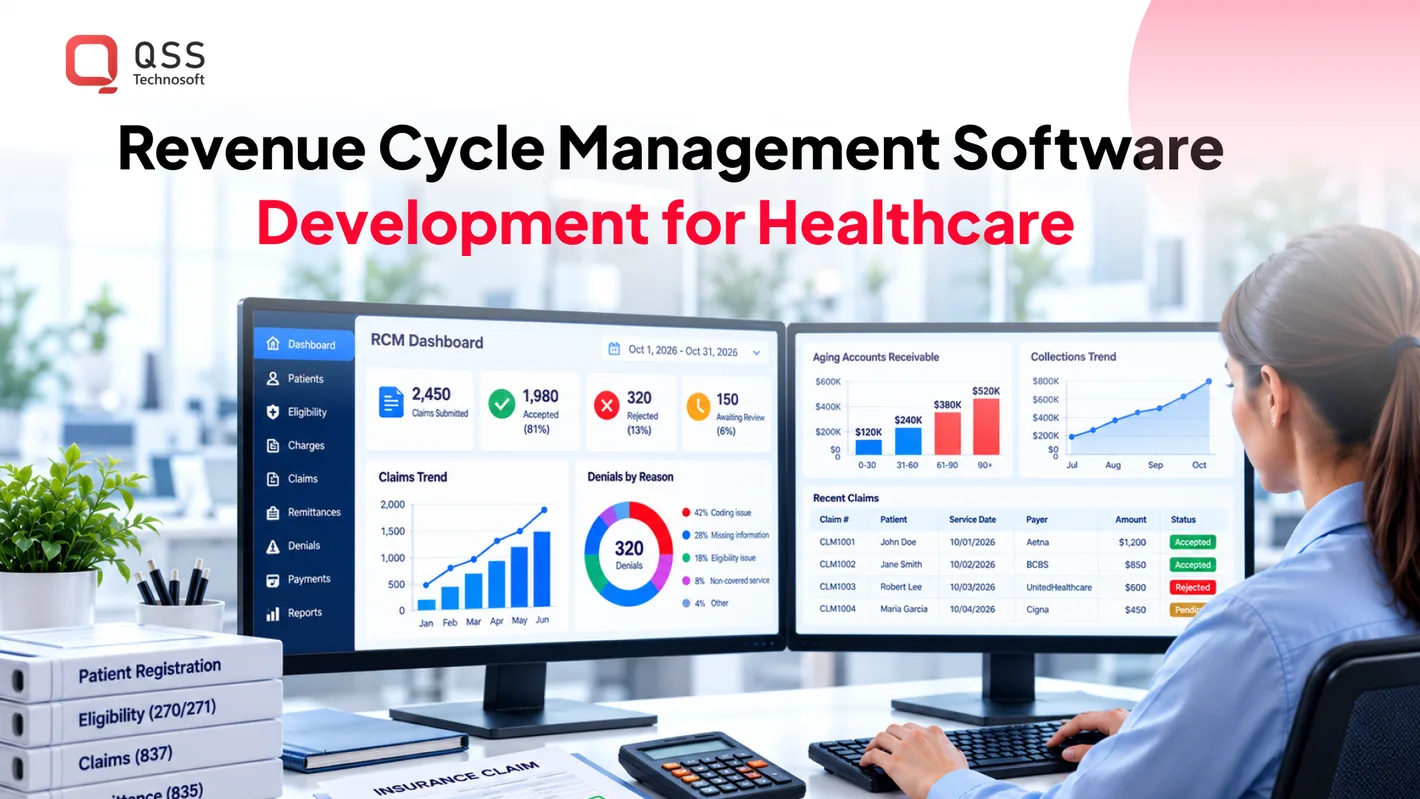
Billing errors rarely begin with the claim itself. They often start during registration, eligibility checks, or charge capture. Revenue cycle management software development connects these steps, from patient intake and insurance verification to claims, payments, and follow-up on unpaid balances.
That complexity is familiar to healthcare leaders: payer rules vary, clinical and financial data live in different systems, and manual handoffs leave room for delays. The software has to connect the work, not just digitize a form. In the United States, that can include eligibility checks using 270/271 transactions, claims processing through 837 transactions, and remittance workflows using 835 transactions.
This article explains what healthcare revenue cycle management includes and how software supports billing workflows, patient registration, and insurance eligibility. It also covers automation, integrations, implementation, and practical decisions for building a system that fits your organization. The aim is to clarify what the software needs to do, where complexity arises, and how to plan the work without treating automation as a substitute for sound processes.
Quick Answer
Revenue cycle management software development builds the system that carries a patient encounter from registration and 270/271 eligibility checks through charge capture, coding (ICD-10, CPT, HCPCS), 837 claims, 835 remittance posting, denial management, and follow-up on unpaid balances. Good RCM software validates claims against NCCI edits and payer rules before submission, routes exceptions to the right staff queue, keeps a traceable history for audits, and protects data under HIPAA. Start with one bounded workflow, integrate EHR, practice management, and clearinghouse data with clear ownership, and measure rework, queue age, and unresolved balances against a baseline. Custom medical software development makes sense when your billing and coding services, payer mix, or integrations don’t fit off-the-shelf products.
What is revenue cycle management in healthcare?
Healthcare revenue cycle management turns a patient encounter into accurate claims, reimbursement, and collections. It links charge capture, coding, electronic claims, payment tracking, and follow-up on unpaid charges.
For US providers, the workflow must connect clinical documentation with billing data. A missed handoff can delay a claim or lead to a denial.
Claims Submission and Tracking
Claims submission sends coded encounter information to an insurer for reimbursement. Claims tracking records each submission’s status, such as accepted, rejected, paid, or awaiting review. For example, the system can flag a claim with no response instead of leaving staff to find it during a later account review. Check that the workflow keeps claim history, payer responses, and next steps together. This visibility helps staff prioritize unresolved accounts and manage collections.
Denial Management
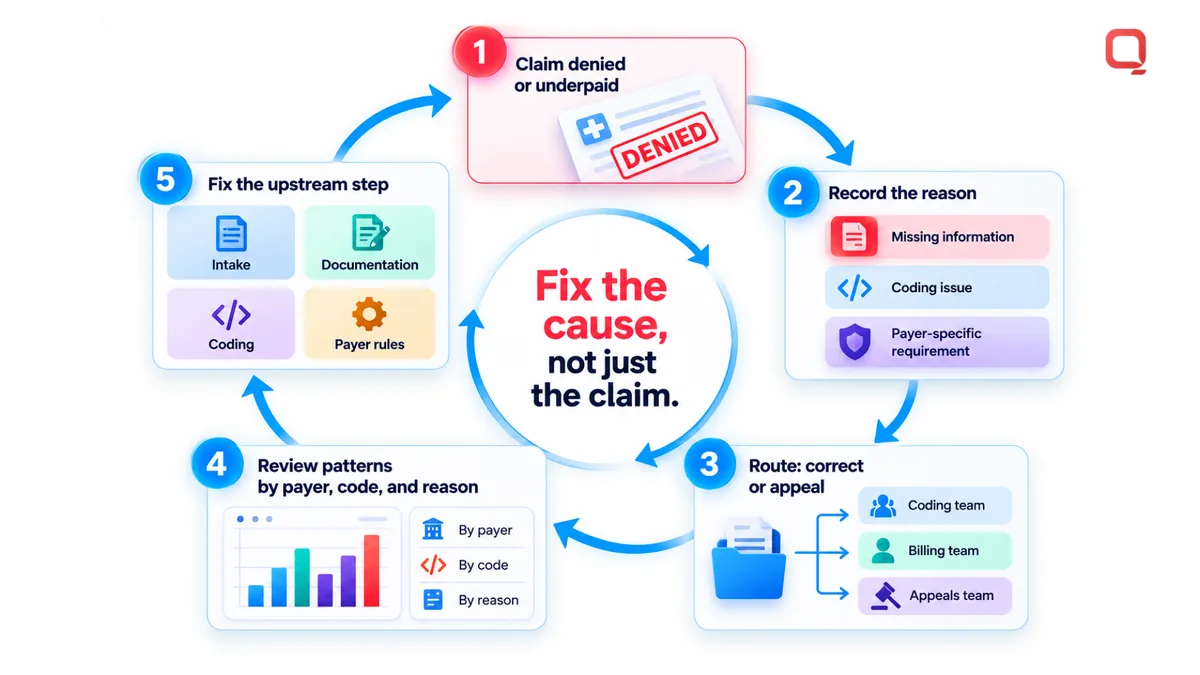
Denial management identifies rejected or underpaid claims, records the reason, and routes each case for correction or appeal. A useful workflow distinguishes missing information from a coding issue or payer-specific requirement. Staff can then fix the underlying problem instead of resubmitting the same error. Reviewing denial patterns by payer, code, and reason can reveal recurring delays and identify billing steps that need attention.
Charge Capture and Claim Workflows
Charge capture connects services documented for an encounter with charges submitted for payment. The workflow should carry patient and insurance details, procedure and diagnosis codes, and the service date into claim preparation. ICD-10, CPT, and HCPCS are standardized code sets used by claims processing systems. Coders need clear documentation to support assigned codes, and they should confirm that codes match the physician and date of service. Missing or mismatched information can disrupt the encounter-to-claim handoff.
Electronic Claims and Compliance Audits
Electronic claims workflows prepare and transmit claim data in a consistent format, then retain the related status and response information. Before an 837 is submitted, a claims rules engine can check claims against NCCI edits and payer-specific rules. These checks help surface issues before transmission, but they depend on accurate source data and maintained rules. For compliance audits, teams need to trace how encounter details became coded charges and submitted claims. Reviewable records make it easier to locate the data, decision, or workflow step behind a claim.
Revenue cycle management also covers patient bills and accounts receivable follow-up. Staff identify unpaid charges, investigate payment status, and act on unresolved balances. Linking these tasks to claim history helps distinguish a payer delay from an internal workflow gap. CFOs and operations leaders can see which payers or codes are associated with payment problems, while billing teams get actionable work queues instead of scattered follow-up tasks.
Can You Handle High Volume Complex Medical Billing?
High-volume medical billing calls for software that processes transactions reliably, protects sensitive information, and supports compliance workflows. Capacity matters, but so do security controls, coding validation, and visibility into timely filing.
A core RCM solution may process up to 500,000 revenue transactions per month. An advanced RCM solution may process over 1,000,000 revenue transactions per month. These volumes call for clear workload queues, traceable processing, and recovery paths when an interface or payer connection fails. Capacity planning should reflect transaction volume, claim complexity, and the systems sending or receiving data.
Assess the system’s ability to:
- Separate routine claim processing from exceptions requiring staff review.
- Record processing status and preserve a history of key workflow events.
- Manage retries without creating duplicate claims or losing transaction context.
- Surface backlogs so operations teams can prioritize unresolved work.
Custom workflows should reflect how billing teams actually work. A system built on assumptions may simply shift bottlenecks from one queue to another.
HIPAA, HITECH, and CMS Compliance
The Health Insurance Portability and Accountability Act (HIPAA) of 1996 makes healthcare organizations legally responsible for protecting the privacy and security of certain health information in the United States, according to the U.S. Department of Health and Human Services. The same department explains that the Health Information Technology for Economic and Clinical Health (HITECH) Act expanded HIPAA enforcement in the United States.
For software teams, align access with job responsibilities and protect sensitive data in storage, during transmission, and throughout operational workflows. CMS regulations define reimbursement policies, billing procedures, and compliance requirements for providers in government healthcare programs. Review how system rules are configured, updated, and recorded so billing teams can trace decisions.
Coding and Timely Filing Compliance
Security and coding controls need to work together. Coders use clear medical documentation to support accurate ICD-10-CM, CPT, and HCPCS Level II reporting, then check that documentation supports assigned codes. They also verify that procedure and diagnosis codes match the physician and date of service. Software can flag missing fields or mismatches for review before claim submission.
Timely filing workflows should track submission dates, payer-specific deadlines, and unresolved claim status. Alerts and work queues can help staff spot claims approaching a filing cutoff. They cannot automatically fix missing documentation or incorrect coding, so route exceptions to staff with the context needed to resolve them.
To optimize complex workflows, test peak transaction patterns, interface failures, and exception handling before deployment. Track queue age, rejected transactions, and duplicate-prevention events after launch. For teams planning custom RCM workflows, a healthcare software project discussion can help frame integration and security requirements.
Revenue cycle automation
Revenue cycle automation uses software to handle repeatable billing tasks, route exceptions, and make workflow status visible. In US healthcare, useful automation connects eligibility, authorization, remittance, and follow-up without concealing work that requires staff judgment.
Technology Stack and AI Automation
An automation stack typically links user-facing work queues, workflow rules, data stores, and interfaces to clinical and financial systems. The design should show how an event, such as a completed encounter, triggers the next task and records its outcome.
AI can help classify incoming documents or suggest categories for denial management. Keep a review path for uncertain results, and record the source data and staff decisions. Automation should reduce manual routing, not make unsupported coding or billing decisions.
Begin with stable, rules-based tasks. For example, software can route a record missing an authorization number to a staff queue instead of allowing it to proceed unnoticed. Each workflow needs defined triggers, required data, exception handling, and a clear owner.
- Automate repeatable validation before a task moves to the next stage.
- Route incomplete or conflicting records to the right team.
- Track processing status and preserve an event history.
- Review exception patterns before changing workflow rules.
These controls help teams improve workflows while keeping activity visible. A rule that works for one payer or service line may not suit another, so configuration needs a defined scope and review process.
Prior authorization automation can gather required information, create a request workflow, and track payer responses. Staff can see which cases are waiting, need supporting documentation, or require follow-up before a scheduled service. The system should retain decision status and related records. It should not treat a submitted request as an approval or let an unresolved authorization step disappear from view.
Automated Remittance Posting
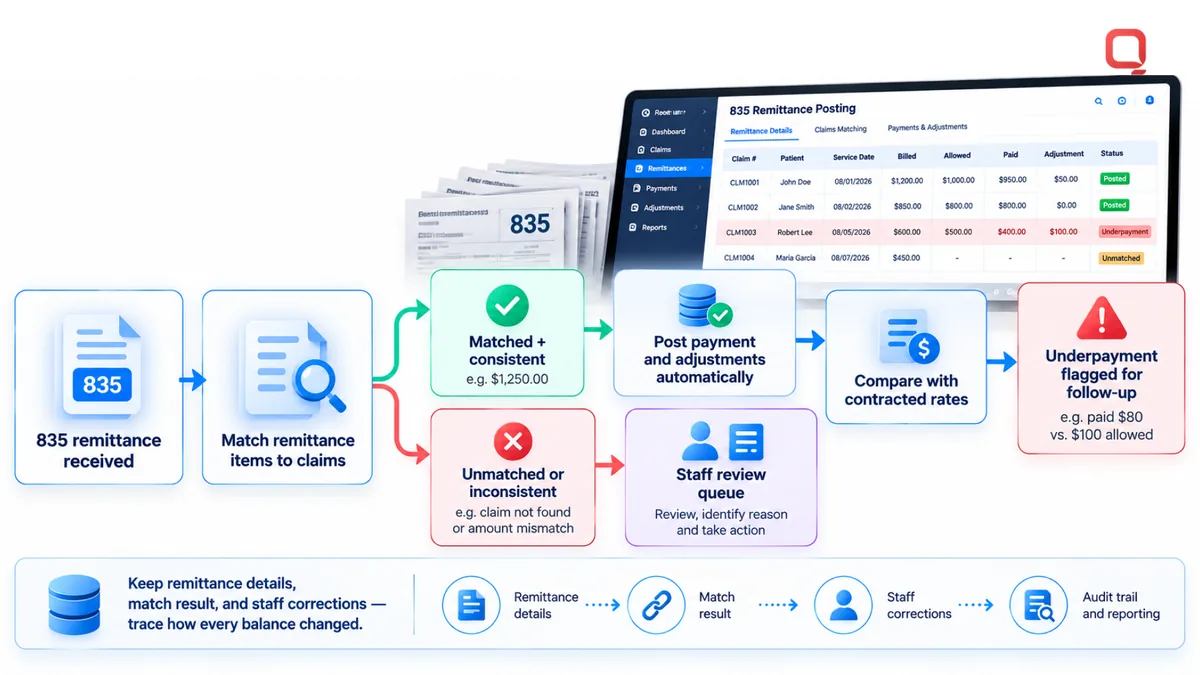
Automated remittance posting uses an 835 transaction to apply payer payment and adjustment details to the appropriate accounts. The workflow can match remittance items to claims, post routine entries, and send unmatched or inconsistent items for review.
Comparing an 835 remittance against contracted rates can help identify underpayments. Preserve the remittance details, matching result, and any staff correction so finance teams can trace how a balance changed.
Automation also needs to scale across medical billing workloads. Separate transaction intake from processing, and make retries safe so a temporary interface failure does not create duplicate work. Monitor queue depth, failed handoffs, and items awaiting review. These measures reveal capacity constraints without confusing higher transaction volume with successful completion.
Prioritize automation based on task frequency, rule stability, and the cost of an error. Start with a clearly bounded workflow, validate real records, and expand once staff can handle exceptions reliably. This keeps automation useful when payer rules, source data, and operational demands vary.
Patient registration and insurance eligibility
Patient registration and insurance eligibility workflows capture accurate demographic and coverage details before billing begins. In US healthcare, real-time 270/271 transactions can check eligibility during scheduling, giving staff information to address before the visit.
Registration involves more than entering a name and address. A workflow should capture patient identity, contact details, subscriber information, payer, member identifiers, and the relationship between patient and subscriber. It should also identify required fields and flag conflicts, such as a date of birth that differs between the registration record and payer response.
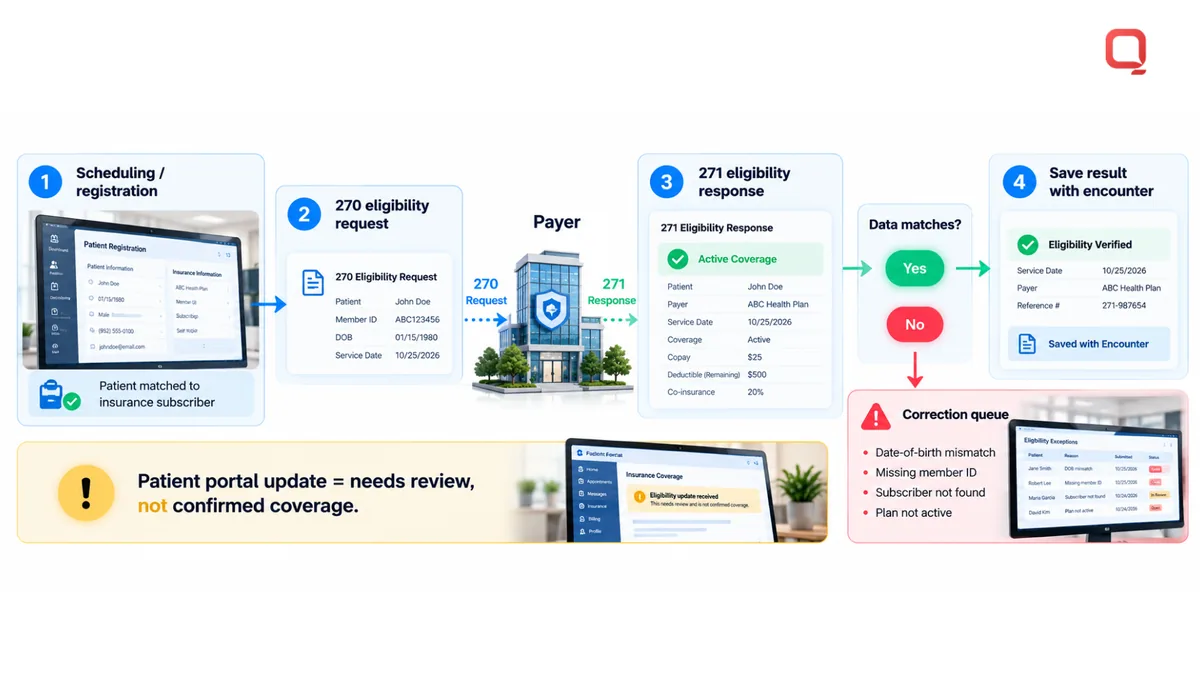
Eligibility checks work best when connected to scheduling and registration. A 270 request asks a payer for coverage information; a 271 response returns eligibility details. The system can present the response in context, including the patient, service date, and payer, rather than leaving staff to interpret a disconnected transaction. Coverage details can change, so the workflow should retain the check’s timestamp and response for later review.
A practical registration workflow can:
- Match the patient record to the correct insurance subscriber.
- Send a 270 eligibility request at scheduling or registration.
- Display the payer’s 271 response for staff review.
- Route missing or inconsistent data to a correction queue.
- Preserve the eligibility result alongside the encounter record.
Integration determines whether these steps function as one process. Connections between scheduling, EHR, and billing systems should map patient identifiers and coverage fields consistently. If an interface drops a member identifier, staff may have to re-enter information or resolve a preventable eligibility issue. Define which system owns each data field and how updates flow to connected systems.
A patient portal can let people submit demographic or insurance updates before an appointment. It should distinguish patient-entered information from verified payer responses. For example, a new insurance card submitted by a patient can prompt staff review, while an eligibility response remains a separate record. Clear prompts, mobile-friendly forms, and accessible language make portal tasks easier to complete without confusing an update with confirmed coverage.
Access management matters, too. Registration staff need the information required for their work, while sensitive records should remain limited to authorized users. Role-based access, event logs, and a defined correction process help teams see who changed coverage details and when. These controls support accurate workflows without giving every user broad access.
Patient engagement improves when the next step is clear. A portal can explain that coverage information needs attention, identify what is missing, and show how to submit it. Analytics can group recurring issues by payer, registration field, or workflow stage. Operations teams can use these patterns to refine forms, staff instructions, and integration mappings, reducing repeated data correction at the point of care.
Revenue cycle workflows and development process
Healthcare revenue cycle workflows link patient access, encounter documentation, medical billing, claims, payments, and account follow-up. Revenue cycle management software development can improve billing performance when teams compare operational changes with agreed baselines, such as rework, queue age, and unresolved balances.
Expected ROI depends on the costs and delays the system targets, how consistently teams use it, and the effort required to integrate and maintain it. Define measures before development, then compare results with the baseline after release.
Revenue Cycle Stages and Workflows
A healthcare workflow moves through registration, encounter documentation, charge review, coding, claims, payment, and account follow-up. Every handoff needs an owner, a defined input, and a clear outcome.
Map a representative case from start to finish, including routine work and exceptions such as corrected records or missing information. This reveals where workflow rules should support staff decisions rather than simply move tasks between queues.
Software Features and Workflow Modules
Organize RCM software around users’ work, not just a list of screens. Product teams can define modules by role, the data they use, the decisions they support, and the downstream systems they affect.
Before adding a feature, identify its operational owner and how success will be assessed. For example, a reporting module should help a finance or operations leader act on a trend, not merely display data without context.
| Decision area | Custom RCM software | Off-the-shelf RCM software |
|---|---|---|
| Workflow fit | Can be designed around defined organizational processes. | Uses available product workflows and configuration. |
| Integration approach | Interfaces can be scoped for selected systems and data flows. | Integration depends on supported connectors and settings. |
| Product ownership | The organization defines priorities and ongoing change needs. | Product capabilities and release direction are set by the vendor. |
| Best fit | Distinctive workflows or integration requirements justify tailored development. | Existing functions align with needs and limit the case for custom work. |
Billing Workflow Streamlining
Streamline medical billing by removing unnecessary handoffs and assigning each exception to a responsible role. Define when a task returns to an earlier stage, when it moves forward, and when staff need to intervene.
Revenue cycle management software development should account for operational ownership after release. Define who approves workflow changes, reviews user feedback, and manages system dependencies. A dashboard is useful only when teams know what action to take in response to each signal.
Begin development with discovery. Document user roles, current workflows, system dependencies, reporting needs, and edge cases. Turn those findings into requirements and acceptance criteria before implementation. Then design interfaces and module boundaries around clear data ownership.
Build and validate in stages. Select a bounded workflow, test representative cases with intended users, and resolve gaps before expanding the scope. Include operational readiness in release planning, including training materials, support ownership, and procedures for handling defects. Revenue cycle management software development is an ongoing product responsibility, not just a software delivery milestone.
QSS Technosoft: Generative AI Solutions
QSS Technosoft helps healthcare teams build or modernize revenue cycle platforms through Healthcare IT Engineering, Legacy System Modernization, and Generative AI Solutions. Turn to the team when disconnected systems, aging workflows, or repetitive billing tasks limit operational visibility.
For an RCM initiative, work can include mapping existing processes, connecting relevant healthcare data, and designing automation with clear review paths. Generative AI can support selected tasks, while coding, claims, and payment decisions remain grounded in defined workflows and staff oversight. The right scope depends on your organization’s systems, data quality, and operational priorities.
If your team is planning an RCM platform or tackling friction in legacy workflows, contact QSS Technosoft to discuss the project.
Set the Next RCM Project Boundary
Start by choosing an operational problem that needs focused engineering attention. Define the teams affected, the systems involved, and the decision the software must support. A tightly scoped starting point gives product, finance, and technology leaders a shared basis for prioritization.
Before development starts, document the current workflow and agree on how to evaluate progress. Assign ownership for product decisions, integration dependencies, data access, and operational review. These decisions help ensure a technically complete release also meets the needs of billing teams who use it every day.
For revenue cycle management software development, prioritize a workflow where the process is understood and the intended outcome can be measured. Expand based on operational evidence, not feature volume. This keeps the roadmap connected to real work as systems and requirements evolve.
QSS Technosoft offers Generative AI Solutions, Healthcare IT Engineering, and Legacy System Modernization for healthcare technology initiatives. Contact QSS Technosoft to discuss your project and define a practical starting point for your RCM platform.
Pick One Revenue Leak and Engineer It Out
Bring the billing workflow causing the most rework, whether that is eligibility, denials, or remittance posting, plus the systems it touches. Our engineers provide revenue cycle management software development and healthcare software development services, from custom healthcare software development and custom medical software development to 270/271, 837, and 835 EDI integration, as an EHR software development company that builds tools your medical billing services and billing and coding services teams use every day.
Discuss your RCM project →